virtual allergist platforms: how telehealth allergy services differ in diagnosis, doctor access, and treatment delivery
Virtual allergy platforms test and treat differently, so pick one that matches your needs.

There are about 4,000 board-certified allergists in the U.S. and millions of people who need allergy care every year. That math has never worked, so telehealth stepped into the gap, and a dozen platforms now offer to get you "seen" for allergies online. But they're built differently under the hood, in ways that matter more than most people realize until after they've already picked one.
What virtual allergy platforms actually do, and where a screen hits its limits
Strip the branding off any of these and you get roughly the same sequence: a symptom questionnaire, a clinician conversation, some form of testing, then a prescription or a referral out. That much is consistent across the board.
The split happens inside each step. Some things just don't work through a camera. Skin prick testing needs a person in a room with you. Patch testing, spirometry, supervised allergy shots run into the same wall. That's the whole reason almost every platform doing remote immunotherapy leans on sublingual drops instead of injections: a drop under the tongue doesn't need a nurse standing by in case you react, so it doesn't need a clinic at all.
Video visits do something I didn't expect the first time I sat through one as a patient instead of a provider. The clinician sees your actual house. The rug, the curtains, whatever's shedding on the couch behind you. Five minutes of video can turn up an allergen source a sterile exam room might miss, simply because someone's looking at where you live instead of taking your word for it.
Virtual care handles seasonal allergies, allergic rhinitis, mild asthma follow-up, and most skin or eye symptoms without much trouble, and that covers most people walking through the door. Complex or severe cases get harder to manage remotely, and platforms don't draw that line in the same place. Some refer out the moment a case looks complicated; others push further before making the call. Figure out which side of that line you're on before you commit to anything.
How platforms differ in the way they test for allergies
This is where things actually diverge, and it's not a minor technical footnote. It decides how specific your treatment can get.
At-home finger-prick blood testing is one route. A kit shows up in your mailbox, you send in a small blood sample, and a clinician reviews results that can flag sensitivities across dozens of environmental allergens without a single clinic visit. This model has become one of the more common answers to the access problem that doesn't sacrifice diagnostic depth to get there.
Then there's the hybrid path: skin prick testing done in person up front, remote management after that. Pinnacle Allergy works this way. Skin prick testing has more clinical history behind it, no argument there, but requiring that first in-person visit brings back the exact barrier telehealth exists to remove.
A third path skips formal testing almost entirely, relying on clinical history and a symptom pattern a clinician reads and makes a judgment call on. It's the fastest route to a prescription, but also the least personalized. Fine if you're dealing with textbook seasonal ragweed. Harder if you've got five overlapping sensitivities you can't untangle on your own.
What does testing depth actually buy you? The gap between a treatment built around your specific allergen profile and a general protocol stretched over a vague symptom pattern. Ask any platform directly what your test result tells the clinician and how it changes what gets prescribed, then watch how they answer.
What "doctor access" actually looks like across different platforms
"See a doctor online" hides a lot underneath it. A board-certified allergist, a general practitioner, and a nurse practitioner are not the same thing, and whoever's actually behind your diagnosis shapes how well the treatment fits you.
Live video with a board-certified allergist sits at the top of this range: real back-and-forth, follow-up questions, someone who notices the rash on your arm you forgot to mention in the intake form. HeyAllergy leans toward fast booking and digital-first care. Cedars-Sinai Connect sits somewhere else entirely, offering full health-system breadth with 24/7 access, though that breadth comes from being part of a much larger hospital system rather than an allergy-focused operation.
Async consultations sit in the middle. You send information, a clinician reads it, you get a response, no live appointment involved. Sesame built its reputation on transparent pricing and quick turnaround here, a model built for speed rather than a drawn-out diagnostic back-and-forth, and for plenty of patients, speed really is the point.
Questionnaire-driven care sits at the other end, where clinician contact is minimal and the prescription comes mostly out of intake data. It's fast and cheap, fine for straightforward cases, harder to trust once your situation has any real complexity to it.
What actually separates these platforms once you're a few months in is who's watching your progress after the first appointment. Immunotherapy is a long-running commitment, not a one-time transaction; doses shift, tolerance builds unevenly, and someone has to be paying attention the whole way through, not just at intake. Some platforms keep board-certified physician oversight running from the initial consult through the full treatment plan, with drops built off a patient's actual test results instead of pulled off a shelf. That kind of continuity shows up unevenly across the field. Check for it directly instead of assuming it's baked in.
How treatment is delivered and what it means for actually finishing the course
Three real categories of treatment show up across these platforms, and they are nowhere close to interchangeable.
Symptom management, meaning antihistamines and nasal corticosteroids, is available from almost any telehealth service on the market, no allergy-specific infrastructure needed. It handles the fallout without touching the cause.
FDA-approved SLIT tablets go a step further, approved for single allergens, grass, ragweed, dust mites, tree pollen, and prescribable remotely. The catch is flexibility, or the lack of it. Great if you're only reacting to one thing. If you've got five sensitivities stacked on top of each other, a single-allergen tablet solves maybe a fifth of your actual problem.
Compounded sublingual drops are the more interesting category: personalized to your specific allergen panel, prescribed off-label, and the backbone of most platforms doing full remote immunotherapy. Because they're compounded, one formula can target several allergens at once, which matters if you're not just reacting to ragweed or just dust mites but some messy combination of both.
Why does delivery format matter so much for whether people actually finish treatment? Allergy shots require weekly or biweekly clinic visits during build-up, sometimes for months straight. That's brutal if you've got a demanding job, live an hour from the nearest allergist, or are dragging a kid to a clinic that often. Drops taken at home remove the scheduling problem entirely. Treatment through either route usually runs three to five years, and a small weekly inconvenience stretched across that stretch of time becomes the real dividing line between who sticks with it and who quits halfway through.
Studies on SLIT show symptom reduction in the 30 to 60% range across allergen types, with some environmental allergy studies climbing to 60 to 80% after consistent use. A 2025 systematic review in Frontiers in Allergy found SLIT-liquid shows favorable tolerability and high adherence across allergens and age groups. Adherence is the whole outcome here, not a side detail. A treatment that performs great in a study but gets abandoned by month eight hasn't helped anybody.
At-home testing feeding into drops built from your own results with physician oversight running the whole way through sits toward the more integrated end of that spectrum. Ask whatever platform you're looking at whether the drop formula is standardized off a shelf, or actually built from your own results.
Cost and insurance coverage as practical differentiators most patients overlook
Cost comparisons fall apart fast if you're only reading the number on the landing page.
In-office allergy shots get billed per injection, and those per-visit costs stack into something substantial over a three-to-five-year course, even with insurance covering part of it. Insurance usually covers shots at in-office programs. Coverage for sublingual drops is much thinner, so most SLIT programs run out of pocket.
That sets up a comparison that looks backwards if you stop reading too early. Shots look cheaper staring at the copay per visit. Factor in missed work, gas money, and the sheer volume of trips over multiple years, and the total picture flips depending on what you're actually counting.
One thing closes the gap more than most people expect: sublingual immunotherapy qualifies as an eligible expense under FSA and HSA accounts. Paying with pre-tax dollars brings the real cost down meaningfully, and plenty of patients never check this before writing off drops as too expensive.
Pricing transparency varies too. Some platforms post their numbers upfront, for example an initial consult around $49 and treatment plans starting near $99 a month. Sesame does something similar. Other platforms make you sit through a full consultation before telling you what any of it costs, and I hear that complaint constantly from people who've been through it.
What actually matters is total cost across a three-year course, not the number on the landing page, and whether an FSA or HSA knocks that number down.
How to read the differences and match them to your actual situation
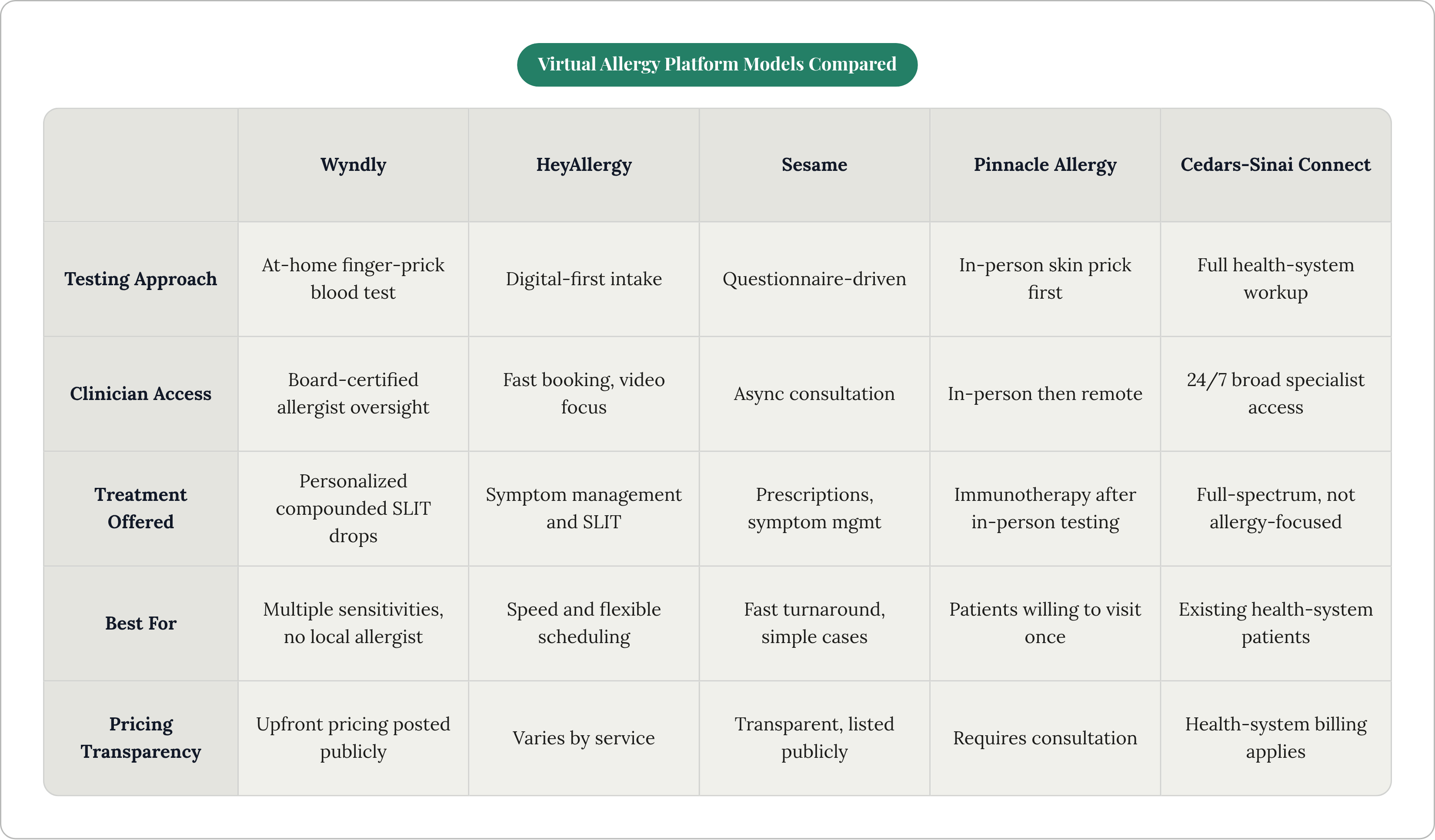
So how do you actually pick, with all of this on the table? It comes down to which piece matters most in your situation, since no platform wins on every front at once.
If you're dealing with multiple environmental sensitivities and there's no allergist within driving distance, at-home testing paired with personalized SLIT drops and real physician oversight is probably your best bet. If speed and flexible scheduling matter more to you than diagnostic depth, HeyAllergy and Sesame are built around exactly that. Already inside a health system and want coordinated care across specialties? Cedars-Sinai Connect gives you breadth, if not allergy-specific depth. And if you've got one clearly identified allergen and nothing more complicated, an FDA-approved SLIT tablet through pretty much any virtual platform probably covers it.
A few things worth watching for, regardless of platform: no clear sign a board-certified allergist is actually involved in your diagnosis, a prescription with no allergen-specific testing behind it anywhere, silence after you've got the prescription in hand, and pricing that stays hidden until after you've paid for a consultation.
There's a real distinction sitting underneath all of this. Platforms that only manage symptoms with medication keep you dependent on antihistamines, leaving the underlying cause untouched. Immunotherapy-capable platforms with real physician oversight are attempting something harder: retraining how your immune system responds, so the symptoms themselves show up less over time.
If you've spent years cycling through nasal sprays and pills with nothing to show for it, ask yourself which platform is actually built to change how your body responds over time, and which one is just booking the fastest appointment or cleaning up after the reaction's already happened.