Diagnosing Allergic Rhinitis vs. Non-Allergic Rhinitis
The mechanism behind rhinitis determines whether antihistamines will actually work.

Rhinitis is inflammation of the nasal mucosa, the moist tissue lining the inside of the nose. When that tissue gets inflamed, it swells, produces excess mucus, and triggers sneezing. The surface experience is maddeningly consistent regardless of cause: the same congestion, the same drip, the same morning sneezing before you've even processed what day it is. What differs entirely is the mechanism producing it, and that mechanism is where diagnosis either earns its keep or fails the patient completely.
Antihistamines block histamine, but histamine is only the primary mediator in allergic rhinitis, where the immune system produces IgE antibodies that trigger mast cells to release it. In non-allergic rhinitis, the immune system is absent from the process entirely; the inflammation arises instead from autonomic nervous system dysregulation, hormonal shifts, direct irritant responses, or medication effects, none of which depend on histamine as the driver. A patient whose congestion and runny nose are produced by vasomotor rhinitis, drug-induced rhinitis, or another non-allergic mechanism is not experiencing a histamine problem, and counteracting histamine does nothing to address the actual mechanism at work. The same surface symptoms, the same congestion and postnasal drip, emerge from entirely different upstream processes, and which process is operating determines whether antihistamines are treating the condition or simply targeting a molecule that isn't really the problem.
Allergic rhinitis is an immune system problem. Specifically, it's IgE-mediated: the body has produced immunoglobulin E antibodies to a specific allergen, and when that allergen arrives in the nasal passages, those antibodies trigger mast cells to release histamine and other inflammatory mediators. The immune system is treating something harmless as a threat. The nasal inflammation is collateral damage.
Non-allergic rhinitis involves the same inflamed tissue, the same symptomatic output, but no immune driver. The mechanisms here include autonomic nervous system dysregulation, hormonal fluctuations, medication effects, or direct irritant responses. No IgE antibodies. Histamine is not the primary mediator. The immune system is absent from the story entirely.
This distinction carries immediate practical weight, because antihistamines counteract histamine. But what if your rhinitis isn't histamine-mediated at all? In that case, antihistamines aren't treating your condition. They're managing a molecule that isn't really the problem.
One important nuance before moving on: these two categories aren't hermetically sealed. A meaningful portion of patients has mixed rhinitis, with features of both. Some patients also have what's increasingly recognized as local allergic rhinitis, where the IgE response occurs in the nasal mucosa itself without producing positive results on systemic allergy testing. Neither of these fits neatly into either box. Non-allergic rhinitis is not "rhinitis we couldn't explain and gave up on." It is a common condition with its own treatment logic, and it warrants the same diagnostic rigor as any other chronic inflammatory condition.
The Subtypes of Non-Allergic Rhinitis and Why They Matter for Diagnosis
Non-allergic rhinitis isn't a single condition. It's a category housing several distinct clinical subtypes, each with different triggers and, in practice, different treatment emphases. Calling them all "non-allergic" is useful for ruling out an immune mechanism, but it doesn't get you anywhere near treatment. Understanding which subtype you're actually dealing with does.
Vasomotor rhinitis is the most clinically prominent chronic subtype. It's caused by dysregulation of the autonomic nervous system's control over nasal blood flow and mucosal secretion. The triggers are environmental and physical: cold air, shifts in humidity or barometric pressure, strong perfumes, cigarette smoke, exhaust fumes. Symptoms lean heavily toward congestion and rhinorrhea. What's notably absent is itching. Significant nasal or ocular itching is uncommon in vasomotor rhinitis, and that absence is a meaningful clinical clue. Diagnosis requires ruling out allergic, infectious, and structural causes first; it is, by definition, a diagnosis of exclusion.
Beyond vasomotor, there are several other recognized subtypes worth naming. Hormonal rhinitis is associated with pregnancy, thyroid dysfunction, or other hormonal shifts, and typically resolves when the hormonal state resolves. Rhinitis medicamentosa is rebound congestion caused by overusing topical decongestant nasal sprays; the nasal passages become dependent on the spray to stay open, and stopping it temporarily worsens symptoms before they improve. Gustatory rhinitis is the predictable rhinorrhea triggered by eating, particularly hot or spicy foods, mediated by sensory nerve stimulation. Non-allergic rhinitis with eosinophilia syndrome, abbreviated NARES, involves elevated eosinophils in nasal secretions without systemic allergy, suggesting localized inflammatory processes that don't fit the classic allergic model. Drug-induced rhinitis can result from antihypertensives, NSAIDs, and a range of other systemic medications.
Then there's the difficult part at the center of this category: roughly half of all non-allergic rhinitis cases never yield an identifiable cause even after thorough workup. Idiopathic rhinitis requires symptom-focused treatment by necessity, because there's no identifiable mechanism to target. That doesn't make the condition less real. It makes precision harder.
One more distinction worth naming. The most common single cause of any rhinitis episode is an acute viral infection, the common cold. It's short-term and self-resolving. Separating an episodic viral illness from a chronic pattern that persists across seasons and years is the first filter before any other diagnostic reasoning begins, and it's sometimes more overlooked than it should be.
The Symptom Patterns That Separate Allergic From Non-Allergic Rhinitis Before Any Test Is Run
The 2020 practice parameter from the American Academy of Allergy, Asthma, and Immunology frames clinical history as the single most important element in diagnosing rhinitis. Tests confirm what history suggests; they don't replace it. Before a single skin prick is made or a blood sample drawn, a careful clinician can build a reasonably strong working hypothesis from symptom patterns alone.
Itching is the signature of allergic rhinitis that non-allergic rhinitis largely lacks. Nasal itching, ocular itching, palatal itching, that maddening itch deep in the ears: these symptoms track IgE-mediated histamine release in ways that mechanical or irritant-driven rhinitis simply doesn't replicate. When a patient leads with itching, that's a meaningful clinical signal pointing toward an immune mechanism.
Symptom timing relative to exposure matters just as much. Seasonal patterns tied to tree, grass, or weed pollen seasons; perennial patterns that intensify around pets or in dusty indoor environments; worsening within minutes of allergen contact. All of these suggest that a specific substance the immune system has learned to treat as a threat is driving the response. Comorbidities are relevant too. Allergic rhinitis frequently co-occurs with asthma, eczema, and chronic sinusitis; their presence raises the prior probability of an allergic mechanism. Family history of atopy matters. Onset in childhood or early adulthood is more typical of allergic disease than of vasomotor rhinitis.
Where allergic rhinitis tracks biological allergens, non-allergic rhinitis tracks physical and chemical exposures. Cold air. Barometric pressure changes, humidity swings, perfume counters, car exhaust, cigarette smoke. Vasomotor patients describe symptoms that don't follow pollen calendars and don't improve when they leave environments they've been told they're "allergic" to. The dominant symptoms are congestion and postnasal drip. Sneezing and itching are less prominent. Onset is later in life than allergic rhinitis, with no family history of atopy, no co-occurring asthma, no eczema.
Where the picture gets complicated is in patients who don't fit cleanly into either column. Both conditions cause fatigue and disrupted sleep, so symptom burden alone doesn't distinguish them. Mixed rhinitis patients carry allergen sensitivity alongside nerve-driven reactivity, meaning positive allergy tests won't fully explain all their symptoms. And local allergic rhinitis is a real diagnostic trap: patients with a textbook allergic symptom profile, including itching, seasonal variation, and ocular symptoms, who test negative on standard systemic testing. The history says allergic; the tests say non-allergic. That discordance has to be recognized rather than resolved in favor of whichever data point is more convenient to act on.
The core clinical question before any test is ordered: do symptoms track a biological trigger with identifiable seasonal or environmental correlates, or a physical and chemical one that doesn't map onto an immune response? That question shapes everything downstream.
How Allergy Testing Confirms or Rules Out the Allergic Diagnosis
The two primary diagnostic tools for allergic rhinitis are the percutaneous skin prick test and the allergen-specific IgE blood test.
The skin prick test places small amounts of allergen extracts on the skin surface, usually the forearm or upper back, and introduces them just beneath the surface with a small lancet. A wheal-and-flare reaction at the test site indicates that IgE antibodies specific to that allergen are present in the skin's mast cells. Results are readable within fifteen to twenty minutes, making it the faster of the two options and a practical first-line choice in most clinical settings.
The allergen-specific IgE blood test measures circulating IgE antibodies to specific allergens in the serum. It's the preferred route when skin testing is impractical: significant skin conditions, inability to safely discontinue antihistamines before testing, or other clinical contraindications. It's also the mechanism behind at-home finger-prick testing panels, which have expanded access considerably for patients who face real logistical barriers to in-office evaluation. Some telehealth providers offer at-home IgE blood testing that patients can complete without a clinic visit.
A positive result confirms sensitization to that allergen. It confirms that IgE antibodies are present and capable of triggering a reaction. But sensitization and clinical diagnosis are not the same thing. A patient sensitized to birch pollen who reports only winter symptoms, when birch pollen is nowhere in the air, is likely experiencing a different mechanism for at least part of their symptom burden. Clinical correlation is mandatory. The test is evidence. It isn't the verdict.
The AAAAI 2020 guideline is clear on this point: allergy testing is most valuable when the results will change the clinical plan, specifically when allergen avoidance or immunotherapy is being considered. For a straightforward presentation with a clear allergen history and seasonal pattern, empiric treatment is reasonable. Testing becomes more important when the history is ambiguous or when immunotherapy is under consideration.
No validated test confirms non-allergic rhinitis. It is, and will likely remain, a diagnosis of exclusion. Which is precisely why clinical history isn't a preliminary formality before the "real" testing begins. It is the diagnostic foundation from which everything else proceeds.
What a Negative Allergy Test Result, or a Partial One, Actually Tells the Clinician
A negative result is not a dead end. It's a redirect. It tells the clinician that systemic IgE-mediated sensitization to the tested allergens is not driving the presentation, and it opens the next set of questions: which non-allergic subtype fits this patient's trigger pattern, and how do we find out?
The next move is to map triggers more precisely. Does congestion worsen in cold air or on humid days? Does proximity to a perfume counter or cigarette smoke trigger it immediately? That pattern points toward vasomotor rhinitis. Did symptoms begin during pregnancy or shortly after starting a new antihypertensive? Hormonal or drug-induced rhinitis belongs in the differential. Is the patient using topical decongestant nasal sprays daily? Rhinitis medicamentosa must be addressed before anything else, because the rebound congestion it creates will confound every subsequent diagnostic and therapeutic effort. It's a complicating variable that has to be removed from the picture first.
When triggers are diffuse and tests are uniformly negative, idiopathic rhinitis is the accurate endpoint: cause unknown, treatment empirical and symptom-targeted. That is not clinical failure. It is an accurate characterization of a condition that currently lacks a more precise mechanistic explanation, and treating it as anything other than that does the patient a disservice.
Partial positive testing is its own complication. A patient testing positive for several allergens may still have most of their daily symptom burden driven by non-allergic mechanisms. Assuming all symptoms are explained by the positive results risks underinvestigating the non-allergic component and, ultimately, undertreating the patient in ways that won't become obvious until they've spent years wondering why they still feel terrible despite following instructions.
Local allergic rhinitis sits at the frontier of this field. Patients with a fully allergic symptom profile but negative systemic tests have localized IgE responses within the nasal mucosa itself, responses that standard blood or skin tests don't capture. Diagnosis currently requires nasal allergen provocation testing, available mainly in specialist centers. The clinical prevalence isn't yet precisely established, but the emerging literature indicates it accounts for a meaningful proportion of rhinitis patients who have historically been categorized as non-allergic or idiopathic. That raises an important question: if negative systemic testing doesn't close the allergic possibility for every patient, what does it mean to be told, as a certainty, that you don't have allergies?
Why Don't Antihistamines Work for Some People With Chronic Nasal Congestion and Runny Nose?
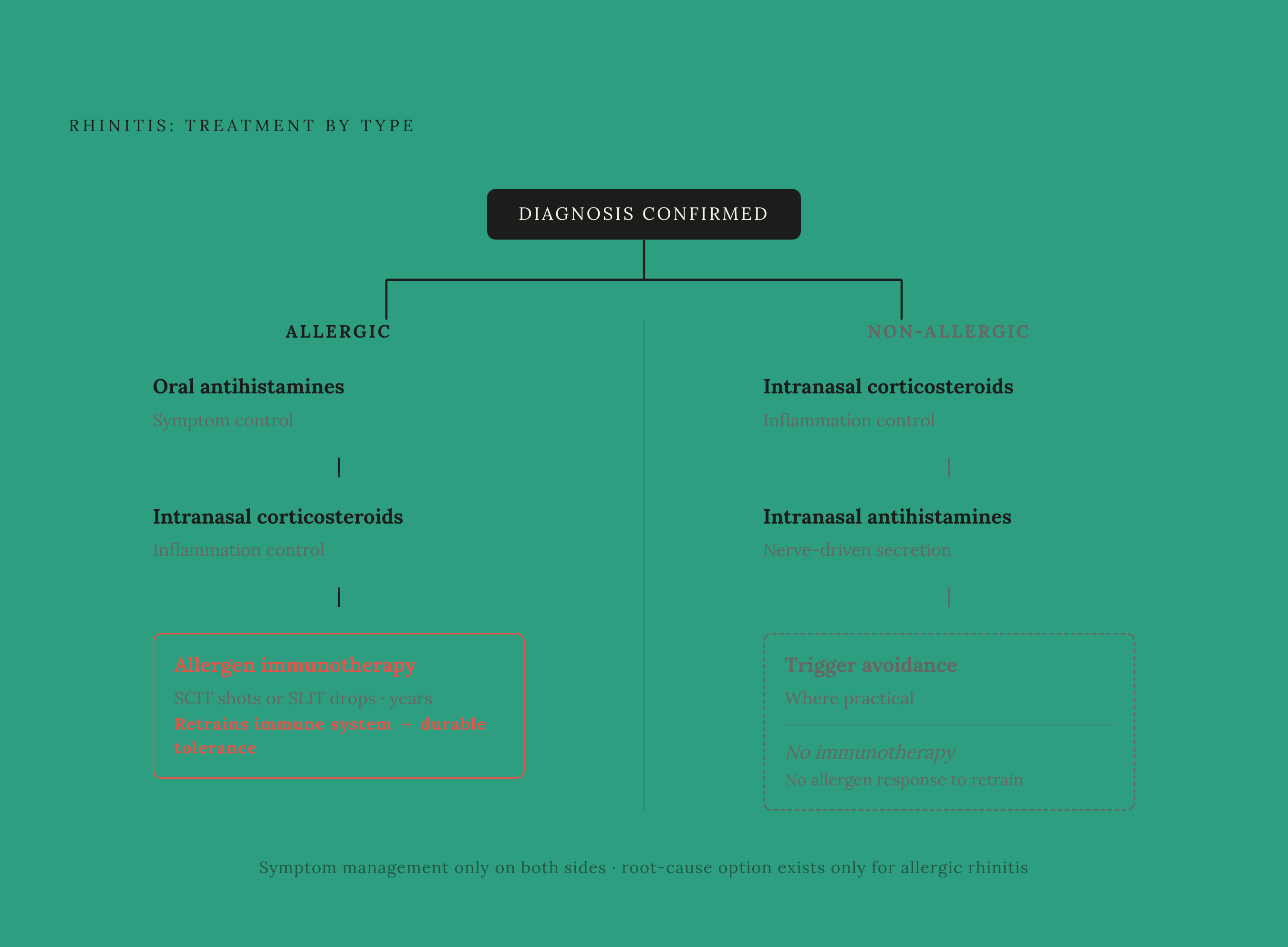
Once the diagnostic category is established, treatment logic diverges completely. This is where misclassification becomes most tangible, and most costly.
For non-allergic rhinitis, intranasal corticosteroids and intranasal antihistamines are appropriate first-line options, reducing nasal inflammation and modulating the nerve-driven secretory responses that characterize vasomotor disease. Trigger avoidance, where practical, removes the stimulus. Immunotherapy is not appropriate because there is no allergen-specific immune response to desensitize. Treatment is symptom management by definition, not root cause resolution, because the root cause is an autonomic or irritant process rather than an immune response that can be retrained.
Symptom medications for allergic rhinitis, oral antihistamines and intranasal corticosteroids, manage the inflammatory consequences of the IgE response. They don't touch the immune response itself. When medication stops, the allergy is unchanged; the next allergen exposure triggers the same cascade. Symptom management for allergic rhinitis is appropriate as a first step, and in mild cases it's entirely reasonable. It is also, by its nature, indefinite.
Allergen immunotherapy is the only available approach that retrains the immune system rather than suppressing its outputs. Subcutaneous immunotherapy, allergy shots, has a long clinical track record. Sublingual immunotherapy, delivered as drops or FDA-approved tablets, works by exposing the immune system to measured allergen doses under the tongue, gradually shifting the response from IgE-mediated reactivity toward immunological tolerance. Multiple double-blind, placebo-controlled trials support meaningful reductions in both symptoms and rescue medication use. The AAO-HNSF 2024 clinical practice guidelines issue a strong recommendation for immunotherapy in allergic rhinitis patients whose symptoms are inadequately controlled by medication and avoidance alone.
A minimum treatment course of several years is recommended for patients who respond. The goal is durable reduction in sensitivity, not temporary relief. Sublingual drops and FDA-approved SLIT tablets can be administered at home on a daily schedule, removing the logistical burden of weekly clinic visits that makes allergy shots impractical for many people.
The misclassification cost runs in both directions. A non-allergic rhinitis patient given immunotherapy gains nothing, because there is no allergen-specific immune response to desensitize. An allergic rhinitis patient maintained indefinitely on antihistamines has their histamine suppressed while the underlying immune dysregulation continues unchecked, accruing consequences that don't show up as nasal symptoms until they show up as something considerably worse.
The Hidden Health Consequences That Make Accurate Diagnosis More Urgent Than Many Patients Realize
Both allergic and non-allergic rhinitis disrupt sleep. Nasal obstruction forces mouth breathing at night, a less efficient and more mechanically disruptive airway pattern that fragments sleep architecture and produces the kind of daytime fatigue patients routinely attribute to overwork or a busy schedule rather than to nasal inflammation.
Allergic rhinitis carries an additional systemic burden that non-allergic rhinitis does not. The immune response releases histamine and other inflammatory mediators that circulate broadly. Histaminergic neurons in the hypothalamus regulate wakefulness and alertness; peripheral histamine released during an allergic reaction interferes with that system, contributing to the cognitive fog and drowsiness that many allergic rhinitis patients experience as a persistent background state. The combination of direct histamine effects during waking hours and fragmented sleep at night creates a sustained cognitive load that patients rarely connect to their rhinitis diagnosis, because it doesn't feel like an allergy symptom. It feels like life.
Fatigue is one of the most common and most underreported symptoms of allergic rhinitis for precisely this reason. Children with undiagnosed allergic rhinitis present as inattentive or academically underperforming. Adults attribute cognitive slowness to professional demands. In both cases, the actual driver goes untreated while something else takes the blame.
Allergic rhinitis also has recognized comorbidities with asthma, atopic dermatitis, and chronic sinusitis, conditions that influence each other; untreated allergic rhinitis can worsen asthmatic control and contribute to recurrent sinus disease. Patients who remain on symptom medications indefinitely, without addressing the immune root cause, often find that the nose feels adequately managed while something else quietly deteriorates. The allergy continues driving inflammation and systemic effects even when nasal symptoms appear partially controlled. That's the part most patients don't realize they're signing up for when they accept indefinite antihistamine use as the plan.
What Patients Should Take Away When Approaching Their Own Diagnosis
Before any test, the most useful thing a patient can do is map their own trigger pattern carefully and specifically.
Ask: do symptoms follow seasons, particular environments, or contact with animals? That trajectory points toward an allergic mechanism. Do symptoms flare with cold air, weather changes, specific smells, or spicy food, independent of season or biological exposure? That pattern points toward non-allergic. Do symptoms persist year-round without any clear environmental correlation? It is also worth considering whether the answer is perennial allergic rhinitis to indoor allergens like dust mites or pet dander, mixed rhinitis, or idiopathic non-allergic rhinitis — and that ambiguity is exactly the reason to pursue formal evaluation rather than self-treating indefinitely.
A detailed trigger log kept over several weeks is more diagnostically useful than any single-visit symptom description. Clinicians work from patterns, not snapshots. The more granularly a patient can describe when symptoms occur, what precedes them, and what relieves or worsens them, the better the history informing the diagnostic process. I've seen patients arrive with years of unresolved symptoms and a two-sentence description of their condition. I've also seen patients arrive with a notebook, dates and triggers and notes on what helped. The notebook wins, most of the time, and not because it impresses anyone; it's because the pattern it reveals is often the closest thing to a diagnosis before any test has been run.
Rhinitis is a condition with no uniform solution. The surface symptoms converge. The upstream mechanisms do not. Selecting the wrong treatment isn't just ineffective; it leaves the correct problem unaddressed while time passes and, in the case of allergic rhinitis, the immune dysregulation and its systemic consequences continue accumulating quietly in the background. The diagnostic path is trying to answer one question: what is upstream of these symptoms? History, allergy testing, and careful trigger mapping are the tools. Getting the answer right is what separates resolving the problem from merely obscuring it.