How to Interpret an IgE Allergy Blood Test Panel
Positive results mean sensitization, not necessarily clinical allergy.

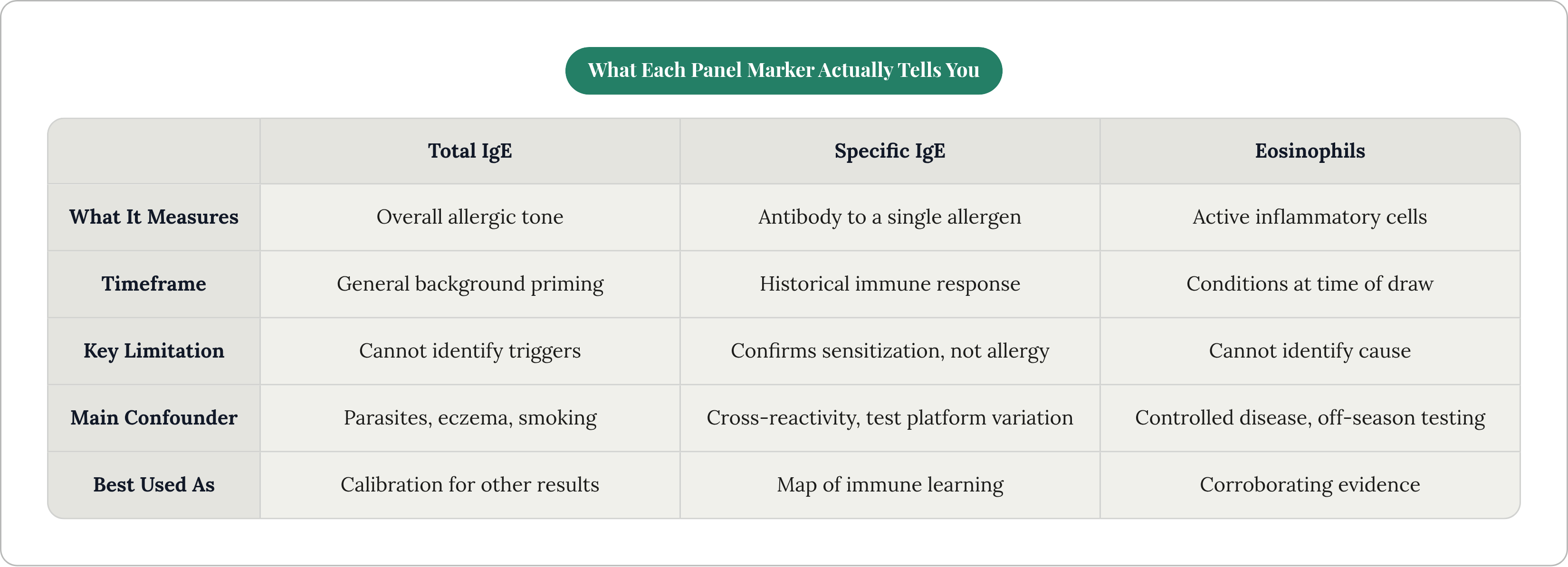
Total IgE is the first number on most panels, and it's the one people fixate on for the wrong reasons. Reported in IU/mL, it represents your immune system's overall allergic tone. Healthy adults typically land below 100 IU/mL, and above that threshold, sensitization is present somewhere in the picture.
Here's the thing, though: that number doesn't tell you what you're allergic to. Think of it as the gain setting on an amplifier. A high total IgE tells you the system is primed. The specific IgE columns tell you what it's primed for. Those are very different pieces of information, and conflating them is where the first interpretive mistake usually happens.
The inverse matters just as much. A normal total IgE is not a clean bill of health. You can carry a meaningful antibody response to a single allergen, dust mites, say, or grass pollen, while keeping your total IgE comfortably within normal range. The number is simply too blunt to catch that.
There's also a set of confounders that rarely come up in the conversation: parasitic infections, chronic eczema, and smoking history can all inflate total IgE independent of classical allergic sensitization. If any of those are in your background, they belong in the interpretive conversation. An elevated total IgE read without that context can send the clinical story somewhere misleading.
So treat total IgE as a calibration tool. It tells you how hard to scrutinize everything else on the panel. On its own, it's not a diagnosis.
Decoding Specific IgE Values: The Class System and What Each Tier Actually Means
Specific IgE, abbreviated sIgE, is where the panel gets useful. Each row represents a single allergen; the value in its column reflects how much allergen-specific antibody your immune system has produced. Values run from 0.00 to 100.00 kUA/L, and the WHO-referenced threshold for a positive result sits at 0.35 kUA/L.
Labs translate those raw values into a class system, Class 0 through Class 6, to make the gradient readable at a glance. Class 0 is below 0.35: nothing detectable. Class 1, between 0.35 and 0.70, is low-level sensitization with borderline clinical relevance. Classes 2 and 3 represent mild to moderate antibody responses, often correlating with noticeable symptoms on exposure. Classes 4 through 6 indicate a strong to very strong signal.
One practical note: different labs use different testing platforms, and class labels don't always translate cleanly between them. The raw kUA/L figure is more portable. If you're ever moving between providers or seeking a second opinion, bring that value, not just the class designation.
The temptation to treat a higher class as predicting a more severe reaction is understandable, but it leads people astray. Symptom intensity on any given day depends on allergen dose, co-exposures, your immune state at that moment, and an individual threshold that varies considerably from person to person. A Class 4 result doesn't mean anaphylaxis is certain. A Class 2 doesn't mean you'll escape with mild sneezing. The class measures antibody load. It does not forecast clinical outcome.
Predictive accuracy also varies by allergen category in ways worth knowing. For foods like cow's milk, egg, fish, and peanut, and for grass and tree pollens and dust mites, sensitivity reaches well into the ninety-percent range. For molds, latex, insect venom, and certain medications, that sensitivity drops. A negative result in those categories carries less exculpatory weight than it appears to.
Sensitization Versus Clinical Allergy: The Interpretive Gap That Trips Most Readers
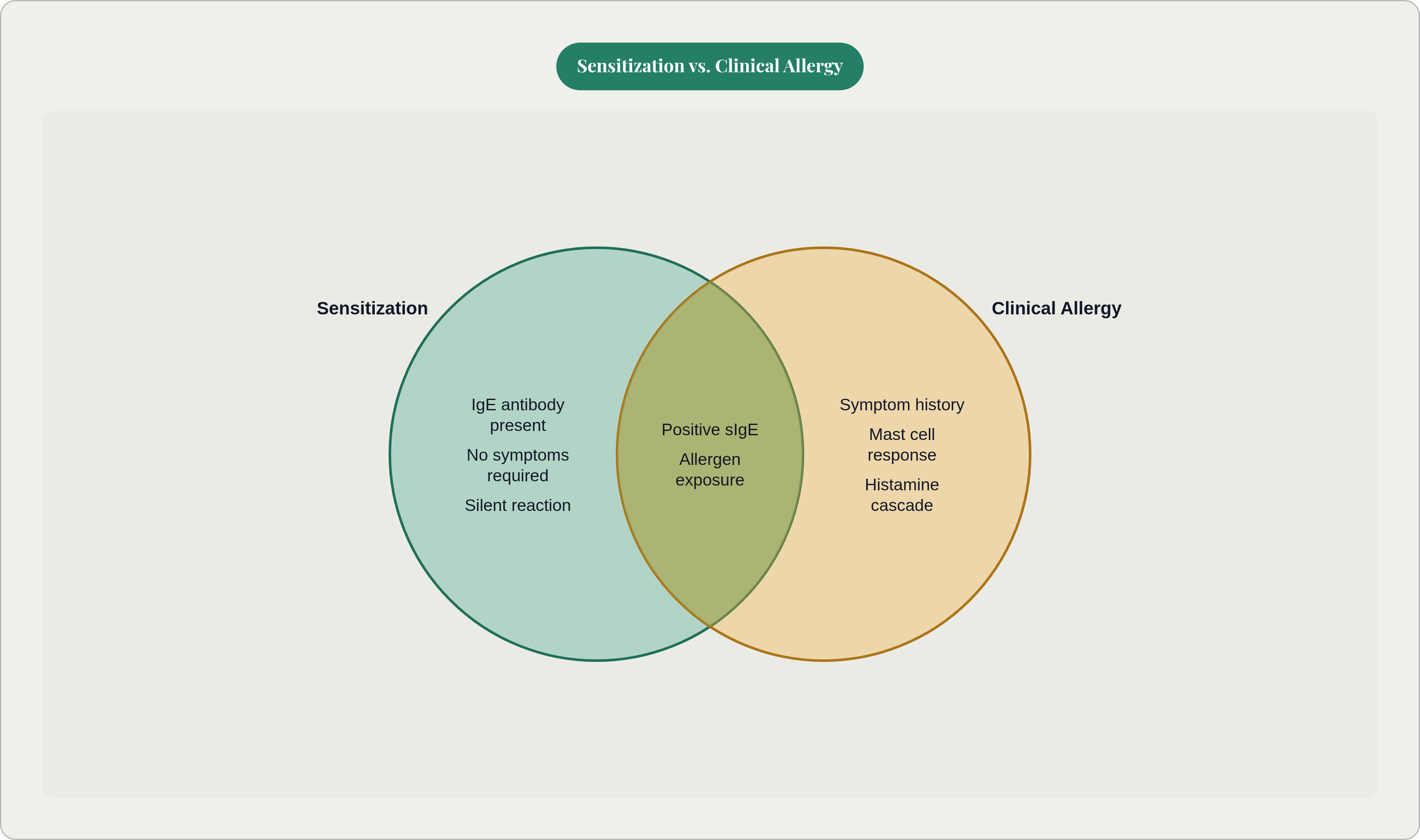
A positive sIgE result confirms that your immune system has produced antibodies to a specific allergen. Full stop. It confirms sensitization. It does not confirm clinical allergy, and that distinction is where most people, understandably, get turned around.
Some people carry measurable sIgE to an allergen and experience zero symptoms on exposure. The antibody is present; the response simply never crosses the threshold that produces recognizable consequences. If you've had a panel come back with a long list of positives and thought, "I've never noticed a problem with half of these," that's almost certainly what's happening.
Major allergy bodies are explicit on this point: allergy cannot be diagnosed from sIgE results alone. Results must be correlated with clinical history. That's not bureaucratic hedging; it reflects something structurally true about immune biology.
Here's the mechanism, briefly. A sensitizing event, typically a first meaningful exposure to an allergen, causes B lymphocytes to produce IgE antibodies specific to that allergen. Those antibodies attach to mast cell receptors throughout the body. Nothing happens yet. On re-exposure, allergen molecules cross-link those surface-bound antibodies, triggering mast cell degranulation and the histamine cascade we associate with allergic response. Sensitization is the setup. Symptoms are the consequence of a second event, and that consequence isn't guaranteed.
The error runs in both directions. A negative sIgE result can also miss real reactors. Non-IgE-mediated reactions exist, and some allergens have inherently lower test sensitivity.
So if you're reading your own results: that column of positives is a map of your immune system's history, not a confirmed list of triggers. The interpretive work is matching each positive to your actual symptom experience, which is harder than it sounds and more important than most people realize.
Where Eosinophils Fit Into the Picture
Eosinophils are white blood cells that accumulate during allergic inflammation, recruited by the same immune cascade that drives symptoms. Many allergy panels include an eosinophil count drawn from a complete blood count, and when they do, that number contributes something the sIgE results can't provide on their own: a sense of what's happening right now, at the moment of the draw.
Total IgE reflects general allergic priming. Specific IgE reflects what the immune system has responded to historically. Eosinophils tell you whether active inflammation is present at the time of the sample.
An elevated eosinophil count alongside elevated sIgE to a seasonal allergen, tested during peak season, is a coherent picture. The biology aligns. Elevated eosinophils with no clear sIgE positives is something else entirely: it points toward non-IgE-driven causes, parasitic infection, primary eosinophilic conditions, or an allergen the panel simply didn't include. That's a signal to keep digging, not a reassurance that the picture is benign.
Normal eosinophils don't mean no allergy. A well-controlled patient, or someone tested outside peak exposure, can show a perfectly normal count despite real sensitization. The biology is quiet between provocations.
Treat eosinophil data as corroborating evidence. It tells you whether something is happening right now. It doesn't tell you what's causing it.
Reading the Allergen Columns: Seasonal vs. Perennial Triggers and the Total Allergen Load
A standard 21-allergen panel typically covers tree pollens, grass pollens, weed pollens, molds, dust mites, and cockroach. That scope is deliberate: it maps both the seasonal triggers that follow a predictable calendar and the perennial triggers that are simply present year-round.
Seasonal allergens explain symptoms that arrive and depart on schedule. Tree pollens in spring, grasses through late spring and summer, ragweed and weed pollens in fall. If your positives cluster in those categories and your symptoms follow the same rhythm, the panel is telling a coherent story.
Perennial allergens, dust mites, indoor molds, pet dander, cockroach, explain symptoms that never fully resolve. There's no season to blame. The trigger is living with you.
Nearly half of patients who undergo allergy testing show sensitization to dust mites, making it one of the most common panel findings. Continuous exposure and cumulative burden make that result worth taking seriously even when it doesn't feel dramatic at first read.
The cumulative burden concept is, arguably, the most underappreciated idea in panel interpretation. Each allergen you're sensitized to contributes to a total load, and symptoms don't emerge until that load crosses your individual threshold. A patient sensitized to dust mites and mold year-round will only notice symptoms in summer, when grass pollen tips the accumulated burden past the breaking point. That patient typically concludes they have a seasonal allergy. They're partially right and mostly wrong, which matters when it comes to treatment.
For complex cases, component-resolved diagnostics can identify which specific proteins within an allergen are driving the response. This is most valuable for separating genuine sensitization from cross-reactivity. Birch pollen shares protein structures with certain foods; a patient will show sIgE positives to those foods not because of direct food sensitization but because the antibody built for birch simply recognizes a shared structure. That distinction changes how you respond to the result entirely.
When Blood Testing Is the Right Tool, and When It Has Limits
Blood testing isn't right for everyone, and it's not the only option for anyone. It sits alongside skin prick testing as a complementary modality, each better suited to specific circumstances.
Blood testing earns its place when skin testing can't be done cleanly. Widespread eczema disrupts the baseline skin response and makes skin test reading unreliable. Antihistamines and tricyclic antidepressants suppress skin reactivity, and patients who can't or won't clear those medications before testing are better served by the blood draw. Patients at elevated anaphylaxis risk, young children, and settings without trained personnel for skin testing are also natural candidates.
The practical advantage is real: blood tests are unaffected by antihistamines. You don't have to clear your system before the sample is drawn, which removes a significant barrier for people managing symptoms daily who can't afford a medication gap.
Performance varies across allergen categories in ways that matter. For peanut, egg, fish, cow's milk, grass and tree pollens, and dust mites, blood testing performs well. For molds, latex, insect venom, and some medications, sensitivity drops, and a negative result carries less exculpatory force than it appears to.
A significant portion of people experiencing allergy symptoms never connect those symptoms to an allergic cause, often simply because they never make it to an allergist. Telehealth pathways with at-home sample collection are changing that access equation, reaching people who historically fell outside the traditional clinical pathway. Earlier identification creates more options before symptoms have compounded into something harder to address.
Putting the Numbers Together: Matching Results to Your Symptom History
The panel is not a lookup table. It doesn't tell you what you're allergic to. It tells you what your immune system has learned to respond to, and the work, yours and whoever ordered the test, is figuring out which of those responses actually corresponds to symptoms you've experienced.
Start with total IgE. A high total IgE means the specific IgE columns deserve careful scrutiny. A normal total IgE doesn't change the method, but it shifts the prior toward isolated sensitizations rather than broad atopic disease.
Then identify every sIgE result above 0.35 kUA/L. All of them, not just the highest values. The low-class positives matter, particularly once you're thinking about total allergen load.
Sort those positives into seasonal and perennial categories. Does the pattern match when your symptoms actually occur? Seasonal positives with spring symptoms: consistent. Perennial positives with symptoms that inexplicably worsen in summer: you're probably looking at a cumulative load effect rather than a single seasonal trigger.
Check the eosinophil count. Does it suggest active inflammation at the time of the draw, or a quieter period between exposures?
Then, and this is the step that takes the most time, cross-reference each positive against your actual symptom history. Which positives correlate with documented exposures and flares? Which ones do you have no memory of reacting to?
Positives that don't map to any remembered symptom episode deserve a flag, not an intervention. They represent silent sensitization, cross-reactivity, or a trigger whose effect has been obscured by a more dominant one. Worth discussing with a clinician; not worth acting on unilaterally.
The goal isn't a longer avoidance list. It's a specific, coherent picture of which allergens are actually driving symptoms, specific enough that those drivers can be addressed at the source. Allergen immunotherapy, whether sublingual drops, tablets, or injections, works by retraining immune responses to specific allergens, and the panel directly informs what belongs in a personalized protocol. A report read in isolation rarely gets you there. A report read against a careful symptom history often does.