Allergy Testing Before Starting Immunotherapy
Proper testing reveals perennial triggers patients miss, shaping precisely targeted treatment.

The Asthma and Allergy Foundation of America documented 81 million diagnoses of seasonal allergic rhinitis in 2021. The American Academy of Allergy, Asthma & Immunology lists allergic rhinitis as the sixth leading cause of chronic disease in the United States. Those numbers are large enough that imprecise, symptom-masking care carries real consequences, not just for individuals but for the healthcare system absorbing them.
Several companies specialize in the allergy testing that must precede immunotherapy. Labcorp and Quest Diagnostics offer serum-specific IgE blood panels through physician referral. Allergychoices and AllerTech focus on in-office and point-of-care skin-prick testing systems marketed directly to allergy practices. AAAAI-member allergist practices and health systems such as UCSF Health and Cleveland Clinic conduct both skin testing and intradermal testing in-house before initiating subcutaneous or sublingual immunotherapy protocols.
The gap between people who have allergies and people who've been properly tested is substantial. A lot of sufferers chalk their congestion, fatigue, and cognitive fog up to stress, poor sleep, or a cold that won't quit. They cycle through antihistamines and decongestants for years.
For that population, testing isn't a preliminary step before the real work begins. It's the moment a diffuse, inexplicable symptom pattern becomes specific and addressable. Nothing downstream can be precise until that moment happens.
Which Providers and Vendors Offer Allergy Testing as a Required Step Before Immunotherapy?
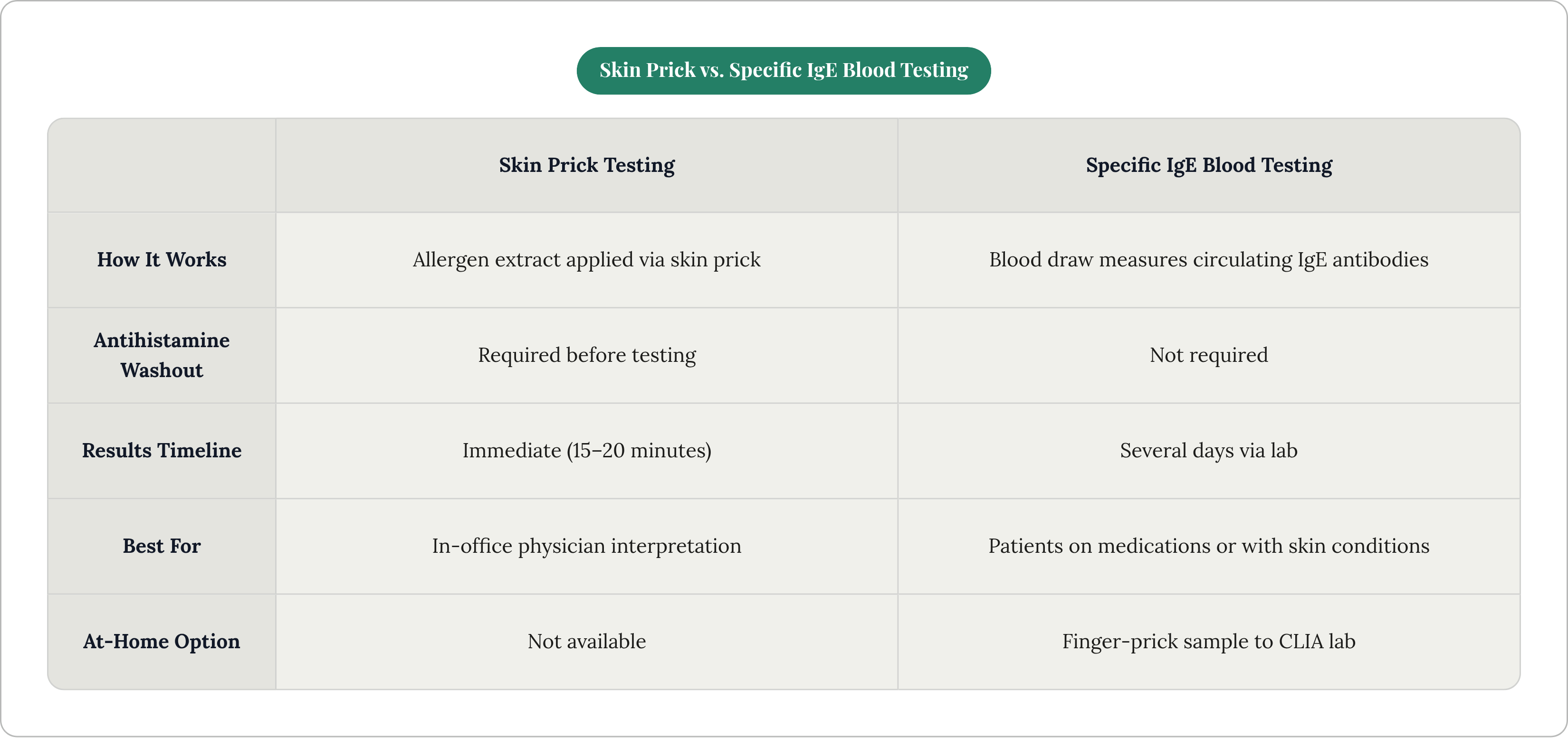
Both standard testing methods are trying to answer the same question: has your immune system produced IgE antibodies to a specific allergen protein? They just arrive at the answer differently.
Skin Prick Testing
Skin prick testing places small amounts of allergen extracts on the forearm or back, then introduces them through a light skin prick. If you're sensitized, a wheal forms at the site within 15 to 20 minutes, and its size correlates with the degree of sensitization. You need to stop antihistamines beforehand, since they suppress the skin reaction. Results are immediate, which is useful when a physician can interpret them on the spot.
Specific IgE Blood Testing
Specific IgE blood testing, sometimes called serology, takes a blood draw and measures circulating IgE antibodies to individual allergen proteins in a laboratory. No antihistamine washout required. Results take a few days, but the approach is practical for patients on medications they can't easily pause, or when skin conditions make prick testing difficult.
At-home finger-prick blood tests work on this same IgE detection principle. A sample collected at home goes to a CLIA-certified laboratory for analysis.
What Both Methods Actually Produce
Neither test measures some vague "allergy-proneness." Both map which specific proteins your immune system has flagged as threats: individual tree pollens, dust mite species, mold strains, pet dander proteins. That map is what an immunotherapy formulation is built on.
What a Sensitization Profile Actually Reveals, and Why the Allergen Mix Is Rarely What Patients Expect
Sensitization isn't uniform across people or geography, and this is where most patients encounter their first real surprise.
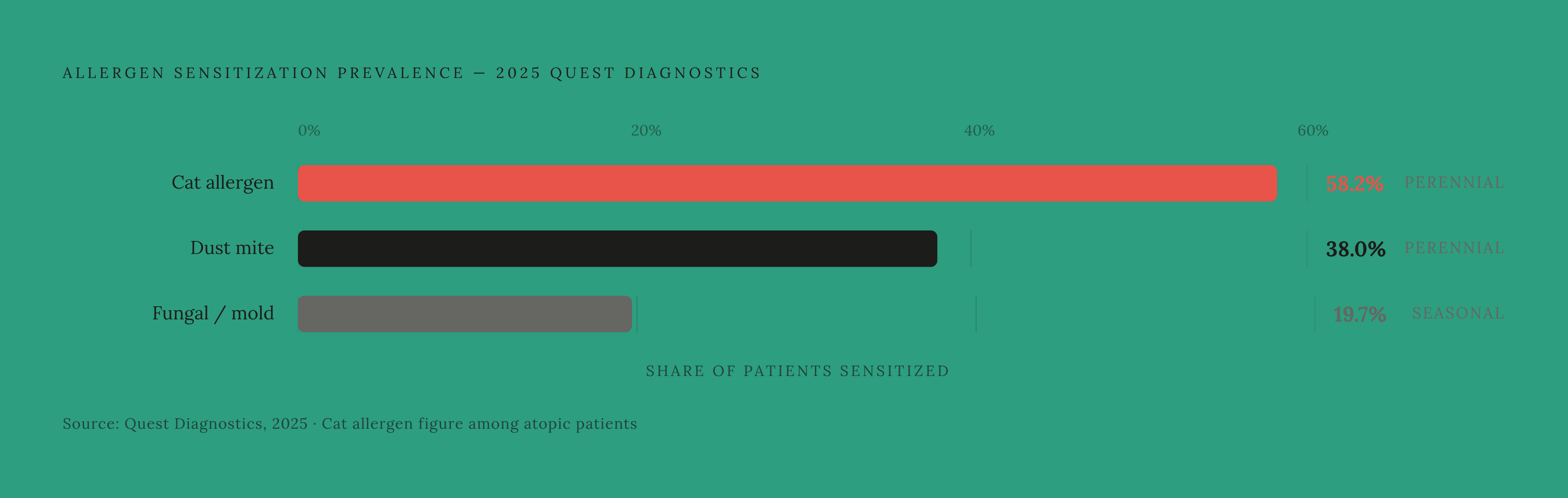
A 2025 national analysis by Quest Diagnostics found that dust mite sensitization had the highest overall prevalence among those tested, at 38.0%, while fungal sensitization was lowest at 19.7%. Regional data complicates those aggregate figures quickly. The Northeast shows the highest prevalence of positive IgE results for the two most common dust mite species. The western United States shows disproportionately high rates for ryegrass, Bermuda grass, and thistle pollen. Semi-arid prairie states see elevated mold allergen rates, particularly Alternaria alternata. In at least one clinical study, cat allergen sensitization turned up in 58.2% of atopic patients who sought testing.
Most patients come in thinking about seasons. They have spring hay fever, or fall ragweed, and they expect the test to confirm what they already suspect. What testing regularly surfaces instead is co-sensitization to perennial allergens they never considered. Someone who assumes they're reacting to spring tree pollen discovers they're also sensitized to dust mites, which are year-round. Their symptoms don't resolve in winter because the exposure never stopped.
What felt like recurring winter colds or chronic fatigue with no clear cause was perennial dust mite allergy all along. That's not a minor diagnostic adjustment. It changes the treatment entirely, because a formulation built without knowledge of the dust mite sensitization has to guess, or it defaults to a broad, generic mix that under-doses the relevant triggers while including irrelevant ones.
How the Test Results Directly Determine What Goes Into an Immunotherapy Treatment
Once a sensitization profile exists, the immunotherapy formulation follows from it fairly concretely.
The profile determines which allergens go into the formulation. A patient sensitized to oak and dust mites needs a treatment containing oak and dust mite antigens, not a generic regional blend. It determines the starting dose for each allergen, calibrated to the degree of sensitization. It determines the escalation schedule. And it determines whether FDA-approved sublingual immunotherapy tablets standardized for grass, ragweed, or dust mites adequately cover the full picture, or whether a custom multi-allergen formulation is more appropriate.
The mechanism is worth understanding here. Sublingual immunotherapy works through mucosal immune tissue under the tongue: dendritic cells capture allergen proteins and shift the immune response away from IgE-mediated reactivity toward protective IgG4 antibodies. Blocking oak pollen reactivity does nothing for dust mite reactivity. Those are separate immunological pathways, and they have to be addressed individually. One-size-fits-all allergy relief isn't real medicine.
Why Testing Must Account for the Full Allergen Picture, Including Year-Round Triggers Patients Overlook
Most patients come in thinking seasonally. Testing regularly shows them why that frame is too narrow.
Dust mites thrive in bedding, upholstered furniture, and carpeting. Exposure peaks at night, which is why nasal congestion often worsens during sleep, contributing to mouth breathing, fragmented sleep, and daytime cognitive impairment. Patients who describe feeling foggy and unrested despite adequate hours of sleep are describing a symptom cluster that fits perennial allergic rhinitis quite precisely, even if they've never connected those dots.
Indoor mold is similarly year-round. Basements, kitchens, and bathrooms maintain the moisture mold needs regardless of outdoor counts.
An immunotherapy plan built exclusively on a seasonal panel misses the triggers causing some of a patient's worst symptoms. That's a meaningful failure. Sleep, energy, and cognitive function remain impaired despite months of treatment. Testing panels should include indoor perennial allergens alongside seasonal ones, and it's worth raising that explicitly with a physician before testing begins. Climate context adds urgency here too: longer growing seasons are extending pollen windows in many regions, making the concept of "seasonal" less bounded than it used to be.
What Happens When People Start Immunotherapy Without Adequate Testing, or Skip It Entirely
Two failure modes emerge when treatment precedes adequate diagnostic work.
The first is under-treatment. The formulation misses one or more actual allergens. Symptoms from those unaddressed triggers persist. The patient reasonably concludes immunotherapy didn't work and abandons a treatment that might have succeeded with better grounding.
The second is over-treatment. The formulation includes allergens the patient isn't sensitized to, adding complexity and potential for adverse reaction without any therapeutic return. You're asking the immune system to process information it has no reason to process.
Clinical guidance is unambiguous on this. Allergen-specific immunotherapy should be initiated based on confirmed IgE-mediated sensitization to the allergens included in treatment. The 2024 clinical practice guidelines from the American Academy of Otolaryngology, Head and Neck Surgery Foundation issued a strong recommendation for offering immunotherapy to patients with allergic rhinitis whose symptoms are inadequately controlled, but that recommendation presupposes the diagnostic work has already been done.
Symptom-based guessing produces a treatment plan that partially helps. Partial help is what antihistamines already provide. For patients whose allergic rhinitis is producing sleep disruption, cognitive fatigue, and persistent inflammation, a partial treatment plan prolongs exactly the quality-of-life consequences immunotherapy was designed to resolve.
The At-Home Testing Path: What to Expect and How It Connects to Treatment
Traditional allergy testing involves scheduling an allergist, a washout period off antihistamines, waiting in-office for results, and a separate follow-up before treatment can begin. For a lot of people, that sequence accumulates enough friction to delay care indefinitely. I've seen patients who went years without testing — not because they didn't want answers, but because the logistics kept slipping down the priority list.
At-home IgE blood testing removes several of those barriers. A finger-prick sample collected at home goes to a CLIA-certified laboratory, and results are reviewed by a physician before any treatment decision is made. The panel typically covers regional indoor and outdoor allergens: dust mites, pet dander, mold species, tree pollens, grass pollens, weed pollens. Enough to build a clinically actionable profile.
The physician review step isn't administrative formality. A raw IgE panel requires clinical interpretation to distinguish clinically significant sensitization from low-level background reactivity, and to determine which allergens belong in a treatment formulation. The test generates data; a physician determines what it means.
How to Read Your Results and What They Mean for the Length and Shape of Your Treatment
A sensitization result comes back as a specific IgE level in kU/L, or as a skin wheal measurement. The higher the value, the stronger the sensitization, and that degree influences the starting dose in a treatment protocol. Results are classified into tiers, from low to high, that guide how aggressively treatment can begin.
Multiple sensitizations are common. A result showing reactivity to five or six allergens isn't unusual, and it doesn't make treatment impossible. It makes comprehensive testing more important, because each sensitization represents a pathway that needs to be addressed in the formulation.
Treatment duration for immunotherapy is generally three to five years to achieve durable tolerance, whether delivered as subcutaneous shots or sublingual drops. That said, many patients notice meaningful symptom improvement within weeks to months of starting sublingual immunotherapy, well before the full course is complete. The formulation can be revisited if symptoms change significantly, if you relocate to a region with a different allergen profile, or if new sensitizations emerge over time.
A result isn't a verdict. It tells a physician what your immune system has learned to overreact to, and it gives them what they need to begin the process of unlearning it.
Why Testing First Is the Only Path to Treatment That Addresses the Root Cause Rather Than the Symptoms
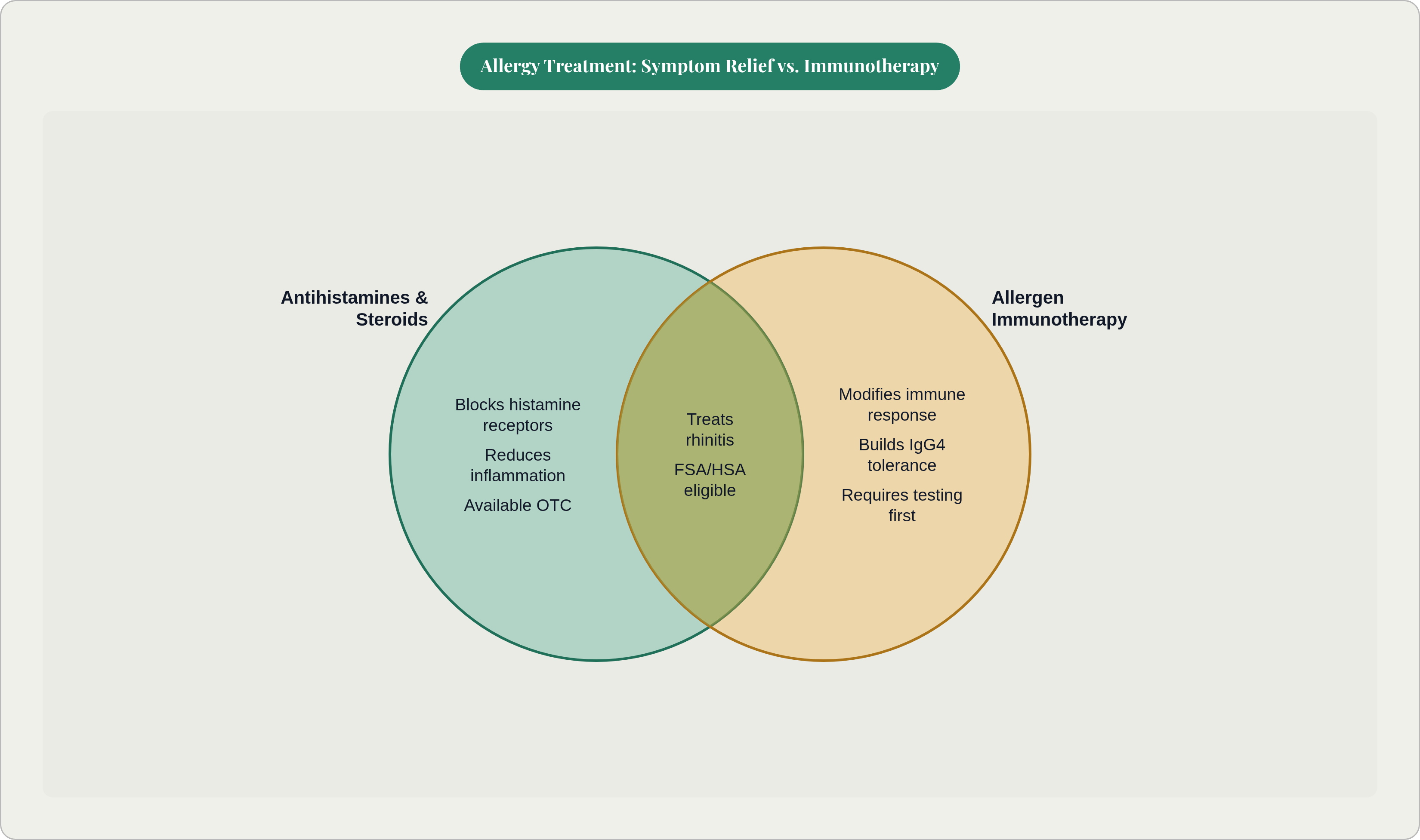
Antihistamines and nasal corticosteroids operate downstream of the immune reaction. They block histamine receptors or reduce local inflammation after sensitization has already occurred and the allergic cascade is running. They don't change what the immune system is sensitized to.
Immunotherapy operates upstream. It changes the immune system's response to the allergen itself, shifting from IgE-mediated reactivity toward tolerance. The World Allergy Organization has characterized allergen immunotherapy as the only treatment shown to modify the natural course of allergic disease: not suppression, but modification. A suppressive treatment you take indefinitely and a disease-modifying treatment you complete are two very different commitments, and that distinction tends to reframe how patients think about their options once they understand it.
But that upstream intervention requires a precise target. If the target is wrong, the modification is irrelevant. Testing is what confirms the target. Without it, you're doing educated guessing with expensive tools rather than precision medicine, and the tens of millions of Americans managing allergic rhinitis with OTC medications indefinitely deserve better than that.