Allergen Panel Testing for Mold, Dust Mites, and Pet Dander
A blood test reveals which indoor allergens your immune system has already primed to fight.

The mechanism is specific: a panel test measures allergen-specific immunoglobulin E, or IgE, in a blood sample. IgE is the antibody class the immune system produces when it has been sensitized to a particular substance. When you're sensitized to dust mites, your body holds a standing order, a pre-loaded immune response ready to fire the next time the relevant proteins appear. The test detects that standing order.
A positive result for a given allergen tells you the immune system has mounted and recorded a response to it. The magnitude of IgE elevation can indicate degree of sensitization, though it isn't a direct proxy for symptom severity. That nuance matters, and here's why: high IgE to cat dander in someone who lives with three cats means something categorically different than the same number in someone whose only cat exposure is a colleague's sweater.
Indoor respiratory panels are comprehensive by design. The Quest Diagnostics Indoor Respiratory Allergy Panel covers cockroach, cat dander, dog dander, two primary house dust mite species, a tropical dust mite species, four mold species, goose feather, and house dust. All of that from a single blood draw. The breadth is the point: it eliminates the sequential, symptom-by-symptom guessing that characterizes untested allergy management.
The species distinctions matter more than most people initially appreciate. Someone sensitized to the European house dust mite does not react identically to the American species. That's a detail with real consequences when you're building a treatment.
What the test doesn't do is equally worth naming. It cannot diagnose allergic disease on its own, and it doesn't predict how severe any given exposure will be. Clinical correlation is required: mapping results against symptom history, exposure patterns, and the realistic likelihood of contact. Raw numbers are data. Numbers in context become treatment targets.
Dust Mites: Why the Most Common Indoor Allergen Is Also the Hardest to Avoid
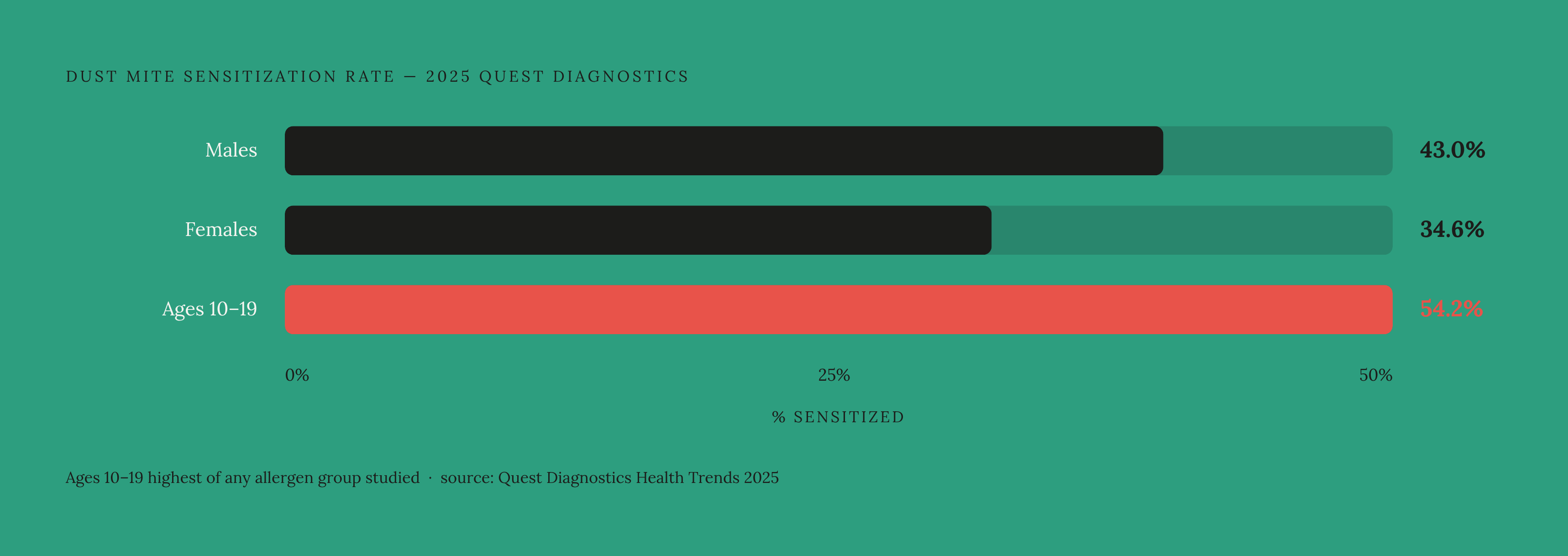
Dust mite sensitization is the most prevalent of all indoor allergens, and the exposure data from a 2025 Quest Diagnostics dataset makes the scale uncomfortable to look at. Sensitization rates reached 43.0% in males and 34.6% in females, the highest of any allergen source studied. In the 10 to 19 age group, that figure climbed to 54.2%. This is not a niche concern; it is the baseline condition for a substantial portion of the population.
The two primary species are Dermatophagoides pteronyssinus, the European house dust mite, and Dermatophagoides farinae, the American variety. The proteins that drive immune responses are predominantly Der p 1 and Der p 2, found in the mites' fecal pellets. These proteins are highly immunogenic, meaning the immune system responds to them with unusual vigor, and they've been directly implicated in asthma exacerbation beyond simple rhinitis.
Where they live is the uncomfortable part. Bedding, upholstered furniture, and carpeting in warm, humid environments are the primary habitats. Above 2 micrograms of dust mite allergen per gram of dust, new sensitizations can develop. Above 10 micrograms per gram, the association with asthma symptoms becomes clinically significant. Older homes, homes in humid climates, homes without consistent climate control: these are the environments where those thresholds are regularly crossed.
Avoidance alone is, practically speaking, insufficient. Encasements, air filtration, humidity control, all worth doing. But you cannot eliminate dust mites from a lived-in home. The mites are a fact of the environment. That's why immune desensitization is a more durable strategy than environmental mitigation alone, not a replacement for it, but a fundamentally different category of intervention.
Panel testing identifies which species is driving the response, and that information feeds directly into how immunotherapy is formulated. That's a clinically meaningful distinction.
Pet Dander: What Cat and Dog Allergens Do That Most Owners Don't Expect
More than half of U.S. households have at least one dog, and roughly a third own a cat, which makes pet allergen exposure the norm rather than the exception. And yet most pet owners have a fundamentally mistaken model of what they're actually reacting to.
The primary cat allergen, Fel d 1, is produced in the sebaceous glands, saliva, and skin of cats. Not in the fur. This is why the concept of a hypoallergenic cat breed is, for most sensitized individuals, more marketing than medicine. The protein is present regardless of coat length or grooming habits.
What makes Fel d 1 distinctive is its particle behavior. It adheres to particles in a size range that allows them to remain airborne for hours and cling readily to fabric. Clothing becomes a vector. A sensitized person who doesn't own a cat may be reacting to Fel d 1 transported into their environment on a colleague's jacket or a child's school bag, which is a counterintuitive finding that a panel result can surface, prompting a different kind of diagnostic inquiry than the patient expected.
Dog allergen, Can f 1, follows a similar pattern but carries a distinct protein profile. A panel that differentiates cat from dog sensitization tells you something practically useful: whether you can comfortably spend time around one species but not the other, which is a question that actually changes how people organize their lives.
There's an emotional dimension here that's worth sitting with. Many people resist testing because they're afraid of what they'll find, specifically that they'll be told to rehome a pet they love. What the data often shows instead is a specific sensitization level, and a clinical pathway, immunotherapy, that can build real tolerance over time. That reframes the decision from an all-or-nothing dilemma to a managed process. The result isn't the verdict it feels like before you have it.
Mold Allergens: The Trigger That Operates Year-Round and Across Both Indoors and Outdoors
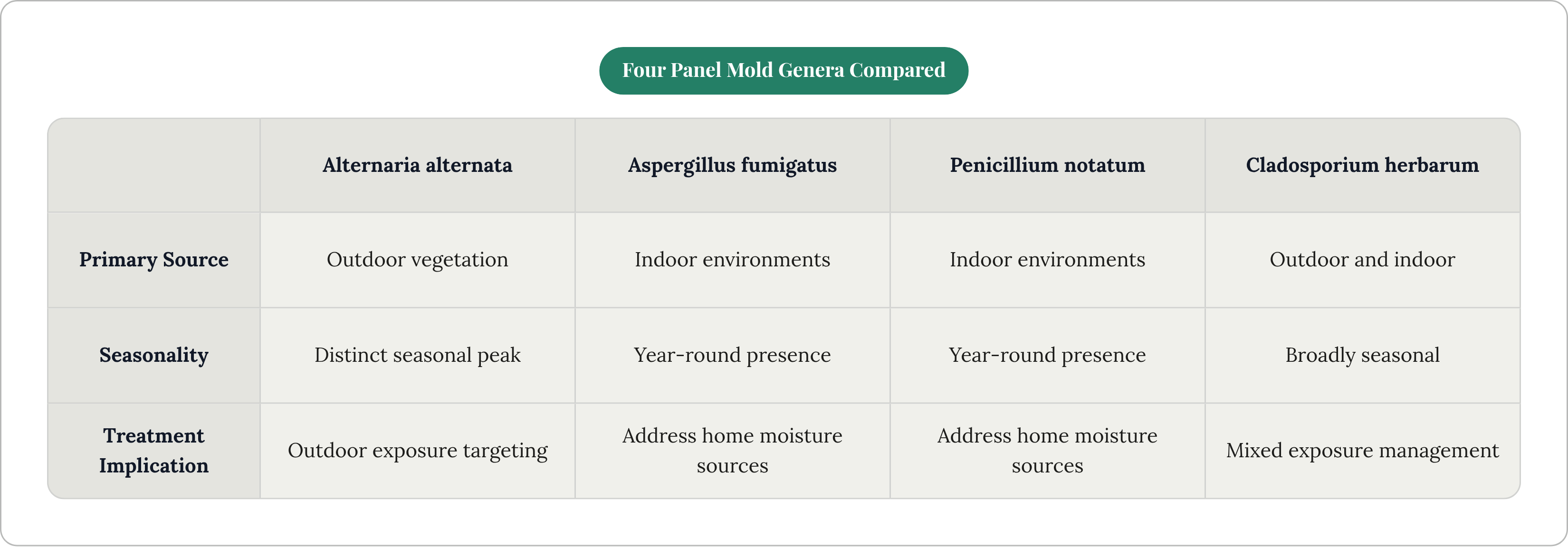
Mold occupies a distinct niche among indoor allergens because its sources straddle the boundary between the home environment and the outdoor world. The four genera panels test for most commonly are Alternaria alternata, Aspergillus fumigatus, Penicillium notatum, and Cladosporium herbarum. These aren't a comprehensive catalog of every mold a building inspector might find; they're the species with the strongest associations with IgE-mediated allergic responses.
Sensitization rates from the 2025 Quest Diagnostics data: 25.3% in males, 16.1% in females. Lower than dust mite, but affecting a substantial portion of the population, and probably underrecognized because mold symptoms are among the most frequently misattributed in allergy medicine.
The misattribution is understandable. Mold sources are often hidden: behind drywall, beneath flooring, inside HVAC systems. The symptoms, congestion, fatigue, difficulty concentrating, overlap with virtually every other indoor allergen and with several unrelated conditions. There's no seasonality cue the way there is with pollen. The trigger is invisible and the symptom picture is generic. Patients often describe these symptoms for years before mold ever enters the conversation.
The neurological angle deserves more attention than it typically receives. Inhaled mold spores provoke inflammatory cascades, and the resulting mediators have been linked to cognitive dulling: difficulty sustaining attention, a persistent flatness in mental clarity. The mechanism is real. Inflammatory molecules can cross the blood-brain barrier and disrupt neurotransmitter function. If that symptom cluster has been attributed to burnout or anxiety for years, mold sensitization may not have made it onto the differential.
Panel testing distinguishes which genera are implicated, and that distinction matters for treatment planning. Alternaria is predominantly an outdoor mold with a distinct seasonal peak. Aspergillus and Penicillium are primarily indoor species with consistent year-round presence. A formulation that addresses both needs to account for both when both are confirmed.
What Symptoms Allergies to These Triggers Actually Produce, Including the Ones That Don't Look Like Allergies
The classic presentation is familiar: sneezing, runny nose, itchy eyes. Most people recognize those during pollen season. The harder problem is the symptom cluster that accumulates quietly over years and never gets correctly attributed to anything.
Sleep disruption is the clearest example. Nasal congestion worsens at night as tissues respond to horizontal positioning and reduced sympathetic tone. Airway resistance increases. The body compensates by shifting to mouth breathing. Per Sleep Foundation reporting from 2021, people with untreated allergic rhinitis experience more frequent nighttime awakenings and less consolidated deep sleep. That matters more than it sounds. Deep sleep is when the brain consolidates memory and clears metabolic waste. Interrupted repeatedly across weeks and months, this compounds into a daytime cognitive deficit that feels like a personality trait, a baseline fog, rather than a symptom with a cause.
Mouth breathing as a downstream effect carries its own consequences: altered facial muscle mechanics during sleep, worsened snoring, and aggravation of sleep-disordered breathing in people already predisposed. None of these present to the patient as allergies. They present as tiredness, snoring, and a vague sense that they're not quite keeping up.
The systemic inflammation piece compounds all of this. Allergic mediators don't remain localized to nasal tissue; they circulate. At sufficient levels, inflammatory molecules can cross the blood-brain barrier and disrupt neurotransmitter signaling. That's a mechanism, not a metaphor, and it helps explain why cognitive symptoms show up in the same patients who have been dismissing their congestion for years.
The pediatric and occupational blind spots are worth naming directly. A child who appears inattentive in class. A working adult who can't sustain concentration through an afternoon. Both are living with chronic inflammatory disruption that has been labeled temperament or a productivity problem. Panel testing offers a mechanism, and a mechanism is the beginning of a solution, which is a different thing entirely from a coping strategy.
How a Physician Reads Panel Results and Turns Them Into a Treatment Target
A positive IgE result is not a standalone verdict. The physician maps it against symptom history, severity and duration, documented exposure patterns, and which allergens the patient realistically encounters on a regular basis versus rarely. A borderline result for an allergen with minimal exposure in a patient's life carries different clinical weight than a high result for something present in their bedroom every night. That interpretive step is where the data becomes actionable.
Polysensitization is the norm rather than the exception. Most people presenting with indoor allergies test positive to multiple allergens simultaneously: dust mite and cat, mold and dust mite, sometimes all three. Treatment needs to address the full confirmed profile. Zeroing in on only the most salient result and ignoring the others is a common error, and it's one that panel testing is specifically designed to prevent.
Prioritization within a panel is a clinical skill, not just arithmetic. Frequency of exposure matters. Symptom correlation matters. The realistic possibility of reducing contact matters. A high result for an allergen the patient encounters only during rare travel is interesting but not clinically urgent, and a good physician knows the difference.
What results enable that guesswork cannot: immunotherapy formulations are built from confirmed specific allergens. Treating indoor allergies generically is a fundamentally different intervention, less targeted, less precise, than treating confirmed Dermatophagoides pteronyssinus and Alternaria alternata sensitization with a formulation calibrated to those specific species. The specificity of the test is what makes the specificity of the treatment possible.
Environmental recommendations follow from the results as well. A dust mite result prompts a practical conversation about mattress encasements, humidity control, and laundering frequency. A mold result prompts inquiry into moisture sources, visible or hidden. A cat result in a catless home prompts a conversation about exposure vectors. The physician's role is to build a coherent, prioritized treatment rationale from the data, which requires both the data and a clinician capable of contextualizing it rather than just reading it off a report.
Why Immunotherapy, Not Ongoing Medication, Is What Panel Results Are Actually Pointing Toward
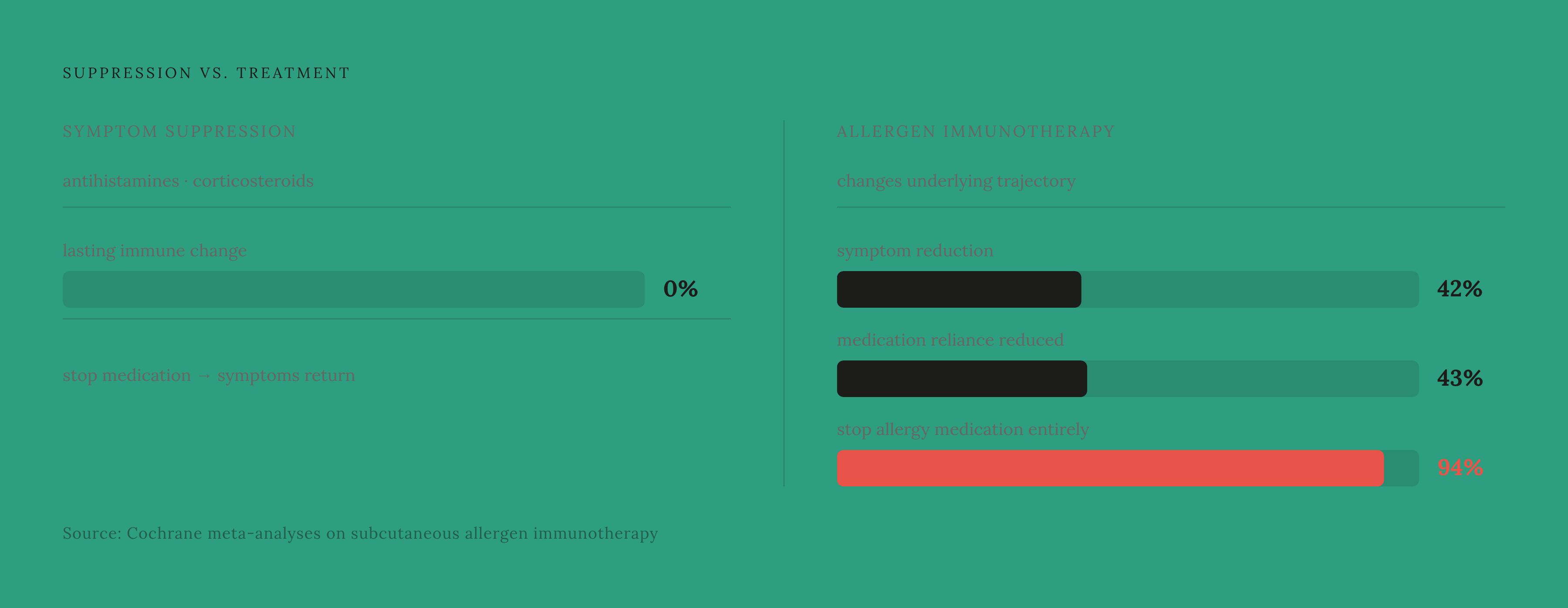
Antihistamines and intranasal corticosteroids do what they're designed to do: suppress symptoms after the immune response has fired. They don't alter the underlying relationship between the immune system and the allergen. Stop taking them, symptoms return, because the immune system's standing order has changed in no meaningful way. That's not a criticism of those medications; it's a description of their mechanism.
Allergen immunotherapy works at a different level entirely. Repeated low-dose allergen exposure, administered consistently over time, produces protective IgG antibody, suppresses IgE, upregulates regulatory T cells, and gradually induces immune tolerance. The immune system is being retrained, not suppressed. That distinction has clinical consequences.
The benchmark is meaningful. Cochrane review meta-analyses across sublingual immunotherapy trials found the treatment reduced symptoms by 42% and reduced reliance on symptom-relieving medication by 43%. Separate studies have found that over 94% of patients are able to stop taking allergy medication regularly once they begin allergen immunotherapy. That figure reframes what the word treatment means in this context. The goal is resolution.
Panel results are the prerequisite for this intervention. Immunotherapy formulations are built from the specific allergens a patient is sensitized to. A confirmed house dust mite sensitization warrants an HDM-specific formulation. A confirmed mold sensitization alongside it requires a formulation that addresses both. A generic formulation for an untested patient is a different intervention, less targeted, and less likely to produce the immune tolerance that makes the therapy worth undertaking across three to five years.
That timeline is worth sitting with. Three to five years of consistent treatment to achieve lasting immune tolerance, a reorientation of the immune system rather than a temporary quieting of it. The World Allergy Organization has characterized allergen immunotherapy as the only treatment with the potential to modify the natural course of allergic disease. Medications manage; immunotherapy changes the underlying trajectory. Those are different categories of intervention, and panel testing is what makes the latter possible.
Sublingual Immunotherapy as the Practical Delivery Method for Most People With Confirmed Indoor Allergen Sensitization
Allergy shots, subcutaneous immunotherapy or SCIT, have the longer research history and build tolerance slightly faster during the initial phase, with roughly 80% efficacy for environmental allergens. Sublingual drops come in at roughly 70%. That gap is narrower than most people expect, and for many patients, it isn't the factor that determines whether they actually complete a multi-year treatment course.
The practical barrier shots create is real and tends to be underweighted in clinical discussions. Weekly in-office visits during the build-up phase, then monthly visits for years of maintenance, represent a scheduling commitment that erodes adherence over time in ways that are predictable and well-documented. For a patient sensitized to dust mites, cat dander, and two mold genera simultaneously, that commitment runs in parallel with a life that does not pause for it.
The safety profile of sublingual immunotherapy compares favorably. Drops produce mild oral symptoms in some patients; sublingual tablets can cause localized mouth irritation early in treatment. Both are administered at home without post-dose observation requirements. Injection site reactions occur in a substantial proportion of SCIT patients, and systemic reactions, while manageable in a clinical setting, are a documented risk that requires patients to remain in the office after each dose. For someone doing this for years, that waiting room time accumulates.
In the United States, FDA-approved sublingual tablets exist for house dust mites, grass pollen, and ragweed. Sublingual drops in liquid form are used off-label domestically but represent the standard formulation in many countries and are widely administered here. A phase III trial published in The Lancet Regional Health Europe in November 2024 confirmed the efficacy and safety of an HDM sublingual tablet in children aged five to eleven, supporting daily self-administration in that population. The evidence base continues to expand.
The at-home delivery model for drops has a straightforward logic for indoor allergen sensitization specifically. A person sensitized to dust mites and mold is most heavily exposed in their own home. Some telehealth allergy services offer a pathway that begins with an at-home finger-prick test, processed by a certified lab, moves through a virtual physician review, and delivers a personalized sublingual drop formulation to the patient's door. For patients whose primary barrier to treatment is logistics rather than motivation, that model removes a genuine friction point.
The larger point is this: panel testing identifies which specific allergens have primed your immune system to react, and that information is exactly what immunotherapy requires to be built correctly. Without it, you're managing symptoms. With it, you're working on causes. Those are different problems with different solutions, and it's worth knowing which one you're actually trying to solve.