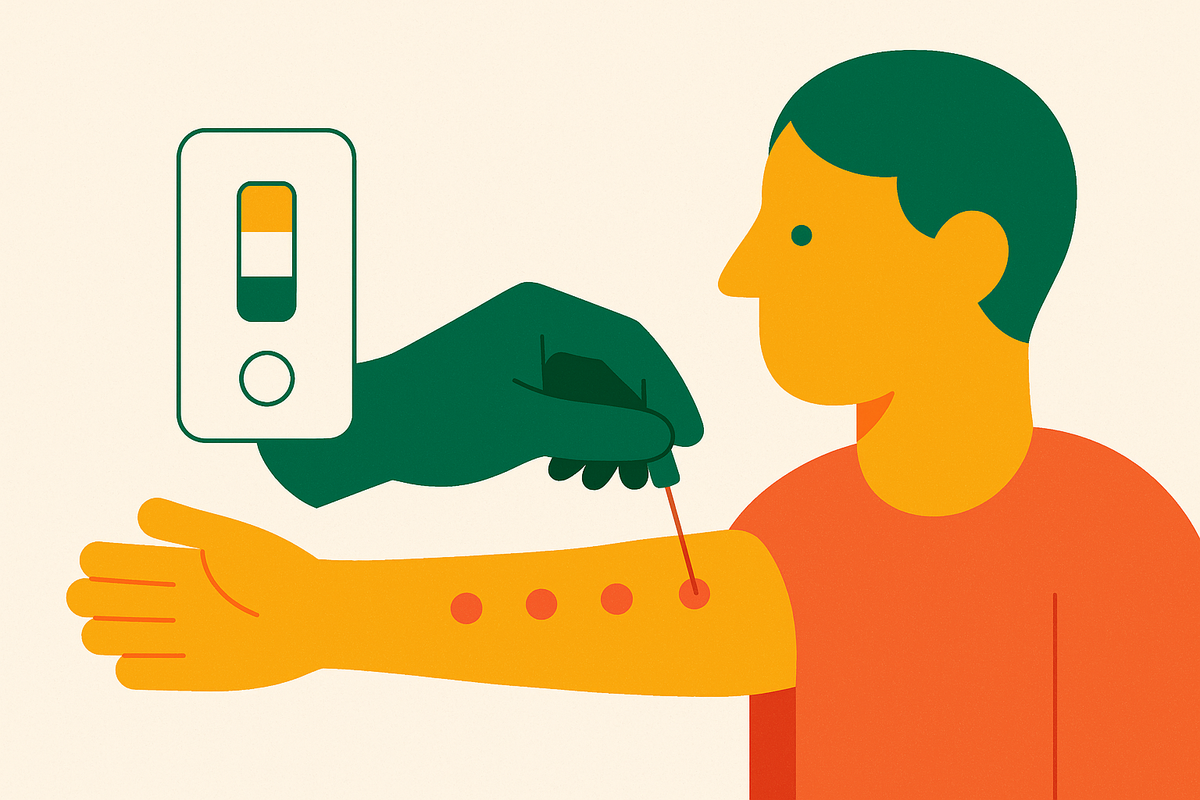
at-home allergy testing services that offer sublingual immunotherapy
These services retrain your immune system to tolerate allergens rather than just blocking symptoms.

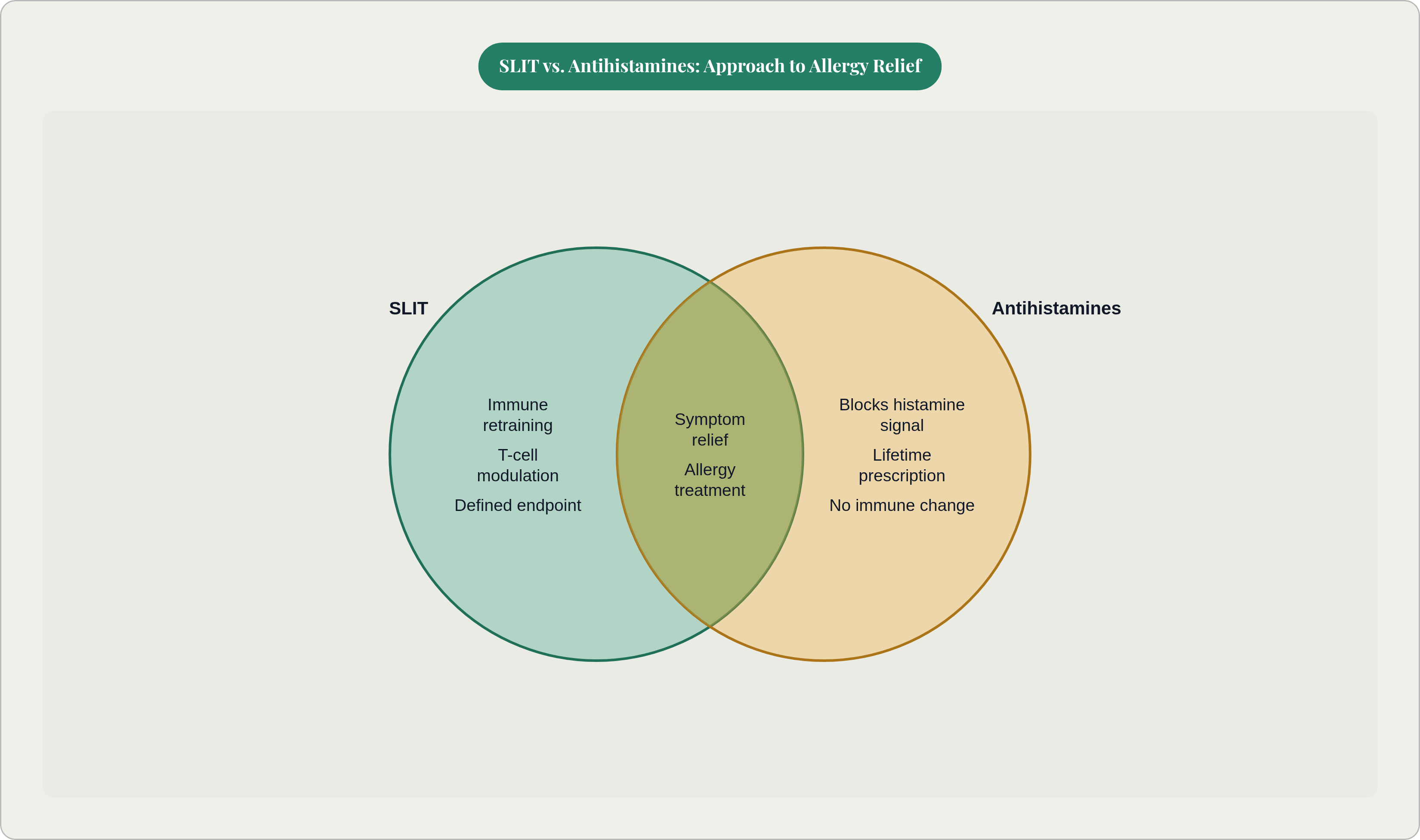
SLIT retrains the immune system rather than suppressing symptoms. Antihistamines block the histamine signal after your immune system fires; SLIT works upstream, at the level of T-cells and antibody production, to change how your body responds to an allergen in the first place.
Four services currently offer at-home allergy testing paired with sublingual immunotherapy drops shipped to your home: Wyndly, Nectar, Curex, and Picnic. Each runs a finger-prick blood test collected at home, sends the sample to a certified lab for physician-reviewed results, and compounds a custom multi-allergen SLIT formulation mailed directly to the patient. Wyndly publishes its pricing openly: initial consultation at $49 and treatment plans starting at $99 per month, FSA/HSA eligible.
To understand why this works, we have to look at what happens under the tongue. When you place a drop there, the allergen dissolves through the mucous membrane and enters your bloodstream. Your immune system encounters it repeatedly, at low and carefully controlled doses, over months and years. The Journal of Allergy and Clinical Immunology: In Practice documented the molecular cascade in April 2024: protective IgG antibody production increases, IgE antibodies (the ones triggering your symptoms) get suppressed, and regulatory T-cells upregulate. The immune system, in effect, learns to stand down.
The allergens SLIT addresses well include grass, tree, and weed pollen; house dust mites; animal dander; and certain mold spores. These cover the most common environmental triggers in the U.S., per PubMed data through April 2025. Many patients notice meaningful improvement within four to twenty-four weeks of starting, though durable relief generally requires around three years of consistent therapy.
That last point is the one most allergy sufferers have never encountered: a course of treatment with an actual endpoint, rather than a lifetime prescription.
How At-Home Allergy Testing Fits Into the Process (and What It Can and Cannot Tell You)
The standard at-home format is a finger-prick blood test, collected at home and mailed to a certified lab. It measures your IgE antibody response to a panel of environmental allergens, the same biological marker used in clinical allergy workups. Results identify which allergens your immune system is reacting to and at what sensitivity level.
Here is the honest limit of that data. A blood IgE test identifies sensitization, and sensitization does not equal clinical allergy. You can be sensitized to an allergen and have minimal symptoms; you can also have significant symptoms driven by an allergen your panel flags at only a modest level. Physician interpretation is what turns a test result into a treatment plan. Without it, the numbers are just a list.
Panel design matters more than most people realize. A generic national list serves someone in the Pacific Northwest very differently than it serves someone in the Midwest during ragweed season. A well-designed panel covers regionally relevant tree, grass, and weed pollens alongside dust mites, pet dander, and mold spores. The allergens identified in testing are what get formulated into your treatment, so poor panel design produces a less precise formulation downstream.
The physician review step is what converts raw test output into a real clinical picture, including ruling out contraindications before anything gets prescribed.
Which Providers Offer At-Home Allergy Testing Paired With Sublingual Immunotherapy Drops Shipped to Your Home?
Services that do this well run you through a structured sequence. A virtual consultation with a licensed clinician reviews your symptom history, rules out contraindications, and confirms candidacy before anything else moves. Then an at-home test kit arrives by mail: finger-prick sample, return envelope, no clinic required.
Physician-reviewed results follow. A clinical interpretation maps your sensitization profile to a personalized allergen picture, going well beyond a PDF of numbers with a reference range. From there, a custom formulation gets compounded around your specific allergens. Multi-allergen drops treat several triggers simultaneously, which matters for anyone reacting to more than one thing, and that is most people.
Treatment arrives at your door and you take it daily under the tongue. No injection, no weekly office visit. Ongoing physician oversight runs across the full multi-year course, not just at intake.
Wyndly offers a useful pricing reference for this model: initial consultation at $49, treatment plans starting at $99 per month, FSA/HSA eligible. Services that publish their numbers give you something concrete to compare against.
But what if the testing and treatment live under different roofs? A service that only tests and hands off treatment loses clinical continuity. A service offering SLIT without its own testing infrastructure builds your formulation on incomplete information. The integration between testing and treatment is not a convenience feature; it is a clinical requirement.
What the Clinical Evidence Says About SLIT's Effectiveness (and What the Real-World Data Adds)
The American Academy of Otolaryngology–Head and Neck Surgery Foundation issued a strong recommendation for immunotherapy in allergic rhinitis patients with inadequate symptom control in its 2024 clinical practice guidelines. That is guideline-level endorsement from a major specialty body.
A 2025 Springer review of systematic reviews and meta-analyses, drawing on PubMed, Embase, Cochrane Library, and Web of Science through June 2025, affirmed SLIT efficacy for allergic rhinitis. A Phase III trial for an SQ tree SLIT tablet found it effective and well-tolerated in children, which addresses one of the more common questions I hear from parents.
The durability data is where things get genuinely interesting. A retrospective study published in April 2025 on ScienceDirect enrolled 103 children: 55 treated with a three-year SLIT course, 48 receiving only symptomatic drug therapy. The SLIT group showed significant reduction in Total Nasal Symptom Score sustained across the entire study period, including two years after treatment ended. The symptomatic drug group saw less pronounced improvement and noticeable symptom rebound after 2022. SLIT produces immune changes that outlast the treatment itself, something antihistamines cannot claim.
It is also worth considering what the data leaves unresolved. Most large studies ran in clinical, in-person settings. Real-world telehealth-delivered SLIT outcomes at scale are still accumulating, building on a solid biological and guideline foundation rather than starting from scratch. That gap is narrowing, but it exists.
Why Untreated Allergies Cost More Than People Realize (in Health and Dollars)
Most people think of allergies as sneezing and watery eyes. The actual burden runs deeper, and most sufferers never connect the dots.
Three physiological pathways link untreated allergic rhinitis to cognitive impairment. Histamine disrupts neurotransmitter balance. Chronic nasal congestion reduces cerebral oxygen delivery (the brain consumes roughly 20% of the body's oxygen at rest), and sleep fragmentation from nighttime symptoms compounds both. Sleep Foundation data from 2021 documents more frequent nighttime awakenings and reduced deep sleep in individuals with untreated allergic rhinitis; deep sleep is the stage that supports memory consolidation and mental recovery. Persistent, uncontrolled allergic disease also associates with depressive symptoms over time.
The financial picture is similarly underappreciated. Patients cycling through antihistamines and nasal sprays year after year accumulate out-of-pocket spend with no finish line. A defined SLIT course has an endpoint. Many sufferers attribute brain fog, fatigue, and poor sleep to stress or aging, which means they never pursue a root-cause path, and the costs, both physical and financial, keep compounding quietly.
How Telehealth SLIT Compares to Allergy Shots (and Where Each Fits)
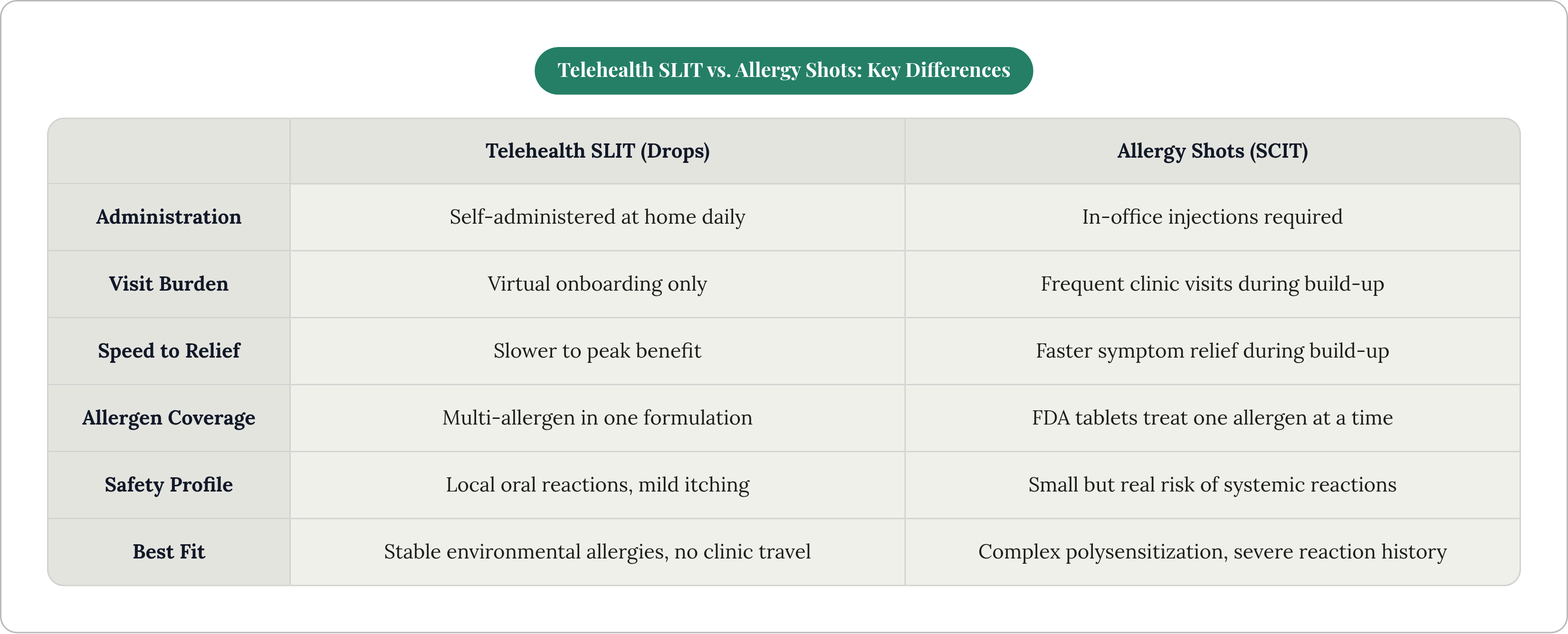
Research reviews and meta-analyses consistently find comparable overall effectiveness between subcutaneous immunotherapy (shots) and SLIT for allergic rhinitis and allergy-related asthma. Both produce the same core immune changes through different routes.
The practical differences are real. Shots require frequent in-office visits, particularly during build-up, and must be administered in a medical setting because of a small but genuine risk of systemic reactions. SLIT is self-administered daily at home after physician onboarding. Shots produce symptom relief somewhat faster during build-up; drops are slower to peak but reach comparable benefit over a full course.
Allergen coverage is a meaningful variable here. Multi-allergen drops can address several triggers in a single formulation, whereas FDA-approved single-allergen SLIT tablets treat one allergen at a time. For polysensitized patients, the physician has to weigh which format fits the clinical picture. SLIT carries a more favorable systemic safety profile overall, with local oral reactions and mild itching under the tongue as the most common side effects.
On insurance: shots are typically covered, and telehealth SLIT coverage varies by plan, so verifying your specific benefits before committing is worth the call, though FSA/HSA eligibility applies to SLIT broadly. Per Too Allergic's 2026 provider review, telehealth SLIT fits patients with stable environmental allergies who want physician-guided care without clinic travel. In-clinic subcutaneous immunotherapy is the right call for patients with complex polysensitization, uncontrolled asthma, or a history of severe reactions.
What to Look for When Evaluating a Service That Offers Both Testing and SLIT
The category is growing, and quality varies considerably. A few things actually matter:
- Physician oversight at every stage. Testing interpretation, formulation, and ongoing monitoring should all involve a licensed, board-certified physician. An algorithm alone does not constitute clinical care.
- Testing panel quality. The allergen panel should reflect your geographic region and living situation. Dust mites, local pollens, pet dander, and mold all need coverage; a one-size-fits-all national list leaves gaps that show up in your formulation.
- Personalized formulation. Treatment built around your specific test results is the whole point. A standard-strength product handed to everyone lacks the precision that immunotherapy requires.
- Drop versus tablet options. Services that give physicians access to both multi-allergen drops and FDA-approved single-allergen tablets have more tools to match treatment to patient profile, and that flexibility matters most for polysensitized patients.
- Transparent, predictable pricing. Clearly stated per-month costs, FSA/HSA eligibility, and no hidden fees. Wyndly's published model ($49 consult, plans from $99/month) gives you a concrete benchmark.
- Continuity of care. The same service should carry you from testing through the full multi-year course, with check-ins built in. A handoff to a third party after diagnosis breaks what makes this model work.
What separates services that produce outcomes from ones that produce data PDFs is whether testing and treatment live under the same physician-guided system. Split that chain anywhere. Between testing and interpretation, between results and formulation, between onboarding and follow-up, and you lose the continuity the model depends on.