Mouth Breathing from Nasal Congestion and Its Health Consequences
Blocked nasal passages force mouth breathing, with cascading health costs.
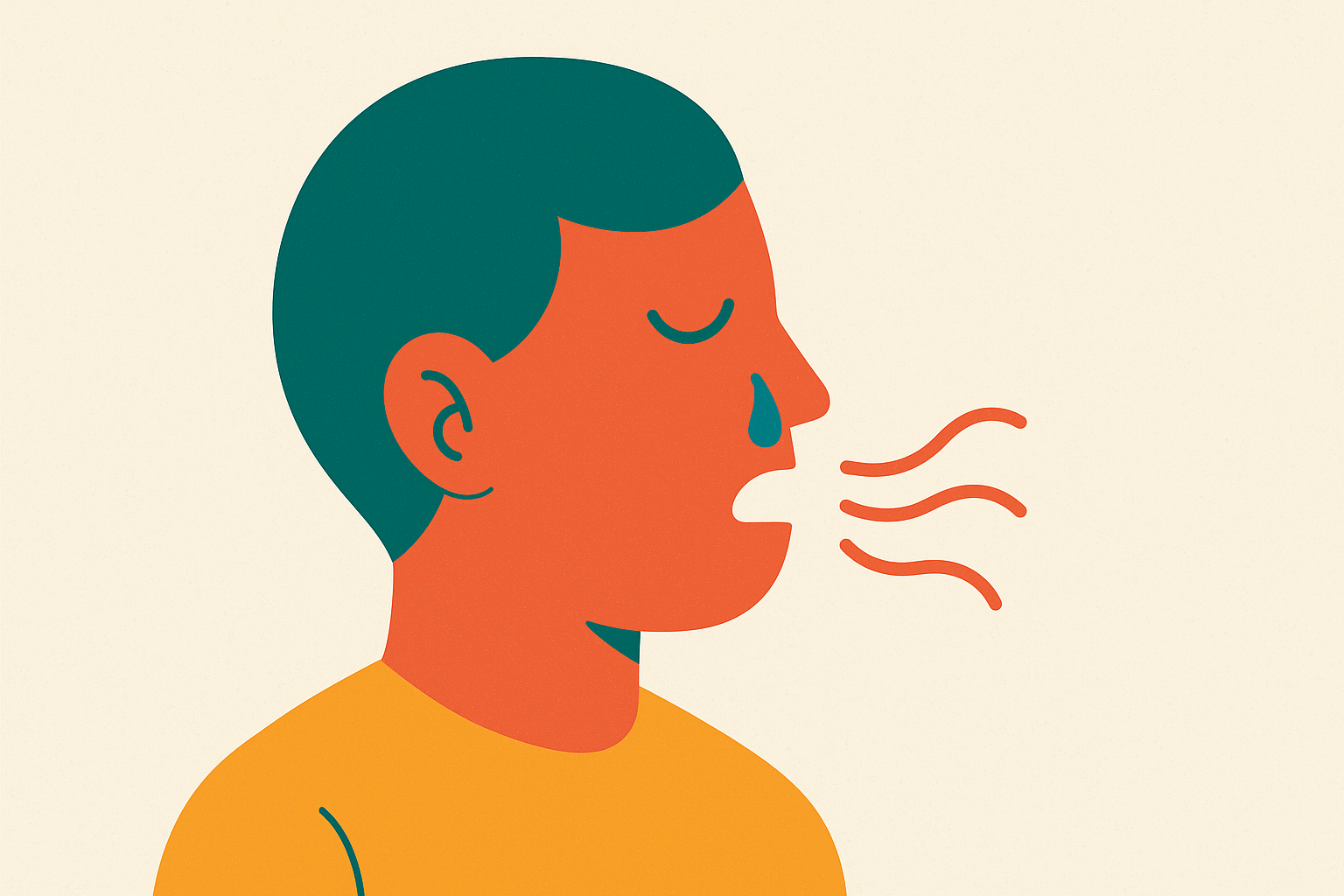
The nose filters, warms, and humidifies every breath before it reaches the lungs, and it produces nitric oxide, a molecule that plays a role in how the body processes oxygen. Mouth breathing skips all of that. Most people who default to it aren't dealing with a habit at all. They're dealing with a blocked nose that left them no other option, and treating it like a behavior problem is exactly why it never gets fixed.
Chronic mouth breathing isn't a habit, it's what the body does when the nose stops working
Ask someone why they breathe through their mouth and the answer is usually a shrug, as if it were a tic they picked up somewhere. But the body doesn't switch airways for no reason. Mouth breathing shows up when nasal airflow gets cut off: chronic sinusitis, allergic swelling and mucus buildup, a deviated septum, enlarged turbinates, nasal polyps, swollen adenoids and tonsils. Allergies, colds, and chronic sinusitis are among the most common reasons a nose stops doing its job.
And once the mouth takes over as the main airway, it tends to stay that way. Muscles adjust, breathing mechanics shift, and the longer it runs unchecked, the harder it gets to reverse. Calling this a habit lets everyone off the hook, the person doing it and the people around them who could have flagged it years earlier.
None of this applies to mouth breathing during a hard run or a bad cold. That's normal, temporary, expected. The real concern is when it becomes the default, night after night, with no obvious trigger in sight. This isn't rare, either: estimates put the share of children who mouth breathe somewhere between 10% and 25%. In a class of 25 kids, that's several breathing through an open mouth every single night, and probably not one of them has been checked for why.
How allergens cause the congestion that forces the airway switch
Environmental allergies affect more than 50 million Americans every year, making them one of the most common chronic conditions in the country. The mechanism is simple: the immune system overreacts to something harmless, and that overreaction shows up as swelling and mucus production inside the nasal passages. The swelling isn't a side effect of the allergy. It is the blockage itself.
Research into indoor allergens points to the same recurring triggers behind the kind of congestion that never seems to lift. Dust mites thrive at 68 to 77°F and 70 to 80% humidity, which describes most bedrooms, and they live in mattresses, carpets, and upholstered furniture. Mold grows in basements, kitchens, bathrooms, and gardens, and its spores trigger allergic rhinitis the moment they're inhaled. Cat dander, the Fel d 1 protein, stays airborne for 15 to 35 minutes after something disturbs it, a blanket, a cushion, a door closing, so exposure keeps going long after the cat has left the room. Dog dander, mouse allergen, and cockroach allergen round out the list, and cockroach allergen alone turns up in roughly 68% of households studied, more in cities.
Seasonal pollen, grass, trees, weeds, comes and goes. Indoor allergens don't take a season off, and that's the real distinction worth sitting with. Someone sleeping on a mattress full of dust mites, or sharing a house with a cat, gets re-exposed to the trigger every night without fail. The inflammation never settles. So the airway never does either.
What the body gives up when mouth breathing becomes the nightly norm
The symptom list starts small: dry mouth, bad breath, snoring, congestion that won't clear no matter how hard it's blown, sore throats that keep coming back, drooling during sleep. Fairly minor on their own.
But strip away nasal filtration, and the air hitting the lungs is unscreened, dry, and cold, a combination that raises the odds of respiratory infection and inflammation. A 2024 to 2025 review by Bayrak, Polastri, and Pehlivan in Thoracic Research and Practice ties oral breathing to headache, poor head positioning, fatigue, drowsiness, nighttime shortness of breath, and open-mouth sleep. Lung function tends to run lower when air skips the nose's warming and humidifying step entirely.
Snoring gets treated as a punchline, but it's usually just the audible version of this same mechanism, and it deserves more attention than it gets. Mouth breathing changes the physics of airflow enough that, in more serious cases, it contributes to airway collapse during sleep, the mechanism behind obstructive sleep apnea. That's a meaningfully bigger problem than a noisy bedroom.
Kids carry a risk adults don't. Years of mouth breathing during the growth years can reshape the face: clinicians describe it as a pattern of elongated facial growth with abnormal jaw and dental development. Dry mouth cuts down on saliva, which raises the risk of malocclusion, gum disease, and cavities. Cleveland Clinic notes research suggesting airway problems in children may interfere with the pituitary gland's release of growth hormone, touching physical development more broadly. Sleep-disordered breathing tied to chronic mouth breathing shows up behaviorally too: irritability, restlessness, symptoms that look a lot like ADHD but trace back to a blocked nose instead. That's worth pausing on. How many kids get a stimulant prescription when what they actually need is a look inside their nose?
The three biological pathways from nasal congestion to brain fog
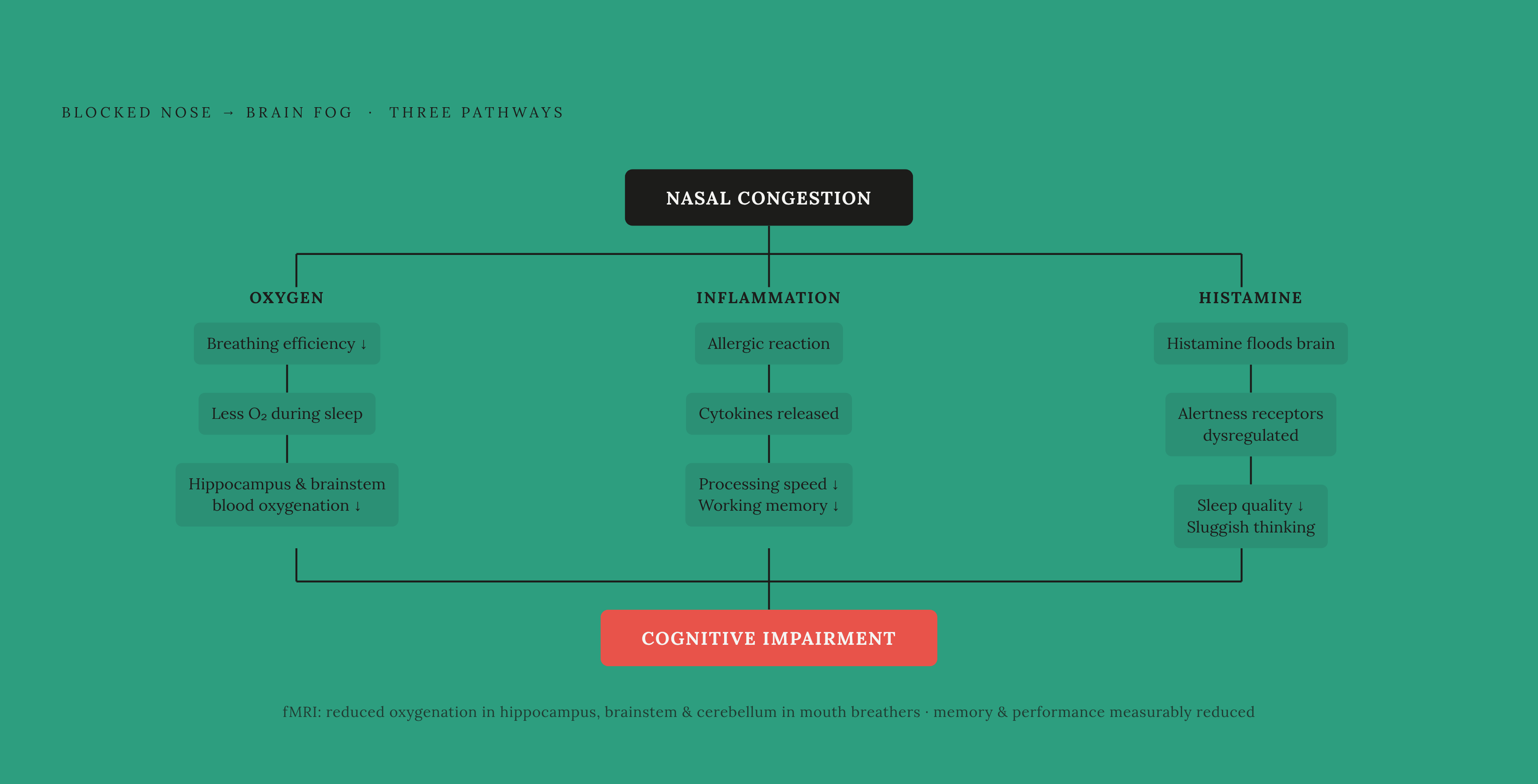
Why does a stuffy nose leave someone foggy at their desk the next day? Three separate mechanisms are doing the damage, and naming them matters, because most people blame stress or a bad night's sleep, never the allergy sitting untreated in their sinuses.
Pathway one is oxygen. Congestion cuts breathing efficiency, and lying flat at night makes it worse, so less oxygen reaches the brain during the exact hours it needs oxygen most, for repair and recovery.
Pathway two is inflammation crossing into the brain itself. Allergic reactions release cytokines that interfere with normal signaling in the brain. The documented result includes slower processing speed, weaker working memory, and trouble with executive function, the mental work behind planning, focus, and decision-making.
Pathway three is histamine throwing off neurotransmitter balance. Histamine receptors in the brain help regulate alertness, sleep, and cognitive processing. Flood the system with histamine during an allergic reaction, and those receptors get overstimulated, and the balance tips toward sluggish thinking.
The Bayrak review also cites an fMRI study finding that people who breathe through their mouths show reduced blood oxygenation in the hippocampus, brainstem, and cerebellum, alongside measurable drops in memory and cognitive performance. Children who mouth breathe have also shown lower academic performance than nasal breathers, which raises an uncomfortable question for any parent chalking up a kid's slipping grades to attitude or effort.
Sleep quality sits underneath all three pathways, and it makes each one worse. Poor sleep is one of the most consistent drivers of brain fog during allergy season, and disrupted sleep interferes with memory consolidation, the process that turns short-term memory into long-term memory. The person blanking on a name they should know, or struggling to think straight by 2 p.m., may never trace it back to a nose that was blocked at 3 a.m.
Why symptom-masking medications leave the airway problem, and everything downstream of it, exactly where it was
Walk into a pharmacy for allergy relief and every option on the shelf is built to handle the symptom, not the trigger. That's worth sitting with, because it explains why so many people cycle through the same medications for years while the underlying problem never moves an inch.
Oral antihistamines cut down on sneezing and itching but are labeled to cause drowsiness and impaired judgment, which means they can add to the very brain fog the congestion is already causing. That's the wrong trade for anyone taking one before work. Antihistamine nasal sprays, azelastine among them, ease sneezing and a runny nose but come with a bitter taste and grogginess that can linger into the next morning. Grogginess from azelastine can linger well into the next day, a notable drawback for something meant to help you function.
Intranasal corticosteroids outperform oral antihistamines at bringing down nasal inflammation. But documented side effects include irritation of the nasal lining, nosebleeds, headaches, and, rarely, effects on the eyes. Long-term use is linked to drying, cracking, and bleeding inside the nose, which is a rough price to pay for a medication taken daily for years.
Decongestant sprays are the worst offender here, because they set a trap most people don't see coming: rebound congestion. Each use narrows blood vessels in the nose, and once the medication wears off, the tissue swells back worse than before. That builds a cycle where the spray becomes something leaned on more and more, just to get back to baseline, not ahead of it.
None of these treat what's causing the problem. They mask symptoms for a few hours, and the nasal passage swells shut again as soon as the dose fades. Each night that happens, the whole chain runs again: mouth breathing, broken sleep, lower oxygen, cytokine release, a foggy morning. On repeat, for years, without anyone questioning why the same bottle keeps showing up on the same nightstand.
Treating the cause instead of managing the obstruction, over and over, forever
A nasal spray opens a blocked airway for a few hours. It does nothing to explain, or change, why that airway keeps blocking in the first place. That's the line between symptom control and actually treating the condition, and most allergy care never crosses it.
Sublingual immunotherapy, SLIT, works differently. It exposes the immune system to small, controlled amounts of an allergen over time, gradually dialing down the hypersensitivity that causes the nasal swelling to begin with. SLIT comes as an FDA-approved tablet, and also as physician-formulated drops taken under the tongue. Both are taken daily, at home, with no injections and no weekly clinic visits.
Because SLIT works on the immune mechanism driving the congestion, the downstream effects, chronic mouth breathing, broken sleep, morning brain fog, get addressed at the source instead of chased one at a time with a different bottle for each symptom. Telehealth has made this more reachable too: at-home finger-prick allergy testing, a virtual consult, a treatment plan mailed to the door, none of the friction of in-person allergy testing that keeps so many people stuck refilling the same over-the-counter medications year after year. Costs for these programs can start around $99 a month, with an initial consult near $49.99, both FSA and HSA eligible. Set that against years of spending on sprays and pills that never once touched the actual cause, and the math isn't close.
So if the list sounds familiar, a blocked nose, restless sleep, grogginess that won't lift, a mind that won't quite focus, those aren't four separate problems. They're one problem, showing up four different ways. A habit is something a person chooses and can talk themselves out of. A root cause doesn't work that way. It has to be treated, or it stays exactly where it is.