Pollen Allergy Symptoms That Appear on Skin
Hives, rashes, and eczema flares can all stem from pollen exposure on skin.
Pollen doesn't just clog sinuses and set off sneezing fits. It shows up on skin too, in forms that range from a faint facial flush to full-blown hives, and the mechanism is the same immune cascade that causes the sneezing in the first place. Once pollen lands on skin, or drifts in through an open window on a high-count day, the immune system in sensitized people reads it as a threat and dumps histamine into the tissue. That histamine causes the itching, redness, and swelling, whether it's in the nasal passages or on the back of a hand.
Most people miss that skin doesn't need heavy, direct contact to react. Standing near an open window, touching your face after time outdoors, brushing against grass: any of that is enough. Roughly 50 million Americans deal with seasonal allergies each year, and skin symptoms are a real, if under-recognized, slice of that group. Pollen comes in waves: tree pollen (birch, oak, ash, cedar, juniper) dominates spring, grasses (rye, Timothy, Bermuda, bluegrass) take over late spring into summer, and weeds (ragweed, mugwort, pigweed) close things out into fall. More exposure days across a long season means more chances for skin to react, plain and simple.
Contact dermatitis from pollen: what it looks like and why it appears where it does
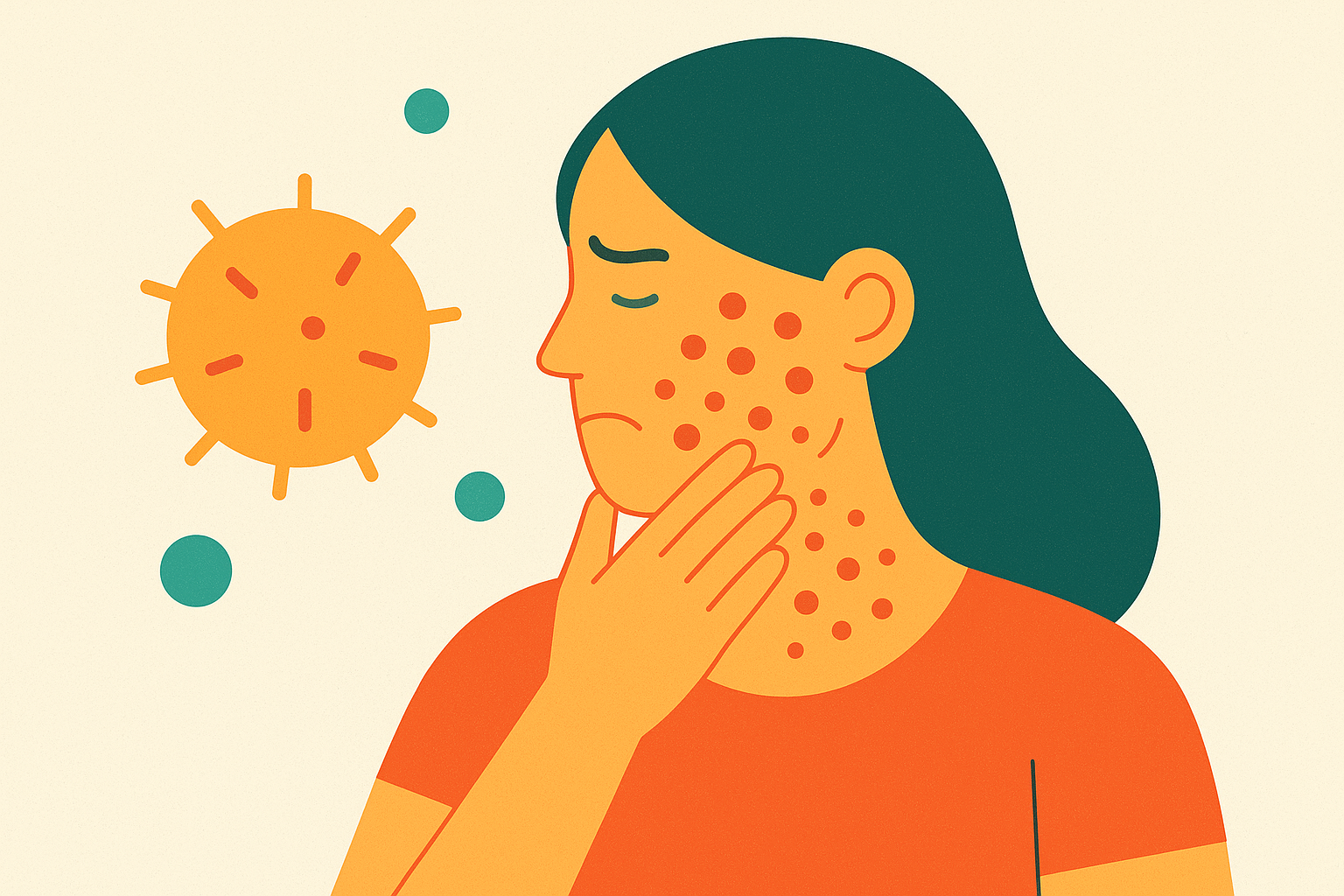
Pollen contact dermatitis, sometimes called allergic contact dermatitis or airborne contact dermatitis, happens when pollen lands directly on exposed skin and sets off a localized immune response. Redness, swelling, itching, sometimes blistering, plus bumps, scaly patches, or a burning feeling that lingers.
Where it shows up isn't random. The face, neck, and forearms are the parts left uncovered during a walk, a bike ride, an afternoon of yard work. Cover that skin and the pattern shifts with it.
Timing, worth paying closest attention to, is what actually trips people up. The reaction is often delayed, sometimes 24 hours, sometimes up to a few days after exposure. A rash appearing midweek might trace back to weekend time outdoors, and most people never make that connection. They blame the new detergent, or the sunscreen, or nothing at all, when the real trigger is sitting three or four days back on the calendar.
Worth separating this from irritant contact dermatitis, which is just physical irritation, skin getting rubbed raw. Allergic contact dermatitis involves a T-cell-mediated immune response, a genuine allergic mechanism working underneath. A variant called photoallergic contact dermatitis also shows up, where pollen or chemicals sitting on skin react with UV light. Worth knowing if you're layering sunscreen or fragrance before heading outside during peak pollen weeks, since the combination itself can be the trigger, not either ingredient alone.
A few things make skin more likely to react in the first place:
- Past exposure to poison ivy, oak, or sumac, since urushiol sensitizes the skin barrier
- Nickel allergy from jewelry or eyeglass frames, which can prime the same patch of skin to react when pollen lands there
- Latex sensitivity, which can prime the skin to react
- Clothing that traps pollen against skin for hours, with fabric dyes adding a second irritant on top
- Preservatives in cosmetics that lower skin's threshold before pollen ever gets involved
Location, timing, texture: those are the three clues. A rash on exposed skin, showing up a day or two after time outdoors during pollen season, points to contact dermatitis more reliably than anything else in the differential.
Hives from pollen: rapid onset, shifting welts, and when they become a warning sign
Hives, or urticaria, look different from contact dermatitis and behave differently too. Raised, red welts, intensely itchy, and they blanch, turn white, when you press on them.
Speed is the tell. Hives can show up within minutes of exposure, not hours or days like contact dermatitis. And they don't stay put: they can appear anywhere, face, chest, back, arms, legs, regardless of where the pollen actually touched skin, because the histamine release is systemic rather than local. Welts shift, merge, grow, then usually fade within a few hours to a few days.
Acute urticaria lasts up to six weeks. Chronic urticaria goes beyond that. Pollen-triggered hives are almost always the acute kind, tied to a season rather than dragging on indefinitely, and that distinction matters when deciding how urgently to chase a cause.
Rarely, hives show up alongside something more serious, such as coughing, shortness of breath, a throat that feels tight, or a swollen tongue. That combination isn't a wait-and-see situation. It signals a systemic reaction and needs immediate medical attention, full stop.
Angioedema often rides along with hives but deserves its own mention. It's swelling below the skin's surface, especially around the eyes and mouth, sometimes with stomach cramping or trouble breathing. Symptoms can last minutes or stretch into days.
One pattern is worth flagging here: hives that show up every spring, or every fall, on something close to a schedule. That regularity is itself a diagnostic clue, and treating each flare as its own isolated, unrelated event misses the point entirely. It's worth chasing down formally instead.
Eczema flares during pollen season: why a compromised skin barrier changes the equation
Eczema, or atopic dermatitis, affects around 15% of children, roughly double the rate recorded in 1997. An estimated 16.5 million adults live with it too, about 7.3% of the adult population, and nearly 40% of those adults deal with moderate to severe disease, according to the American College of Allergy, Asthma & Immunology (ACAAI).
Why does pollen season hit eczema sufferers harder? A compromised skin barrier lets airborne allergens penetrate without any direct contact at all. The vulnerability sits right there, in the barrier itself. Pollen doesn't need to land and sit. It just needs a gap to slip through, and eczema-prone skin is full of gaps.
Eczema and seasonal allergic rhinitis share underlying immune pathways, which is why the two conditions travel together so often. Pollen can trigger both at once in the same person. That's why someone's nose and skin can act up on the exact same afternoon, from the exact same walk outside.
Baseline eczema looks like dry, sensitive, red, itchy patches that tend to appear on exposed and flexural areas of the body. A flare turns that up: itching intensifies, skin cracks and sometimes oozes clear or yellowish fluid, and thickened patches can take days to weeks to calm back down.
The giveaway is seasonality. Flares that reliably worsen in spring point to tree pollen. Summer flares point to grass. Late summer and fall point to weed pollen, ragweed especially. Plenty of eczema sufferers blame soap, or detergent, or fabric alone, and never clock pollen as the seasonal driver sitting underneath. That's a mistake, and a common one. Missing that piece changes how the whole condition gets managed, because a person ends up swapping products instead of addressing the actual trigger.
Facial rashes and generalized skin hypersensitivity: the subtler presentations that don't fit a named diagnosis
Not every pollen-driven skin reaction fits neatly into "hives" or "eczema flare." Facial redness and irritation during allergy season is its own category, and it's distressing precisely because it's on display, front and center, for anyone to see. It's no less a real allergic response just because it lacks a textbook welt or a scaly patch.
Then there's generalized skin hypersensitivity: no specific rash at all, just skin that feels tight, reactive, easily irritated for weeks on end. That's a systemic histamine effect working across the whole body rather than a localized reaction at one contact point.
On the more severe end sit blistering and visible skin color changes. Less common, but worth naming anyway, since someone experiencing either one deserves to recognize it as allergy-related instead of assuming something else entirely is wrong.
Why do these subtler cases go unattributed so often? A few reasons stack up. There's no obvious rash pattern to point to and name. Symptoms track pollen counts day to day rather than sitting still as a fixed, describable rash. And plenty of sufferers just treat the surface, moisturizer here, cortisone there, without ever tracing the problem back to the pollen driving it underneath.
There's a social cost buried in this too. A visible facial rash during peak season carries real psychological weight, and that alone is reason enough to chase an actual diagnosis instead of just waiting out the weeks until counts drop.
Why skin symptoms and respiratory symptoms track together, and what that means for diagnosis
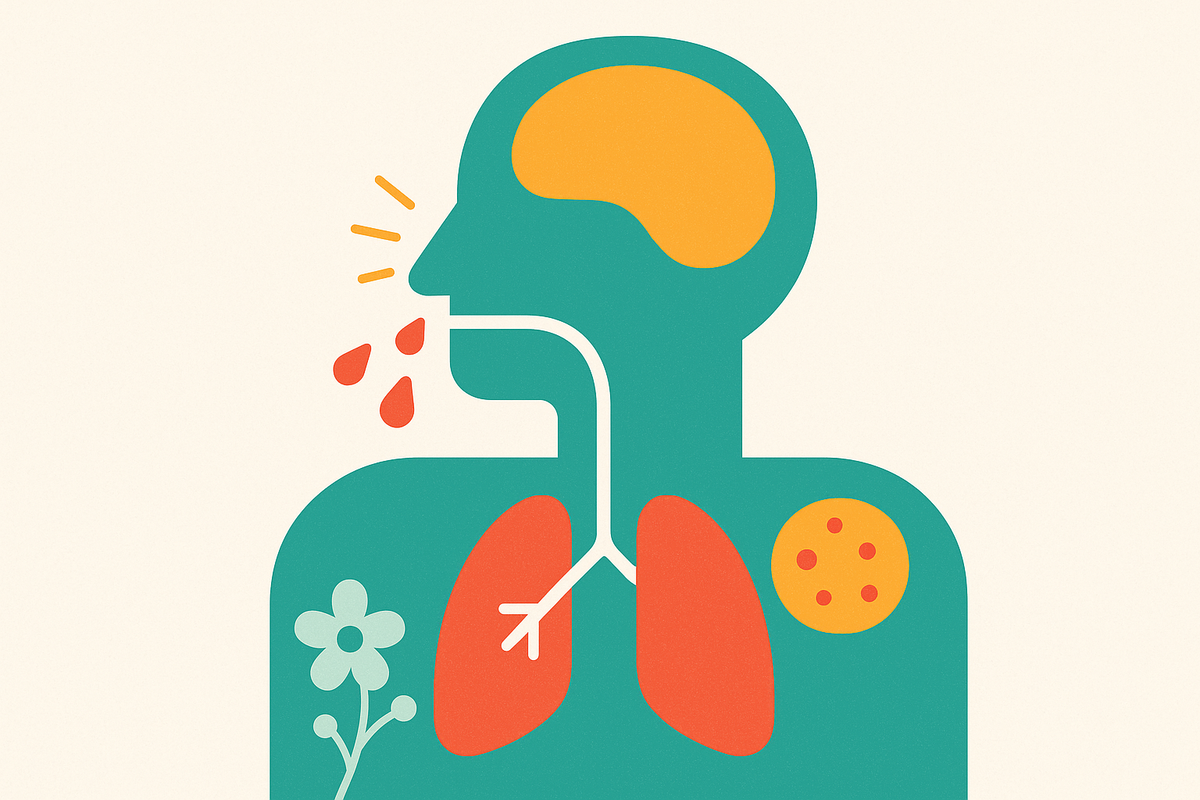
Sneezing and a skin rash might look like two separate problems. They're not: both come from the same IgE-mediated immune response, the same histamine release, just showing up in different organs. One system, multiple expressions.
That's also why eczema, allergic rhinitis, and asthma cluster in the same people so often. They share an atopic, immune-overreactive foundation underneath. Skin and respiratory symptoms during pollen season are frequently the same underlying diagnosis, just wearing different clothes depending on which tissue happens to react.
Which raises a useful question: if the timing of a skin symptom lines up with a specific pollen calendar, does that timing carry diagnostic weight on its own, even without a lab test? It does, and it shouldn't be dismissed just because there's no test result yet. Flares that track reliably with a particular part of the pollen calendar point toward sensitization to the pollens dominant in that window. Grass pollen follows in late spring, and weed pollen, ragweed especially, comes later in the season. A rash that follows this calendar year after year is worth investigating formally, whether or not a skin prick test has confirmed anything yet.
Allergy testing, whether a skin prick test in an office or an at-home finger-prick blood test, identifies exactly which allergens are driving the reaction. The diagnosis carries weight beyond formality. Knowing whether birch, ryegrass, or ragweed is the actual trigger changes what treatment can realistically address, because treating "pollen allergy" in the abstract doesn't point anyone toward the right immunotherapy formula.
A retrospective study covering 1,711 outpatients between 2017 and 2020 found grass reactivity at 60.5%, rye at 57.22%, birch at 47.34%, and alder at 42.5%. Multiple overlapping sensitizations are the norm, not the exception. That overlap is exactly why symptoms stretch across a long season instead of spiking once and disappearing: different pollens hand off to each other as the calendar turns, and a person sensitized to several keeps reacting the whole way through, tree pollen fading into grass fading into ragweed.
Skin reactions that recur reliably during pollen season aren't a random dermatology problem showing up on its own schedule. They're a solid argument for getting tested, not for reaching for a new moisturizer.
What symptom management with antihistamines and topical treatments actually does, and doesn't do, for pollen skin reactions
Antihistamines block histamine receptors, which cuts down itch, welt size, and redness. For acute hives and flare-related itching, that's genuinely useful, and it works fast.
Second-generation antihistamines, loratadine, fexofenadine, cetirizine, levocetirizine, beat the older options for hives, and it isn't a close call. Their non-sedating profile matters when someone's taking a pill daily through a three-month pollen season and still needs to drive, work, and think clearly.
First-generation antihistamines like diphenhydramine bring sedation, confusion, dizziness, and impaired concentration as documented side effects, and those risks land harder in older patients. There's little reason to reach for it as a default anymore, and prescribing habits that still lean on it are worth questioning.
On the topical side: hydrocortisone cream handles temporary itch relief, prescription topical steroids target localized eczema patches, and oral steroids come into play for large or severe flares, typically a 5 to 14 day course.
Here's the part most people get backwards: none of these treatments touch the immune system's underlying sensitization to pollen. The same trigger produces the same response next season, and the one after that. Antihistamines taken mid-flare suppress a symptom in real time; they don't interrupt the allergic process that caused it. Topical steroids calm local inflammation while the systemic allergic response sits untouched underneath, waiting for next April.
That's the masking problem in practice. Someone who treats spring eczema flares with topical steroids every year, never getting tested, never addressing the pollen allergy driving it, runs the identical cycle on repeat, season after season, with no exit built in.
A few practical basics help in the meantime, though none of them fix the underlying issue. Avoid scratching, since it opens the door to infection and makes irritation worse. Cool water washes plus immediate moisturizing calm eczema-prone skin. Minimizing sun exposure on already-irritated skin matters too, given how UV light can worsen photoallergic reactions. New clothing is worth washing before the first wear, since fabric finishes and dyes can act as a second trigger layered on top of pollen.
There's a line for when self-management stops being enough: hives persisting beyond a few weeks, eczema that doesn't respond after several weeks of over-the-counter treatment, or any systemic symptom at all. Those call for a professional evaluation, not another round of the same cream.
Treating the underlying pollen allergy: how immunotherapy addresses skin symptoms at the source
Immunotherapy works on a different target entirely. Instead of blocking histamine after it's already released, it goes after the sensitization itself, the IgE-mediated response that makes pollen a threat to the immune system in the first place. Repeated, controlled exposure to the allergen trains regulatory T cells and gradually shifts the immune system away from reacting at all.
Research published in JACI In Practice in June 2024 documented the immunological shifts behind that process: production of protective IgG antibodies, suppression of IgE antibodies, and an increase in regulatory T cells. That's a mechanistic change happening under the hood, not a symptom cover-up applied on top.
Two forms exist, and picking between them comes down to more than raw efficacy numbers. Subcutaneous immunotherapy, SCIT, allergy shots, gets injected in a medical office. It has the longer track record and tends to bring faster relief during the initial build-up phase, though it requires ongoing clinic visits, a real practical barrier for anyone juggling a work schedule around appointment slots. There's also a reason administration happens in a clinical setting rather than at home, which is exactly why administration happens in-office under clinical supervision.
Sublingual immunotherapy, SLIT, takes a different path: drops or tablets under the tongue at home, no clinic visits once the initial setup is done. Clinical efficacy for allergic rhinitis runs comparable to SCIT, and a systematic literature review found it substantially free from serious systemic reactions. Among FDA-approved SLIT tablets, Oralair covers five grass pollens: Sweet Vernal, Orchard, Perennial Rye, Timothy, and Kentucky Blue Grass.
For most people weighing the two, SLIT is the more realistic long-term bet, precisely because it doesn't demand a recurring clinic visit for three to five years straight. Efficacy runs close enough between the two that adherence becomes the deciding factor, and adherence is where SCIT loses people to missed appointments and scheduling fatigue. Either path addresses something antihistamines and topical steroids can't touch: the sensitization itself. That's the difference between managing a flare every April and not having one to manage at all.