At-Home Allergy Blood Test Accuracy vs. Skin Prick Test
Blood tests and skin prick tests measure the same immune response with comparable accuracy.
Both skin prick tests and clinical blood tests are reading the same biological story from different angles. That is the one thing worth establishing before anything else.
Both are measuring your immune system's IgE-antibody response to specific allergens. IgE is the antibody class involved in classic allergic reactions. When your immune system has been sensitized to, say, grass pollen, it produces allergen-specific IgE. Both test types are trying to detect and quantify that response, just through different mechanisms.
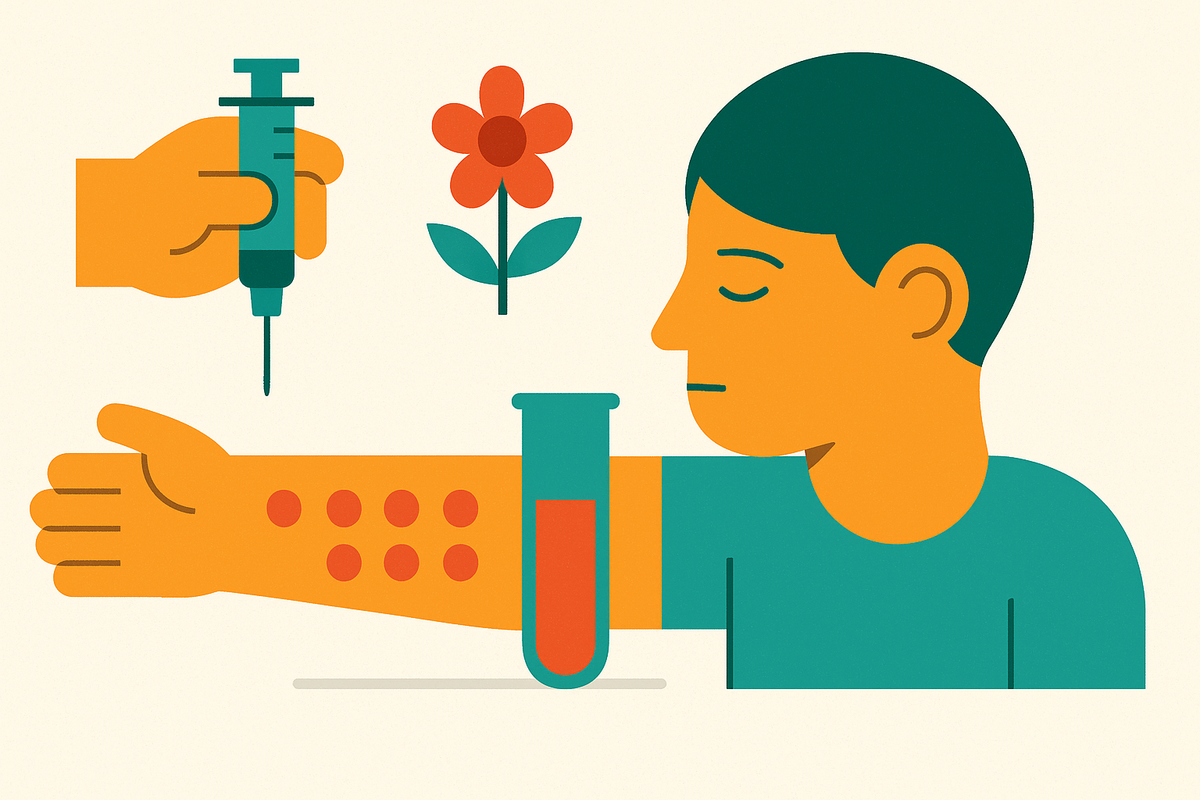
The skin prick test, SPT, introduces a tiny amount of allergen extract to the surface of your skin, usually the forearm or back. If you are sensitized, a raised, red, itchy wheal appears within 15 to 20 minutes. The clinician reads that reaction in real time. A full panel covering dozens of environmental and food allergens typically wraps in a single 30-minute appointment.
The clinical serum IgE blood test targets the same molecule but works differently in practice. A blood draw goes to a certified lab, which uses immunoassay techniques to quantify how much allergen-specific IgE is circulating in your bloodstream. Results are numerical. A result above 0.35 is generally considered positive; levels above 100 IU/mL are typically indicative of allergy. Turnaround is three to seven days. No immediate result, no clinician watching anything unfold.
Neither result is a diagnosis on its own. A positive test indicates sensitization. Whether that sensitization translates into clinical allergy, something that actually explains your symptoms and warrants treatment, requires a physician who knows your history. That part is not optional.
How Skin Prick Test Sensitivity and Specificity Compare to Blood Testing
The skin prick test is the gold standard for diagnosing environmental allergies. Reported accuracy for allergens like pollen, mold, and pet dander falls in the range of 85 to 95%. A systematic review and meta-analysis published through NCBI in 2016 confirmed that SPT accurately discriminates between patients with and without allergic rhinitis. That is meaningful validation, not just clinical convention.
Clinical blood testing is not a lesser alternative; it is a different one, with its own performance profile. Accuracy for common environmental allergens in controlled lab settings also sits in the low-to-mid 90s. And there is something blood testing gives you that SPT cannot: a number you can track over time. If you begin immunotherapy and want to see whether your IgE levels are actually shifting, blood tests provide that longitudinal visibility.
Where the two diverge is subtle. SPT sensitivity can be marginally higher for certain allergens; blood tests can show higher specificity in some head-to-head comparisons, meaning fewer false positives. But the practical accuracy gap between a well-executed SPT and a high-quality clinical blood test is narrower than most patients expect. What actually differentiates them clinically is feasibility, not performance.
It is also worth considering a caveat that applies equally to both: a positive result reflects sensitization, not necessarily active disease. A positive wheal or an elevated IgE number without corroborating symptoms and exposure history is an incomplete picture. Clinical judgment is what turns a data point into a diagnosis.
When Clinical Circumstances Make One Test Clearly Preferable Over the Other
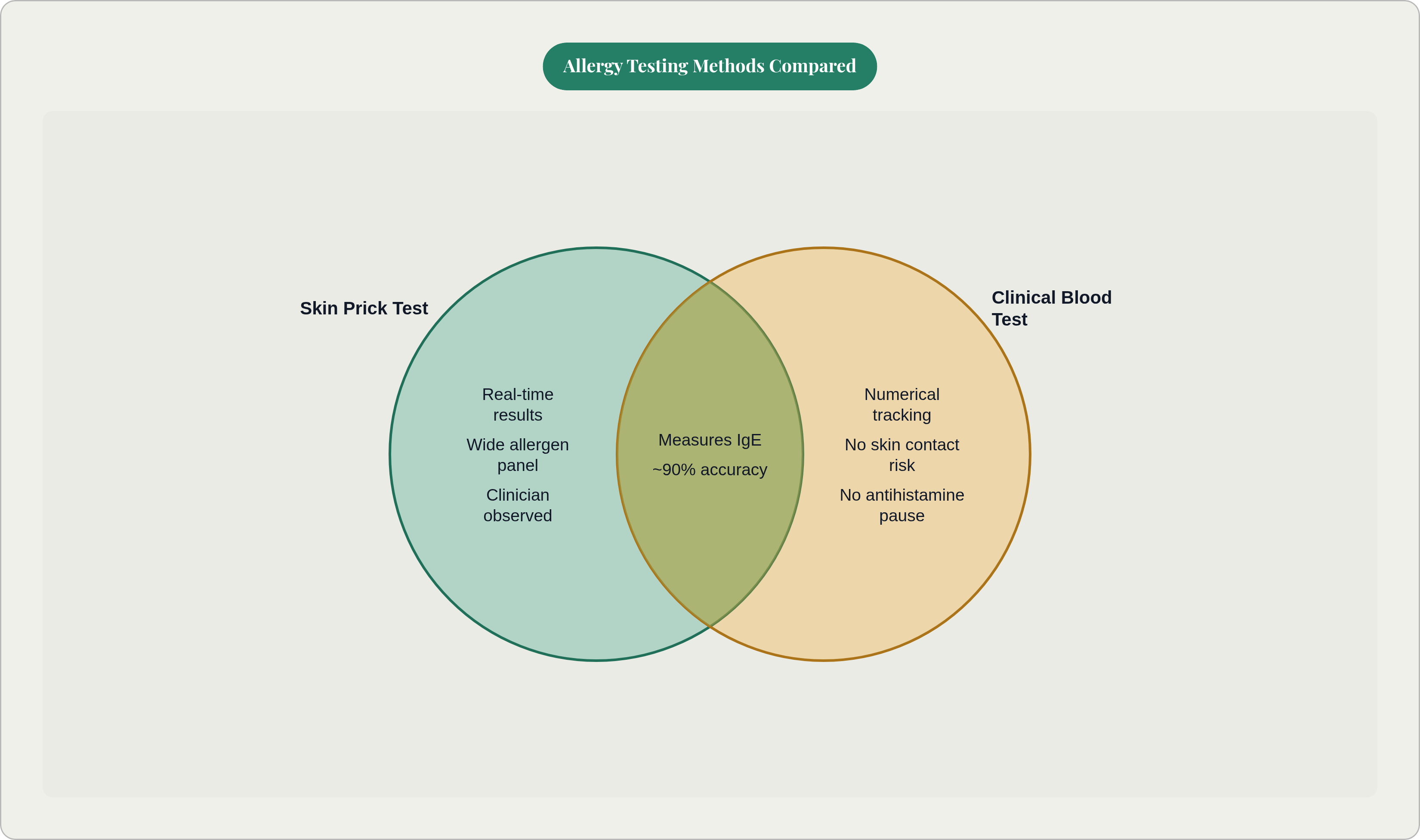
For a routine environmental allergy workup, SPT is usually the first choice. It screens a wide allergen panel in one visit, results are immediate, and for children especially, the ability to discuss findings with a parent in real time has real practical value.
But what if SPT is simply not an option? There are situations where it is not appropriate, and blood testing is not just preferable; it is the only defensible choice.
Antihistamines suppress the skin's wheal response. If a patient cannot discontinue them three to seven days before the test, SPT results will be unreliable. Blood testing has no such restriction; circulating IgE is not affected by antihistamines in the same way.
Patients with severe eczema or dermographism present a different problem. When skin is already reactive or compromised, distinguishing an allergen-induced wheal from background noise becomes clinically difficult. Blood testing sidesteps that entirely.
For patients with a history of severe anaphylaxis, introducing allergen extracts through skin contact carries real risk. Blood testing introduces nothing. For patients on beta-blockers or certain tricyclic antidepressants, SPT interpretation and emergency management of any adverse reaction become more complicated, sometimes prohibitively so.
In my experience, the more practically useful framing is to think of these two tests as complementary rather than competitive. SPT is frequently the first screen; blood testing confirms ambiguous results or fills in gaps the skin panel cannot address. It is sequencing, not substitution.
What At-Home Finger-Prick IgE Tests Can and Cannot Deliver
The phrase "at-home allergy test" covers a wide range of products with meaningfully different scientific validity. The category label obscures a distinction that matters enormously.
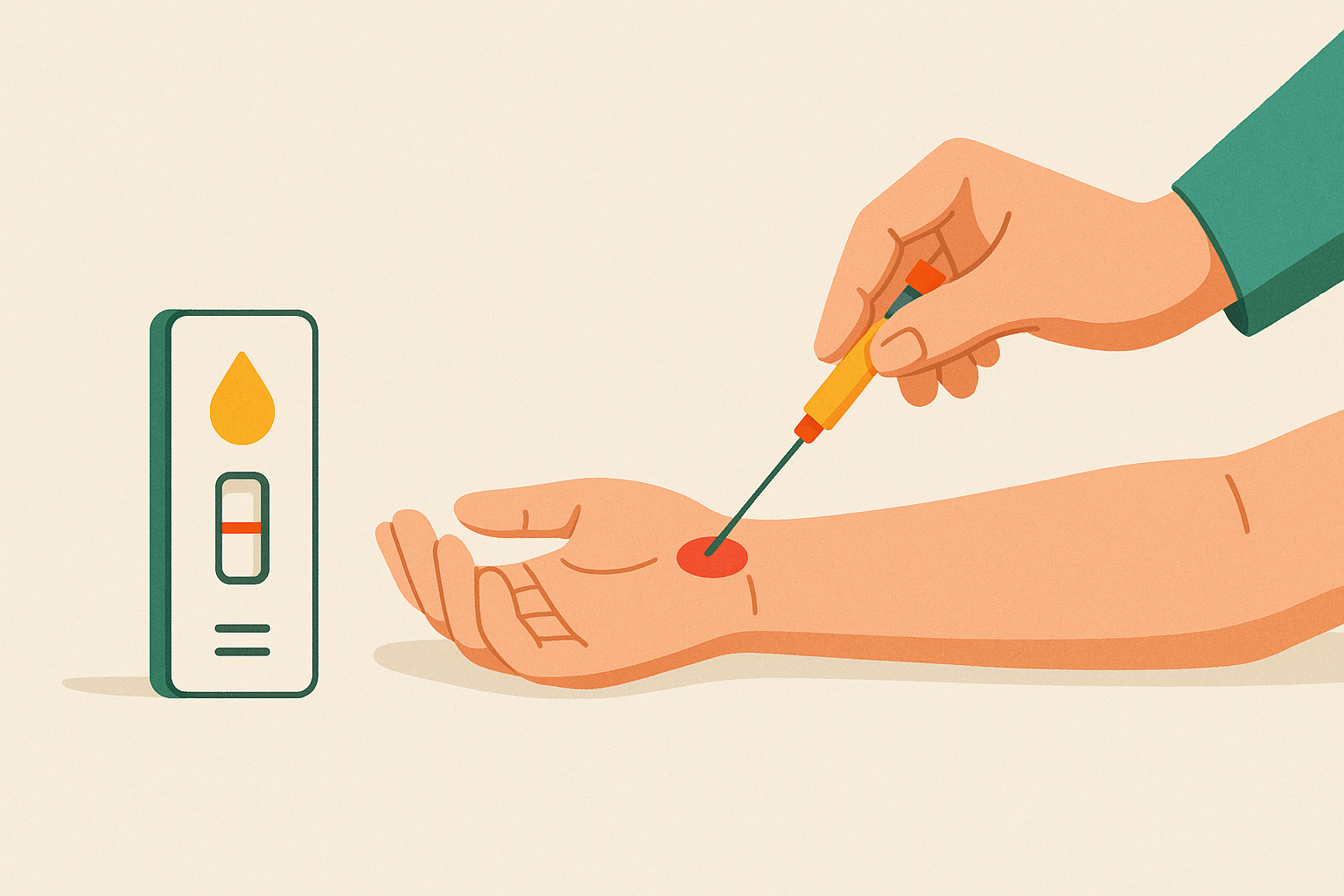
Some finger-prick kits measure allergen-specific IgE antibodies and process samples through a CLIA-certified laboratory. These are scientifically grounded; they are measuring the same antibody that clinical blood tests target. Others, including many consumer panels marketed with extensive food and environmental lists, measure IgG antibodies instead.
But why exactly does this distinction matter so much? IgE and IgG are not interchangeable. They serve entirely different functions in the immune system. IgG antibodies reflect exposure and immune memory; they do not indicate allergic sensitization in the clinical sense. Major allergy organizations have consistently advised against using IgG test results for clinical allergy decisions, and these kits are not FDA-cleared for allergy diagnosis. That is not a technicality. It is the difference between measuring something relevant and measuring something immunologically unrelated.
Legitimate IgE-based finger-prick kits can cover 40 or more aeroallergens, with turnaround ranging from a couple of business days to about a week. They can meaningfully identify sensitization to common environmental allergens: dust mites, pet dander, pollen, mold. For someone with mild or seasonal symptoms who wants a preliminary picture before committing to a clinic visit, a quality IgE kit is a credible starting point.
What these tests cannot do: confirm food allergies with clinical reliability, assess asthma triggers or drug reactions, or replicate the real-time, clinician-observed assessment that SPT provides. AI-assisted lab calibration and symptom-tracking apps that sync with results are emerging in 2025, making it easier to bring at-home data into a productive clinical conversation, but they do not change what the test is fundamentally measuring.
Why At-Home Test Accuracy Depends More on Kit Type Than on the Home Setting Itself
In-office testing sets the accuracy benchmark at roughly 90% for common environmental allergens. People often assume the home collection step is where accuracy erodes. It is a reasonable assumption, but it is mostly wrong.
The finger-prick, sample card, and mailed-to-lab sequence introduces minimal error when instructions are followed. The laboratory process downstream is not meaningfully different because the sample originated on your kitchen counter instead of a phlebotomy chair. The lab does not know. The assay does not know.
The actual accuracy risk in at-home testing comes from two sources, and neither one is the collection setting.
The first is product selection. An IgE-based kit processed at a CLIA-certified lab, especially one that includes physician review of results, closely approximates clinical blood test accuracy for the allergens it covers. An IgG-based consumer panel produces results that look like diagnostic data but measure something unrelated to allergic disease. Selecting the wrong product is a significant error, and it is easy to make because the packaging often looks nearly identical.
The second risk is interpretation. Even a technically accurate IgE result can mislead without clinical context. Sensitization is not the same as clinical allergy, and a number on a printout does not tell you whether that sensitization explains your symptoms, how it should influence treatment, or what else might be contributing. A physician contextualizing results against your symptom history and exposure patterns is what transforms raw data into something actionable.
A quality at-home IgE test reviewed by a physician is a substantively different product from an IgG consumer panel reviewed by no one. Both are called "at-home allergy tests." They are not the same thing.
How the Choice of Testing Method Affects the Path to Treatment
An accurate test result is only valuable if it leads somewhere clinically useful. That raises an important question: does test choice matter more than most people realize?
Both SPT and clinical blood tests are accepted by allergists as the foundation for designing immunotherapy treatment plans. Sublingual immunotherapy, including SLIT drops and FDA-approved SLIT tablets, is calibrated to specific allergens. The more precise your sensitization profile, the more targeted that treatment can be. A vague result, or one derived from IgG testing, cannot support that level of specificity.
At-home IgE testing, when reviewed by a physician, can function as a legitimate first step toward immunotherapy. For patients who face genuine access or cost barriers to in-office testing, that matters practically. The physician involvement requirement is not a formality; it is what makes the result clinically actionable rather than merely informative.
Patients who lack an accurate diagnosis tend to stay on a symptom-management cycle indefinitely. Antihistamines, nasal sprays, decongestants: these address symptoms. They do not touch the underlying immune sensitization. Immunotherapy does. The trajectory from chronic symptom management to actual immune desensitization runs directly through accurate testing, and the choice of test determines whether you get on that path at all.
An inaccurate or misinterpreted result does not usually produce dramatic harm. What it more commonly produces is prolonged delay. Another season. Another OTC product. Another year of reduced quality of life with no clearer understanding of why.
A Practical Framework for Choosing the Right Test Given Your Situation
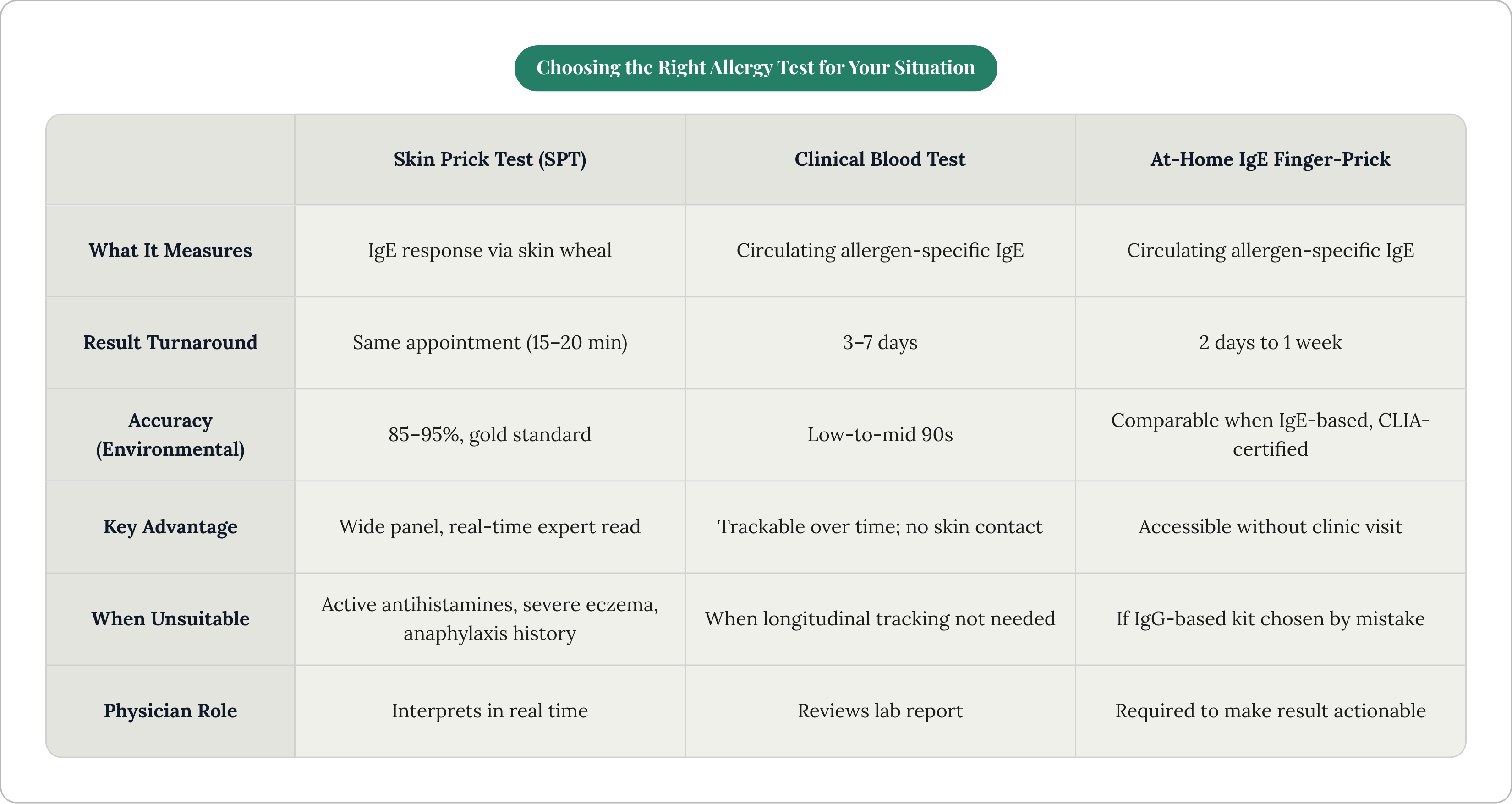
Physician involvement in interpreting results is non-negotiable, regardless of which test you pursue. A result without clinical context is incomplete by definition, and that applies whether you had a skin prick test in a specialist's office or a finger-prick kit on your kitchen table.
If you have access to an allergist and no medical contraindications, SPT is the most information-dense single appointment available to you. A wide allergen panel, expert-interpreted results, and the ability to discuss findings and next steps in the same visit make it the most efficient path for most people.
If you cannot safely discontinue antihistamines, have severe eczema or dermographism, or have a history of anaphylaxis, clinical blood testing is the appropriate alternative. Accuracy is comparable; the risks associated with skin introduction of allergens are absent.
If in-office testing is inaccessible, cost-prohibitive, or you simply want a preliminary read before committing to a clinic visit, an at-home finger-prick IgE kit from a provider that uses a CLIA-certified laboratory and includes physician review of results is a credible starting point. Confirm it measures IgE before purchasing. Treat the result as triage, not a terminal diagnosis.
The question is not which test is abstractly "best." The question is which test, given your specific medical situation and practical constraints, is most likely to produce an accurate IgE sensitization profile that a qualified physician can interpret and act on. That profile, however you obtain it, is what makes personalized treatment possible. Without it, you are managing symptoms. With it, you have a chance at addressing the actual source. Wyndly, a direct-to-consumer telehealth allergy clinic that pairs at-home IgE testing with physician-guided sublingual immunotherapy delivered by mail, is one option built around exactly that sequence.