How Sublingual Immunotherapy Desensitizes the Immune System
Drops placed under the tongue retrain immune cells to stop attacking harmless allergens.

Allergies aren't a malfunction so much as a case of mistaken identity. The immune system flags harmless proteins, pollen, dust mite droppings, mold spores, as dangerous invaders, and builds an entire defense system around that mistake. Sublingual immunotherapy (SLIT), the allergy drops or tablets placed under the tongue, works by slowly correcting that misidentification at the source. Understanding how it does that explains why the relief sticks around long after treatment ends, while a pill only masks symptoms for a few hours.
Start with who's involved in the mistake. CD4+ T-helper cells, specifically the Th2 subset that dominates in allergic people, kick off the chain, and they signal to B lymphocytes, which respond by making allergen-specific IgE antibodies. Those antibodies coat mast cells and basophils sitting in the mucosal tissue of the nose, eyes, and airway, loading them like traps. The Th2 cells also pump out a trio of cytokines, IL-4, IL-5, and IL-13, that keep the whole inflammatory engine running.
Here's where the actual misery comes from. On re-exposure to pollen or dander, the IgE-coated mast cells burst open, a process called degranulation, and dump histamine, tryptase, prostaglandins, and leukotrienes into the tissue. That's the sneezing, the congestion, the itching, the swelling. Antihistamines and nasal sprays work downstream of all this: they mop up or block the chemical mediators after they've already been released, but they never touch the Th2 bias generating IgE in the first place. SLIT moves the target upstream, to the mechanism itself. That's the reason it outperforms symptom control over the long run, and comparing the two head to head, as if they're solving the same problem, misses the point entirely.
What makes the mouth's mucosal tissue an unusually tolerant immunological environment
Why put allergen under the tongue at all, instead of swallowing it or injecting it? The answer comes down to what the mouth's lining is built for.
The oral mucosa spends every day exposed to food proteins and the trillions of bacteria living in the mouth. If it reacted to all of that the way skin reacts to a splinter, eating would be a constant immune emergency. So the tissue defaults toward tolerance. The dendritic cells stationed under the tongue, the immune system's local scouts, belong to a specialized, tolerogenic subset built to calm things down rather than sound the alarm, while dendritic cells in skin or airway tissue lean the opposite way, primed to flag anything unfamiliar as a threat. That difference in wiring explains why SLIT starts under the tongue and not on the arm.
The sublingual space also drains fast, straight into the cervical lymph nodes in the neck. That gives antigen-presenting cells a quick, direct line to the rest of the immune system, which matters for how fast the tolerance signal spreads.
The instructions on the bottle matter more than they seem to. Holding the drops or a dissolving tablet under the tongue for 30 to 60 seconds before swallowing gives that tolerogenic tissue time to actually absorb the allergen. Swallow right away, and most of it heads straight to the stomach, bypassing the mechanism that makes the treatment work. Skip that step often enough and the drops lose much of their value, delivering little more than the ritual of a daily habit.
One tradeoff worth sitting with: sublingual absorption isn't as direct as an injection into the fat under the skin. Published research suggests SLIT needs something like 50 to 100 times more allergen than subcutaneous shots to reach similar effectiveness. That's the cost of using a gentler entry point, and it's why SLIT drops and tablets are formulated at the doses they are.
The step-by-step immune cascade that SLIT triggers from mouth to lymph node to systemic tolerance
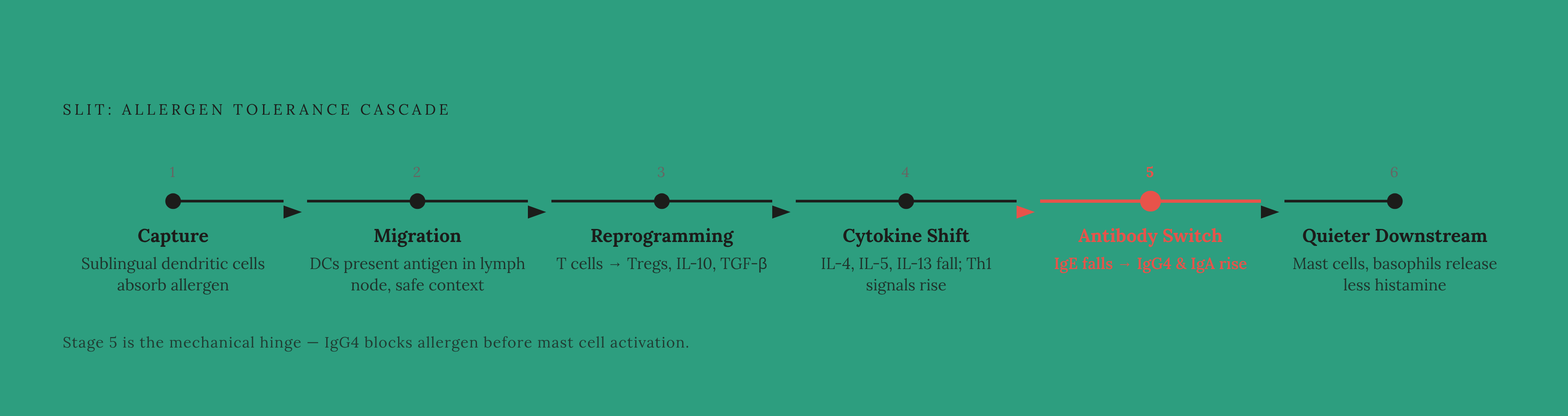
Picture the sequence as six links in a chain, each one setting up the next.
Capture. The tolerogenic dendritic cells under the tongue pick up allergen proteins straight from the drops or tablet.
Migration. Those dendritic cells travel to nearby lymph nodes and present fragments of the allergen to naive T cells, in a context that reads as safe rather than hostile.
Reprogramming. That safe context nudges T cells toward becoming Th1 cells instead of the allergic Th2 type. Just as important, it produces regulatory T cells, or Tregs, that release IL-10 and TGF-beta, two cytokines whose job is to dial down the allergic response.
Cytokine shift. IL-4, IL-5, and IL-13 start to fall while Th1 and regulatory signals take up more space. This shift is, at the molecular level, what "desensitization" actually means.
Antibody switch. B cells, now taking cues from a different set of T cells, make less allergen-specific IgE and shift toward IgG4, a blocking antibody, and IgA. IgG4 works like a decoy: it grabs the allergen before the IgE sitting on mast cells gets the chance, so the trap never springs.
Quieter downstream. Mast cells and basophils, triggered far less often, release less histamine and fewer inflammatory chemicals. Symptoms fade because the signal telling the body to react has gone quiet.
None of this happens in one dose, and that's the part people underestimate most. It's a cascade that has to be triggered over and over, daily, to build and hold that tolerogenic pattern. Miss the daily trigger and the chain doesn't advance; it resets closer to where it started, which is the whole reason adherence over months matters more here than it does with a pill you can forget for a week without consequence.
Why this mechanism produces lasting remission rather than temporary relief
An antihistamine blocks histamine receptors for a few hours, and once the drug clears the bloodstream, the entire IgE-Th2 machine sits there untouched, ready to fire again on the next exposure. Nasal steroids go a step further, calming local inflammation in the tissue, but they still leave the underlying T-cell and antibody profile driving the reaction unchanged. Both work at a different level than immunotherapy: they're a different category of tool aimed at a different problem, symptom control rather than the actual mechanism generating the symptoms.
SLIT's effect comes from a different source: the Th2-to-Th1 shift and the buildup of Tregs aren't a drug effect that wears off. They're an actual retraining of immune memory. That's the basis for a claim that shows up often in the allergy literature: immunotherapy gets described as a treatment that may change the natural course of allergic disease, rather than just suppress its symptoms.
Clinically, that shows up as durability. Patients who finish a full course of SLIT tend to keep seeing benefits well after they stop taking the drops, which fits what you'd expect if Treg populations and IgG4 levels stick around rather than fading with the last dose.
One nuance worth flagging: the retraining is allergen-specific. Drops formulated for grass pollen retrain the immune response to grass, not ragweed, not cat dander. That's why multi-allergen formulations exist, built around a patient's actual sensitization profile instead of a one-size-fits-all mix.
What the clinical trial record shows about how well the mechanism translates into real symptom reduction
Mechanism is one thing. Does it show up in the numbers? A 2025 systematic review and meta-analysis pooling 25 randomized controlled trials (1,830 patients) for symptom scores, and 19 trials (1,555 patients) for medication use, found SLIT-liquid significantly outperformed placebo on both. The symptom score effect landed at a standardized mean difference of −0.30; the medication score effect came in stronger, at −0.51, both statistically significant.
What does an SMD of −0.51 on medication use actually mean? It's a moderate-to-large effect: patients on SLIT needed meaningfully less rescue medication, antihistamines, decongestants, whatever they'd normally reach for. That's a direct, measurable readout of the IgE suppression the mechanism predicts, showing up in what people actually take, not just how they report feeling.
The same analysis found the effect held across different allergen types and age groups, not just in one narrow slice of patients. A separate nine-year cohort study, following over 11,000 patients, found allergen immunotherapy tied to 21% fewer asthma medications, 21% fewer severe asthma exacerbations, and 33% fewer new oral steroid prescriptions compared to patients who skipped immunotherapy, with younger children showing the sharpest drops in rhinitis medication use.
In everyday practice, both SLIT and allergy shots tend to cut symptoms somewhere in the range of 30 to 60% for most patients. That spread reflects how much individual immune responses and allergen exposure vary from person to person, not any flaw in the treatment. What's still being worked out is the fine print: optimal treatment length, ideal dosing intervals, which allergen combinations perform best together. The underlying mechanism is settled science; the engineering around delivery is what's still catching up to it.
How SLIT and allergy shots engage the same immune mechanism through different delivery routes
Subcutaneous immunotherapy, the traditional allergy shot, and SLIT arrive at the same immune destination: Tregs go up, the Th2-to-Th1 shift happens, IgE drops, IgG4 and IgA rise. The biology converges, but the road taken to get there differs, and that road matters more than most patients realize when they're choosing between the two.
Shots have a longer track record simply because they've been around longer, and some head-to-head comparisons suggest SCIT moves a bit faster during the initial build-up phase, edging out SLIT for certain allergens. That speed comes at a cost, though, and it's a cost most people don't hear about until they're already sitting in the waiting room.
Here's the case for SLIT, stated plainly: for most patients outside of severe, treatment-resistant cases, it's the better default. The reasoning has less to do with gentleness and more to do with completion rates: the version of treatment someone actually finishes beats the version they quit in month four. Drops rarely trigger a systemic reaction; side effects are mostly mild itching or tingling in the mouth. Shots carry a real risk of systemic reactions, which is why clinics require patients to sit in the waiting room for observation after each injection. Drops get taken at home, daily, while shots mean weekly or biweekly clinic visits during build-up and monthly visits after that. For a lot of patients, that recurring clinic schedule, more than the biology, is the actual reason treatment gets abandoned halfway through, and a treatment abandoned in year two delivers zero percent of the outcome regardless of how good its build-up phase looked on paper.
The dose gap mentioned earlier, that 50-to-100-times difference in allergen needed sublingually versus by injection, explains why SLIT can run a bit slower in the early going. It doesn't change the outcome over a full course of treatment. The two routes land in roughly the same place, so the honest way to frame the choice comes down to which one a given patient will actually stick with for three years, and for most people with schedules that don't bend, that answer is SLIT.
For anyone whose schedule doesn't bend easily around recurring clinic appointments, a demanding job, frequent travel, a fear of needles, or living far from a specialist, SLIT delivers the same underlying immune retraining without leaving the house. Telehealth allergy care has pushed this further: virtual consults, at-home finger-prick testing, and personalized drop formulations mailed to a patient's door mean the entire SLIT pathway can run without a single in-person visit, while a board-certified allergist still oversees the plan.
What the mechanism implies about treatment duration, adherence, and when patients can expect results
Because SLIT works by slowly retraining immune memory rather than blocking a receptor, it runs on a clock measured in months, not days. That's worth sitting with before starting, so the pace doesn't feel like the treatment is failing when it's actually right on schedule.
In the early weeks to first few months, tolerogenic dendritic cells are being trained and Treg populations are just starting to expand. Some patients notice symptoms getting milder even before full tolerance sets in. Between roughly months three and twelve, IgG4 levels climb and the IgE ratio starts to shift, and medication use typically begins dropping. That timeline lines up with a one-year randomized trial in adolescents, 65 patients followed for 12 months, which found reduced need for rescue medication alongside a good safety profile.
Full courses generally run several years, and that length isn't arbitrary. It reflects how long immune memory cells need consistent re-exposure before the tolerogenic pattern holds on its own, without ongoing reinforcement.
Skipping doses isn't a minor lapse. It interrupts the signal the dendritic cell-Treg pathway needs to consolidate the shift, and consistency here is a mechanical requirement of how the retraining works, a stricter standard than the usual "try to take it every day if you can" advice most people expect.
Starting earlier tends to pay off too. The longer the immune system has spent locked into Th2-skewed allergy mode, the more entrenched that pattern gets, and pediatric patients seem to see especially strong drops in medication use, likely because there's less immune habit to unwind.
The most useful way to think about SLIT is as a slow process of biological re-education, one that unfolds on its own timeline rather than a faster or slower version of taking a pill. Understanding what's actually happening under the tongue and in the lymph nodes is what makes a multi-year timeline feel reasonable, rather than like nothing is happening at all.