Long-Term Side Effects of Allergy Shots
What patients don't learn until years in: tolerance fades fast if you quit early.

If you've been diagnosed with allergic rhinitis, you've probably had some version of this conversation with your allergist: shots work well, the injections themselves are minor, serious reactions are rare, and you'll feel meaningfully better within a year or two. That's all true. It's also incomplete.
Allergy shots are worth the commitment for many patients, but the full picture requires more than the standard pre-treatment briefing provides. The treatment runs three to five years, with weekly injections during the buildup phase and monthly injections during maintenance, meaning the cumulative number of individual exposure events is substantial. Side effects across that arc include recurring local reactions at the injection site that can involve real swelling and discomfort for hours, systemic reactions whose per-injection probability compounds across hundreds of doses, and a structural cost that is easy to overlook: patients who stop early, before the immune reprogramming is complete, lose the durability of whatever tolerance was built and are left with only temporary benefit from all the burden they already absorbed. The buildup phase carries the highest systemic reaction risk, and uncontrolled asthma is a recognized contraindication that changes the risk calculus significantly.
The part of the allergy shot conversation that gets compressed is the long view. And allergy shots are, by design, a long-game treatment. We're talking three to five years, dozens to well over a hundred individual injections, and a clinic requirement that doesn't flex. When you spread side effects across that kind of timeline, the picture changes. Not necessarily for the worse, but into something more complex than "occasional soreness at the injection site."
That's what this piece is about. Not whether allergy shots work. They do. But what a patient is actually signing up for when they commit to subcutaneous immunotherapy (SCIT), beginning with what the informed consent conversation usually covers and ending with what it often doesn't.
What Most Patients Are Told Before They Start
The standard pre-treatment briefing on allergy shots is accurate, as far as it goes. Local reactions at the injection site are common: redness, mild swelling, some itching. These are transient and manageable. Beyond that, you experience a brief systemic flare shortly after injection, some sneezing or nasal congestion, your immune system reacting to the allergen it just encountered. Clinic staff handle these routinely. The 20 to 30 minute post-injection observation period exists precisely to catch anything that escalates.
For a single injection, that's a reasonable risk summary. The problem is that most patients internalize this as their entire risk profile, when it's actually only the risk profile for the first few visits.
A full course of allergy shots is not a series of isolated events. It is a sustained, multi-year biological intervention with a recurring exposure cadence. The side effect landscape at month one is not the side effect landscape at year three. Understanding that distinction is the core of what this article is trying to work through.
Systemic and Anaphylactic Reactions Across Hundreds of Injections
Anaphylaxis from allergy shots is rare. Full stop. Per the published clinical literature, serious systemic reactions are infrequent, and fatalities are exceptionally uncommon. That framing is accurate and it's important.
But here is where patients deserve a more granular accounting: "rare per injection" is not the same thing as "rare across your full treatment course."
If you are completing a standard protocol, you are receiving injections weekly during buildup, then every two to four weeks during maintenance, for years. The cumulative number of individual injection events is substantial. Each one is a discrete exposure. The probability of encountering a reaction compounds across those events in a way that a per-shot figure doesn't fully communicate.
Risk is also not evenly distributed across the arc of treatment. The buildup phase, when doses are escalating and your tolerance threshold is still being established, carries higher systemic reaction risk than the maintenance phase. This matters for another reason: if you miss appointments during buildup, your protocol typically requires stepping back to a lower dose and rebuilding. That's not just inconvenient. It reintroduces the elevated risk of the escalation phase for a patient who has already completed it once.
Certain patient profiles are at meaningfully higher risk throughout. Uncontrolled asthma, in particular, is a well-recognized contraindication for SCIT. Allergists screen for this, but it's worth understanding the mechanism: severe asthmatic patients who react to a shot respond more severely because their airways are already compromised. For patients in this category, the risk calculus is different enough that some are not candidates at all.
The clinic-visit requirement isn't bureaucratic. It's a safety architecture. Epinephrine and emergency support need to be available because serious reactions need immediate treatment. Every dose, across the full multi-year course, carries its own small window of risk. What patients rarely calculate before they start is what that looks like in aggregate.
Large Local Reactions That Recur and Accumulate
Large local reactions occupy an interesting clinical middle ground. They're not dangerous the way anaphylaxis is. But they're not nothing, either, and patients underestimate them at the outset.
A large local reaction isn't just a faint pink mark at the injection site. It can mean significant arm swelling, real inflammation, the kind of visible, uncomfortable response that can affect how you use your arm for the rest of the day. Some patients experience these for hours. During buildup, as doses increase, some patients find these reactions worsening rather than resolving.
The clinical posture on large local reactions is generally measured: they're not reliable predictors of systemic risk, and they don't preclude continuing treatment. But they do sometimes prompt dose adjustments, which slows progress and can extend the overall treatment timeline beyond the already lengthy baseline.
What I want you to think about is the cumulative texture of this. A minor annoyance at injection one is a very different experience than a recurring, predictable discomfort that shows up on a schedule for three years. For patients with needle sensitivity or injection-site reactivity, the accumulation of these reactions across weekly and then monthly appointments becomes a meaningful attrition driver. Not because any single reaction is unbearable, but because the aggregate is.
What Happens If You Stop Allergy Shots Before the Full Course Is Done?
Early discontinuation of allergy shots is common in practice. Life happens: job changes, travel schedules, new children, illness, relocation. The logistical demands of weekly clinic visits for years are real, and the people who struggle to sustain them are not outliers.
Here's what makes this clinically significant. The 2024 guidelines from a major otolaryngology and head-and-neck surgery professional body recommend a minimum of three years for patients who respond to treatment. Meaningful symptom improvement often doesn't become palpable until one to two years in, which means patients are absorbing the highest-burden phase of treatment before they have clear evidence that it's working for them.
When patients stop before completing the full course, the immune reprogramming is unfinished. The tolerance that was being built is not durable. Symptom return is a documented outcome for patients who discontinue early. The years of injections, side effects, and clinic visits already endured yield only temporary benefit.
That's a particular kind of side effect, isn't it? Not a rash or a systemic reaction, but a structural cost baked into the design of the treatment. Patients who cannot sustain the commitment end up having absorbed all the short-term burden with only a fraction of the long-term benefit. It's worth naming that directly, because most patient-facing materials don't.
The Immune Dysregulation Question
This is the section where I want to be careful, because the evidence here is in an early state, and the last thing a reader needs is an alarming claim that isn't warranted.
Here's what's established: allergen-specific immunotherapy works by inducing real changes in immune system signaling. Regulatory T cells shift. The balance between certain immune response pathways changes. Cytokine profiles are altered. This is not a side effect of the treatment; this is the mechanism. You are, over years, partially reprogramming how your immune system responds to specific stimuli.
Here's the open question: some physicians and researchers have raised a theoretical concern about whether sustained immune modulation of this kind could influence susceptibility to immune-mediated conditions over the long term. This discussion has appeared in published clinical literature and in clinical forums. It is not a confirmed epidemiological finding. A causal link to autoimmune disease has not been established at a population level.
But it is a real enough concern that it surfaces in serious clinical conversation, and it's one that patients considering a multi-year commitment, particularly those on indefinite maintenance protocols for something like severe insect venom allergy, should feel empowered to raise with their prescribing allergist. Not as a reason to refuse treatment, but as a legitimate question that a thoughtful clinician should be able to address.
The straightforward answer right now is: we don't know the full long-term immunological picture. For a therapy that has been in use for over a century, that's a somewhat surprising gap. It's also an argument for continued research, not necessarily for avoidance.
The Clinic Burden as a Cumulative Health Variable
This one doesn't show up in side effect literature, but I think it belongs in this conversation.
Every allergy shot requires a clinic visit. There is no home-dosing option. The post-injection observation window is not optional. Across a full three-to-five-year course, the cumulative time investment in travel, waiting, injection, and monitoring is substantial. During buildup, patients are doing this weekly. During maintenance, monthly.
For working adults managing demanding schedules, for parents of young children, for patients in underserved areas where allergy specialty clinics are not nearby, this is not a mild inconvenience. It can be a functional impossibility. And the patients who drop out because of logistics, not because of biological reactions, still absorb the side effects of partial treatment. The immune system was disrupted and then the intervention stopped before completion.
Completion rates are a meaningful predictor of whether immunotherapy delivers its intended benefit. Treatments that can be administered at home consistently show better adherence across the literature, for the obvious reason that eliminating the travel-and-wait burden removes a primary attrition driver. This is a design limitation of SCIT that affects long-term outcomes entirely independently of any biological side effect. It deserves to be part of the informed consent picture.
How Sublingual Immunotherapy Compares Across These Dimensions
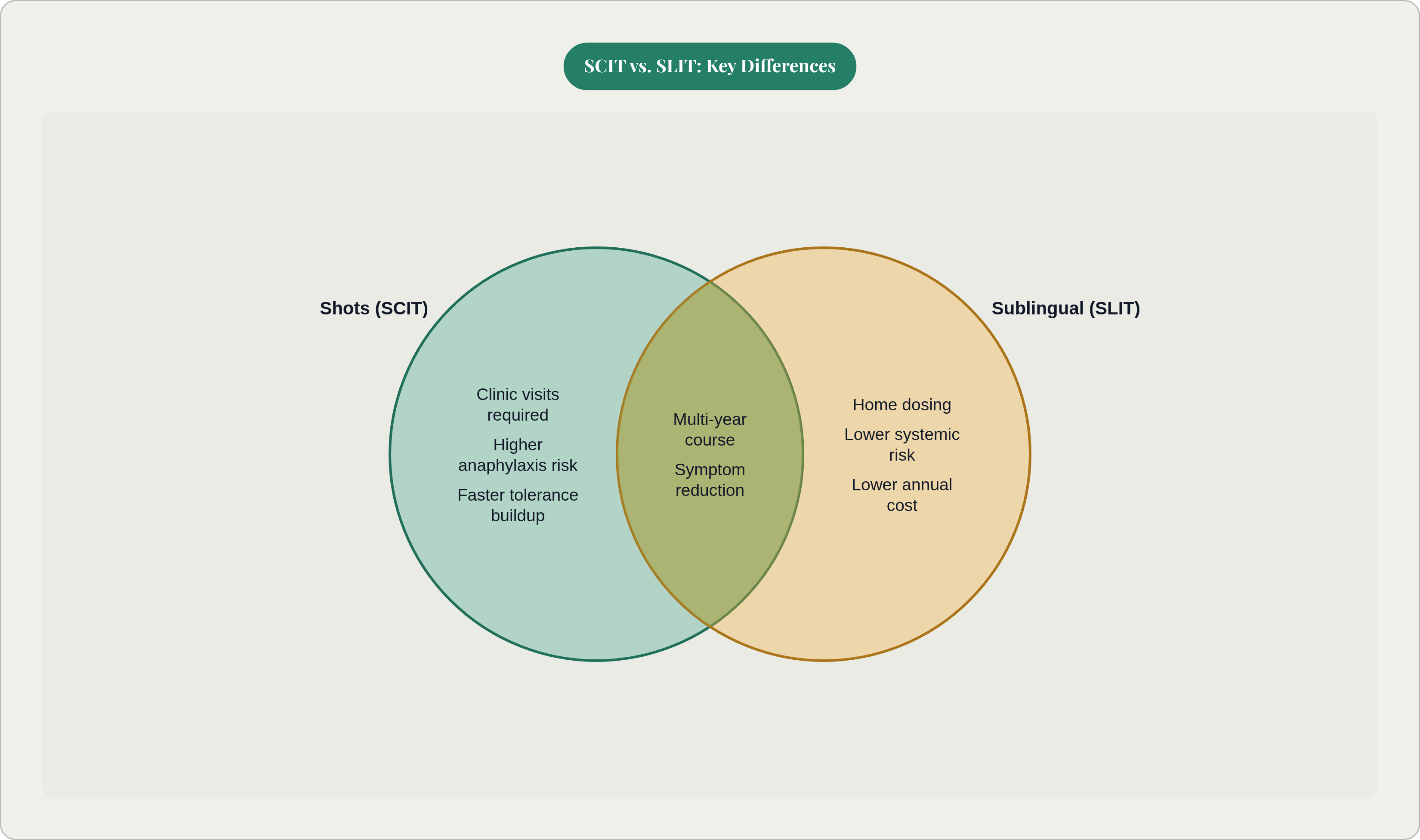
Sublingual immunotherapy (SLIT) delivers allergen via a dissolving tablet or liquid drops under the tongue. After supervised administration of the first dose in a clinical setting, the rest of the treatment happens at home, daily, over a comparable multi-year course.
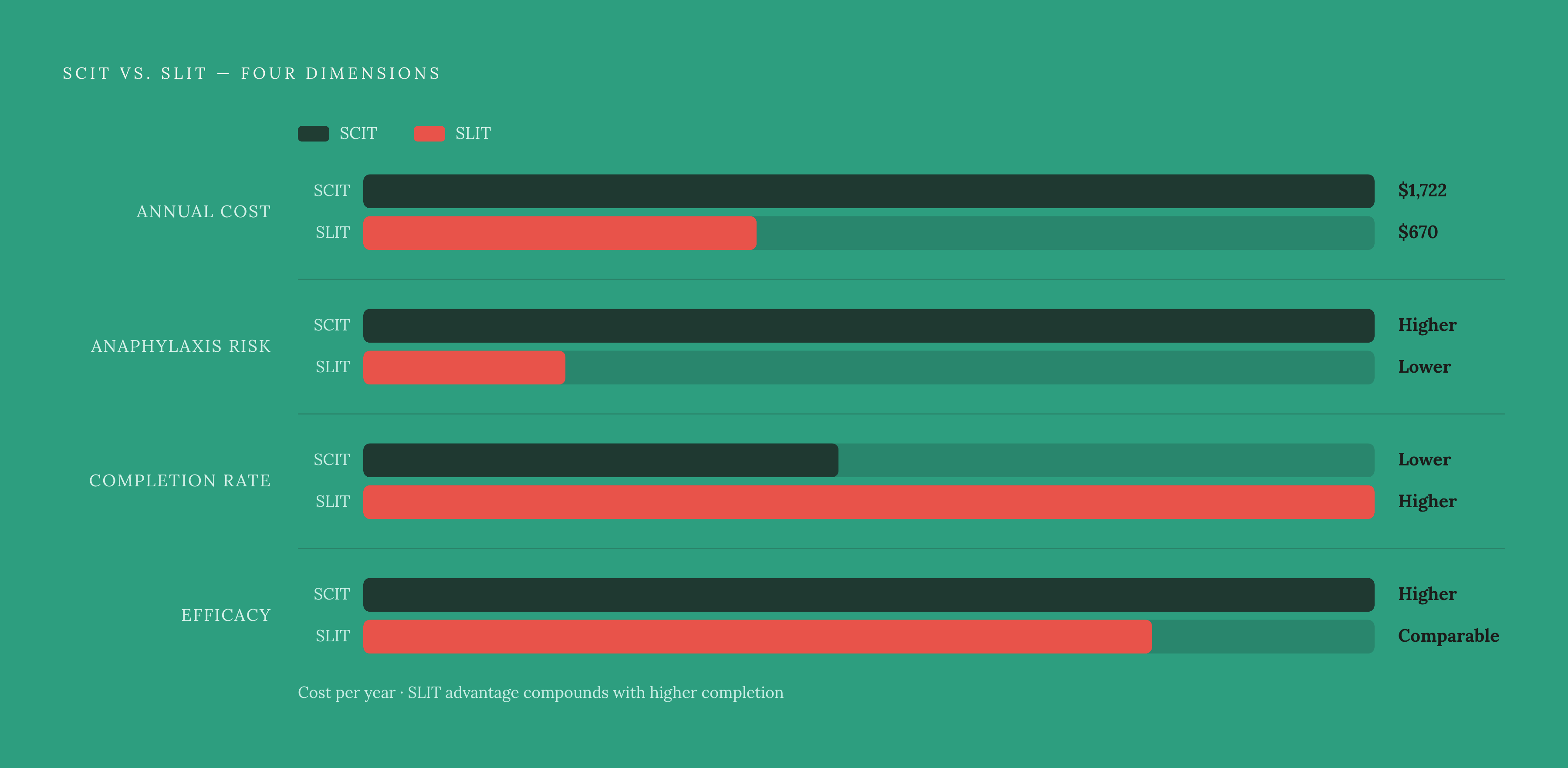
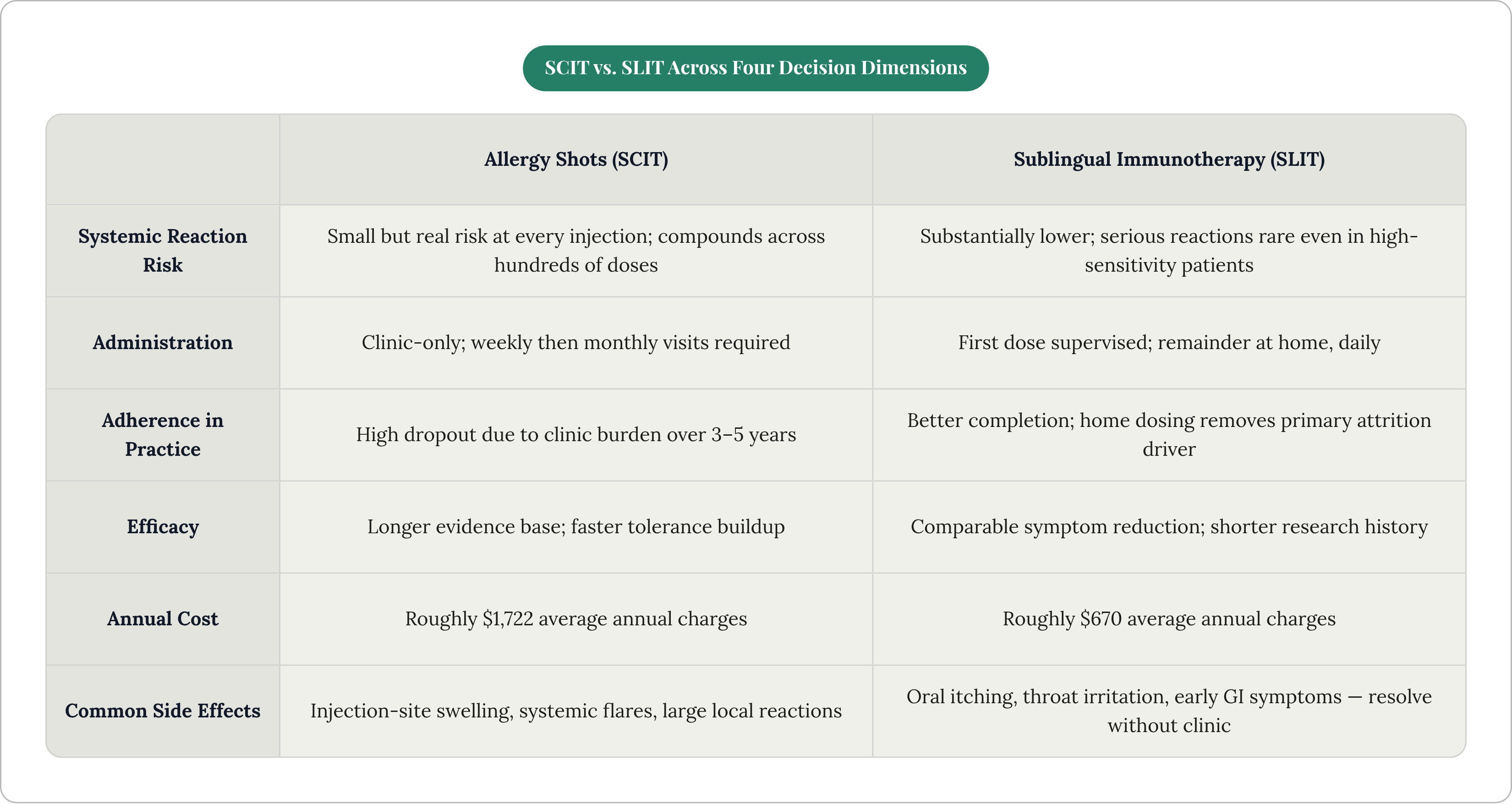
On the anaphylaxis question, the safety profile of SLIT is meaningfully different. The oral mucosal route of administration produces a different biological response than subcutaneous injection, and serious systemic reactions are substantially less frequent in the available literature. In clinical trials for peanut SLIT, a high-sensitivity population if ever there was one, multisystem reactions occurred in eight percent of active participants and twenty percent of placebo subjects, and no participant in the active group required epinephrine. That's a meaningful data point about relative safety architecture.
On the dropout dimension, SLIT adherence is consistently better in practice. Home dosing removes the single largest structural barrier to completion. The treatment that gets completed is the treatment that delivers benefit. This is not a trivial difference.
On efficacy, both approaches reduce symptoms by a comparable range in most patients. SCIT has a longer evidentiary history and builds tolerance more quickly in the buildup phase. But the efficacy advantage of a treatment that patients cannot realistically complete, week after week, year after year, is narrower in practice than it looks on paper.
On cost, the numbers are striking. One analysis in the brief found average annual charges of roughly $1,722 for SCIT versus $670 for SLIT. Even when modeling SCIT at higher efficacy, SLIT remained the more cost-effective option per successful outcome.
SLIT is not free of side effects. Oral itching, throat irritation, and gastrointestinal symptoms are common in the early weeks. But these are local, they resolve, and they don't require a clinic for management. SCIT has a century-long research foundation that SLIT is still catching up to; the long-term systemic picture of sublingual therapy across multi-decade exposure is less mapped. But what's currently documented doesn't surface the cumulative systemic risk profile that injections carry.
The comparison a patient should be making isn't simply "which one works." It's: which one works, is safe across hundreds of doses, can I realistically complete, and what does it actually cost across the full arc of treatment? Those are four separate variables, and the answer to all four shapes the calculus differently than efficacy alone.
Allergy shots are legitimate medicine. For many patients, they remain the right choice. But the informed version of that choice includes the long view, not just the 30-minute window after shot number one.