Allergy Shot Schedule and Time Commitment Breakdown
The time commitment, not the needle, is why most people quit allergy shots.

Allergy shots run on a schedule dictated by immune biology, not clinic convenience, and that schedule is the single biggest reason people quit before finishing. It stretches three to five years and claims a real, recurring chunk of a patient's calendar. Most people evaluating this treatment focus on the needle. They should be focused on the calendar, because the calendar is what actually breaks people.
Allergy shots, known clinically as subcutaneous immunotherapy or SCIT, work by injecting controlled doses of a specific allergen so the immune system gradually stops overreacting to it. An antihistamine or a nasal spray just mutes symptoms while the underlying immune misfire keeps firing underneath. SCIT is trying to retrain the misfire itself, which is why the schedule can't be rushed: push the dose up too fast and the immune system throws a serious reaction instead of building a trained response. So the process splits into two phases. Buildup climbs the dose toward the highest tolerable level. Maintenance holds that level steady long enough for the change to actually stick.
Roughly 81 million Americans carry a diagnosis of seasonal allergic rhinitis, and this population makes up the bulk of who ends up in an allergist's chair discussing shots. The allergens most commonly treated this way include tree, grass, and weed pollen, dust mites, mold spores, pet dander, cockroach, and stinging insects. None of the scheduling that follows is arbitrary. It's a direct readout of how immune desensitization actually works, and it's worth understanding before anyone signs up for it.
The buildup phase week by week: visit frequency, what happens at each appointment, and how long it takes
Conventional buildup runs 3 to 6 months. Most standard protocols call for one injection a week, though some clinics use twice-weekly schedules. Accelerated cluster or rush protocols compress the timeline by giving multiple injections in a single visit rather than adding more weekly trips, but that speed isn't free, and the tradeoff comes later.
A typical appointment breaks into three parts: check-in, the injection itself (usually in the upper arm), and a mandatory 30-minute observation period afterward. That window isn't optional. Serious reactions almost always show up within that stretch, which is the entire reason it exists. Add it up and a standard buildup visit runs about 45 minutes, start to finish.
Each injection carries slightly more allergen than the one before it. Depending on how many allergens are being treated, a patient might get 1 to 4 injections per visit. Cluster-style protocols compress this differently: sessions run longer than a standard visit, with multiple injection sets given at intervals, and true rush immunotherapy can pack the entire buildup into 1 to 3 full days with injections every 15 to 60 minutes. That speed comes at a real cost, though. Faster buildup means closer physician supervision and a higher reaction risk, which is exactly why it's reserved for select cases instead of offered as the default option.
For most patients on the conventional path, buildup means roughly two clinic visits a week, each eating close to an hour. Over the course of a month, the clinic hours add up quickly, every month, for 3 to 6 months straight. Here's the part that catches people off guard: symptom relief during all of this is minimal or absent. The immune system is being trained, not calmed, so patients often feel nothing change until well past this phase. Anyone expecting buildup to bring relief is measuring the wrong outcome.
The maintenance phase: what monthly shots look like over three to five years
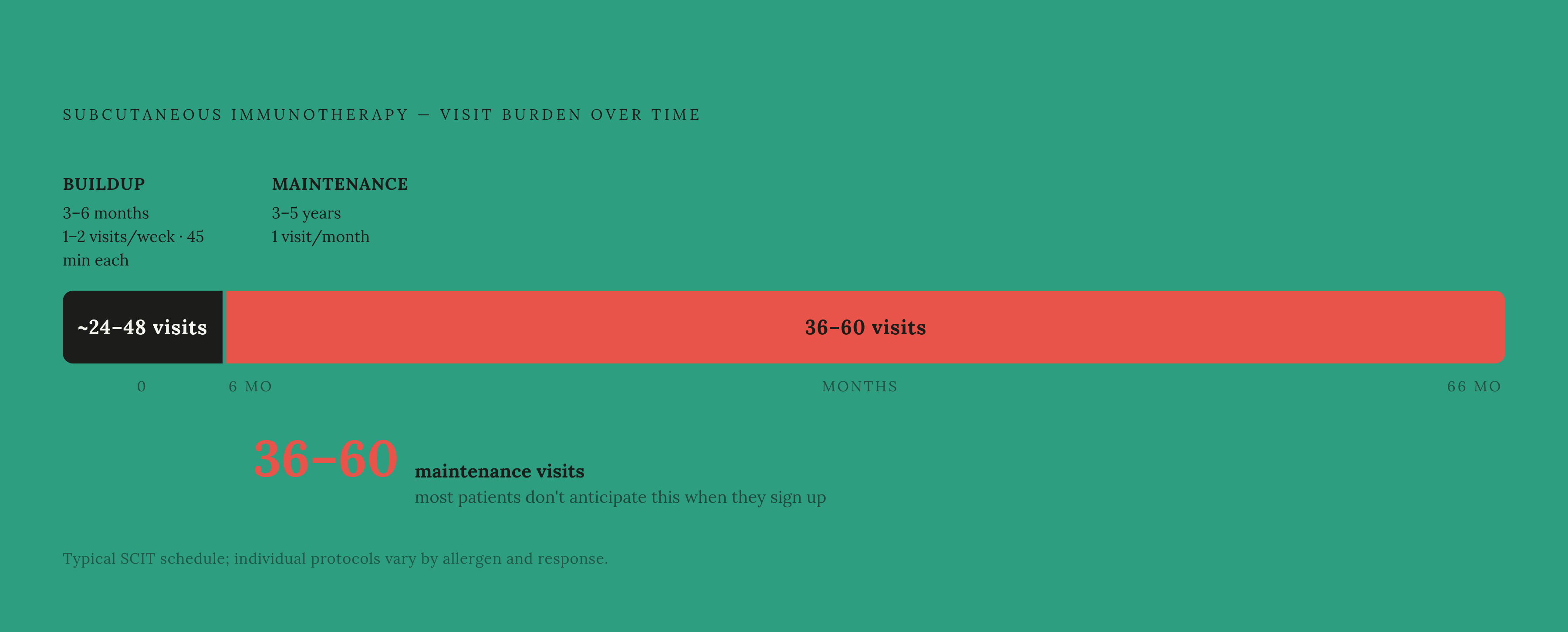
Maintenance starts once a patient hits target dose, typically after somewhere around 25 to 30 buildup injections. From there, frequency drops sharply: shots move to once every 2 to 4 weeks, and most clinics settle into a monthly rhythm.
The observation window during maintenance is typically around 30 minutes, bringing total visit time down somewhat from the buildup phase. But the phase itself stretches long. Clinical evidence supports a minimum of 3 years for patients who are responding to treatment, and many stay in maintenance for up to 5.
The dose doesn't climb here. It holds steady, because the goal has shifted from pushing tolerance higher to locking in the tolerance already built. An annual check-in with the allergist confirms the treatment is working. Multiply it out and maintenance alone adds up to somewhere between 36 and 60 monthly visits over the full course. That's not a series of appointments. That's a multi-year relationship with one clinic's hours and calendar, and it should be treated with the same weight as any other multi-year commitment before it starts.
According to Moffitt & Mesaros ENT, patients who complete at least 3 years get the best outcomes, with some retaining benefits for roughly 2 to 3 years after stopping altogether. Among patients who undergo allergy shot treatment, around 80% see significant improvement. Sit with that number for a second, because it's tied to completion, not to starting. Nobody gets partial credit for two good years and a dropped third.
What happens when you miss a shot, and why gaps cost more time than they save
Tolerance isn't a permanent deposit. It fades when allergen exposure lapses, which is why missed appointments come with real, spelled-out consequences instead of a quiet pass.
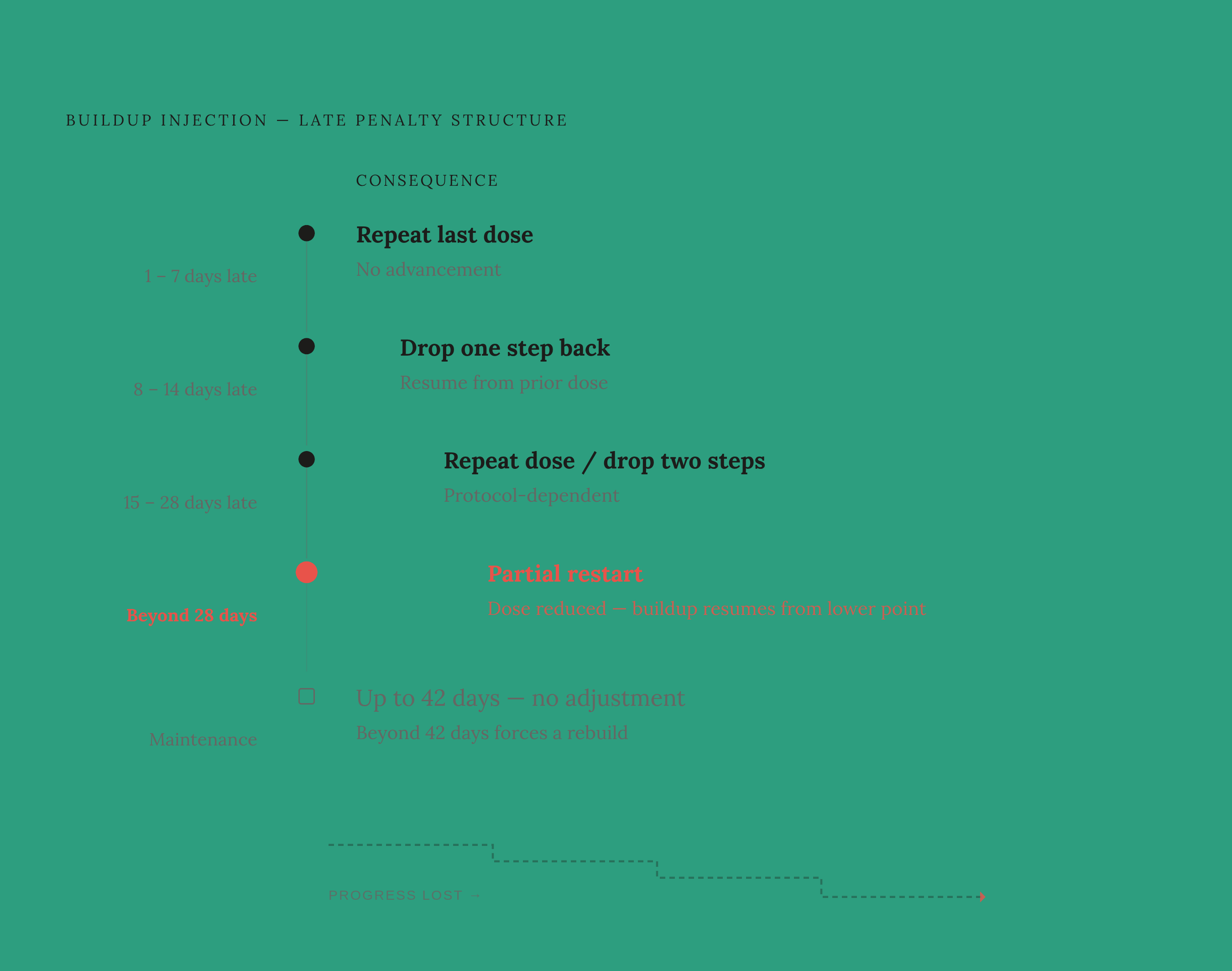
During buildup, the rules get specific fast. Per CliniqHealthcare and National Allergy & ENT protocols: 1 to 7 days late means repeating the last dose without advancing. 8 to 14 days late drops the dose one step back. 15 to 28 days late means repeating the last dose, though some protocols drop two steps instead. Beyond 28 days, the dose gets adjusted downward and the patient effectively resumes buildup from a lower point.
Maintenance is more forgiving, with a window of up to 42 days before an adjustment kicks in. Cross that line, though, and the dose drops, forcing a rebuild back up to the maintenance level.
None of this is clinic bureaucracy. It's biology enforcing its own rules. A single extended gap during buildup can set the whole timeline back by weeks, and patients who travel often, work unpredictable hours, or live far from their allergist's office run into this problem structurally, not because of any lack of discipline on their part. Missing shots doesn't just pause progress. It actively adds visits and time to the total course of treatment, which means the people least able to make every appointment are the ones who end up spending the most time in the chair overall.
The full time math: how many hours allergy shots actually claim over the course of treatment
Add the two phases together and the scale of the commitment comes into focus. Buildup alone, at roughly two visits a week for 3 to 6 months, comes out to somewhere between 24 and 48 clinic visits, each around 45 minutes in the building. Maintenance, at about one visit a month for 3 to 5 years, adds another 36 to 60 visits, each running somewhat less time than a buildup visit.
None of that includes drive time or parking. For anyone in a suburban or rural area, round-trip travel can easily double the real time cost of each visit, and that math almost never makes it into the initial conversation with an allergist.
The observation period is non-negotiable on both ends of this timeline. Patients cannot get the shot and walk out the door. They stay on-site for the full window, which turns a routine injection into a genuine scheduling constraint rather than a quick errand. On top of that, patients are sometimes advised to carry an epinephrine auto-injector on injection days, in case a systemic reaction develops after they've already left the clinic. That's an added layer of logistics most outpatient treatments don't ask for.
Clinic hours, appointment availability, distance, and seasonal demand for allergist slots all shape how realistic this schedule actually is for a given person. Working adults, parents of young kids, and anyone without a flexible calendar feel this hardest, because the schedule doesn't bend to accommodate them. They're the ones who have to bend, appointment after appointment, for years.
Reactions, safety monitoring, and what the observation window is actually for
Local reactions at the injection site (swelling, redness, itching) are common during buildup, showing up in a substantial share of patients depending on the study. Most get managed with something simple: a cool compress, a topical corticosteroid, or an antihistamine. Anything larger than a quarter-size swelling needs to get reported to clinic staff, since it can mean the next dose needs adjusting downward.
Systemic reactions are rarer, but they're the reason the whole safety structure exists in the first place. Hives, wheezing, chest tightness, lightheadedness, nausea, and in the most serious cases, anaphylaxis. Standard allergy practice guidelines call for shots to be given in a facility equipped and staffed to manage these reactions, because they can turn life-threatening fast.
Why 30 minutes specifically? Because that's the window in which most serious reactions develop, not an arbitrary number pulled from a policy manual. The monitoring requirement itself keeps allergy shots tied to a physical clinic in a way that most outpatient treatments simply don't require. This is also the piece that keeps allergy shots tied to a physical clinic: the monitoring can't follow a patient home, and that's precisely the constraint that separates SCIT from SLIT later on.
Who tends to stick with allergy shots and who tends not to, and what the research says about completion rates
Clinical evidence keeps pointing at the same conclusion: outcomes track with duration. Patients who complete at least 3 years see the best results, and that link between sticking with it and actually benefiting is well documented. Adherence isn't a side factor here. It's the main variable.
Sticking with it is the hard part, though. The schedule is demanding enough that plenty of patients who start never make it to the finish line. A few factors show up again and again as predictors of trouble: distance from an allergist's clinic, inflexible work hours or jobs without paid time off for medical visits, and parenting schedules that turn weekday clinic trips into a logistical headache. The sheer frequency of buildup injections wears people down too, week after week, long before any relief shows up. Illness, travel, or any disruption that triggers a gap adds a further complication, since the dose-reduction rules then stretch the timeline out even more.
Missing shots doesn't just cost time. It costs progress, because the rules require going backward in dose before moving forward again. That 80% improvement figure isn't really a statement about how well the protocol works in some abstract sense. It's a statement about how much adherence matters, since adherence is the variable actually separating good outcomes from wasted years.
Relief doesn't arrive quickly, either, even for patients who follow the schedule perfectly. Telehealth allergy clinics like Wyndly, which deliver sublingual immunotherapy at home, are partly designed around this reality. Some notice change during treatment, but according to AllergyAva, meaningful relief can take up to 12 months on the maintenance dose. That means some patients invest close to a year before feeling anything resembling a payoff. Worth asking upfront: can a given schedule and set of obligations actually absorb that kind of wait?
How sublingual immunotherapy compares on schedule and time commitment
Sublingual immunotherapy, or SLIT, delivers allergen doses under the tongue instead of through an injection, either as an FDA-approved tablet for things like dust mites, certain grasses, and ragweed, or as physician-prescribed drops. Either way, it's taken daily, at home, which already tells you where this comparison is headed.
The underlying mechanism isn't all that different from shots. Allergen crosses the mucous membranes into the bloodstream, T-cells gradually learn tolerance instead of reaction, and the immune system builds protective IgG while suppressing IgE, according to a 2024 paper in the Journal of Allergy and Clinical Immunology: In Practice.
Where it diverges is the schedule, and this is where the case for SLIT gets hard to ignore for a lot of people. There's no mandatory observation period. Administering a tablet or drop takes a minute or two. No clinic visit is required for the daily dose, since that happens at home whenever it's convenient. And there's no dose-reset penalty in the same rigid sense that governs SCIT, so travel or an irregular routine doesn't threaten the whole timeline the way it can with shots.
That said, SLIT isn't a shortcut to a shorter commitment. It still demands years for the results to hold. The difference is in structure, not duration. On effectiveness, meta-analyses show SLIT meaningfully reduces both clinical symptoms and reliance on anti-allergic medication in allergic rhinitis, and research findings have generally found it favorable overall once efficacy is weighed against fewer treatment-related side effects.
Shots do hold an edge in one specific area worth flagging honestly. A 2024 study in the journal Children followed 69 pediatric patients over 3 or more years of treatment for house dust mites or pollen, and found a median FEV1 increase (a lung function measure) of 8% with SCIT compared to a decline of 1% with SLIT, even though both approaches drove asthma exacerbations down to near zero. So the injection format isn't strictly inferior. It just asks for more calendar in exchange for that edge.
Safety profiles differ too. SLIT's systemic reaction risk sits well below SCIT's, and its local reactions are mostly mild mouth irritation rather than injection-site swelling. For anyone whose week can't absorb 1 to 2 clinic visits during buildup and monthly visits for years afterward, SLIT's at-home format sidesteps the exact structural conflict that makes shot adherence so difficult. Telehealth-based SLIT programs, which pair virtual consultations with at-home finger-prick testing, extend that further, putting doctor-guided immunotherapy within reach for people who don't live anywhere near an allergist.
How to use this schedule information to have a realistic conversation with an allergist
Before agreeing to start allergy shots, ask the clinic which specific protocol they use (conventional, cluster, or rush) and get a plain answer on what that means for the first six months in actual calendar terms. Vague reassurance isn't useful here. Numbers are.
A few questions belong in that conversation directly. What appointment hours does the clinic offer, and how far ahead does booking need to happen? What's the actual dose-adjustment consequence of missing a shot due to illness or travel? How many allergens are being targeted, and does that change how many injections happen per visit? Realistically, when should symptom improvement start showing up? And is sublingual immunotherapy a reasonable alternative, or even a complement, given the specifics of this case?
The 2024 AAO-HNSF guidelines put a floor of 3 years on treatment for patients who are responding, and that number belongs in the very first conversation, not as a surprise two years in. Patients with flexible schedules, easy clinic access, and no contraindications tend to find allergy shots a solid fit. Patients juggling rigid work hours, long commutes, or unpredictable travel should treat that mismatch as a real signal, not an obstacle to push through on willpower. Reaching that conclusion before the first injection costs nothing. Reaching it after the fourth missed appointment costs months.
Sources
- Allergy Shots Timeline: What to Expect During Allergy Immunotherapy
- Immunotherapy (Allergy Shots) - National Allergy & ENT
- Allergy Shots: What to Expect, Timeline, Benefits, and Risks
- How Long Before Allergy Immunotherapy Works - Moffitt & Mesaros ENT
- Allergy Shot Scheduling and Tracking
- familyallergy.com