Allergy Shot Reaction Severity and When to Seek Care
Know the difference between a local lump and a systemic reaction requiring immediate care.
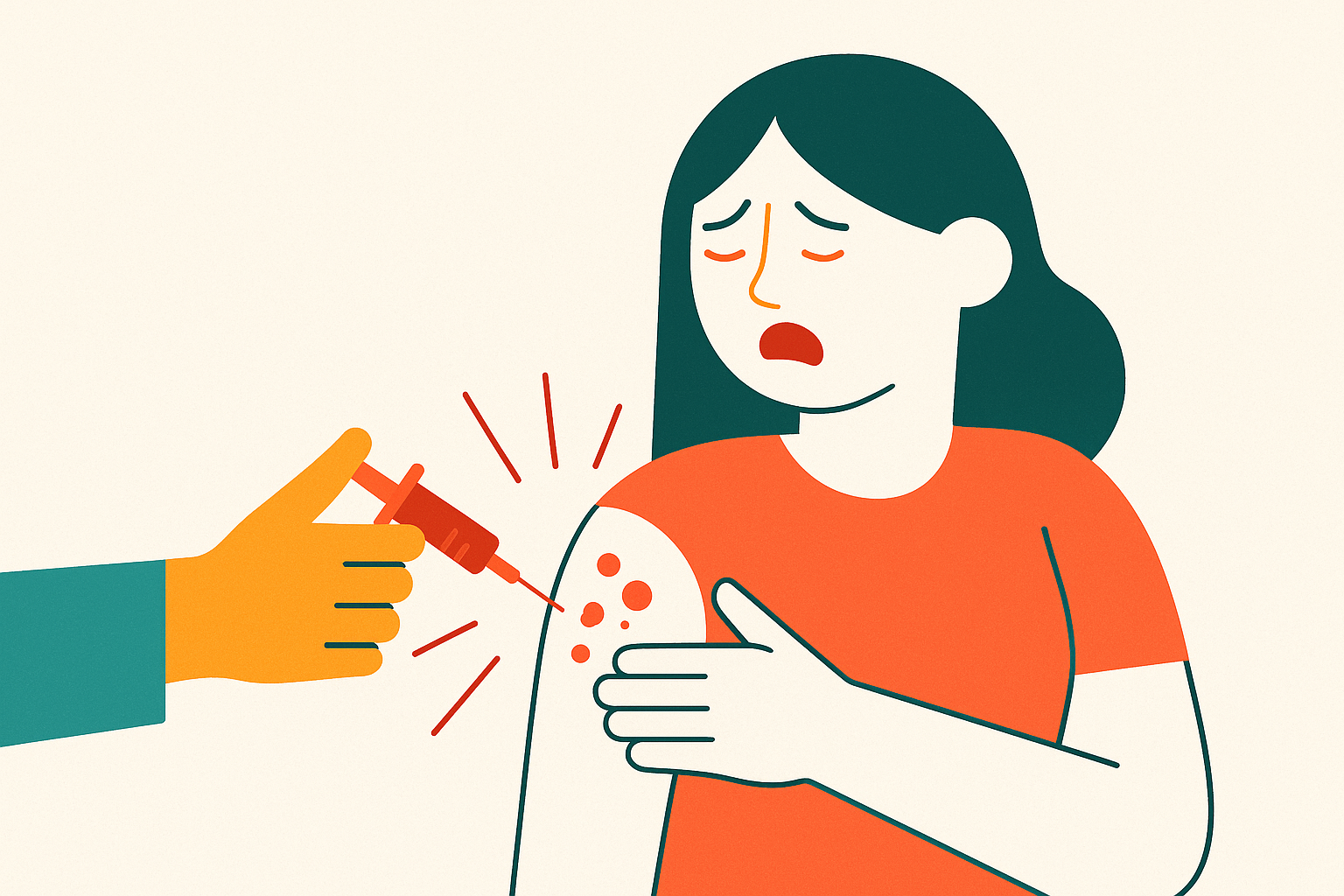
Most people walk out of their first few allergy shot appointments surprised by how little happens. A firm lump, some redness, maybe itching that peaks around the 45-minute mark and fades before dinner. This is the expected response. Your immune system is acknowledging the allergen, cataloguing it, doing exactly what the therapy needs it to do. It resolves within 24 to 48 hours, and it usually does so without much fanfare.
Clinicians draw the line between routine and "large" at roughly the size of a quarter, about 22 millimeters. Under that threshold, a cold compress and an oral antihistamine handle it. Nothing urgent to flag.
A large local reaction, swelling the size of a fifty-cent piece or bigger that persists past 24 hours, occupies its own category. Not dangerous, not a reason to panic, but worth a call to the clinic before your next visit. It tells the provider that the current dose is sitting right at the edge of your tolerance. They pull back slightly and titrate upward again. This is routine, not a setback.
The distinction that actually matters, the one patients routinely conflate, is between a large local reaction and a systemic one. Both can feel alarming in the moment. They are not the same thing, and the difference between them is geographic: one stays in the arm.
The jump to systemic: recognizing signs that go beyond the injection site
The definition is cleaner than most people expect: a systemic reaction involves any part of the body outside the injection site. That's it.
What it looks like in practice varies considerably. Hives spreading across the torso. Sudden nasal congestion. Throat tightness, difficulty swallowing, wheezing. A wave of nausea or dizziness that comes from nowhere. These symptoms often arrive mild, and that mildness is not reassurance so much as it is a narrow interval of opportunity before things accelerate.
The 30-minute post-injection observation period exists because the majority of systemic reactions declare themselves within that window. Staying the full 30 minutes isn't bureaucratic caution; it's when a clinician can intervene while the intervention is still relatively simple. Leaving at 20 minutes because you feel fine is, statistically, usually fine. Occasionally it isn't, and that's precisely why the protocol makes no room for negotiation.
A 2024 revision to the clinical grading system used by allergists reached 85 percent consensus on reclassifying the boundary between moderate and more dangerous reactions. For someone sitting in a clinic chair, though, the taxonomy matters far less than the practical logic it encodes: symptom away from the injection site, act immediately, and avoid a wait-and-see posture.
Anaphylaxis: why it is a 911 call every time, without exception
Anaphylaxis sits at the far end of this spectrum, a rapid, whole-body cascade that can close the airway, collapse blood pressure, and become fatal in the time it takes to debate whether to call for help. The raw numbers are small: roughly 1 fatal event per 9 million injection visits, near-fatal events at approximately 5.4 per million. Small, yes. But the asymmetry is severe. A bad outcome in those cases is irreversible in a way that a false alarm is not, which is why the protocol isn't structured around probability assessment. It's structured around immediate action.
Suspected anaphylaxis means calling 911. Driving yourself anywhere is off the table.
If you carry an epinephrine auto-injector, it goes in first: outer mid-thigh, through clothing if necessary, before the 911 call. Then you wait for help. That sequence matters.
One thing that catches even experienced patients off guard is the biphasic response. A second wave of severe symptoms can emerge anywhere from one to 72 hours after apparent recovery, with no additional allergen exposure. It's been documented in somewhere between 1 and 20 percent of cases, clustering most commonly in that 4-to-12-hour window after initial resolution. I've seen patients insist they felt fine and push to leave early, and I understand the impulse. But "I feel better" after a severe reaction is not, by itself, clinical clearance. Moderate reactions warrant 4 to 8 hours of observation; severe reactions warrant up to 24.
Who is most likely to experience a serious reaction
Risk is not evenly distributed, and it shifts over the course of treatment in ways that aren't always intuitive.
The single strongest predictor of a serious reaction is having already had one. Prior systemic reaction raises subsequent risk roughly fourfold, and that history belongs in every pre-shot conversation with the clinic, rather than buried in intake paperwork completed at enrollment.
Active, poorly controlled asthma meaningfully amplifies the probability that a moderate systemic reaction escalates into something severe. Vigorous exercise within a couple of hours before or after a shot accelerates allergen distribution from the injection site into systemic circulation. Active infection, fever, elevated stress, and certain cardiovascular and antidepressant medications are all established cofactors, so patients on complex regimens should review their full medication list with the treating clinic before shots begin.
Two timing-specific risks deserve their own attention. When starting from a fresh vial, even when the allergen formulation is identical, potency varies between batches. Standard protocol calls for a 50 percent dose reduction at that transition for exactly this reason: a dose that was comfortable from the previous vial will often provoke a stronger response from the new one. Separately, during peak pollen season, the immune system is already operating at a heightened state of reactivity, and the same dose that felt unremarkable in January produces a meaningfully larger reaction in April. This isn't malfunction; it's biology. But it explains why a shot that felt fine for months can suddenly feel different, and why the pre-shot screening questions the clinic asks aren't procedural formality.
What you should not do before or after a shot — and why the contraindications exist
Avoid getting a shot if you're running a fever, have an active rash, are wheezing, or your allergy symptoms have measurably worsened that day. These conditions indicate an immune system already operating in a reactive state, and adding allergen exposure onto that baseline is how manageable situations compound into complicated ones.
The 2-hour no-exercise rule after each shot is mechanistic, not arbitrary. Physical activity increases blood flow, which accelerates allergen distribution from the injection site into systemic circulation. More allergen reaching the immune system faster is the condition that drives reactions. Understanding the mechanism makes the restriction easier to actually follow.
The 30-minute observation window applies across all phases of treatment, including maintenance. Patients sometimes assume that years of uneventful injections have effectively exempted them from this requirement. They haven't. Some patients experience their first systemic reaction after an extended streak of unremarkable visits, which is precisely the scenario the window is designed to catch.
Medication compatibility is a pre-treatment conversation. Certain antihypertensive and antidepressant medications interact with the catecholamine pathways involved in treating anaphylaxis, which can make reactions both more likely to escalate and harder to reverse. For patients on complex regimens, this isn't a footnote.
A practical decision framework: local reaction, systemic warning signs, or emergency
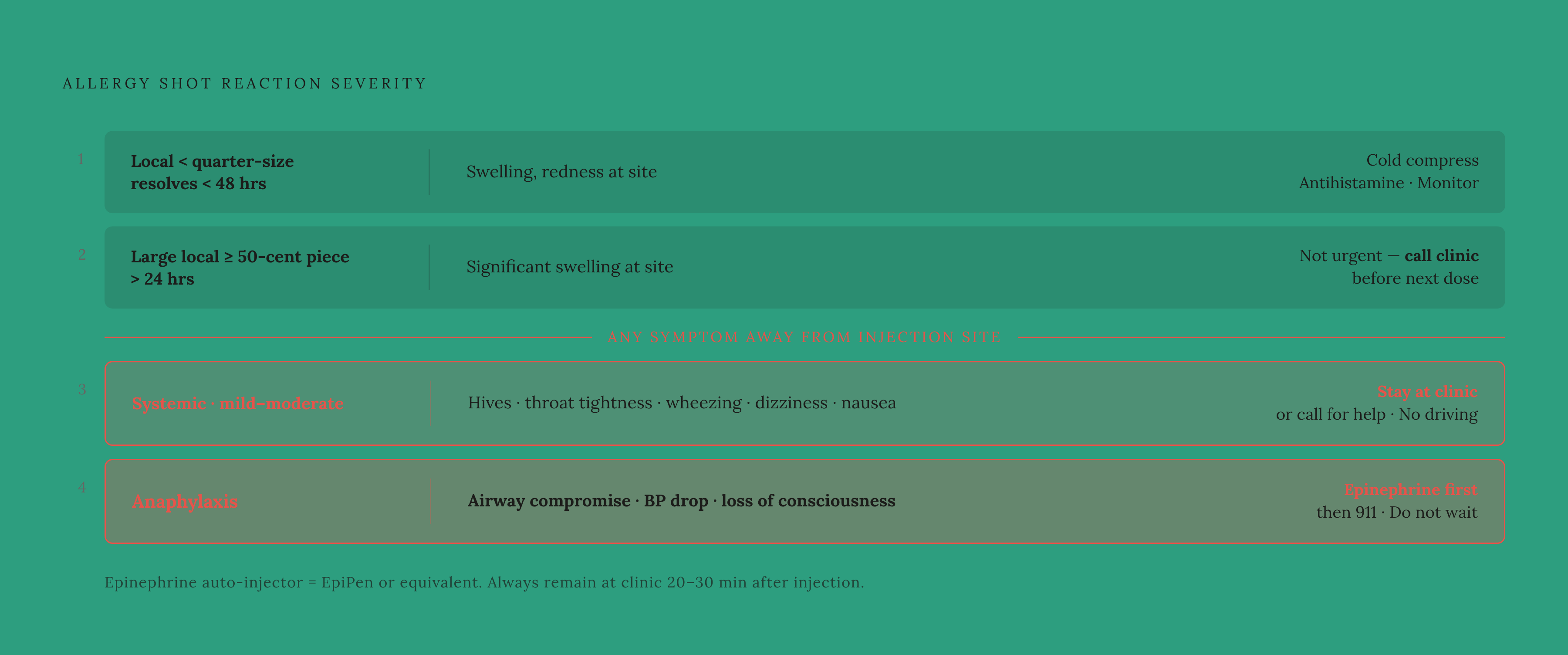
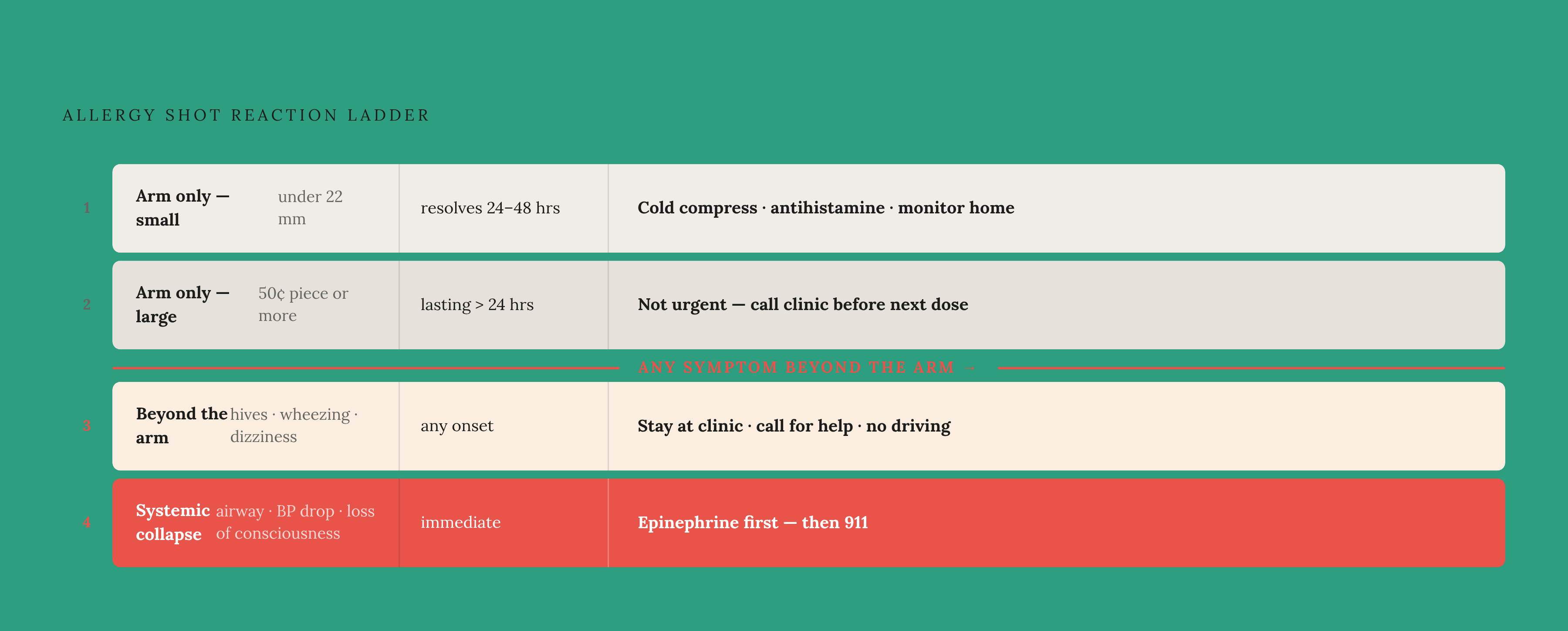
When you're sitting in the clinic chair trying to assess what you're feeling, a clear tiered structure serves you better than a vague spectrum you're trying to locate yourself on.
Local reaction under the quarter-size threshold, resolving within 24 to 48 hours: normal. Cold compress, antihistamine if needed, monitor at home.
Large local reaction, fifty-cent piece or larger, lasting more than 24 hours: not an emergency, but report it to the clinic before your next injection so dosing can be adjusted.
Any symptom occurring away from the injection site, hives, throat tightness, wheezing, dizziness, nausea, flushing beyond the arm: systemic reaction. Stay at the clinic or call for help. Driving yourself anywhere is off the table.
Airway compromise, significant blood pressure drop, loss of consciousness: epinephrine auto-injector first if you have one, then 911. Do not wait to see which direction symptoms evolve.
After any systemic reaction, hold off on returning to shots until the treating physician has cleared you. Dosing protocol will need reassessment, and in some cases the broader question of whether to continue the program at all gets reconsidered.
One practical habit worth building: a brief note after each injection. Reaction size, duration, anything beyond the arm. Thirty seconds of documentation gives your clinic something concrete to work with at the next visit, rather than relying on memory reconstructed weeks later. It sounds minor. In practice, it changes the quality of the conversation.
How the reaction risk profile of allergy shots shapes the case for at-home sublingual immunotherapy
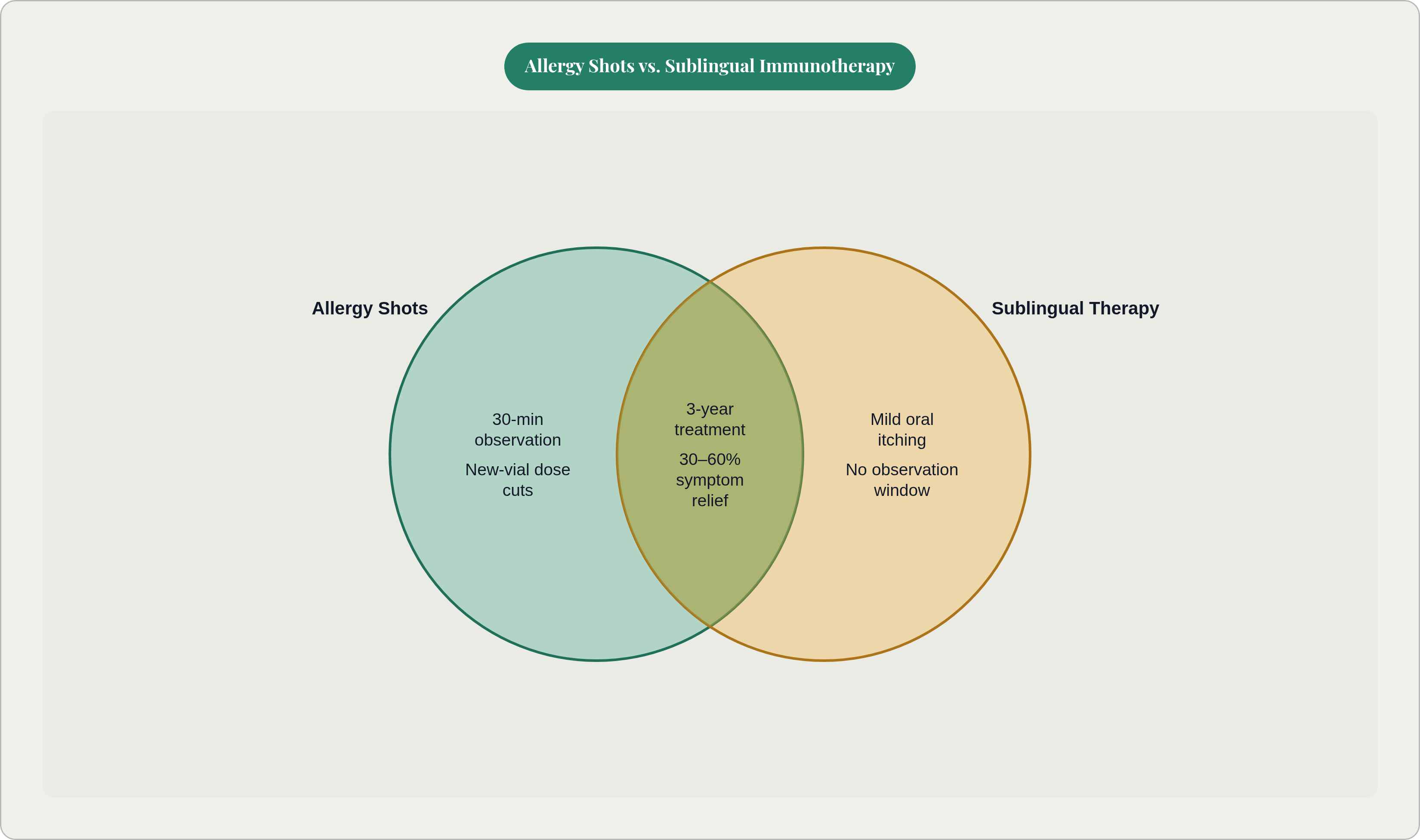
Local injection site reactions occur in somewhere between 26 and 82 percent of patients receiving allergy shots. That range is wide, but even at the low end it tells you something worth sitting with: the entire clinical infrastructure surrounding shots, the 30-minute wait, the no-exercise window, the seasonal adjustments, the new-vial dose reductions, isn't built for rare edge cases. It's built for events that happen with real regularity, across a patient population, over a treatment course measured in years.
Grade 3 severe systemic reactions occur at roughly 1 per 300,000 visits; Grade 4 anaphylaxis at approximately 1 per 160,000. The monitoring infrastructure exists because those numbers aren't zero, and because protocol is what keeps them survivable when they do occur.
All of this also makes allergy shots logistically demanding in ways that accumulate. Weekly clinic visits, observation windows, seasonal scheduling adjustments, years of sustained commitment. For many patients, that's workable. For others, geography or scheduling or an existing risk factor profile makes it impractical, not merely inconvenient.
Sublingual immunotherapy, delivered as drops or FDA-approved tablets to the oral mucosa rather than by injection, produces a different reaction profile at the level of the delivery route itself. Systemic reactions are substantially less frequent. Most adverse effects are mild oral itching or tingling that resolves within the first few days. That profile is what allows self-administration at home without mandatory post-dose observation. A pediatric peanut sublingual trial found that 8 percent of active participants reported multisystem reactions compared to 20 percent in the placebo group, and no participant required epinephrine.
Both approaches pursue the same immunological objective: retraining the immune system rather than suppressing symptoms. Both require roughly three years of consistent treatment for durable benefit. Efficacy is comparable, with symptom reductions in the 30 to 60 percent range for most patients across both modalities. Injections produce faster early relief during the build-up phase; that gap narrows over a full course.
The reaction risk profile is a clinically legitimate variable in the treatment decision, not just a lifestyle preference. Which delivery method is appropriate depends on the patient. But making that judgment clearly requires understanding what each option's risk profile actually looks like, not just which one sounds easier to fit into a schedule. Wyndly, a direct-to-consumer telehealth allergy clinic that delivers personalized sublingual drops or FDA-approved tablets to patients at home after a virtual doctor visit, is one structured way to pursue that route.