Delayed Reaction to Allergy Shot Causes and Management
Uncontrolled asthma and prior reactions drive most serious complications hours after injection.
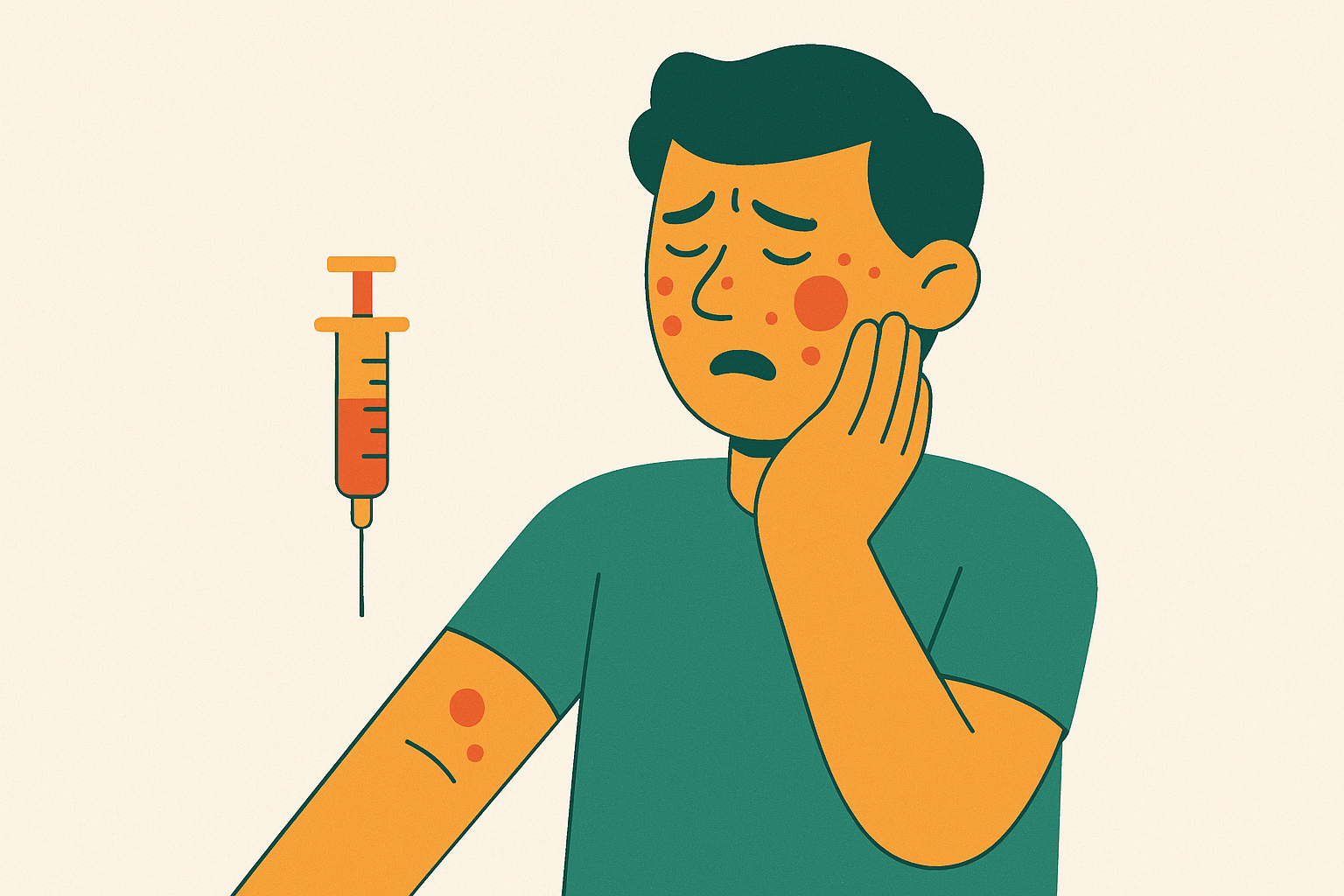
Allergy shots, also called subcutaneous immunotherapy or SCIT, work by feeding the immune system small, rising doses of an allergen over three to five years until real tolerance sets in. Most reactions show up at the injection site and fade on their own, but some don't. They wait, sometimes for hours, sometimes until well after the patient's gone home, and I want to walk through those delayed systemic reactions specifically, because they're the ones that catch people off guard.
How often delayed and systemic reactions actually occur
Local reactions are common. Itching or redness bigger than an inch across hits somewhere between 26% and 86% of SCIT patients, which is a wide range, I know, but whatever the exact number, these are a nuisance, not a danger.
Systemic reactions live in a different category. Less than 1% of patients get one, and the per-injection rate runs about 0.1% to 0.2%. Life-threatening systemic reactions occur around 1 per 160,000 injection visits, and fatal reactions are rarer still: somewhere between 1 per 7.2 million and 1 per 9.1 million visits. A Canadian clinic looked at 4,242 injections and found 10 that needed epinephrine, an incidence of 1 in 424, or 0.24%.
One number stuck with me longer than the rest. Research has found that roughly half of all systemic reactions happened outside the clinic, even with the standard 30-minute observation window in place. That window catches fast, immediate danger, but it was never built to catch what comes later. The risk doesn't vanish once someone walks out the door; it just moves somewhere the clinic can't watch anymore.
These are small numbers, and I won't pretend otherwise. But small isn't the same as zero, and once you notice that delayed reactions track with specific risk factors and specific timing, the picture stops looking random. It starts looking like something a patient can actually plan around.
The main causes and mechanisms behind delayed reactions
Why would a reaction wait hours to show up? Immune activation just isn't instant. Mast cells and basophils release their chemical signals, cytokine cascades build over time, and IgE-driven responses take a while to fully play out, sometimes minutes, sometimes half a day.
One mechanism worth knowing: the depot effect. Some SCIT formulations, more common in Europe, use aluminum hydroxide as an adjuvant, and that alum forms a small depot under the skin and releases allergen slowly instead of all at once. A 2025 study in the Annals of Allergy, Asthma & Immunology, drawing on the European Anaphylaxis Registry, points to this as a possible explanation for why European data shows higher rates of delayed reactions than other regions.
Dosing matters too. Build-up, while doses are still climbing, carries more risk than maintenance, where the dose has leveled off, and rush protocols compress that build-up into a shorter timeline, which stacks even more risk on top. Season plays its own role: a shot during peak pollen, when the immune system's already primed and irritated, raises the odds compared with that same shot in a quieter month.
Then there's the plain procedural stuff, like the wrong dose, the wrong extract, or a needle that lands in a blood vessel instead of the subcutaneous tissue it's supposed to reach. Timing on the patient's side matters too: exercise after a shot speeds up blood flow, and that can pull the allergen into circulation faster than expected, occasionally turning a borderline dose into an actual reaction. A patient fighting a cold, or whose allergy symptoms are already flaring, isn't starting from the same immune baseline as someone stable. That shift changes how the body handles the dose.
Who faces a higher risk of a serious delayed reaction
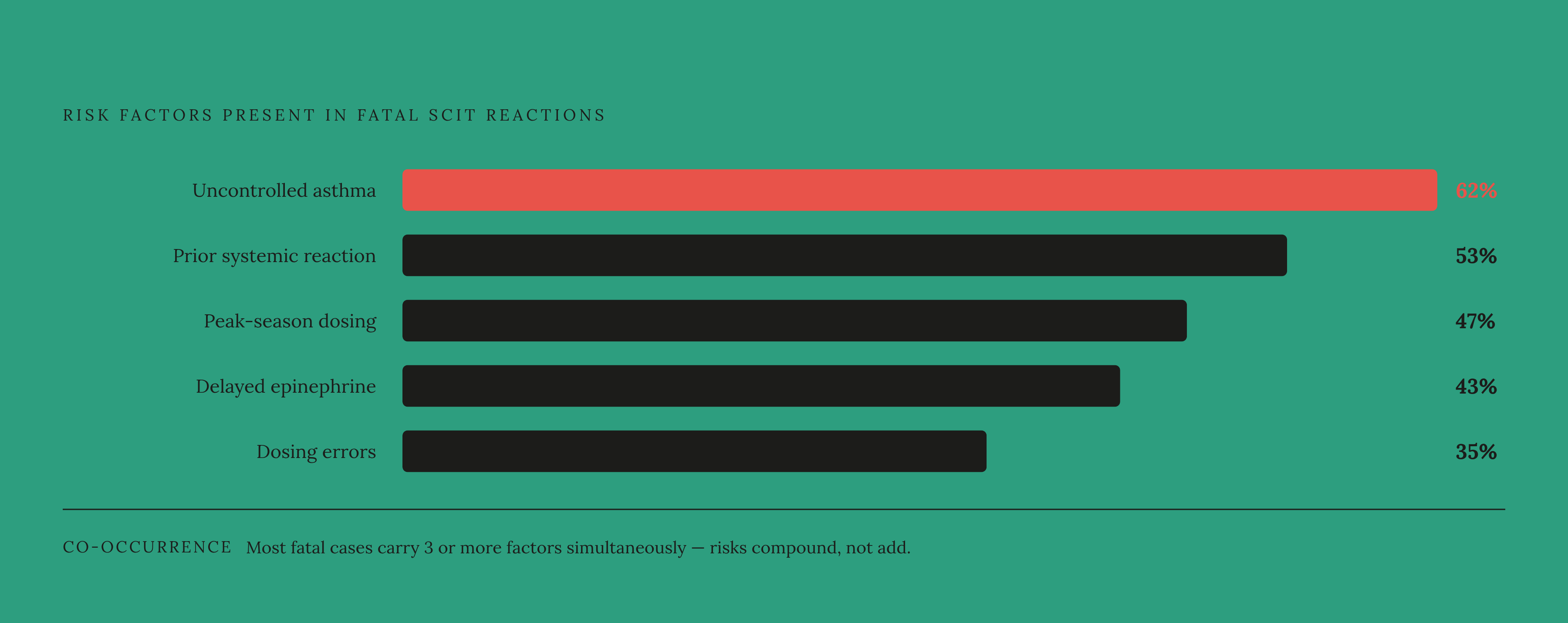
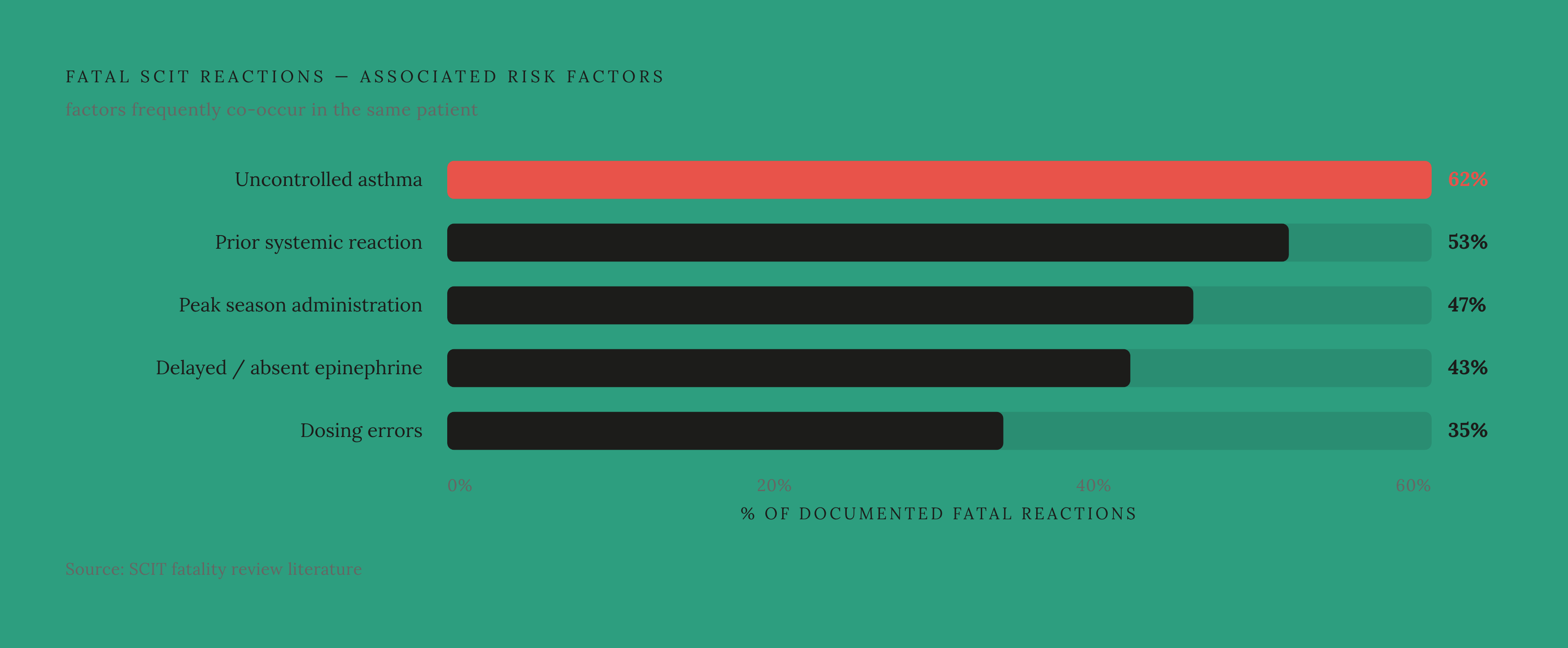
Some patients carry more risk than others, and the data on fatal reactions makes that pattern pretty clear. Uncontrolled asthma shows up in 62% of documented fatal SCIT reactions, by far the biggest single risk factor. A prior systemic reaction to SCIT shows up in 53% of fatal cases, and a body that's reacted once can react again; that much isn't complicated.
Timing counts too. Peak season administration appears in 47% of fatal cases, and here's a factor that has nothing to do with the patient's biology at all: delayed or absent epinephrine use shows up in 43% of fatal cases. That's a treatment gap, not a patient failure, and it tells me outcomes often hinge as much on what happens after symptoms start as on the reaction itself. Dosing errors turn up in 35% of fatal cases, another sign that process matters just as much as biology here.
Age plays into it as well. The 2025 European Anaphylaxis Registry analysis found that serious grade III delayed reactions clustered disproportionately in children and teenagers, often with asthma sitting alongside as a complicating factor. Medications deserve a mention, too: beta-blockers blunt how well epinephrine works during a severe reaction, and ACE inhibitors have drawn specific concern in venom immunotherapy. Anyone on either one needs a direct conversation with their allergist before starting SCIT.
None of this sits alone in most fatal cases; it stacks. A patient with uncontrolled asthma, getting a shot during grass season, on a beta-blocker, carries a very different risk load than a stable adult managing mild seasonal rhinitis, even though they're getting the exact same treatment.
Recognizing the signs of a delayed systemic reaction
A delayed reaction can look exactly like an immediate one, and the symptoms aren't different; only the clock is.
Mild end of things: generalized hives, itching, sneezing, a runny nose that outlasts the usual brief post-shot irritation. Moderate steps it up: swelling in the face, lips, or throat, worsening congestion, mild tightness in the chest. Severe demands action right away: wheezing, shortness of breath, a real drop in blood pressure, a pulse that's racing or weak, nausea, vomiting, dizziness, loss of consciousness. That's anaphylaxis, and it doesn't wait for permission.
A 2022 case published in the Annals of Allergy, Asthma & Immunology shows how easy this is to get wrong. A 35-year-old man experienced a delayed-onset anaphylactic reaction beginning 12 hours after his first SCIT dose and didn't seek care, instead treating it himself with diphenhydramine, an antihistamine, which gave him only temporary relief. Wheezing developed at 24 hours, then returned again at 72 hours, and each time he chalked it up to his underlying condition rather than the shot.
That's the trap with delayed reactions: distance from the injection makes people doubt the connection is even real. Any respiratory symptom, any cardiovascular symptom, any widespread skin reaction that shows up within hours of a shot deserves treatment as reaction-related until proven otherwise, even if the patient's been home for hours and started to relax. Local reactions right at the injection site, redness, minor swelling, some itching, are common and usually clear up on their own. Real concern starts when symptoms spread past the injection site or move into the airways and cardiovascular system, and roughly half of systemic reactions happen after that 30-minute clinic window closes, meaning leaving the building doesn't mean the risk window closed too.
What to do when a delayed reaction develops at home
The right response depends entirely on severity, so sort by what's actually happening, not by how alarmed you feel.
Mild local reactions, redness or minor swelling right at the injection site, just need ice, an antihistamine if the allergist has recommended one, and some watching to make sure nothing spreads. Mild systemic symptoms sit in a different category: generalized itching or hives with no throat involvement call for contacting the prescribing allergist right away instead of waiting to see if things settle.
Moderate to severe symptoms belong in their own tier entirely. Any respiratory involvement, throat tightness, dizziness, or cardiovascular signs mean using the epinephrine autoinjector immediately and calling emergency services, and the patient should not drive themselves anywhere.
Why not just reach for an antihistamine first? They work too slowly, and they don't touch the cardiovascular or respiratory mechanics of anaphylaxis, since they just quiet the skin symptoms. That 2022 case is a direct illustration of the mistake: temporary relief that masked a real problem instead of solving it. Every SCIT patient should have an epinephrine autoinjector on hand, and for patients carrying identified risk factors, that's not optional. The 2025 Annals and European Registry data specifically calls for considering autoinjector prescriptions for children, teenagers, and other higher-risk patients.
After any systemic reaction, the conversation with the clinic matters as much as the reaction itself. The allergist needs the timeline: roughly when symptoms started, what showed up first and what followed, which medications got taken and whether they helped at all. That information often leads to a lower dose or an adjusted schedule going forward. A few habits help prevent repeat trouble: skip strenuous exercise for several hours after a shot, skip the shot entirely when sick or when allergy symptoms are flaring hard, and flag any new medication, especially beta-blockers, before the next visit.
How clinics work to prevent delayed reactions before they happen
The 30-minute observation window is built to catch reactions most likely to happen fast. Think of it as a floor, not a ceiling.
Good clinics screen before every single injection, not just the first one. That means checking current health, symptom levels, recent illness, and new medications before the needle goes in. Asthma control gets checked at each visit too, and that's not just paperwork; given that uncontrolled asthma shows up in the majority of fatal cases, this one check might do more preventive work than almost anything else in the process.
Beta-blockers get specific attention. Most guidelines call for stopping them before starting SCIT, since they get in the way of epinephrine's ability to reverse a severe reaction. Dose reduction kicks in after a treatment gap, during early build-up, and after any prior systemic reaction, because a body that reacted once doesn't get the same dose escalation as one that hasn't.
Patient education is its own layer, and an easy one to underrate. Clinics need patients to actually know what a delayed reaction looks like, how to use an epinephrine autoinjector without freezing up, and when the right call is the emergency room instead of waiting it out at home. For patients carrying real risk, kids with asthma, anyone with a prior systemic reaction, the 2025 European registry study raises a question worth putting to your own allergist directly: should your observation window run longer than 30 minutes?
How sublingual immunotherapy compares on the reaction risk question
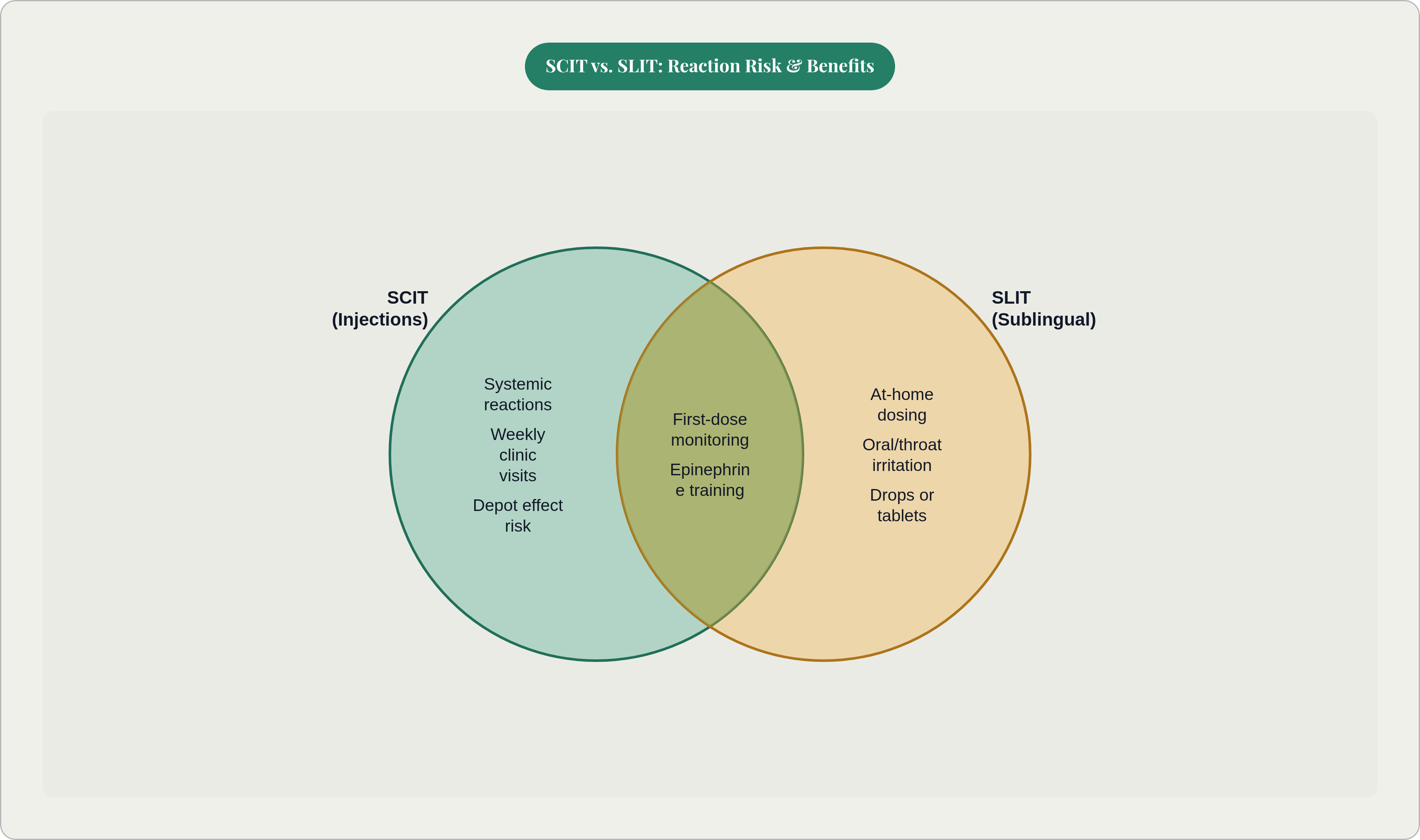
Sublingual immunotherapy, or SLIT, chases the same biological goal as SCIT: building regulatory T-cell responses, tamping down IgE, teaching the immune system tolerance. The safety profile splits off in a way that actually matters, though.
SLIT's most common side effects stay local: oral itching, throat irritation, mild swelling in the mouth, rather than reaching into the airways or cardiovascular system the way systemic SCIT reactions can. Recent reviews in both adults and kids find no real difference between SCIT and SLIT on symptom control or medication needs, but SLIT shows fewer treatment-related adverse events overall. That gap shows up in the data itself, not in how either one gets marketed.
SLIT still carries risk from day one. The first dose needs in-office administration, a 30-minute observation period, and epinephrine training, same as SCIT, and the difference shows up after that. For patients whose risk factors or reaction history make weekly injections hard to sustain, SLIT is a real, clinically recognized option worth raising with an allergist, though it isn't a guaranteed fit for everyone.
Part of what makes SLIT appealing for the right patient is what it takes off the table. At-home dosing, through sublingual drops or FDA-approved tablets, cuts out the weekly clinic visit entirely once that first dose clears. Studies on consistent SLIT use for environmental allergies report symptom drops in the 60% to 80% range. For patients managing real reaction anxiety, or who simply can't get to a clinic every week, weigh that against SCIT's tighter track record on head-to-head symptom data before deciding. Some allergists now offer virtual follow-ups alongside at-home SLIT dosing, which helps people without easy access to an in-person clinic. Wyndly, a direct-to-consumer telehealth allergy service that mails personalized sublingual drops or FDA-approved tablets to patients after a virtual doctor visit, is one example of how at-home SLIT care is currently structured. It's still worth asking any provider how they handle the first-dose observation, and what their plan is if something goes wrong hours later at home.