Side Effects of Allergy Shots Patients Should Know
Delayed reactions and seasonal flare-ups make side effect timing unpredictable for most patients.

Allergy shots (subcutaneous immunotherapy, or SCIT) produce local reactions in most patients: redness, swelling, itching, and tenderness at the injection site, often lasting a day or two after the injection.
Local reactions at the injection site are the most common experience: redness, swelling, itching, and tenderness that can appear several hours after the injection, or even a day or two later, not just in the clinic waiting room. Ice, rotating injection sites, and an over-the-counter antihistamine handle most of these reactions; they are self-limiting and rarely a reason to stop treatment. Systemic reactions, ranging from generalized hives and nasal symptoms to more pronounced respiratory effects, are less frequent but can occur up to several hours after leaving the clinic, so knowing what to watch for at home matters as much as the 30-minute in-office observation period. Reactions tend to be more pronounced during peak pollen season even at a familiar dose, because elevated immune reactivity in the surrounding environment changes how the same injection behaves.
Redness, swelling, itching, tenderness at the injection site. These are the calling cards of subcutaneous immunotherapy (SCIT), the clinical name for allergy shots, and the majority of patients encounter them at some point, especially during the buildup phase when doses are climbing weekly. This is not a side effect that happens to a small, unlucky cohort. It is the modal experience.
What catches people off guard most often is the timing. A reaction doesn't have to show up in the waiting room. It can surface several hours later, or even a day or two after the injection, right around the time you've stopped thinking about it. Delayed-onset local reactions are common, and patients who are unforewarned tend to misattribute them, sometimes attributing the swelling to a bug bite, sometimes deciding something is wrong when it is actually entirely expected.
Management is straightforward: ice, rotation of injection sites, and an over-the-counter antihistamine if needed. The reactions are self-limiting and rarely a clinical reason to discontinue treatment.
There is one subtlety worth knowing. The severity of local reactions can wax and wane with the calendar, not just with your dose. During peak pollen season, when your immune system is already operating at an elevated state of alertness, the same dose that felt uneventful in January will produce a more pronounced local response in April. This is a feature of how the immune system works during active exposure, not a sign that the treatment is failing or that something went wrong. But if your allergist hasn't mentioned it, you will find it disorienting when it happens.
Track your local reactions and report them. They matter diagnostically, and they are your first real data about how your immune system is calibrating to the protocol.
What should I expect from systemic reactions, and what do I watch for after leaving the clinic?
A systemic reaction is any immune response that occurs away from the injection site. The spectrum is wide, and the mild end of it is easy to confuse with your allergies themselves.
Generalized itching. Hives appearing on a part of the body nowhere near the shot. Nasal congestion, sneezing, a runny nose that starts 20 minutes after you've received the injection. A subtle urge to clear your throat. Mild wheezing. These are real systemic reactions, and they can feel indistinguishable from a bad allergy day, which is precisely why patients need to know they belong in a different category and deserve a different response.
Moving up the spectrum: widespread hives, swelling that extends beyond the injection site, chest tightness, more pronounced respiratory symptoms. These are less frequent, but they are not rare enough to treat as statistical abstractions.
Most systemic reactions, when they occur, manifest within 30 minutes of injection. This is the direct, structural rationale for the mandatory in-office observation period after every shot. The wait is not administrative courtesy. It is the protocol acknowledging, explicitly, that this risk window exists.
But here is what many patients are never told: late-onset systemic reactions can occur anywhere from 30 minutes to several hours after you have left the clinic. The probability drops considerably outside the observation window, but it does not reach zero. Patients need to know what to watch for at home, not just in the waiting room chair.
Certain variables elevate the probability of a systemic reaction considerably. Poorly controlled asthma is chief among them. Getting a shot during peak allergy season, when your immune system is already primed and reactive, raises the risk at what would otherwise be a routine dose level. Active illness or infection, even something minor, can shift immune reactivity enough to make a standard dose behave unexpectedly. Beta-blockers are a particularly consequential medication interaction, and we'll return to why. And the moments of greatest risk within the protocol itself are the dose escalation steps, when the allergenic load you're receiving is, by design, higher than what your body has previously tolerated.
Anaphylaxis (the rare but serious end of the risk spectrum)
Anaphylaxis is the reason the 30-minute wait exists. Full stop.
It is a severe, potentially life-threatening systemic allergic reaction: rapid drop in blood pressure, throat swelling, difficulty breathing, potential loss of consciousness. It requires immediate epinephrine. Every clinic administering allergy shots is equipped with it specifically because anaphylaxis, while rare, is an acknowledged risk of the protocol.
The candid framing here matters. The 30-minute observation requirement is not a formality or a liability hedge; it is a structural acknowledgment that a catastrophic immune response can occur after any injection, and that distance from emergency intervention dramatically changes the outcome. Patients who leave early are not bending a rule. They are removing themselves from the only safety net the protocol provides during the highest-risk window.
The buildup phase carries the most elevated anaphylaxis risk. When doses are escalating and the patient's tolerance threshold is still being established, each injection is, by definition, asking the immune system to accommodate more than it has before. This is where the system is being meaningfully stressed.
Poorly controlled asthma is the strongest individual risk modifier. Clinics will not administer a shot during an active asthma flare for this reason. It is one of the most consistent contraindications across practice settings.
Deaths associated with allergy shots have been reported in the medical literature. They are not common. The long-term safety record of SCIT, at the population level, is solid. But candid counsel includes acknowledging that the acute anaphylaxis window persists throughout the entire treatment course, not just in the early months. This is not a reason to refuse treatment if you are a well-screened, well-managed candidate. It is a reason to take the protocol's non-negotiables seriously.
The variables that make side effect risk different for each patient
Risk in this protocol is not distributed equally, and understanding your own modifiers matters more than knowing the population-level numbers.
Asthma control status is the single most important individual variable. Poorly controlled asthma does not just modestly raise the probability of a systemic or anaphylactic reaction; it substantially reconfigures your risk profile. Before starting shots, or before any given injection, this is the question that deserves the most careful self-assessment.
Seasonal timing affects reactivity at the same dose. Peak pollen periods, when your immune system is already engaged in active allergic response, make injections inherently more provocative. Some patients are surprised to learn that a dose they tolerated comfortably all winter becomes more reactive in spring, because the variable is the immunological context surrounding it, not the shot itself.
Where you are in the protocol matters enormously. The buildup phase, particularly during dose increases, is the highest-risk window. Maintenance, once your dose has stabilized, is considerably more predictable.
Active illness at injection time is worth taking seriously even when it feels minor. Even a mild cold can alter immune reactivity enough to make postponement the clinically sound choice. Good allergy clinics have protocols for this; patients should understand the reasoning behind the deferral rather than viewing it as inconvenient overcaution.
Beta-blockers require explicit mention. These medications, used for cardiac conditions and sometimes for migraines, reduce the effectiveness of epinephrine, which is the first-line treatment for anaphylaxis. If epinephrine becomes necessary and is partially blunted by beta-blocker use, the clinical situation becomes substantially more difficult to manage. Allergists screen for this, but patients who are on beta-blockers need to raise it proactively, every time there is any change in their medication regimen.
Gaps in the injection schedule introduce a mechanism many patients fail to anticipate. Immunological tolerance built during the buildup phase can partially reverse during a significant lapse. Resuming at the previously tolerated dose after a long gap therefore carries the same elevated risk as a dose escalation step, because the immune system's learned accommodation has regressed. Clinics typically require a dose rollback after extended absences, which extends the overall timeline and the period of elevated risk.
Finally, individual allergen sensitivity varies. A patient being desensitized to bee venom or certain molds carries a meaningfully different baseline risk profile than someone treating mild seasonal grass pollen allergy. The allergen itself, not just the protocol, is a variable in your personal risk calculus.
What the multi-year schedule means practically for patients who experience side effects
This is where the arithmetic of commitment becomes real.
Allergy shots are not a course of antibiotics. They are a three-to-five-year protocol, with injections every one to two weeks for the first six to ten months, followed by monthly maintenance visits for years afterward. Every single one of those visits includes the 30-minute observation window. At minimum, you are committing roughly an hour per visit, often more.
When a reaction occurs, that time extends. When a systemic reaction occurs, dose rollback typically follows, which elongates the buildup phase and pushes the timeline to meaningful symptom relief further out. Most patients begin noticing improvement somewhere between three and six months into treatment; substantial relief often takes a year or two. A significant reaction and the subsequent schedule adjustment can displace that timeline considerably.
Local reactions during buildup are not a one-time event. They recur across dozens of injection visits. The arm that swells and itches in February will likely have opinions about the escalating dose in June. This is manageable, but it accumulates.
There is an adherence dynamic worth naming directly. Patients who experience a significant systemic reaction sometimes discontinue treatment, which is a psychologically understandable response to a frightening event. The clinical consequence, though, is that stopping before the protocol is complete forfeits the long-term tolerance the treatment is building toward. The immunological work done in the buildup phase does not fully persist without the maintenance phase reinforcing it. Discontinuation is not a neutral act.
The clinic dependency is structural and cannot be negotiated away. Unlike oral medications or at-home therapies, every dose of SCIT requires physical presence in a monitored setting. Travel, work demands, illness, childcare, and the ordinary entropy of life all create gaps. Those gaps have clinical consequences. Before committing to shots, a patient should assess, with real candor, whether their life as it actually exists (not as they optimistically project it) can accommodate this schedule reliably across a multi-year horizon.
How sublingual immunotherapy compares on the side effect profile
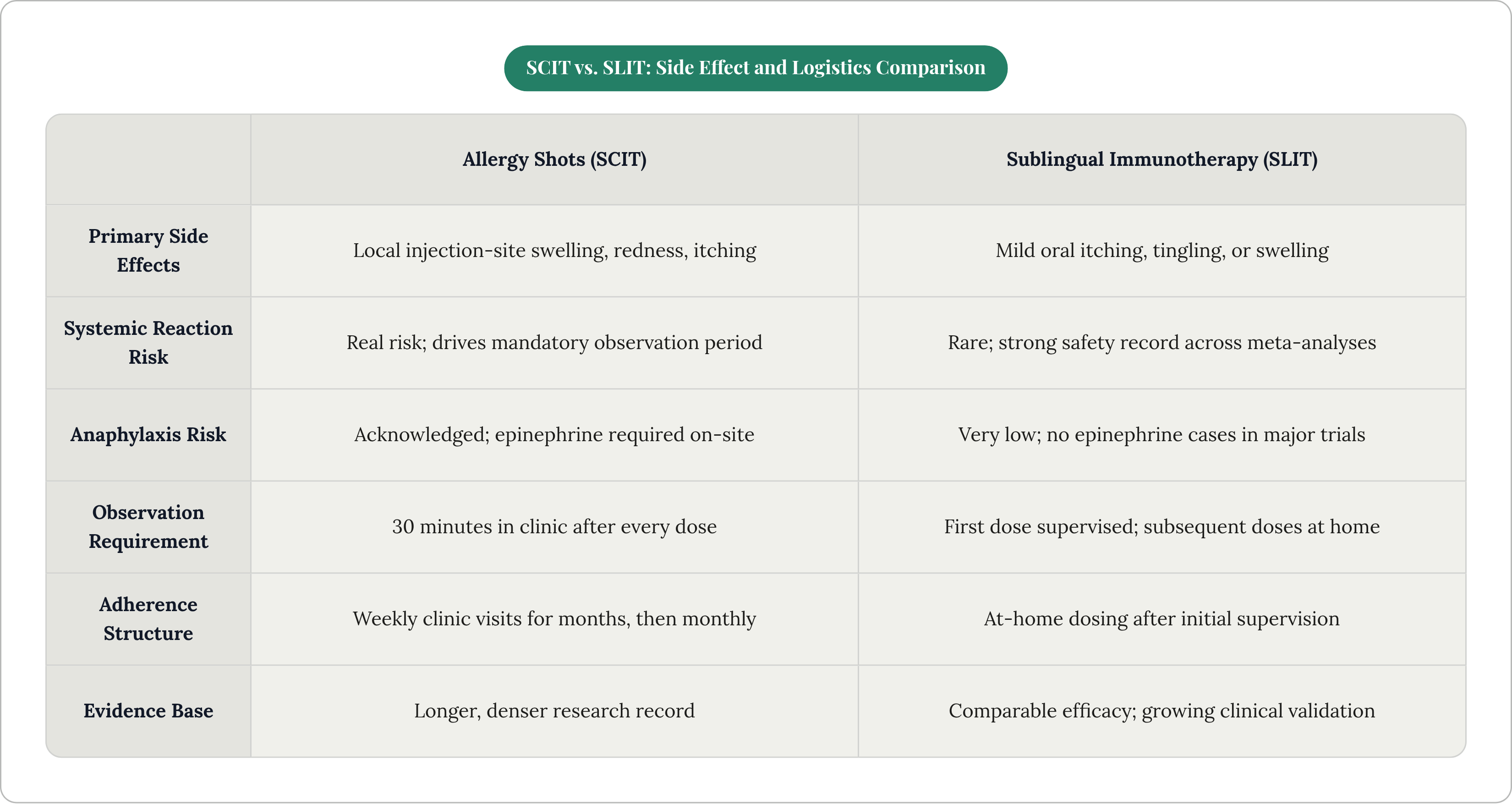
Sublingual immunotherapy (SLIT) operates on the same biological principle as shots: it is not symptom masking, it is tolerance-building through graduated allergen exposure. The delivery mechanism is entirely different (drops or dissolving tablets placed under the tongue), and this distinction produces a categorically different side effect profile.
The predominant reactions with SLIT are local oral effects: mild itching, tingling, or swelling under the tongue. They are generally mild and resolve quickly. Serious systemic reactions with sublingual delivery are rare; the safety literature across multiple meta-analyses characterizes SLIT as substantially free from serious systemic events in a way that SCIT, by the nature of its delivery, cannot claim equivalently.
A peanut SLIT trial published in the Journal of Allergy and Clinical Immunology in 2024 provides instructive context. In that study, multisystem reactions were reported by caregivers in 8% of active subjects and 20% of placebo subjects. Notably, no participant required epinephrine, which speaks to the safety margin of sublingual delivery even in a high-sensitivity population treating one of the most reactive allergens in existence.
There is no mandatory observation period after each dose for established sublingual regimens. After the first dose, which typically requires medical supervision for FDA-approved tablet formulations, subsequent doses are taken at home. The logistical implications of this are significant: the clinic dependency that shapes the SCIT experience is largely absent.
On efficacy, the 2024 clinical practice guidelines from the American Academy of Otolaryngology-Head and Neck Surgery Foundation issued a strong recommendation for immunotherapy broadly, covering both modalities. For most environmental allergens, SLIT achieves comparable symptom reduction to shots.
The candid tradeoff: shots have a longer and denser research record, and some evidence suggests faster early benefit in certain patients. SLIT's advantages are most pronounced across the full multi-year treatment course, where its safety profile and at-home administration model create a more sustainable adherence structure for patients who cannot reliably maintain a weekly clinic schedule.
Neither modality is universally superior. They are different tools, and the right one depends on the patient's health status, allergen profile, and life circumstances.
What an informed decision actually requires before starting shots
Certain questions should be answered before any patient commits to an immunotherapy protocol. To be answered not by a pamphlet, but in a real conversation with the prescribing allergist.
Is your asthma currently well-controlled? If not, this is not the right moment to start. What medications are you taking, and do any of them interact with epinephrine? Beta-blockers in particular need to be surfaced and discussed explicitly. What is the clinic's protocol if a systemic reaction occurs during your observation period? What happens to your dose schedule if you miss several appointments, or have a significant reaction and need to roll back? And critically: are you being tested and treated for your actual allergen profile, or a generic panel that may not reflect what is driving your symptoms?
That last question is more important than it initially appears. A treatment plan calibrated to your actual allergy test results will consistently outperform one built on assumptions or broad-spectrum protocols. This principle applies regardless of whether you pursue shots or sublingual immunotherapy.
The schedule reality check deserves its own moment of candor. Weekly clinic visits for six to ten months, then monthly visits for years. Life changes. Assess this against your actual life, not your ideal one.
If SCIT doesn't fit, sublingual immunotherapy is a clinically validated, regulatory-agency-approved alternative for a range of major allergen categories, with a gentler side effect profile and an adherence structure that suits more patients over a multi-year horizon. The choice of modality should be a real conversation, not a default.
What is not a viable long-term strategy is indefinitely managing symptoms with antihistamines and nasal sprays. Those medications address symptoms; they do not retrain the immune system. The root cause remains active and continues to compound. Getting tested, getting an accurate allergen profile, and beginning some form of immunotherapy is the step that antihistamines cannot substitute for, and the side effect picture explored here is precisely what should inform how you take that step, not whether.