How to Interpret an Allergy Test Results Report
Decode your allergy test results by matching sensitization numbers to your actual symptoms.

About 81 million Americans got diagnosed with seasonal allergic rhinitis in 2021. Most of them got their results back as a printout full of allergen codes and decimal numbers, with nobody around to explain what any of it means. That gap, between "you tested positive" and "so what happens now," is what this piece is trying to close.
What allergy tests are actually measuring (IgE antibodies explained)
Every allergy test, skin prick or blood draw, is reading the same underlying story: your immune system's IgE-antibody response to a specific allergen.
IgE is the antibody class behind classic allergic reactions. Its job is to flag a perceived threat and set off histamine release, along with a handful of other inflammatory chemicals. Why would a body build antibodies against something as harmless as ragweed pollen or a dust mite dropping? That's the whole foundation of allergy biology right there. The immune system mistook something benign for something dangerous once, and it keeps making that same mistake on repeat, every single exposure.
Two formats show up on most reports. Skin prick testing (SPT) applies allergen extracts to the skin and checks the reaction 15 to 20 minutes later; a positive shows up as a wheal (that raised bump) of 3 mm or more. Blood-based IgE testing comes in a couple of forms: ImmunoCAP specific IgE measures the actual quantity of allergen-specific IgE circulating in your blood, and ELISA detects antibodies against specific allergens on some lab panels too.
At-home finger-prick kits run on the same principle, processed under CLIA lab standards. Quite a few panels now screen 40 or more aeroallergens, results back in a few business days to a week.
Neither format hands you a diagnosis on its own. They're confirmatory, both of them. Your clinical history (what symptoms you get, when they show up, how bad they get) is what makes anyone suspect allergy in the first place. The test confirms or rules out that suspicion; it doesn't generate it from scratch.
How to read the numbers on a blood IgE test report
Blood IgE values sit on a continuous scale from 0.00 to 100.00. That number reflects how much allergen-specific IgE is circulating in your blood, nothing more exotic than that.
Anything above 0.35 generally counts as positive. Below that, sensitization is unlikely. But the space above 0.35 isn't one flat category, and treating it that way is where people get confused. Just above 0.35 usually means low-level sensitization, which might cause noticeable symptoms or might do nothing much at all. Mid-range values point to moderate sensitization, where symptoms tend to show up more consistently. High values toward the upper end mean strong sensitization, often tied to more severe symptoms triggered by even small exposures.
A high number doesn't automatically mean worse symptoms. And a low positive doesn't mean the allergen is irrelevant to you, either. Symptom patterns have to get matched against results; they don't get read off them in isolation. Each allergen gets its own value, so a report might list a dozen or more separate numbers, one per allergen tested. You're looking at a whole column, not a single verdict handed down from on high.
Some commercial panels tack on IgG food-sensitivity testing. That has limited clinical value, honestly, and can genuinely mislead you. If you're chasing a true allergy question, IgE is the number that matters.
What the numbers won't tell you: which specific exposure caused last week's reaction, whether a sensitivity will worsen over time, or whether you need treatment starting today. Those calls need a clinician's judgment layered on top of the raw values, every time.
How to read the rating scale on a skin prick test report
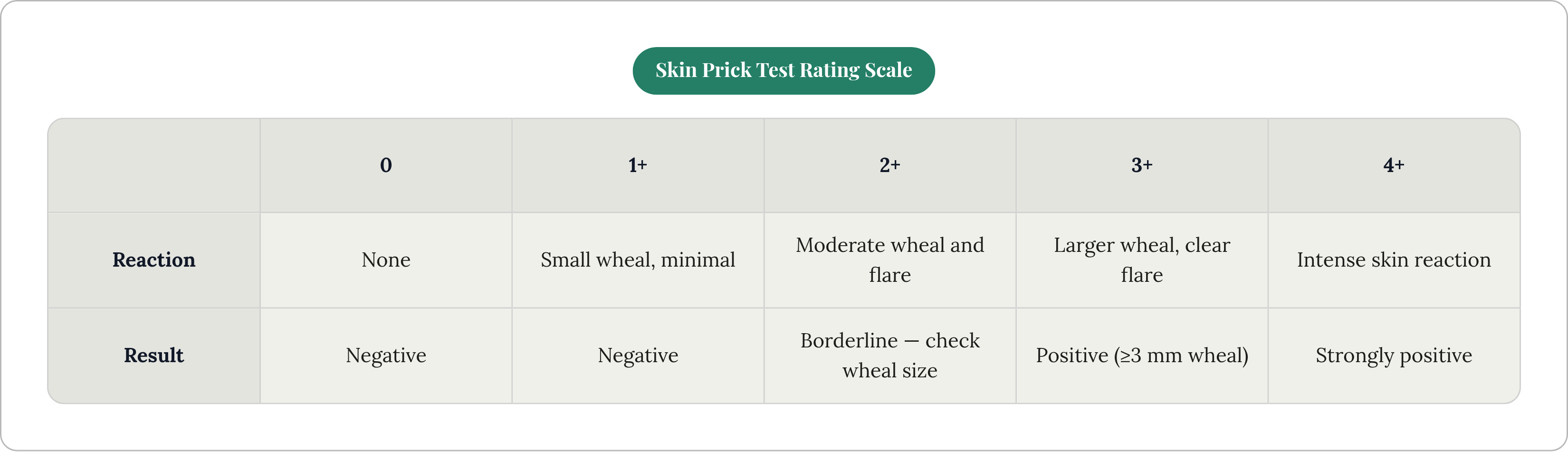
Skin prick results skip the 0-to-100 scale entirely and run on a 0 to 4+ rating instead. A 0 means no wheal, no reaction. A 1+ is a small wheal with minimal reaction. 2+ is moderate wheal and flare. 3+ is a larger wheal with a clear flare response. 4+ means the skin reacted intensely to that allergen extract.
Wheal size is the threshold that actually matters here: 3 millimeters or more in diameter reads positive, anything smaller reads negative, even with some redness around it. Labs run positive and negative controls alongside the allergen extracts too, and this matters more than it sounds like it should. A patient who reacts to the histamine control but shows nothing on any allergen extract has a real, meaningful negative. A patient who doesn't react to the histamine control at all might have results that just aren't interpretable, full stop, no matter what the allergen readings show.
A 4+ describes how skin behaved under a controlled test condition. It isn't a severity forecast for what happens when you walk outside during peak pollen, and that can look pretty different from how symptoms actually play out on some random Tuesday in April.
Some reports run SPT and blood IgE side by side. When they do, the two should generally agree. Bring any discrepancy straight to your clinician rather than trying to puzzle it out solo at your kitchen table.
What sensitization means versus what clinical allergy means
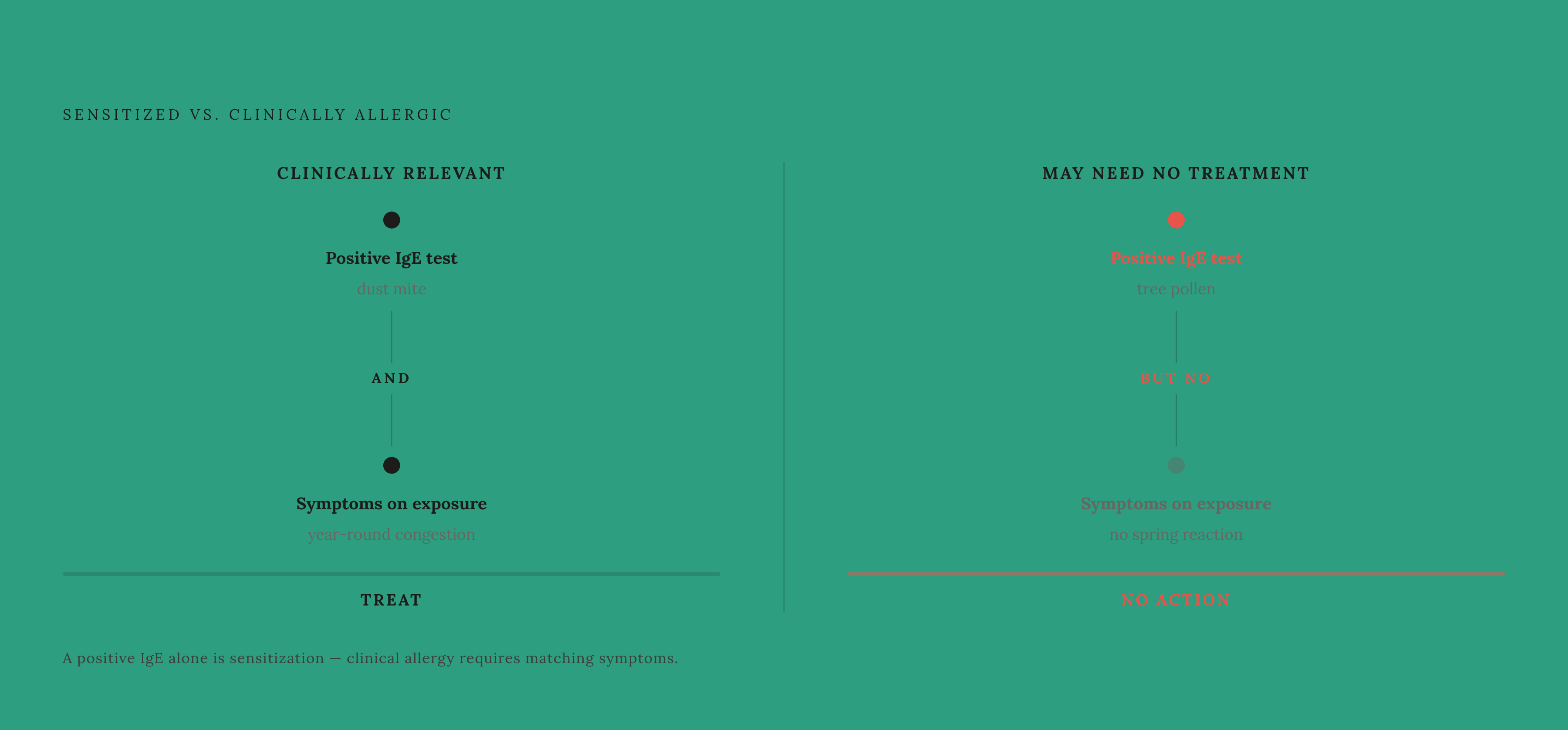
A positive IgE result, on either test, means sensitization: your immune system built antibodies against that allergen. That's the whole claim. It's not proof the allergen is making you miserable.
Sensitization isn't the same thing as clinical allergy, and plenty of sensitized people go through real exposure and feel nothing at all. So what actually confirms clinical allergy? Two things have to line up: sensitization on testing, and symptoms on exposure to that same allergen in real life.
Take a practical case. Someone tests positive for dust mites and deals with congestion year-round. That's clinically relevant, worth acting on. Now say that same person tests positive for a tree pollen they're barely ever exposed to, and they've never had a spring symptom in their life. That positive might not need treatment at all. Your clinical history is what sorts out which results are driving symptoms and which ones are just sitting there on the page, doing nothing.
In-office skin prick testing still sets the benchmark for diagnostic accuracy on common environmental allergies, landing around 90%. At-home blood panels are clinically useful too, built to guide your next move, though a real conversation with a clinician still matters for interpreting what you get back. Neither format reliably assesses food allergy, asthma triggers, or drug reactions. Those need their own diagnostic tools entirely.
The allergens most commonly flagged on reports and what they mean
Quest Diagnostics data on U.S. patients tested for IgE-mediated sensitization found dust mite sensitization had the highest prevalence of any category, at 38.0% across all age groups, while fungi and mold came in lowest, at 19.7%. Everything else splits mostly into two buckets: perennial and seasonal.
Perennial allergens stick around all year. Dust mites (Dermatophagoides pteronyssinus, D. farinae) shed proteins mostly from fecal matter and body fragments, concentrated in bedding, upholstered furniture, and carpet. Hot-washing bedding at 130°F or above, mattress encasements, and keeping indoor humidity under 50% all cut exposure down. Pet dander is protein from skin cells, saliva, and urine, not the fur itself, and cats and dogs are the usual suspects, though cockroach and mouse allergens are major indoor triggers too, especially in cities. Indoor mold (Alternaria, Aspergillus, Fusarium) thrives in basements, bathrooms, and kitchens; its spores go airborne and get inhaled, symptoms often running year-round with spikes whenever humidity climbs.
Seasonal allergens follow the calendar instead. Tree pollens (birch, oak, maple, elm, ash, hickory, pecan) typically peak in spring, though that timing keeps drifting earlier as climate patterns shift. Grass pollens (ryegrass, Timothy, Bermuda, Johnson, bluegrass) run late spring into early summer. Weed pollens are dominated by ragweed, which peaks in September and affects up to 60 million people. Outdoor mold spores spike after rainfall and in fallen leaves, often overlapping right into pollen season.
Warming temperatures and higher CO₂ levels are stretching pollen seasons longer and pushing peak loads higher than they used to run. If you're in a warmer region, exposures that used to be seasonal might be creeping toward year-round. And if your report flags both a perennial and a seasonal allergen as positive, you might be dealing with two separate symptom patterns stacking on top of each other at certain points in the year.
Connecting test results to the symptoms patients often don't attribute to allergies
Most people expect their allergy story to read "sneezing, runny nose," end of story. But the allergens sitting on that positive list often explain a lot more than nasal symptoms, and this is where I think a lot of reports fail patients: nobody tells them to look further.
Histamine doesn't stay in your nose. It also works as a neurotransmitter, and allergic inflammation disrupts histamine balance and cytokine signaling in ways that dull alertness and mental sharpness, not just nasal passages. Nasal congestion compounds it: it pushes people into mouth breathing, degrades sleep quality, and fragments the deep sleep stage where memory consolidation and mental recovery actually happen. Nighttime makes it worse, not better. Congestion tends to intensify after dark as swollen tissue restricts airflow further, feeding restless sleep or, in more severe cases, tipping into sleep apnea — a pattern well recognized in allergic rhinitis.
Stack daytime histamine effects on top of nighttime sleep disruption, and you get a brain fog that doesn't lift until the underlying immune response gets addressed. Coffee and willpower both fall short against it, and the connection to a seasonal pollen count often goes unrecognized for months.
Here's a useful exercise once you know which allergens tested positive: check whether your symptoms track with those allergens' exposure windows. Year-round for dust mites, spring for tree pollen, a September spike for ragweed. When symptoms and exposure line up like that, it's a strong signal the positive result is clinically relevant, not just sitting there unrelated to anything you actually feel.
Older antihistamines carry a sedative effect too. If you're still taking one and still feel foggy, you might be dealing with the medication's side effects stacked right on top of the allergy-driven impairment it was supposed to fix in the first place.
What a positive result actually opens the door to (beyond symptom management)
A positive IgE result, read alongside your clinical history, isn't just informational. It names the specific immune targets that treatment can actually go after, which makes it actionable in a way a lot of patients don't expect walking in.
Antihistamines and nasal corticosteroid sprays manage symptoms. They don't touch the immune system's underlying response, since they're relief measures, useful for day-to-day comfort rather than long-term resolution.
Immunotherapy is the category built to work directly off a positive result. Whether it's subcutaneous (shots) or sublingual (drops or FDA-approved tablets), the mechanism stays the same: gradual desensitization to the specific allergens your report flagged. Sublingual immunotherapy in particular has solid clinical backing for the aeroallergens that show up most often on these reports: grass pollen, tree pollen, dust mites, and weeds.
That allergen-specific quality is exactly why the test result matters in the first place. Treatment gets built around what your immune system is actually reacting to, tailored rather than handed out as a generic formula to everyone who walks in with a stuffy nose.
Some services pair at-home allergy testing with a virtual clinical consultation, so a patient can move from a confusing printout to a doctor-guided treatment plan without sitting in a waiting room. A clinician reviews your results and works with you on a personalized treatment plan.
A test result works more like coordinates than a verdict. The numbers point to which allergens are stirring up your immune response, your symptoms tell you what that's actually costing you day to day, and the treatment decision is where the two finally meet.