At-Home Allergy Test Accuracy vs Lab Skin Prick Testing
Lab skin testing edges out at-home kits for accuracy.
81 million Americans carry a seasonal allergic rhinitis diagnosis, and a good chunk of them still can't tell you what's actually setting it off. Even more live with symptoms year round and never connect the dots to dust mites, mold, or the cat sleeping on their pillow. That gap between "I have allergies" and "I know what I'm allergic to" is where testing earns its keep, and picking a method means understanding what each one actually measures.
Indoor allergens don't announce themselves the way grass pollen in May does. Waking up congested every single day, with no season to blame, just feels like fatigue, or stress, or getting older. Dust mites and pet dander don't come with a calendar the way ragweed does, and mold spores in a damp basement don't send a warning text. So people spend years blaming bad sleep on everything except the thing sitting in their ductwork.
What skin prick testing actually does and why clinicians treat it as the reference standard
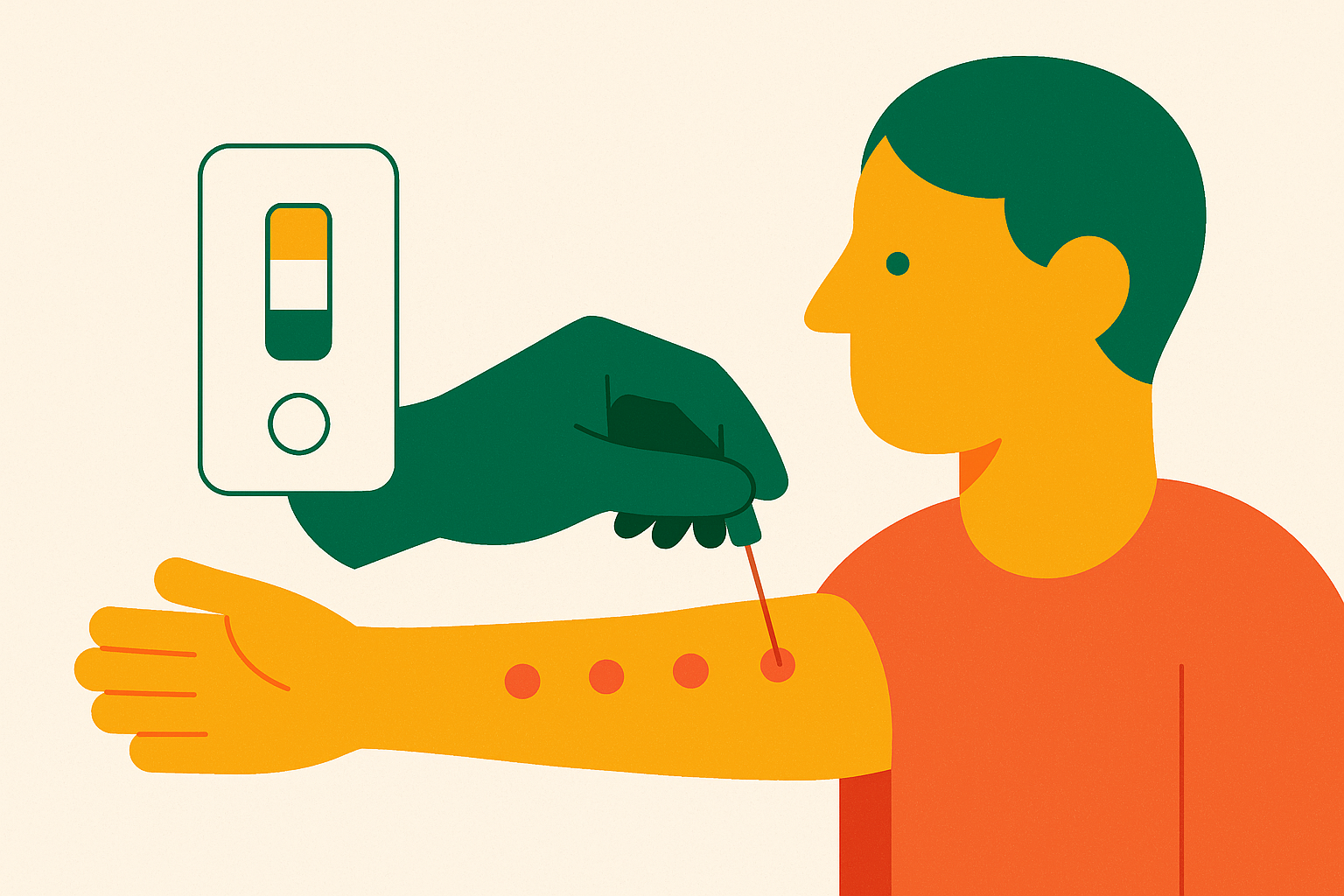
I've sat in on this test more times than I can count, watched the same fifteen-minute wait play out on someone's forearm, and it still holds up. A clinician places small drops of purified allergen extract on your skin, scratches lightly underneath each one, and waits. A raised bump, called a wheal, shows up within 15 to 20 minutes if your immune system reacts, and no wheal means no reaction. It doesn't get more direct than that.
One visit screens dozens of allergens at once, and sensitivity for common triggers, pollen, dust mites, pet dander, runs above 90% in clinical sources. But that number was never just about the scratch. A trained clinician reads the wheal in real time against your actual history: the sneezing every April, the cat that sleeps on your pillow. A bump on skin means little by itself; it means something once someone who has read thousands of them puts it next to your story. That interpretation is doing more of the work than most people give it credit for.
When skin testing isn't an option, someone's on a medication that interferes with results, say, or dealing with severe eczema, serum-specific IgE blood testing steps in. Same antibody, same target, different medium. Insurance usually covers the in-office version too, which takes a real bite out of what would otherwise be an access problem.
So the 90% figure is real, but it's also built on skilled hands, good extracts, and a clinician who knows what he's looking at, not the scratch alone.
How at-home IgE tests work and what the accuracy data actually says
At-home testing runs on the same biology through a different door. A finger-prick sample gets mailed to a CLIA-certified lab, which measures specific IgE antibodies, the same marker skin prick testing chases. Turnaround runs two business days to a week for most kits; the bigger panels, the ones covering 80 to 100 allergens, can take 7 to 10 days.
Panel sizes have grown fast. Plenty of kits now test 40-plus aeroallergens, and some climb into that 80-to-100 range, close to what you'd get screened for in an office visit. Accuracy claims run from 70% to 90% depending on the vendor, and that's a wide enough spread that it should make you pause. Most of those numbers come from the vendors themselves, not independent researchers, so read them the way you'd read any claim a company makes about its own product.
Blood-based IgE testing sits a step below skin prick testing on sensitivity. How much does that matter in practice? Less, once someone reads the results against a real symptom history, the same interpretive step that makes skin testing work in the first place.
One real advantage on the home side: you don't have to stop taking antihistamines before testing. Telling someone with miserable symptoms right now to go off Zyrtec for a week just to get tested is a genuine deterrent, and blood tests skip that step entirely. Some partner labs have also started using AI-assisted calibration to cut down on false positives, and mobile apps now let people sync results with symptom diaries, so a patient shows up to a follow-up with more than a single number on a page. Clinicians still treat at-home results as screening-level, not diagnostic, and that's the right way to hold it: a finding is where a conversation starts, not where it ends.
The IgG problem: one category of at-home test that measures the wrong thing entirely
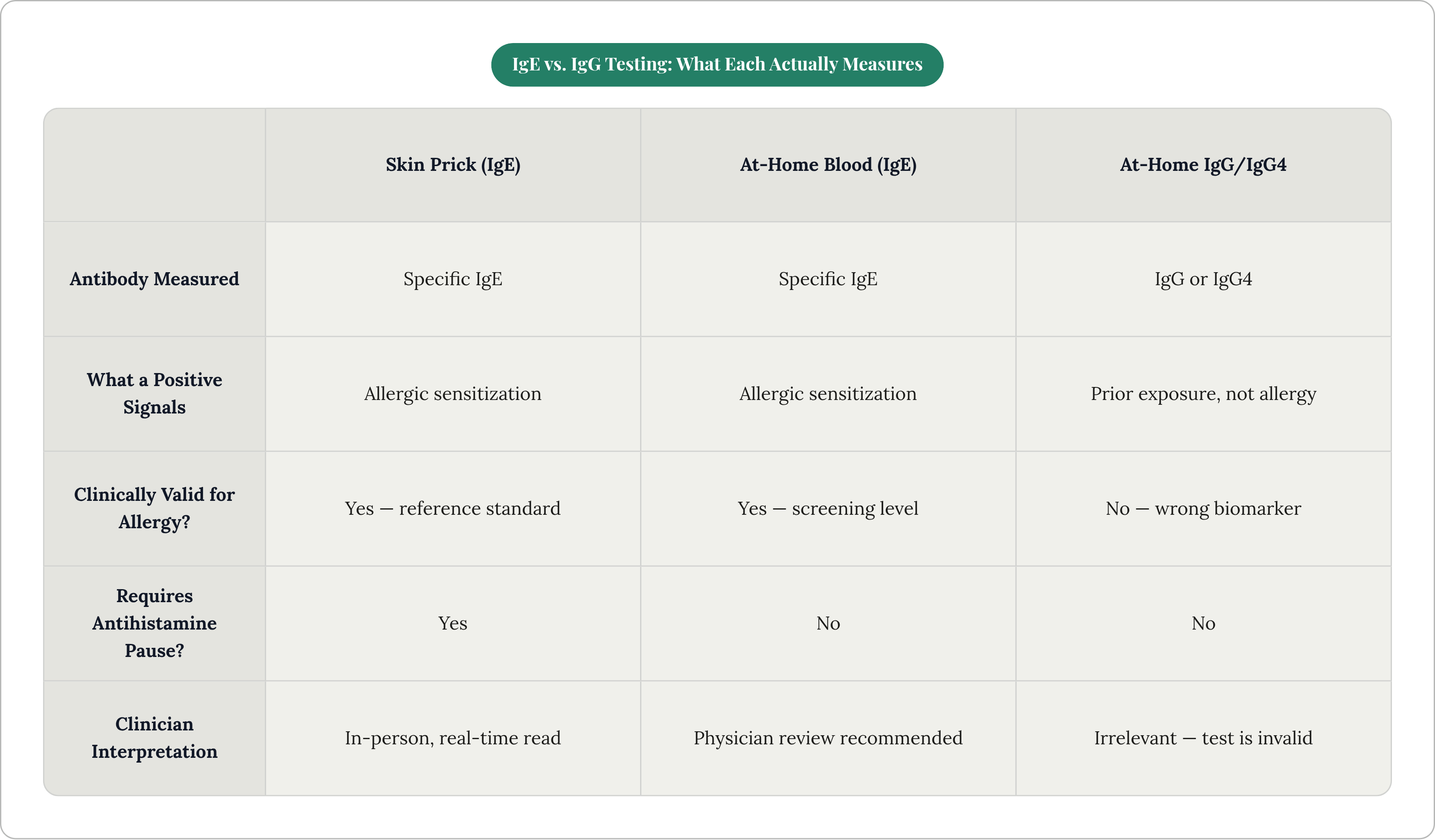
This is the part that actually causes harm. A meaningful chunk of consumer "allergy" tests on the market don't measure IgE at all. They measure IgG, often specifically IgG4, and that's a different question with a different answer.
IgE is the antibody behind actual allergic reactions: hives, sneezing, swelling. IgG runs on a separate immune pathway entirely, and elevated IgG4 to a food more often means you've been exposed to it, maybe even that you tolerate it fine, rather than that you're allergic to it. Close to the opposite signal from the one people think they're getting.
Allergy societies have pushed back on IgG panels for food allergy diagnosis for years, and the concern isn't abstract. Someone gets a panel back showing elevated IgG4 to eggs, wheat, and dairy, and cuts all three out of their diet on the spot, even though none of that elevation ever pointed to an allergic response. That's a real restriction, built on a misread result.
This isn't an accuracy problem in the way the rest of this piece talks about accuracy, since a perfectly precise IgG test is still measuring the wrong thing for allergy purposes. So before buying any at-home kit, check what it actually tests, and look for "specific IgE" or "sIgE" on the label. If you see IgG or IgG4 instead, that's a different test answering a different question, one you probably didn't mean to ask.
Where the accuracy gap between methods is real and where it is overstated
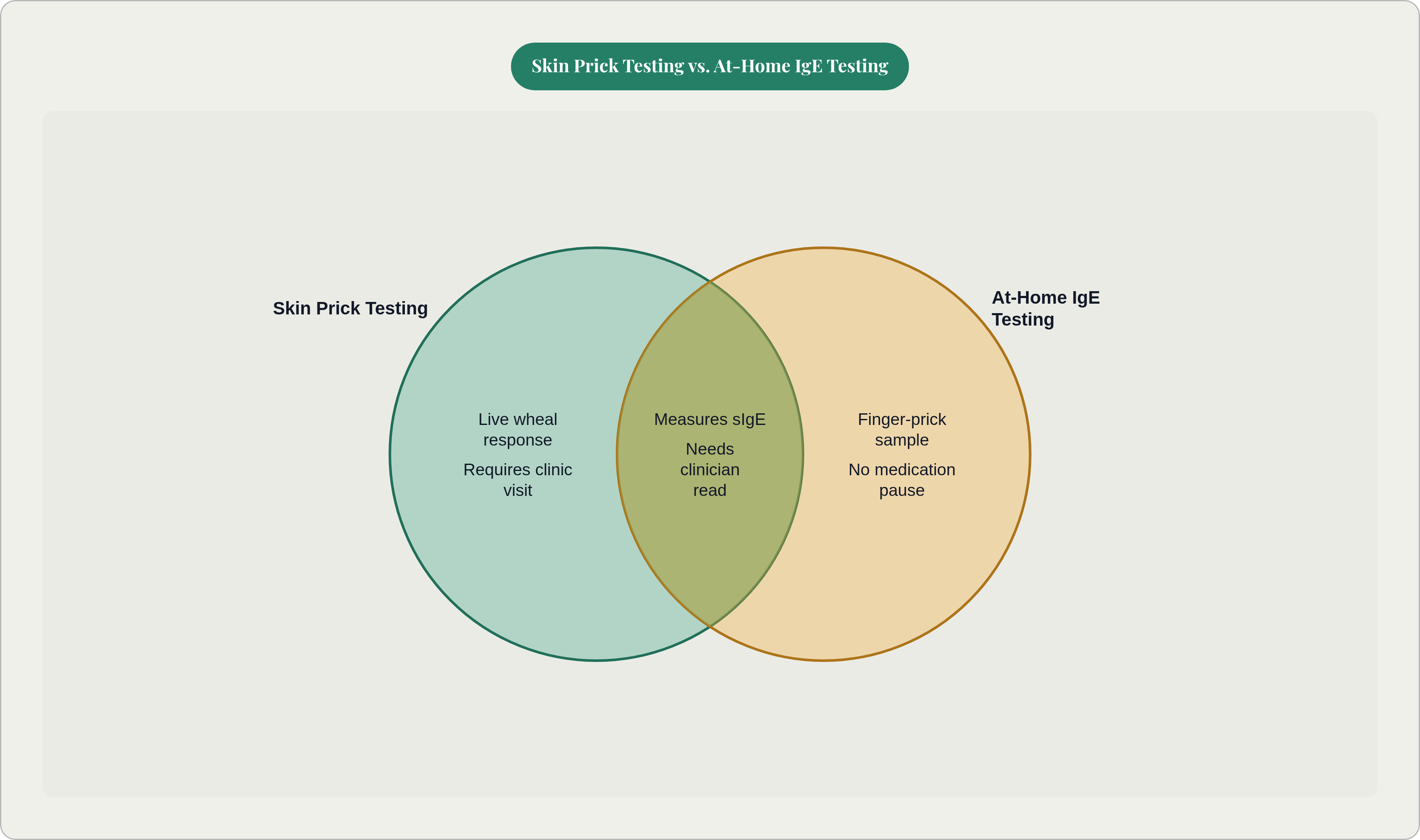
Both skin prick testing and at-home blood tests chase the same biomarker, specific IgE. The difference is that skin testing adds a live biological response, the wheal, which a blood draw can't produce. That live response is genuinely informative, and it's a big part of why in-office testing keeps its edge on sensitivity.
Where does that edge matter most? Food allergies, where a false positive carries real weight: unnecessary avoidance on one end, false confidence around a genuine risk on the other. Environmental allergens look different, and blood IgE testing holds up broadly well there.
Worth being honest about where that 90% skin-testing figure comes from, too. Strip out the clinician's real-time read, and the same wheal, judged cold off a chart, loses a lot of its precision. That number reflects the whole visit, clinician included, not just what happens on the skin. Meanwhile, the 70%-to-90% range on at-home tests isn't fixed. It moves with the vendor, the size of the allergen panel, and how carefully the sample gets handled between your kitchen table and the lab, which makes some of that variability a shipping question as much as a biology one.
So where does at-home testing earn its keep? Spotting likely environmental triggers in someone with a clear seasonal or year-round pattern, and giving you a starting point before you sit down with a provider, so the conversation opens with data instead of a guess. And where does it come up short? Ruling an allergy out with real confidence, guiding treatment for anyone with a history of severe reactions, standing in for a full workup when symptoms are tangled up with something like chronic sinusitis or non-allergic rhinitis.
Skin prick testing throws off false positives too, which is the whole reason clinical interpretation sits on top of the raw result, since neither method is immune to noise. The real question was never which test is flawless; it's what you do once you've got a result in hand.
What an at-home result can and cannot tell you about next steps
Say your at-home test comes back positive for grass pollen, dust mites, or cat dander. What does that actually tell you?
Something real, a signal worth paying attention to, especially once you line it up against your own symptom timeline. Does the positive match when you actually feel worse: every spring, every night you sleep near your pet, every time you're down in a musty basement? That overlap is where a home result starts to earn its keep. Mobile symptom-diary tools have closed some of that gap too; showing up to a provider with weeks of logged symptoms tied to a test result gives them far more to work with than one number.
What a result alone can't do: tell you how severe a reaction might get, tell you whether a borderline IgE level means anything clinically, or clear you for immunotherapy on its own. If you're thinking about treatment, sublingual drops or allergy shots, an at-home result works best as the opening line of a conversation, not the closing one.
Some services pair the finger-prick sample with physician review afterward, so you keep the convenience of testing from your kitchen table and still get back the piece that made skin prick testing reliable in the office to begin with: an actual clinician reading the result against your history.
Why getting tested at all — by any reliable method — matters more than which method is perfect
What's the actual cost of not testing? Nobody puts that number on a chart, and it's bigger than most people assume.
Untreated allergies don't just cause sneezing. Nasal congestion disrupts sleep and pushes people toward mouth breathing at night, which fragments rest further. Histamine affects neurotransmitter activity, and sinus congestion can reduce cerebral oxygen flow. String that together over months or years and you get the fatigue and brain fog a lot of people quietly live with, never once tracing it back to an allergen sitting in their bedsheets.
Plenty of people cycle through antihistamines and nasal sprays for years without ever landing on a cause. Those manage symptoms in the moment, sure, but the immune sensitization actually driving all of it goes untouched, treatment aimed at the smoke, not the fire.
Knowing your specific trigger, even from a screening-level test taken at your kitchen table, opens the door to something more permanent. Allergen immunotherapy, sublingual drops or shots, requires knowing exactly what you're desensitizing against, and no trigger identified means no immunotherapy plan to build.
And for a lot of people, the real barrier was never skepticism about at-home testing. It's that in-office testing costs money, takes time off work, requires a clinic nearby, and sometimes means going off medication you actually need right now. At-home testing sidesteps every one of those.
An imperfect test that actually gets taken, and reviewed by a physician afterward, beats a perfect test that never happens. Skin prick testing remains an excellent, well-earned standard, and nothing here argues against it. But if a home kit comes back positive for something environmental, the right next move is a clinician who can put it in context and map out an actual plan, not another year of antihistamines and guessing.