Food Allergy vs. Environmental Allergy Testing Differences
Environmental allergies are easier to test because you can't choose to breathe pollen.
Food and environmental allergies share the same immune wiring. Your body flags something harmless as a threat, builds IgE antibodies against it, and floods your system with histamine on the next exposure. What changes everything downstream, though, is how you're exposed in the first place. That one difference decides how these two get tested, how the results get read, and what happens after.
Before you even pick a test, there's a sorting problem most people never stop to think about. Not every bad reaction to food is an allergy; lactose intolerance, for instance, is a digestive issue with no immune system involved, so no allergy test will ever catch it. It isn't built to look for it. Roughly 30% of U.S. adults deal with environmental allergies, and about 10% have a food allergy, and those two groups overlap more than you'd expect. I've sat across from patients who genuinely couldn't tell me which camp they were in.
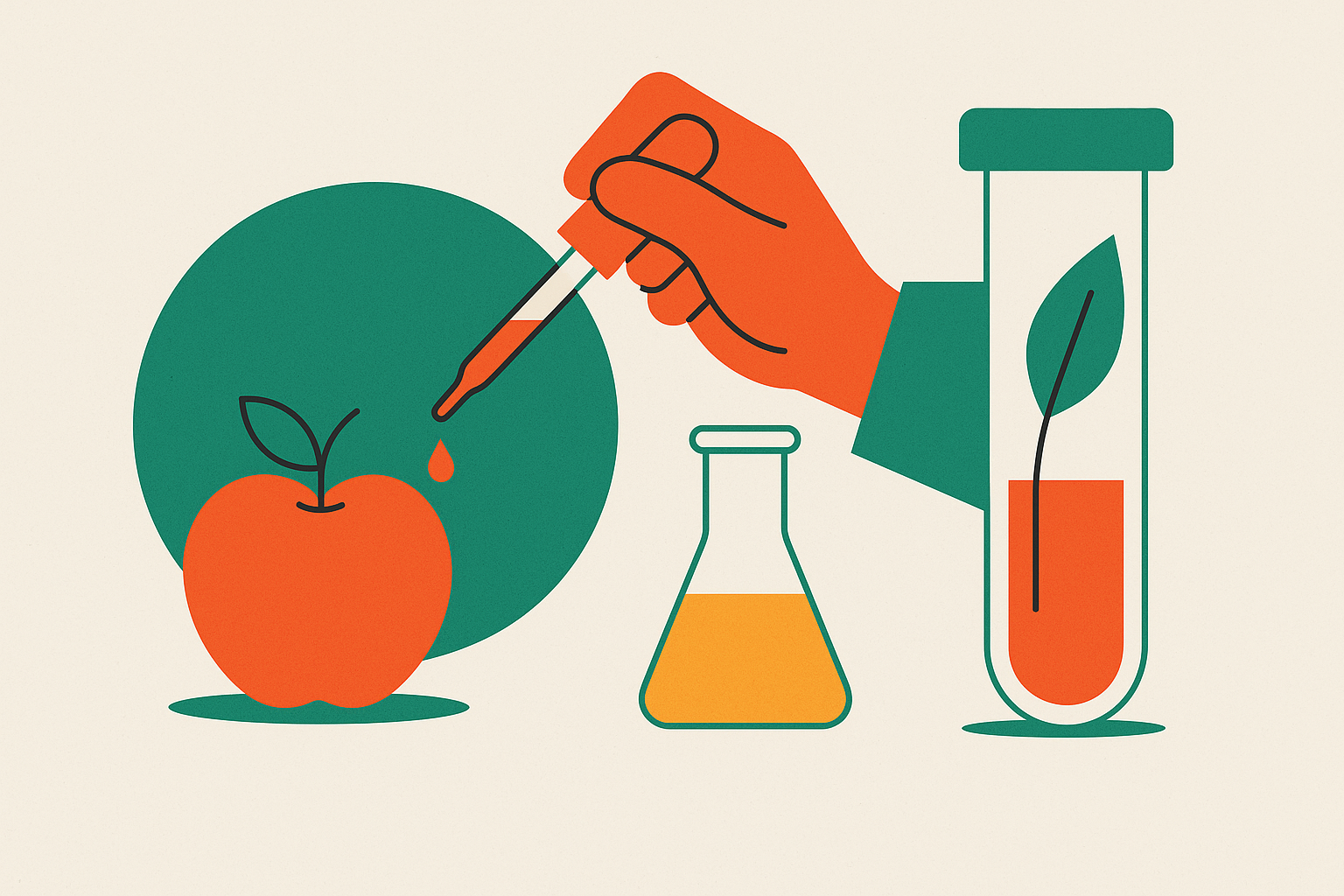
Pollen-food cross-reactivity muddies the water further. Some people test positive for apples or melon because their immune system already recognizes similar proteins in birch or ragweed pollen; the food test isn't wrong, exactly, it's just answering a different question than the one being asked. That's one reason these two testing worlds bleed into each other more than most people expect walking in.
What environmental allergy testing is actually measuring and why a positive result is relatively straightforward
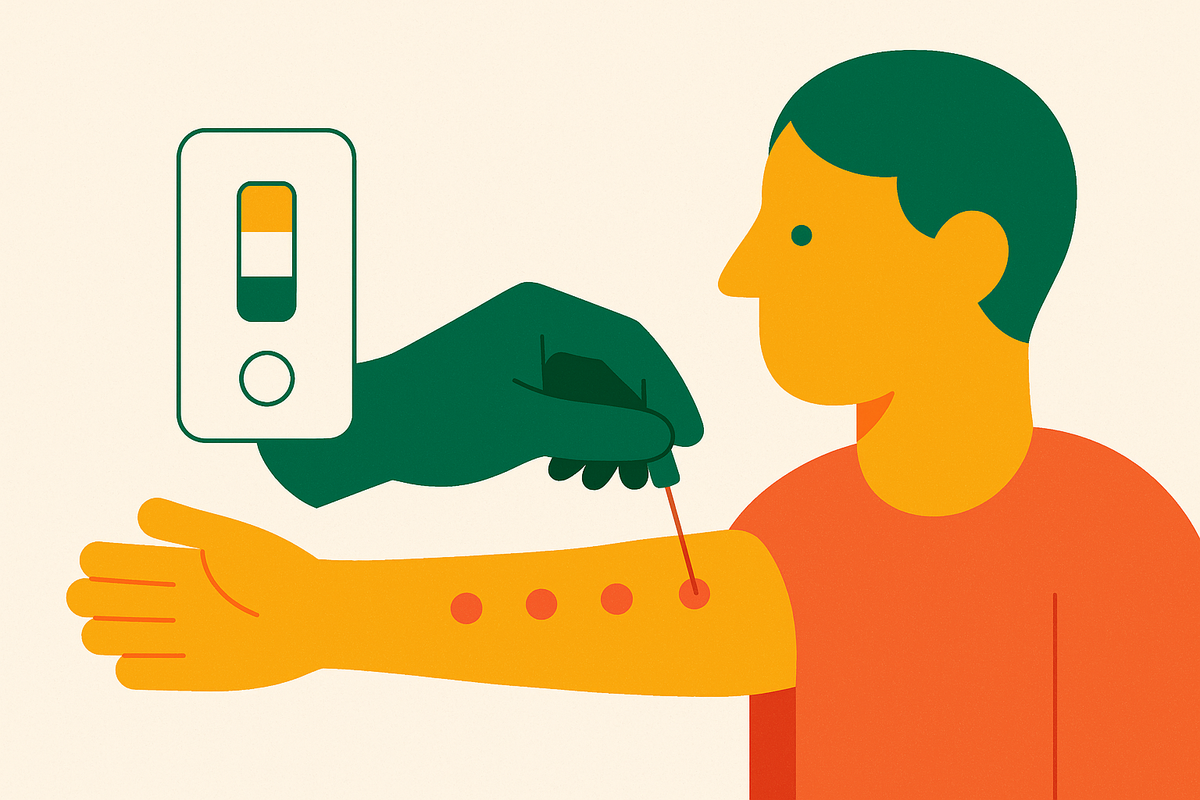
Skin prick testing is the workhorse here, and for good reason. A clinician places a drop of allergen extract on your forearm or back, pricks the skin, then checks for a wheal (that raised, itchy bump) at the 15-to-20-minute mark. A histamine control and a saline control run alongside it, so the clinician knows the reaction is real and not just skin being skin. A standard panel usually covers tree pollen, grass pollen, weed pollen, mold, dust mites, pet dander, and cockroach. Cast a wide net on purpose here: broad testing lets you see the whole allergic picture instead of chasing one suspect while three others go unnoticed.
Specific IgE blood testing is the fallback, and it's often the smarter call when skin testing isn't practical. Severe eczema covering the usual test sites, a recent bad reaction, someone who can't come off antihistamines: any of these push you toward blood work instead. That antihistamine issue trips up more people than you'd guess. Skin testing needs 5 to 7 antihistamine-free days beforehand, and I've had patients show up having taken a Zyrtec that morning, with no idea it would tank their results.
Here's what makes environmental testing genuinely easier to act on than food testing: nobody chooses to inhale ragweed pollen the way they choose to eat a peanut. A positive result for dust mites or grass pollen, paired with a history that lines up, is a strong signal on its own. There's no oral challenge equivalent for pollen. You can't have someone breathe graduated doses of tree pollen in a clinic to confirm anything, so the test result carries more weight by default. Treatment follows the same logic: partial avoidance (you can't eliminate outdoor air, so full avoidance was never on the table), plus immunotherapy. Testing broad, in this case, isn't overkill. It's how you map the whole seasonal picture instead of guessing at one culprit and missing the rest.
Why food allergy testing is harder to interpret and requires an extra confirmation step
Food testing runs into a specificity problem that environmental testing mostly avoids. Skin prick and specific IgE blood tests both catch sensitization well, meaning your immune system has met the food and built antibodies against it. Sensitization isn't the same thing as a reaction at the dinner table, though. Per EAACI guidelines published in Allergy in 2023, a positive result tells you exposure happened; it does not tell you the person will react when they actually eat the food. Plenty of sensitized people eat it daily without issue.
That gap matters more than it sounds like it should. Act on a positive test without confirming it, and you can push someone into cutting out whole food groups for no real reason: nutritional fallout sometimes, and almost always a layer of anxiety that never needed to exist.
Test performance isn't even across foods either. Those same 2023 EAACI guidelines show skin prick and specific IgE perform better for peanut and cashew than for wheat and soy. Component-resolved diagnostics, or CRD, earn their keep in exactly this gap. Instead of testing a whole food extract, CRD isolates specific proteins within it: Ara h 2 for peanut, Cor a 14 for hazelnut, Ana o 3 for cashew. That granularity matters most when a positive result might just be pollen cross-reactivity dressed up as a food allergy.
The oral food challenge is what actually settles the question. The patient eats the suspected food in small, increasing amounts under direct supervision; it's the only method that confirms or rules out a clinical allergy with real certainty. It's not a first screen, though, and it shouldn't be. It comes after other testing points toward allergy, or when checking whether a kid has outgrown one. For obvious safety reasons, it happens in a clinic. There's no home version.
Worth keeping an eye on: the basophil activation test, or BAT, which measures how immune cells respond outside the body. One published study found an AUC of 0.90 for baked milk allergy and 0.81 for fresh milk, against 0.79 and 0.74 for specific IgE, and 0.70 and 0.78 for skin prick. More accurate, possibly. It's nowhere near routine use yet, and I wouldn't expect that to change fast.
One thing deserves its own paragraph. IgG food sensitivity panels get marketed aggressively, but major allergy societies don't back them, and for good reason. IgG antibodies show up when you eat foods normally; they mark exposure, not allergy. Cutting foods based on an IgG panel means cutting them based on nothing.
The tests both types share, and where they perform differently for each
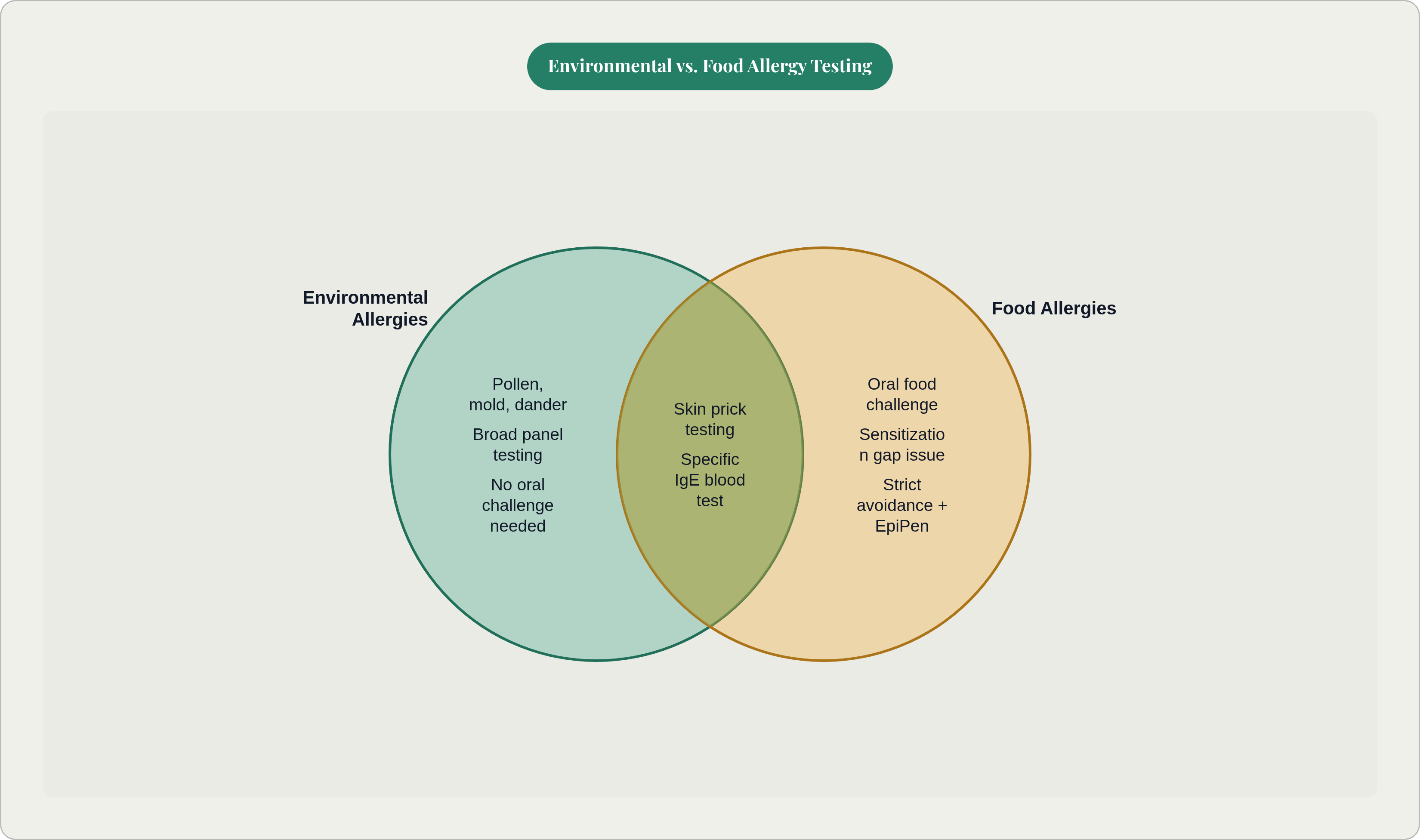
Skin prick and specific IgE blood testing serve both allergy types, but what a positive result actually means shifts depending on what's being tested. For environmental allergens, a positive wheal plus a matching symptom history is usually enough to move straight to treatment. For food, that same positive wheal only proves sensitization exists; you still need more before calling it a clinical allergy, because specificity runs lower.
Skin testing edges out blood testing slightly on sensitivity, though it costs you that 5-to-7-day antihistamine window. Blood testing becomes the default whenever skin testing isn't an option, regardless of which allergy type you're chasing.
So what can neither test do? For food, neither one separates sensitization from a real, repeatable reaction; that's the exact gap the oral food challenge exists to close. For environmental allergies, neither test recreates the slow, cumulative dose of natural exposure, weeks of pollen in the air, months of dust mites building up in the carpet. That's part of why symptom diaries and seasonal timing still carry real weight when a clinician sits down to read results.
At-home testing: where it fits for environmental allergies and where it falls short for food
At-home finger-prick specific IgE kits, run through CLIA-certified labs, are the current standard outside a clinic. CLIA certification means validated methods, real quality controls, proficiency testing; it's the one thing worth confirming before you trust a kit with your blood sample. Many panels test 40-plus aeroallergens at once, with results back anywhere from two business days to about a week.
For environmental allergies, this is legitimate ground to start on. In-office testing sets the benchmark around 90% diagnostic accuracy for common environmental allergens, so an at-home result works as a strong screening signal, not a full diagnosis on its own. It gets a lot more useful once a physician actually reviews the results with you, rather than leaving you alone with a lab printout.
Food allergy testing is where at-home kits hit a wall. A home specific IgE test can flag sensitization, same as in-office testing, but a positive result still doesn't confirm anyone will react to the food. You can't run an oral food challenge at your kitchen table; the risk just doesn't allow it. And if there's a complicated history behind it (prior anaphylaxis, eosinophilic esophagitis, a kid with growth concerns tied to food avoidance), that needs an in-clinic workup with skin testing and a supervised challenge. No shortcuts there, and I wouldn't want there to be.
Match the test to the actual question you're asking. Broad environmental screening pairs fine with at-home testing plus physician review. Suspect a food allergy? A home test can open the conversation, but don't overhaul your diet off it alone. High-risk food history? Skip home testing entirely and go straight to a clinic.
How the follow-up path after testing differs between environmental and food allergies
Once an environmental allergy gets confirmed, the choices are fairly structured: avoidance, medication to mask symptoms, or immunotherapy. Avoidance alone rarely does the job on its own, since you can't avoid outdoor air, and indoor allergens like dust mites and pet dander stick around even in a spotless house. Per AAFA data from 2025, 8 out of 10 people in the U.S. get exposed to dust mites, and 6 out of 10 to cat or dog dander. Pet dander in particular can linger in a home for weeks or months after the animal is gone.
Medication helps with symptoms but doesn't touch the sensitization underneath it; your immune system stays just as primed as before you took anything. Sublingual immunotherapy, or SLIT, whether off-label drops or FDA-approved tablets, is the one option that retrains the immune response over time instead of just muting it. It's taken at home, no weekly clinic visits required, which makes it realistic for the majority of people who couldn't commit to regular allergy shots.
Food allergy follow-up looks different, more conditional at every step. A negative oral food challenge means the food goes back on the table, literally, no further treatment needed. A confirmed allergy usually means strict avoidance as the main strategy, plus an epinephrine auto-injector on hand for anaphylaxis risk. Oral immunotherapy, or OIT, exists for a handful of food allergies (peanut being the most established), but it's still emerging, specialist-managed, and nowhere near as available as environmental SLIT. Food allergy management still mostly comes down to getting a confirmed diagnosis and managing avoidance carefully, not long-term desensitization at the scale environmental treatment has reached.
The symptoms that make it hard to know which type of allergy to test for first
Here's where self-diagnosis gets genuinely tricky. Sneezing, itching, congestion, skin rash, stomach upset: all of these show up in both environmental and food allergy, which means symptoms alone often can't tell you which test to book first.
Some patterns lean environmental. Symptoms that track with the seasons, or that flare specifically outdoors in spring, around pets, or in a damp basement, point that way. So does a cluster of nasal congestion, itchy eyes, and sneezing, especially when pollen counts spike. If symptoms ease the moment you leave the house, or get worse in one specific room, that's often dust mites or mold at work. Don't skip over the quieter symptoms either. Fatigue, brain fog, and bad sleep that track with congestion are real, documented consequences of allergic rhinitis, though plenty of people chalk it up to stress or just getting older.
Other patterns point toward food instead. Symptoms showing up within minutes to a couple hours of eating something specific, that's a real clue worth following. Hives, swelling, GI distress, or in serious cases throat tightening, especially when the same food triggers it every single time, all point toward a food-driven reaction rather than an environmental one.
Then there's the cross-reactivity wrinkle again. Someone sensitized to birch or ragweed might get tingling in the mouth after biting into a raw apple or a piece of melon, a condition called pollen-food allergy syndrome. Easy to mistake for a standalone food allergy when the actual root cause is sitting in the pollen count outside.
So where does that leave you? If symptoms are persistent, seasonal, or clearly tied to an environment, start with environmental testing. If they're tightly linked to specific meals and repeat reliably, pursue a food allergy evaluation instead. If both patterns show up, both deserve a look, usually starting with whichever one is wrecking your quality of life more.
Roughly 81 million Americans have been diagnosed with seasonal allergic rhinitis, per AAFA. A good number of them are walking around with fatigue and brain fog they've never once connected to a trigger, mostly because nobody's tested for it.