Seasonal vs. Perennial Allergy Testing Timing
Test seasonal allergies during pollen season for reliable results; perennial ones anytime.

When your body encounters something it's been sensitized to, it produces allergen-specific immunoglobulin E antibodies. IgE is what allergy tests are looking for, whether you're doing a skin prick test in a clinic or a finger-prick blood draw at home. That's the whole game: detecting a biological signature.
Here's what most people aren't told, though. IgE levels move. They rise during and after allergen exposure, then fall when exposure drops off for long stretches. Run a blood test deep in an off-season and you'll get a low-positive or a clean negative that looks like "no allergy detected" but is actually saying something far more specific: your IgE happens to be low right now. Those are not the same finding, and conflating them is how real sensitivities go undiagnosed for years.
Skin prick testing is generally less dependent on circulating IgE than serum-based blood tests, which is part of why clinicians consider it the more sensitive method. But timing still affects both. The practical upshot, before you can even think about when to test, is that you need to know what type of trigger you're dealing with. Seasonal or perennial: that distinction sits upstream of everything else.
When to Test for Seasonal Allergies and Why the Window Around Peak Season Is Most Useful
Seasonal allergies follow pollen calendars, and pollen calendars are geography-dependent. In most of the United States, tree pollen peaks between March and May, though in the South it can arrive as early as January. Grass pollen runs late spring into early summer. Weed and ragweed stretch from late summer into fall. Rough anchors, not fixed rules.
And they're getting rougher. The Asthma and Allergy Foundation of America's 2025 Climate Report found that pollen seasons in many regions now start 20 or more days earlier than historical norms. Ragweed season has extended by two to three weeks in some areas. If you're timing your test based on what you remember from five years ago, you're working from an outdated map.
The optimal window for testing seasonal allergies is during or shortly after the relevant pollen season, when IgE concentrations are elevated and sensitization is reliably detectable. Testing during active symptoms carries additional diagnostic value: you're catching your immune system mid-response rather than trying to infer a pattern from a quiet period. But what if you've been testing outside that window without realizing it? There's a meaningful difference between detecting latent sensitization and confirming that an allergen is circulating and affecting you right now. Both are useful, but the latter leaves less room for ambiguity.
One thing that catches people off guard: antihistamines suppress the skin reaction used in prick tests. If you're pursuing that method, confirm with your provider how far in advance to stop your medications. Showing up medicated can blunt the result entirely.
Why Perennial Allergy Sufferers Can Test Any Time, and Why Many Wait Too Long Anyway
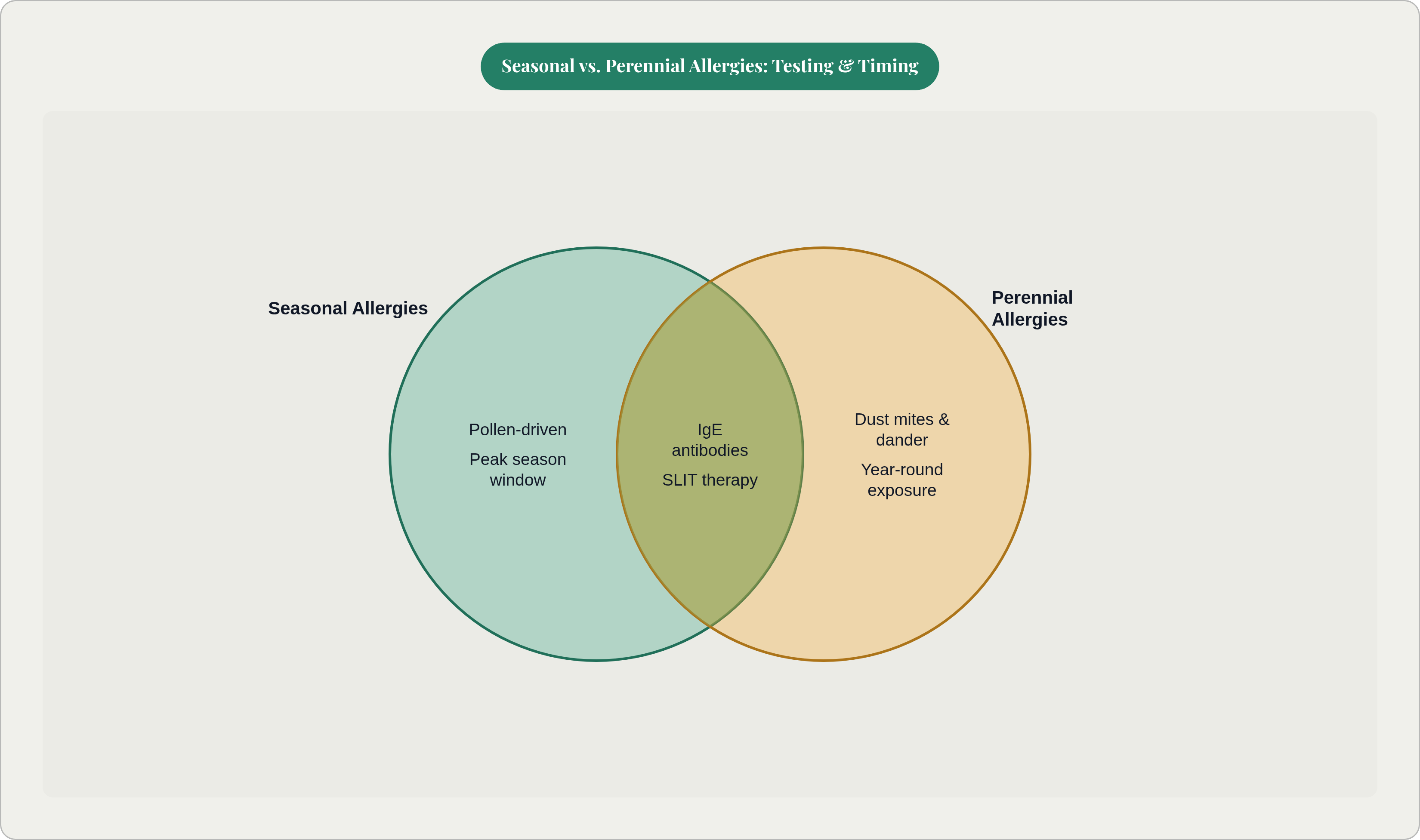
Perennial allergens don't observe a calendar. Dust mite concentrations in a mattress don't peak in June. Pet dander accumulates year-round. Mold grows wherever moisture allows, regardless of month. Because exposure is continuous, IgE levels for perennial triggers remain relatively stable across seasons. A test in January gives you essentially the same signal as a test in August.
So the timing question, for perennial sufferers, effectively disappears. What replaces it is harder: why haven't you tested yet?
Chronic, year-round symptoms get misread as recurring colds, persistent sinus infections, "bad sinuses." Because they don't arrive and depart seasonally, they don't register as allergic. People adapt. They build routines that accommodate the congestion, the fatigue, the foggy mornings, and they stop questioning whether those things are fixable. Years go by, sometimes a decade or more, before someone asks a different question.
Cockroach allergen is one example that illustrates how invisible this can get. It's present in a significant majority of inner-city apartments and is a well-documented driver of childhood asthma. Most patients have considered it as a possibility, because nothing in daily life signals its presence, even as it actively affects their respiratory health.
For perennial sufferers, the answer to "when should I test" isn't a season. There is no right month. The answer is to stop waiting. Every additional month is more time managing a diagnosable, treatable condition as though it were a permanent inconvenience.
What Stays Unresolved When Allergies Go Undiagnosed: The Health Costs of Waiting
Untreated allergic rhinitis doesn't stay in the nose. It ramifies outward in ways most sufferers rarely trace back to allergies, because the connections aren't intuitive and nobody usually draws them.
Nasal congestion drives mouth breathing. Mouth breathing fragments sleep. The Sleep Foundation found in 2021 that people with untreated allergic rhinitis experience more frequent nighttime awakenings and reduced deep sleep, and fragmented sleep impairs memory consolidation, which produces the cognitive fog and sluggish mornings that allergy patients often describe as their worst symptom. It gets chalked up to stress, to aging, to screens. Rarely to an immune response nobody has addressed.
Histamine also functions as a neurotransmitter. When allergic inflammation disrupts histamine balance, alertness and cognitive acuity decline through a pathway entirely separate from sleep disruption. Two biological mechanisms, converging, either of which would affect performance on its own.
It is also worth considering the psychological dimension. People with allergies are statistically more likely to experience depression and anxiety than those without. The connection is seldom made in conversation.
For children, the picture includes increased susceptibility to ear infections from fluid buildup, with downstream effects on hearing and speech development that can follow them for years. For those with asthma, unmanaged allergic triggers mean more frequent attacks. The CDC noted in 2021 that allergic conditions contribute meaningfully to missed workdays and reduced productivity nationally. None of that pauses while someone waits for a convenient time to get tested.
How At-Home Testing Fits Into the Seasonal vs. Perennial Timing Framework
Traditional skin prick testing happens in a clinic, requires scheduling often weeks out, and requires stopping medications in advance. For a seasonal sufferer, that friction alone can mean missing the optimal window, particularly because appointment demand spikes exactly when symptoms peak. The people who most need to test during a specific window are competing for clinic slots at precisely the worst moment.
At-home serum-based testing, using a finger-prick blood sample, measures allergen-specific IgE without the scheduling problem. For seasonal sufferers, you can test when symptoms are actually present, which is the window you want. For perennial sufferers, timing is already moot; at-home testing just removes another friction point from a population that already delays.
The underlying immunology doesn't change with the format. Seasonal allergens yield the clearest signal during or shortly after peak exposure. Perennial allergens present a stable signal year-round. What changes is the logistical barrier between "I should probably get tested" and actually doing it.
An accurate diagnosis, regardless of how you get there, does two things simultaneously: it identifies the specific trigger and it rules out non-allergic rhinitis or sinus infections that can mimic allergic symptoms. Those are different conditions with different treatment paths, and spending years on the wrong intervention because you conflated them is more common than it should be.
At-home finger-prick testing, paired with a virtual consultation, is structured to meet patients when their symptoms are most diagnostically useful, including during the seasonal windows when IgE is elevated and results are clearest, without requiring a clinic visit.
What a Diagnosis Unlocks: Moving From Identifying the Trigger to Retraining the Immune System
A specific allergen identification is the prerequisite for immunotherapy. Without it, you cannot personalize treatment. You cannot retrain an immune system against a trigger you haven't identified; that's the whole logic of the approach, and it's not a technicality.
Sublingual immunotherapy, SLIT, works by introducing small, calibrated amounts of a specific allergen through drops or tablets held under the tongue daily. Specialized immune cells in the sublingual mucosa capture allergen proteins and present them to T-cells, gradually shifting the response away from IgE-driven reactions and toward the production of protective IgG4 antibodies. This is not symptom suppression. It's a durable modification of the immune response itself, which is a distinct category of intervention from an antihistamine you take before mowing the lawn.
The evidence behind it is substantive. A meta-analysis covering 21 trials found that SLIT produced meaningful reductions in both symptom burden and rescue medication use. The 2024 guidelines from the American Academy of Otolaryngology and Head and Neck Surgery Foundation issued a strong recommendation for immunotherapy in patients whose allergic rhinitis isn't adequately controlled through medication and avoidance alone. FDA-approved SLIT tablets currently cover grass, ragweed, and house dust mites, spanning both seasonal and perennial categories.
Those same 2024 guidelines recommend a minimum treatment duration of three years for patients who respond. Three years. That raises an important question: how much ground is lost while the diagnosis is still pending? Every month of delayed diagnosis is a month that could have been counting toward that threshold. Knowing which allergen type you're dealing with, and testing at the moment that yields the clearest result, compresses the gap between symptomatic and actually improving.
The sequence, once you see it, is not complicated. Test when the biology supports it, get a result that reflects your actual immune profile, and you have the foundation for a real diagnosis. That diagnosis is what opens the door to immunotherapy, and immunotherapy, sustained over time, changes how your immune system relates to the allergen at the root. The goal isn't a better allergy season. It's building a life free from organizing around one.