FDA-Approved SLIT Tablets for Grass and Dust Mite Allergies
Sublingual tablets retrain your immune system instead of just masking allergy symptoms.
Allergic rhinitis affects an estimated 400 million people worldwide, and somewhere between 15% and 30% of Americans deal with it: enough to make it the fifth most common chronic disease in the country, per the American Academy of Family Physicians. Most people manage it the same way I did for years before I started paying attention to this field: antihistamines, nasal sprays, whatever's fastest at the pharmacy counter. That approach masks symptoms without touching the immune system that's actually causing them.
The cost of staying in that loop adds up fast. Direct medical spending on allergic rhinitis runs somewhere between $2 billion and $5 billion a year in the U.S., and a systematic review found that indirect costs, lost productivity, people showing up to work but not really functioning, make up most of that burden. About 3.6% of adults miss work outright because of it, and 36% say it hurts how well they perform when they do show up. Then there's the toll nobody logs anywhere: brain fog, wrecked sleep, a nose that never fully opens. A lot of patients don't even connect these to allergies, and they just live with it, the way I did.
So here's the actual subject of this piece: sublingual immunotherapy tablets, SLIT for short, work on the underlying immune response rather than just muffling it for a few hours. I want to walk through what they are, who they're for, and what the evidence actually says, because the gap between managing symptoms and changing the disease is bigger than most people realize.
What sublingual immunotherapy tablets actually are and how they differ from allergy shots and daily medications
Medication suppresses the allergic response after it's already fired, while immunotherapy tries to keep it from firing in the first place. One manages a symptom; the other retrains the system generating it.
SLIT tablets and allergy shots, subcutaneous immunotherapy, both fall into that second category. Neither works fast, and both are disease-modifying, aimed at the underlying immune mechanism instead of papering over its output. Shots mean weekly visits to a clinic, administered by a provider, for months or years, while SLIT tablets are taken once a day, at home, after a single supervised first dose in a doctor's office. For most patients I've talked to, that's the whole ballgame: a treatment that fits into a life instead of competing with it.
Worth separating SLIT tablets from SLIT drops here too, sometimes called allergy drops. The tablets on the U.S. market are FDA-approved, with standardized dosing backed by large clinical trials, while the liquid drops are used off-label in this country and aren't FDA-approved for specific allergens here. Tablets are the regulated, evidence-checked version of the same underlying idea.
The actual act of taking one is almost comically undramatic. Per the American College of Allergy, Asthma and Immunology, you place the tablet under your tongue, let it dissolve for one to two minutes, then swallow, with no injection, no clinic chair, and no waiting room involved. Results take longer to show up, though: this is a multi-year course built for durable tolerance, not next-day relief.
The four FDA-approved SLIT tablets: what each one treats and who qualifies
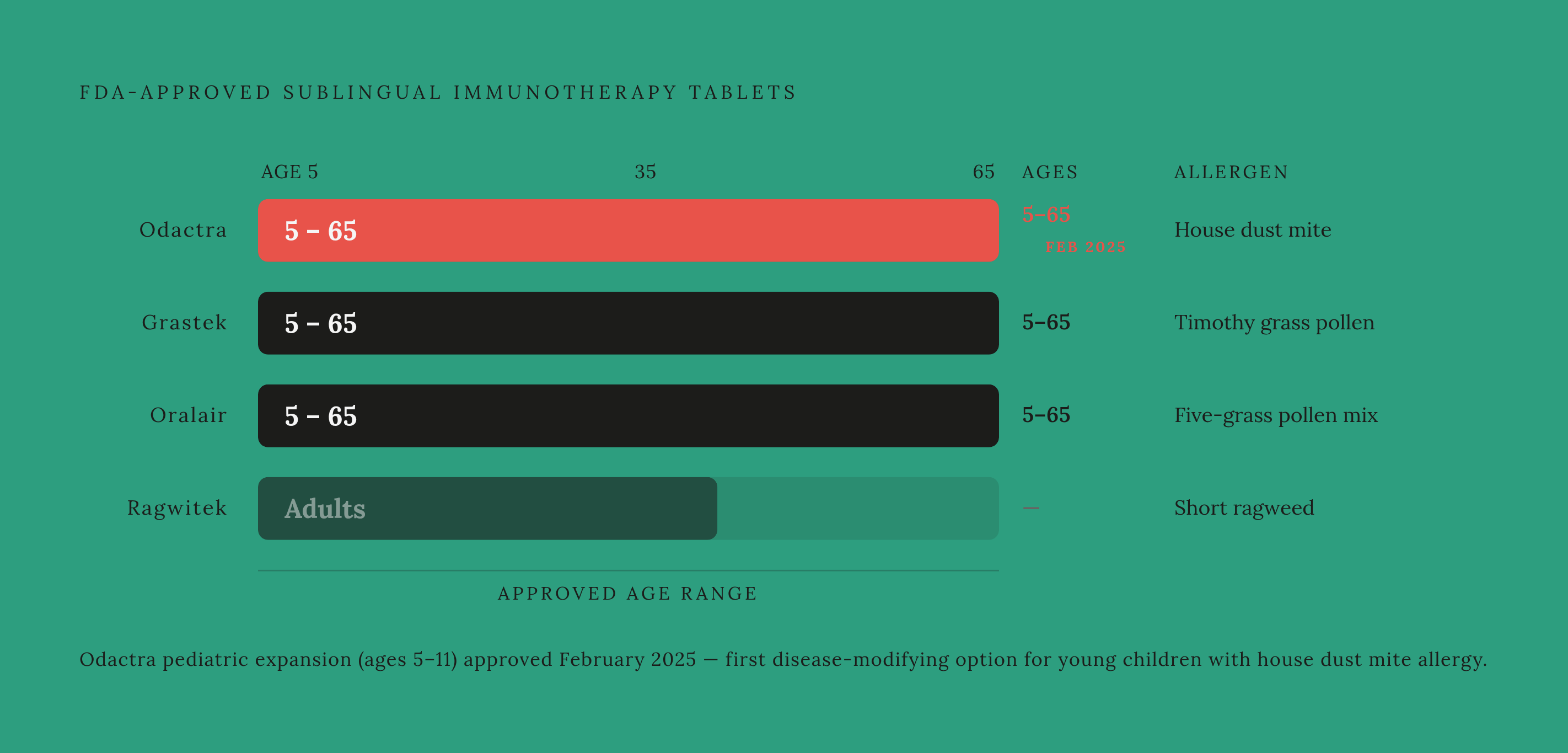
Four products currently carry FDA approval in the U.S.
- Odactra, for house dust mite allergy
- Grastek, for Timothy grass pollen
- Oralair, covering a five-grass pollen mix
- Ragwitek, for short ragweed
Grastek, Oralair, and Odactra are approved for allergic rhinitis, and confirmed sensitization to the relevant allergen is required before treatment begins. As of February 2025, all three of those allergen categories, grass, ragweed, and dust mite, carry an approved age range of 5 to 65.
The Odactra update is worth sitting with for a second. Until February 2025, it was approved only for adults, and the FDA's label expansion that month opened it to children ages 5 to 11, which hands a noninvasive, disease-modifying option to a population that previously had zero approved sublingual tablets for dust mite allergy. Healio's coverage of the approval framed it as widening clinicians' ability to start immunotherapy earlier in a patient's life, rather than waiting for adulthood to address the root cause.
One more distinction worth knowing: grass allergens are seasonal by nature, while dust mite exposure persists throughout the year, because dust mites don't take a season off. None of these four are meant for a vague sense of "I think I'm allergic to something." Confirmed sensitization to that specific allergen is the entry ticket, full stop.
Why grass and dust mite allergens in particular are so common and so hard to escape
Grass pollen is one of the most widespread seasonal triggers in the country; sensitization to grass allergens shows up constantly among Americans, per the AAFP. Dust mites are the more interesting case, though, because avoiding them sounds simple on paper and turns out to be nearly impossible in practice.
These are microscopic bugs, roughly 0.4 millimeters long, invisible without magnification, and they live in bedding, upholstery, carpet, anywhere shed skin cells collect, because that's their food source: your skin, your pet's skin, flaked off constantly and mostly unnoticed. Each mite produces around 20 fecal pellets a day, and each pellet measures somewhere between 10 and 35 micrograms across, about the size of a pollen grain, small enough to float and small enough to inhale without ever knowing it happened.
Unlike a seasonal grass allergy, dust mite exposure doesn't ease up in winter, and that perennial quality is exactly why avoidance alone rarely works. You can wash bedding at 130°F or higher, use mattress encasements, run a HEPA vacuum on a schedule. All of that helps some, but none of it eliminates exposure, because the problem lives in the place you spend most of your life: your own home.
There's a wrinkle here too, and it's a significant one. A French retrospective survey of patients receiving immunotherapy for dust mite allergy found that roughly two-thirds were also sensitized to other allergens. Dust mite allergy rarely shows up alone; it tends to travel with grass, pet dander, or other triggers, and it frequently overlaps with asthma and eczema flares, so the stakes go beyond a stuffy nose. That's part of why the testing step, covered a bit further down, carries so much weight.
How SLIT tablets retrain the immune system at the cellular level
So what's actually happening under the tongue during those one to two minutes? The tissue there is dense with antigen-presenting cells, dendritic cells especially, and repeated low-dose allergen exposure in that environment nudges the immune system away from an allergic, IgE-driven reaction and toward something closer to tolerance.
Lab work has documented a handful of measurable shifts over the course of treatment:
- Rising production of protective IgG antibodies
- Suppression of IgE, the antibody actually responsible for allergic symptoms
- An uptick in regulatory T cells
- Gradual induction of tolerance specific to that one allergen
For dust mite allergy, there's a more specific mechanism worth naming. Mite fecal particles can cleave the tight junctions between epithelial cells, which increases permeability and lets allergen reach dendritic cells more easily, feeding the sensitization cycle. SLIT appears to interrupt that cycle over time, gradually changing what the histamine-releasing cells do when they encounter the allergen, rather than just blunting the reaction once it's already underway.
Researchers are also chasing allergoids, recombinant allergens, and adjuvant formulations meant to push both efficacy and safety further. Nothing final to report there yet, but it's a live area.
What the clinical trial record shows about how well SLIT tablets work
Odactra's pivotal trials involved roughly 2,500 participants across placebo-controlled studies. Patients on the tablet showed a 16% to 18% reduction in symptoms and rescue medication use compared with placebo, according to the Pharmaceutical Journal.
Sit with that number for a second before deciding what it means, since this is a placebo-subtracted figure for a perennial, historically hard-to-treat allergen, and it's not a cure rate, so nobody should expect it to read like one. Still, a double-digit reduction against placebo, in a condition that shrugs off avoidance strategies, is a real signal, not a rounding error.
Zoom out to the broader SLIT literature and the picture holds. Early skepticism about sublingual immunotherapy centered on studies that were open-label or loosely controlled, and that skepticism was fair at the time. But a meta-analysis published in the Journal of Allergy and Clinical Immunology identified 21 trials that met a higher methodological bar, and the pooled effect on both symptoms and rescue medication use came out positive. Multiple meta-analyses since have confirmed meaningful symptom reduction for allergic rhinitis specifically, though the evidence for allergic asthma is promising but more contested and hasn't reached the same consensus.
What should a patient actually expect on the calendar? Noticeable benefit often shows up within weeks to months, not immediately, and daily adherence matters here more than almost anything else, since skipping doses causes the desensitization process to lose its momentum. The standard recommendation for benefit that outlasts the treatment itself is three years or longer, a timeline built on the durability data, not a guess.
There's also early, exploratory work looking at whether SLIT might eventually stretch to atopic dermatitis, food allergy, or latex allergy. For now, though, the evidence base is strongest where it started: inhalant allergens like grass and dust mite.
The safety profile, first-dose requirements, and who should not start SLIT tablets
The most commonly reported side effects in clinical trials are local, and honestly not surprising given where the tablet sits: itching in the mouth or ears, swelling of the lip or tongue, some nausea, mostly a reaction at the site of administration rather than a systemic event.
Serious reactions are possible, but rare, and that's exactly why the regulatory framework builds in real guardrails instead of leaving this to guesswork. The first dose has to be given in a clinical setting, followed by a 30-minute observation period. Before any subsequent doses happen at home, the patient needs access to injectable epinephrine, a requirement baked directly into how these tablets are approved to be used.
Before anyone starts, a physician needs to check a few boxes:
- Rule out eosinophilic esophagitis (EoE), which is a contraindication
- Confirm asthma is controlled; uncontrolled or severe asthma rules a patient out
- Confirm the patient falls within the approved age range of 5 to 65 under current FDA labeling
Both the 2020 AAAAI/ACAAI Rhinitis guidelines and the 2024 AAO-HNS guideline on immunotherapy for inhalant allergy endorse SLIT tablets, provided these safety measures are in place. In practice, that means you can't just pick these up over the counter, since they require a prescription, confirmed testing, and a physician willing to supervise that first dose in person.
How getting tested and confirmed for the right allergen determines whether SLIT tablets are the right path
None of this works if you're treating the wrong allergen. FDA-approved SLIT tablets require confirmed sensitization to the specific allergen being treated, house dust mite or grass, rather than a hunch based on when symptoms happen to flare.
That matters more than it looks at first glance, since plenty of people attribute their symptoms to the wrong trigger entirely. Treating the actual allergen is the whole premise of personalized immunotherapy, and guessing wrong means months of a tablet doing close to nothing. Given how often dust mite allergy shows up alongside other sensitizations, mapping the full allergen profile, not just one suspect, shapes a treatment plan that actually matches what's happening in the body.
The access picture here has shifted, and for the better. Testing for IgE sensitization is the necessary starting point, and a physician can use those results to identify what's actually triggering symptoms. Once that testing comes back, a physician can map which approved tablet matches the confirmed allergen, screen for contraindications like EoE or uncontrolled asthma, and set the right schedule: seasonal for grass, year-round for dust mite.
Access to allergy evaluation has been a barrier for many patients who defaulted to over-the-counter medication rather than pursuing a formal workup. On the financial side, out-of-pocket costs are a real consideration for anyone weighing this path, and it's worth checking coverage options with a provider or insurer.
What a realistic multi-year SLIT tablet course looks like in practice
Day to day, it's one tablet, dissolved under the tongue for one to two minutes, then swallowed, with no clinic visit required after that first supervised dose. It fits into a morning routine the way a vitamin does, which is sort of the point.
Grass tablets and Odactra don't run on the same clock, though. Grass treatment typically starts weeks ahead of pollen season and continues through it, a seasonal commitment that ends and restarts every year, while Odactra runs daily, year-round, matching the fact that dust mites never really leave.
On the benefit timeline: early improvement sometimes shows up within weeks to months, but the full immunologic shift builds over years, and three years or longer is the standard for benefit that sticks around after treatment stops. Adherence is the variable that makes or breaks the whole thing, since skipping doses regularly causes the desensitization process to stall out.
What actually changes over that stretch? Less reliance on antihistamines and nasal sprays, fewer flare days, and a duller reaction when exposure happens by accident, which it will. The goal was never zero exposure; that's not realistic for grass or dust mite, not even close. The goal is a quieter immune response to an exposure that's going to keep happening regardless of what anyone does about it.
The 30-minute observation window for that first dose can feel like a hurdle. It's a one-time step, though, and everything after it runs on the patient's own schedule, at home. For children aged 5 and up, now eligible for Odactra following the 2025 label expansion, the same first-dose protocol applies, and a pediatric allergist or a telehealth provider experienced with that age group should be the one supervising it.
Who
Not everyone with a runny nose in April needs to think hard about this, but for someone who's been sensitized and confirmed, through testing rather than assumption, to grass or house dust mite allergy, and who's grown tired of managing symptoms instead of addressing them, SLIT tablets are worth considering. It's a multi-year commitment, backed by a clinical trial record, with a defined safety protocol and a mechanism that goes after the immune response itself instead of muting its output for a few hours at a time.
That's a different kind of investment than reaching for the antihistamine aisle every morning. Whether it's the right one comes down to testing, a real conversation with a physician about contraindications, and an honest look at whether daily adherence for a few years is something you can actually sustain. For a lot of people stuck in that expensive, quality-of-life-eroding loop, it's worth finding out where you land.