Children and Sublingual Immunotherapy Safety Evidence
Sublingual immunotherapy shows a strong safety record in children ages 5–11.

Allergic rhinitis usually shows up early, and when the trigger is dust mites, it doesn't ease off with the seasons. It runs year-round, chips away at a kid's sleep and focus, and drags in problems that have nothing to do with sneezing. Antihistamines and nasal sprays mute the alarm for a few hours and leave the underlying disease process untouched. Only one approach is built to change that process, and the safety data behind it in children is more solid than most parents assume.
Start with the nose. Chronic congestion pushes a child into mouth breathing, and mouth breathing during the years when facial bones are still forming can change how the jaw grows, how teeth come in, whether a kid ends up with an overbite. Clinicians treating young patients have flagged this exact chain of events. Fluid buildup in the ear, another common side effect of nasal inflammation, can dull hearing right when a child is picking up language. That's not a small window to lose.
Then there's sleep. Allergic nasal obstruction is one of the paths into sleep-disordered breathing, and pediatric sleep studies put obstructive sleep apnea in up to 4% of typically developing kids, with habitual snoring reported by parents in around 11% of cases. Sleep-disordered breathing in kids doesn't look like fatigue the way it does in adults. It looks like hyperactivity, short tempers, a kid who can't sit still in class. Research has linked it to worse academic performance, lower scores on neurocognitive testing, and behavioral problems at school.
Asthma piles onto all of this rather than sitting off to the side. It's common enough that the MT-12 trial, covered below, specifically enrolled children with allergic rhinitis with and without asthma, because the two so often travel together.
So the real fork in the road isn't which pill controls symptoms best today. It's whether a family will consider the one treatment aimed at the cause, and whether that treatment is safe enough in young children to justify years of daily commitment. The safety data on sublingual immunotherapy (SLIT) answers exactly that question. And it holds up better under scrutiny than the "wait and see" instinct most families start with.
How sublingual immunotherapy re-educates the immune system rather than suppressing symptoms
Medication and immunotherapy solve two different problems, and conflating them is the most common mistake parents make when comparing options. A decongestant or antihistamine mutes the immune system's alarm bell for a few hours. Immunotherapy tries to convince the alarm system to stop going off in the first place. A nasal spray and a SLIT tablet are not two versions of the same idea: one manages a reaction, the other retrains the thing producing it.
What actually happens under the tongue? SLIT drives the body to produce regulatory T cells, which release two signaling proteins, IL-10 and TGF-beta, that calm down the mast cells, basophils, eosinophils, and Th2 immune cells responsible for allergic symptoms. Over time, the immune response shifts away from that Th2 pattern toward a Th1 pattern, a less allergy-prone state. The body also starts making IgG4, sometimes called a "blocking antibody," which competes with IgE for the allergen before it can trigger a mast cell or basophil into action.
One quirk worth flagging: allergen-specific IgE actually rises briefly early in treatment. That sounds like a red flag, but it rarely comes with any adverse effects, and it's followed by a long-term decline that tracks with lasting tolerance. Call it a bump on the way down, not a warning light.
Why does a tablet or drop under the tongue accomplish any of this in the first place? The tissue there is packed with Langerhans cells and dendritic cells, the immune system's messengers that decide whether to raise an alarm or stand down. Oral mucosa happens to be a favorable spot for training those cells toward tolerance. This isn't a fringe idea, either. Sublingual vaccines have been administered to humans at a scale of roughly 2 billion doses, with an established safety record behind that volume.
For kids specifically, two formats exist. FDA-approved SLIT tablets come in standardized doses for single allergens, things like grass pollen, ragweed, or dust mites, and dissolve under the tongue daily. Custom sublingual drops, used off-label, can cover several allergens at once, which matters for children sensitized to more than one trigger. Most families notice gradual symptom relief over time, but the full course runs multiple years to lock in lasting immune change.
Whether SLIT does something real to the immune system isn't really in dispute anymore. The live question is whether that immune activity comes with an acceptable safety trade-off in children, and that's where the trial data takes over.
What the MT-12 phase III trial established about SLIT safety in children aged 5–11
MT-12 is a phase III, randomized, double-blind, placebo-controlled trial published in The Lancet Regional Health, Europe, on November 26, 2024. It looked at children aged 5 to 11 with house dust mite allergic rhinitis or rhinoconjunctivitis, with or without asthma: a younger group than most immunotherapy trials have historically covered.
The scale here is notable. 1,460 kids randomized roughly 1:1, 729 to the SQ HDM SLIT-tablet and 731 to placebo. That makes MT-12 one of the largest pediatric SLIT trials run to date.
On safety, the active group did see more treatment-related adverse events than placebo, which is expected with anything that actually engages the immune system. Most events were mild or moderate, and the dominant pattern was local reactions at the administration site. Discontinuation because of an adverse event happened in just 2.5% of the active group over a full year of daily treatment. The trial's own conclusion was that the safety profile supports daily self-administration at home.
Efficacy backs up the trade-off. Over the final 8 weeks, the total combined rhinitis score showed an absolute difference of 1.0 favoring treatment (95% CI: 0.5 to 1.4, p < 0.0001), a 22.0% relative reduction. Daily symptom scores, medication use, and quality of life scores also showed improvement in the treatment group.
MT-12 settles safety in this age group about as well as one trial can. It's real, well-characterized, and mostly a story about mild local reactions rather than anything systemic. What it doesn't settle is how things look past roughly a year of follow-up, or how the picture holds for children with severe asthma, a subgroup the trial touched on but wasn't built to fully answer.
The SQ tree SLIT-tablet trial and what the first pediatric pivotal trial for tree pollen adds
MT-12 covered dust mites. A separate trial covers tree pollen, described as the first pediatric trial to produce solid efficacy and safety evidence for the SQ tree SLIT-tablet, in children and teens aged 5 to 17.
The allergen here is a birch-dominated tree pollen mix, a major cause of spring allergic rhinitis in temperate climates. Safety looked a lot like MT-12: generally well tolerated, with most treatment-related adverse events being mild or moderate local reactions at the administration site. On efficacy, the trial found a statistically significant, clinically meaningful drop in total combined score during birch pollen season, an absolute difference of 1.29 (95% CI: 0.58 to 2.00, p =.0004), a 21.9% relative reduction.
Why does a second trial, on a completely different allergen, matter this much? Because it tells readers the safety pattern from MT-12 isn't a fluke tied to dust mites or one particular formulation. The same local-reaction-dominant safety profile shows up again, this time across a wider age range reaching into adolescence. Two trials, two allergens, two age brackets. One consistent safety story.
How systematic reviews position SLIT's safety profile against subcutaneous immunotherapy in children
Individual trials only say so much on their own. Systematic reviews pool results across many trials, and two recent ones give a clearer view of how SLIT stacks up against subcutaneous immunotherapy (SCIT), the shot-based alternative, in kids.
Asiri and colleagues published a review in the International Journal of General Medicine in November 2025, searching PubMed, Embase, Cochrane Library, and Scopus through July 2024. Seven randomized controlled trials met their criteria, covering children 18 and under with allergic rhinitis. A separate meta-analysis focused on pediatric asthma outcomes, also pulling from PubMed, Cochrane Library, and Embase, and likewise landed on seven qualifying studies.
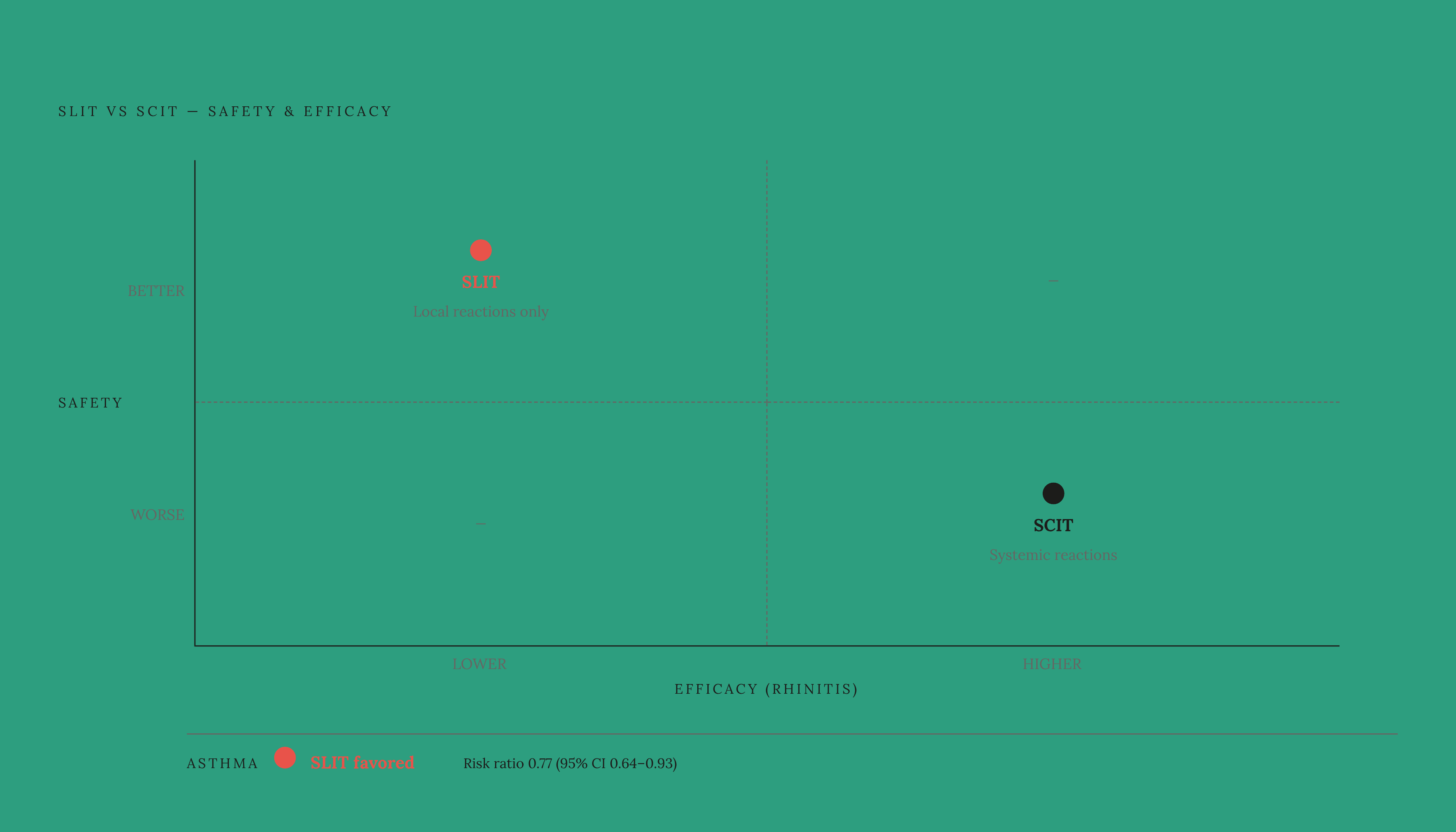
The safety finding from Asiri et al. is clean, and it's worth stating plainly: SLIT beats SCIT on safety, full stop. Adverse events with SLIT were mostly local. SCIT carried a higher risk of systemic reactions, the kind that involve more than just the injection site. On efficacy, both approaches reduced rhinitis symptoms and medication use compared to no treatment, with some studies suggesting SCIT might edge out SLIT on certain measures, like total rhinitis symptom score change from baseline.
That efficacy edge gets cited a lot by people arguing for shots, so it's worth being precise about what it isn't. It isn't a safety edge, and it doesn't show up in the asthma data at all. The asthma-focused meta-analysis found no meaningful difference between SLIT and SCIT on total asthma symptom scores, and actually found higher rates of asthma improvement in the SLIT group (risk ratio 0.77, 95% CI: 0.64 to 0.93). The asthma-focused meta-analysis did not find a meaningful safety advantage for either treatment over the other. Put the two findings together and the honest read is this: wherever SCIT has an advantage, it's a narrow efficacy edge on certain rhinitis measures, not a safety edge. And on asthma specifically, SLIT holds its own or does better.
Why does this layer of evidence matter beyond the individual trials? It shows the safety advantage isn't tied to one manufacturer, one trial design, or some quirk of dust mite allergy. It holds up across the broader RCT literature, and the driver appears to be the route of delivery itself, sublingual versus injected, rather than anything particular about how children's immune systems respond. Both reviews flag that long-term comparative data is still thin, a fair caveat worth carrying forward. Asiri et al. are explicit that choosing between SLIT and SCIT should come down to individual factors: efficacy, safety, how likely the family is to stick with the regimen, and practical circumstances.
The age threshold below 5 and what it means for practical eligibility
Immunotherapy generally isn't recommended for children under 5, and clinical guidelines reflect practical considerations around monitoring young children during treatment rather than a hard biological floor on immune retraining.
MT-12 enrolled starting at age 5, and that floor wasn't arbitrary. It reflects the same clinical thinking. So the trial evidence covered here speaks to children age 5 and up. For a family with a younger child and serious allergy symptoms, the right move is a conversation with a physician about when evaluation makes sense, not an open-ended wait.
Here's where families tend to slip up a second time, right after confusing symptom control with immunotherapy in the first place: treating the age-5 threshold as a reason to delay once a child is actually old enough. Delaying treatment once a child is eligible means more years of unaddressed immune dysregulation. The real question at that first evaluation is readiness, not whether immunotherapy is worth pursuing at all.
What the safety profile looks like in practice: types of reactions, their frequency, and what to monitor
Across the trials, the pattern repeats: local reactions dominate. Itching, tingling, or mild swelling under the tongue, right where the dose goes. Both MT-12 and the tree pollen trial describe these events as mild to moderate, and self-resolving.
The 2.5% discontinuation rate in MT-12 is worth sitting with for a second. Over a full year, in a trial of more than a thousand children, only a small fraction stopped treatment because of a side effect. That's a low bar to clear for a therapy that's actively engaging the immune system every day.
Systemic reactions, the kind that involve more than the mouth, show up far less often with SLIT than with SCIT, according to the systematic review data above. Skipping the needle isn't just a convenience question, it's a mechanical difference. There's no injection depositing allergen into tissue where it can spread beyond the local site, so the pathway to a systemic event mostly isn't there in the first place.
For parents managing this at home, a few practical points stand out:
- Hold the dose under the tongue for the period specified by the prescribing physician before swallowing. That short window doubles as a built-in moment to notice anything unusual.
- MT-12's conclusion that the safety profile "supports daily self-administration" means home dosing is well-supported by the data, though a physician still guides the initial dose and any escalation.
- Because younger kids might not flag discomfort reliably, the age-5 threshold functions as much as a monitoring bar as an age cutoff.
- Mild oral itching or a throat tickle isn't a reason to stop treatment.
Hives, swelling beyond the mouth, or any respiratory symptoms sit in a different category entirely, and warrant a call to the prescribing physician, not a wait-and-see night at home.
How the evidence base informs the conversation parents and clinicians should have
At this point, the evidence supports a fairly direct statement: SLIT has a well-documented safety profile in children aged 5 and older, backed by large randomized trials covering different allergens and age ranges and confirmed across multiple systematic reviews. Parents and clinicians weighing this option aren't looking at something unproven or experimental. Waiting on the theory that "there isn't enough data yet" doesn't hold up against a 1,460-child randomized trial and two independent systematic reviews pointing the same direction. That instinct to wait and see is understandable, but it's the one position the evidence doesn't actually support anymore.
That said, one size doesn't fit all here. The Asiri et al. review says as much directly: choosing between treatments needs to account for efficacy, safety, how well a family can stick with the routine, and the child's specific situation.
A few questions are worth bringing into that conversation directly:
- Which allergens are actually driving the symptoms, and does the trial evidence cover those specific allergens?
- Is asthma part of the picture? MT-12 looked at asthma outcomes directly, and the pediatric asthma meta-analysis found SLIT and SCIT performed similarly.
- Can the family realistically commit to multiple years of daily treatment, and does at-home sublingual dosing make that more workable than weekly trips to a clinic for shots?
- How old is the child, and how well can they communicate if something feels off?
None of this happens in a vacuum. The downstream effects of untreated allergic rhinitis (facial and jaw development, disrupted sleep, cognitive and behavioral effects, speech delays tied to hearing loss) are real reasons this isn't a decision to leave on the back burner. Immunotherapy remains the one option with evidence behind it for actually changing the underlying disease process, not just covering it up for a few hours at a time.
Telehealth evaluation and at-home sublingual treatment, whether that's compounded drops or an FDA-approved tablet prescribed under a physician's supervision, have made this more workable for families who can't easily manage weekly in-office visits. And because doctor-guided immunotherapy programs generally qualify for FSA and HSA spending, the financial side of a multi-year commitment often looks more manageable than it first appears.
Sources
- Efficacy and safety of SQ house dust mite sublingual immunotherapy-tablet (12 SQ-HDM) in children with allergic rhinitis/rhinoconjunctivitis with or without asthma (MT-12): a randomised, double-blind, placebo-controlled, phase III trial
- Efficacy and Safety of Sublingual and Subcutaneous Immunotherapy in Children with Allergic Rhinitis: A Systematic Review of Randomized Trials Including Direct and Indirect Comparisons
- Efficacy and safety of subcutaneous and sublingual allergen immunotherapy in the treatment of asthma in children: a systematic review and meta-analysis - PubMed
- pubmed.ncbi.nlm.nih.gov
- ncbi.nlm.nih.gov
- thelancet.com
- researchgate.net