Allergy Shot Reactions and Safety Protocols
Mild local reactions are common, but systemic reactions demand supervised epinephrine access.
Allergy shots work by putting a small, controlled amount of allergen into your body, over and over, until your immune system stops overreacting to it. That's the whole premise, though the risk that comes with it is real: everything from a red bump at the injection site to, in rare cases, anaphylaxis. I've spent enough time around allergy clinics to know that the wait times, the epinephrine sitting on the shelf, the dose adjustments made visit by visit, none of that is bureaucratic padding. It's there because this risk is predictable enough to manage, and serious enough that nobody gets to skip the managing.
The risks of allergy shots range from local reactions at the injection site, redness, swelling, itching, tenderness, which occur in anywhere from 26% to 82% of patients during build-up, to systemic reactions involving the whole body: hives, asthma flares, and in rare cases anaphylaxis. Anaphylaxis is the reaction every clinic protocol gets built around, because it can move from mild to life-threatening in minutes, and across all causes carries a lifetime prevalence of up to 1 in 20 people. The 30-minute wait after each injection exists because most systemic reactions cluster inside that window, and trained staff spend it watching for specific signs: skin changes, respiratory distress, cardiovascular instability, and neurological symptoms. Epinephrine is the only first-line treatment for anaphylaxis, and there is no acceptable alternative first move, which is why the wait requires supervised access to emergency equipment and cannot be skipped or done at home.
Reactions split into two buckets, and they're not the same conversation. Local reactions stay put at the injection site: redness, swelling, itching, tenderness. Depending on the allergen mix and dose stage, somewhere between 26% and 82% of patients get one during the build-up phase, and most people feel this at some point. It shows up within minutes to an hour and fades on its own, nothing to write home about.
Systemic reactions are a different animal entirely, because they involve the whole body rather than just the skin around the needle. Mild versions look like hives spreading beyond the injection site, sneezing, a runny nose. Moderate versions bring chest tightness or an asthma flare, while severe versions mean anaphylaxis, and that's the one every protocol in the building gets built around. These happen less often than local reactions, but anaphylaxis, across all causes, carries a lifetime prevalence of up to 1 in 20 people. That's not a small number for a clinic to plan around, and it's why nobody treats allergy shots like a routine flu shot.
So why does build-up carry more risk than maintenance? The dosing logic explains it. Each week, the dose climbs a notch past what the immune system has already handled, and that narrows the gap between a dose that builds tolerance and one that triggers a reaction. Throw in recent illness, exercise too close to the injection, a heavy pollen day, or a simple dosing error, and that gap tightens even more.
What anaphylaxis from allergy shots actually looks like and why timing matters
Anaphylaxis doesn't build slowly. It can go from mild to life-threatening in minutes, which is exactly why the clock matters here more than almost anywhere else in medicine.
Early signs are flushing, hives, a throat that feels like it's tightening, nausea, or sometimes just a vague, hard-to-name sense that something's off. From there, things move fast: the airway can swell, the bronchial tubes spasm, breathing gets harder. Left untreated, this slides toward vascular collapse, and the window for stepping in is short. Every minute without epinephrine shrinks that window further.
The field takes this seriously enough to study it as its own thing. A 2025 study using the European Anaphylaxis Registry looked specifically at anaphylaxis triggered by allergen immunotherapy, treating it as a distinct clinical event rather than folding it into anaphylaxis broadly. That's a meaningful signal, telling you the medical community sees this as predictable enough to track as a pattern.
And yet, people who know they're at risk still hesitate. Research published on PMC found that improper or delayed epinephrine administration remains a real problem, even among patients and caregivers who understand, in theory, that they might need it. That's the tension running through this whole topic: anaphylaxis from allergy shots is predictable enough that protocols exist for it, but dangerous enough that those protocols can't be optional.
Why do you have to wait 30 minutes at the clinic after an allergy shot?
After every allergy shot, patients wait at the clinic for 30 minutes under direct observation by trained staff. Doesn't matter how good you feel walking out of the exam room; it's thirty minutes, every time.
Why that specific number? Most systemic reactions happen inside that window. Reactions that start after 30 minutes are uncommon, and when they do happen, they tend to run milder. The wait is built around where the actual danger clusters, not around some arbitrary caution baked in for legal cover.
During that half hour, staff are watching for specific things, well beyond making small talk in a waiting room chair. Skin changes, like hives, flushing, and swelling that spreads past the injection site. Respiratory signs such as coughing, wheezing, and tightness in the throat. Cardiovascular signs, including a drop in blood pressure and a pulse racing or going weak, along with neurological signs like dizziness, confusion, or loss of consciousness. That's a structured monitoring interval with a real clinical purpose behind it, not a formality.
Here's what patients should know going in: this 30 minutes applies to every single visit, whether you're three weeks into build-up or five years into maintenance. Over a multi-year course of treatment, that adds up to a real chunk of time, one you have to plan around indefinitely, not just during the intense early months.
This is also the dividing line between in-office immunotherapy and anything done at home. The requirement exists because the risk profile demands supervised access to emergency equipment. It's not a preference thing.
On-site epinephrine and the emergency response infrastructure clinics must maintain
Epinephrine is the first-line treatment for anaphylaxis, full stop, with no substitute drug and no alternative first move to try instead. The American Academy of Family Physicians laid this out plainly in its 2024 practice guidelines: prompt injection is essential, and waiting around to see if symptoms resolve on their own isn't an acceptable strategy.
So what does a clinic actually need on hand to run this program responsibly? Epinephrine autoinjectors or pre-filled syringes, sitting somewhere immediately accessible, not locked in a cabinet across the building. Antihistamines and corticosteroids as backup agents, useful for cleaning up lingering symptoms after the main event, but incapable of reversing anaphylaxis on their own. Supplemental oxygen, and staff trained specifically in recognizing and responding to anaphylaxis, not just generally competent nursing staff. And a written emergency protocol spelling out who does what; documented clinic and school anaphylaxis protocols walk through staff roles step by step once a reaction starts.
The ACAAI/AAAAI Joint Task Force for Practice Parameters put out updated anaphylaxis management guidelines in December 2023, and those guidelines shape current best practice at clinics running immunotherapy programs today.
Here's where the gap actually shows up, though. Some patients, and even some staff, delay giving epinephrine because they're waiting to see if the reaction "gets worse" first. I get the instinct, since nobody wants to jump to the most aggressive option if it turns out to be nothing. But that hesitation is exactly what the equipment and training exist to override; they're the backup that makes the whole shot protocol defensible in the first place.
Dose adjustment rules and how clinics prevent reactions before they happen
Most reactions aren't random bad luck. They follow patterns, and dose-adjustment rules exist to catch those patterns before they turn into something worse.
A clinic will typically hold or reduce a dose when the previous visit produced a local reaction bigger than a defined size threshold, or any systemic reaction at all, even a mild one. Same goes if the patient is sick, having an asthma flare, or fighting an active infection that day. Missed doses matter too: skipping appointments means stepping the dose back down, not resuming where treatment left off, because the immune system's tolerance doesn't hold steady on its own. And high pollen counts count against you as well, since baseline immune reactivity is already elevated before the needle even goes in.
Before every injection, patients get asked about symptoms since the last visit, part of the screening that catches warning signs before the needle goes in rather than after.
Then there's the exercise question, which catches some patients off guard. Vigorous activity around the time of a shot increases blood flow, and that speeds up how fast the allergen gets absorbed, raising the odds of a systemic reaction. So patients are usually told to skip intense exercise for several hours before and after each injection. It sounds minor, but it isn't.
Every adjustment rule is really chasing the same target: keep the dose inside a narrow zone, high enough to build tolerance, low enough that the immune system doesn't get overwhelmed. It's a moving target, recalculated visit by visit, not a formula you set once and forget.
What patients are agreeing to when they start allergy shots — the practical commitment
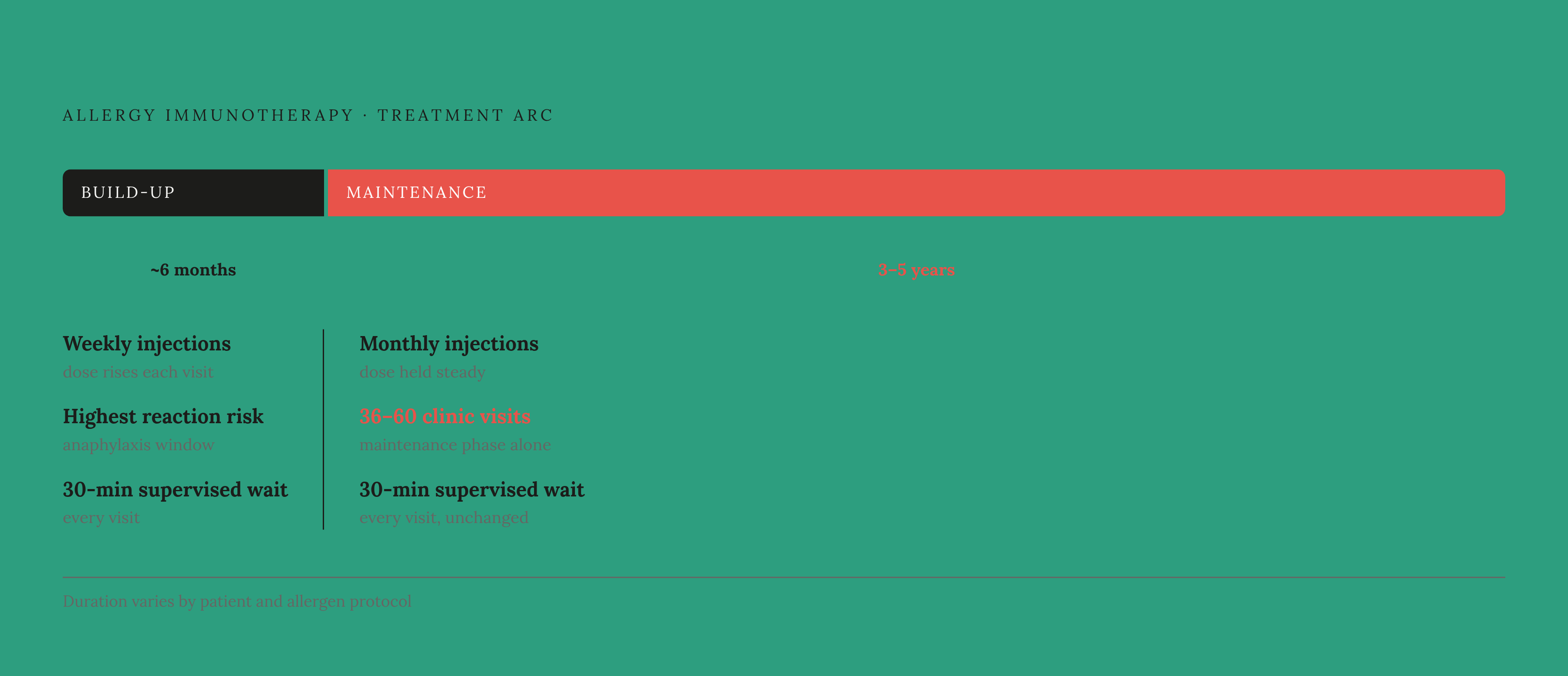
Starting allergy shots means signing up for a schedule that runs for years, not weeks, which is worth saying plainly, because I don't think everyone walks in understanding that.
Build-up phase comes first: typically weekly injections for several months, with the dose climbing at each visit. This is the highest-risk stretch and also the most demanding one in terms of visits. Once the target dose is hit, maintenance phase begins, injections space out (often to monthly), and that continues for several years after. Every one of those visits, build-up or maintenance, carries the same 30-minute wait. Across a multi-year course, that's a real cumulative time cost, easy to underestimate at the start when you're focused on just getting through week one.
Is it worth it? For certain conditions, the answer is about as clear as this field gets. Venom immunotherapy, for bee, wasp, hornet, and fire ant allergy, achieves 95 to 98% protection against severe reactions to future stings. Sublingual alternatives haven't matched that number for this specific use, which is a big part of why shots remain the standard for venom allergy specifically.
For environmental allergies, pollen, dust mites, pet dander, the efficacy case still holds up, but the calculus shifts. What trips people up usually isn't whether the treatment works; it's the logistics. Patients who live far from a clinic, who work inflexible hours, or who are shuttling kids to their own allergy appointments on top of managing their own treatment, run into a structural access problem. That's a scheduling and geography issue, not a medical one, and no amount of protocol tweaking fixes it.
Going in clear-eyed, understanding that the wait times and screening questions and dose holds are structural requirements of the treatment rather than extras bolted on for caution's sake, is what lets someone make an honest call about whether shots actually fit their life.
How sublingual immunotherapy reframes the safety trade-off for environmental allergies
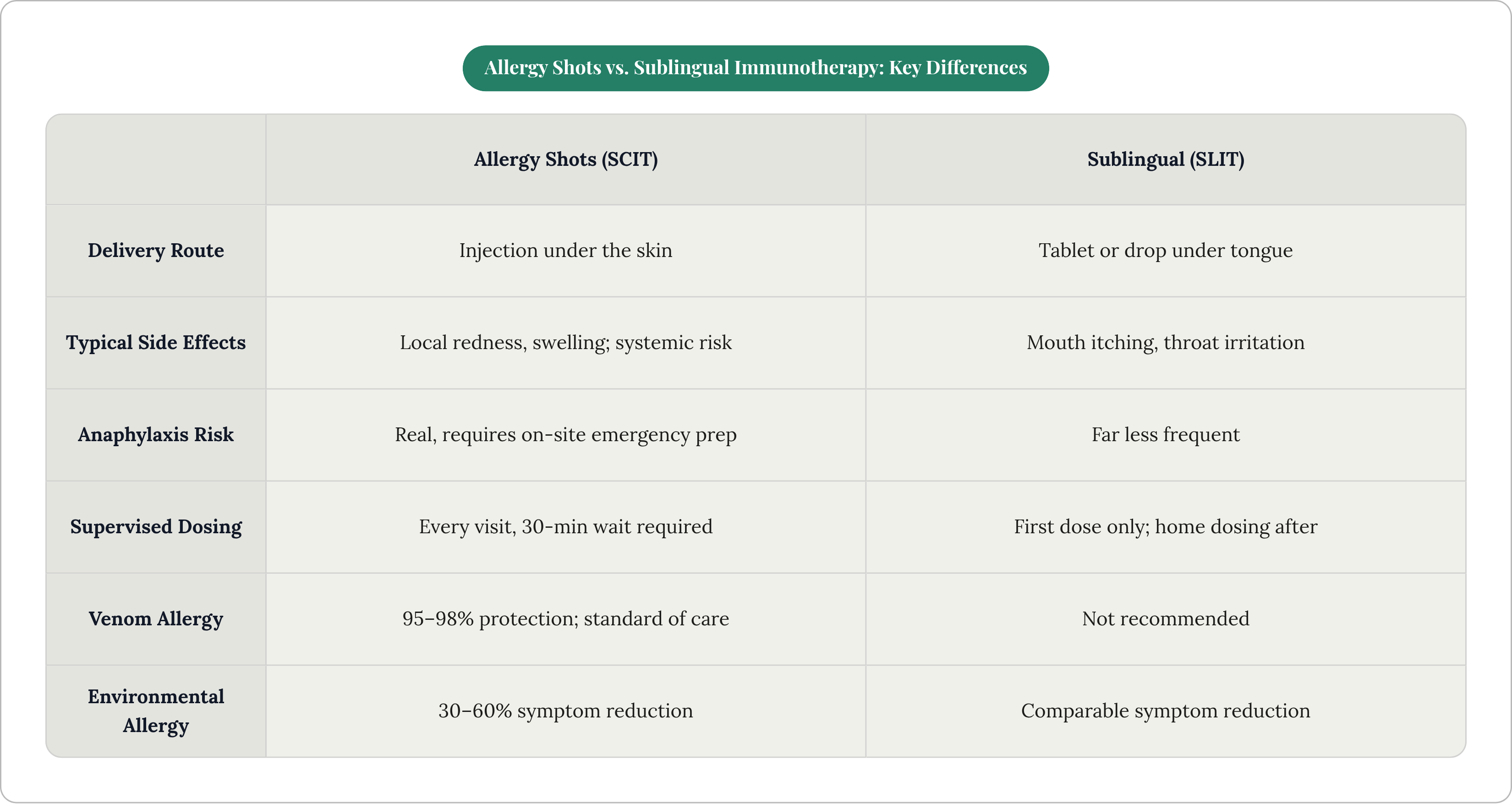
Sublingual immunotherapy, SLIT for short, delivers the allergen under the tongue instead of through a needle. One change in delivery route, and the whole reaction profile shifts with it.
Side effects with SLIT tend to stay local to the mouth: itching or tingling under the tongue, throat irritation, mild swelling. These generally ease off as dosing continues, and severe systemic reactions happen far less often with SLIT than with injections. That pattern holds up consistently across comparative research, not as some one-off finding worth discounting.
That said, SLIT isn't entirely free of the supervised-start requirement, and it's worth being upfront about that. FDA-approved SLIT tablets, Odactra for dust mite, Grastek for Timothy grass, Oralair for a five-grass mix, Ragwitek for ragweed, all require the first dose to be given under medical supervision, with that same 30-minute observation window used for shots. The reasoning is identical: confirm no severe reaction happens before the patient starts dosing solo. What changes is everything after that first dose. Once cleared, SLIT gets taken at home, daily, without the ongoing visit schedule or the on-site emergency setup that shots require for years.
Does the milder safety profile settle which option is better? Not entirely, and I'd push back on anyone who claims it does. Research shows both approaches cut symptoms by 30 to 60% in most patients, and comparative reviews haven't found meaningful differences in symptom control or medication use between injections and SLIT for inhalant allergens like pollen or dust mite. Venom allergy is the clear exception here: SLIT hasn't shown comparable results, and it isn't recommended for that use.
Shots carry a heavier safety protocol because their reaction risk runs higher; SLIT's gentler profile is exactly what makes at-home dosing medically defensible once that first supervised dose is behind you. For patients whose schedules can't absorb years of weekly or monthly clinic visits, that difference stops being a technical footnote and becomes the deciding factor. Telehealth programs built around doctor-guided at-home SLIT, whether drops or the FDA-approved tablets, are opening up that lower-risk path to people who've gone without treatment simply because geography or scheduling made the shot route a non-starter.