Sublingual Drops vs. Allergy Shots Efficacy Comparison
Safety and adherence matter more than raw efficacy numbers.
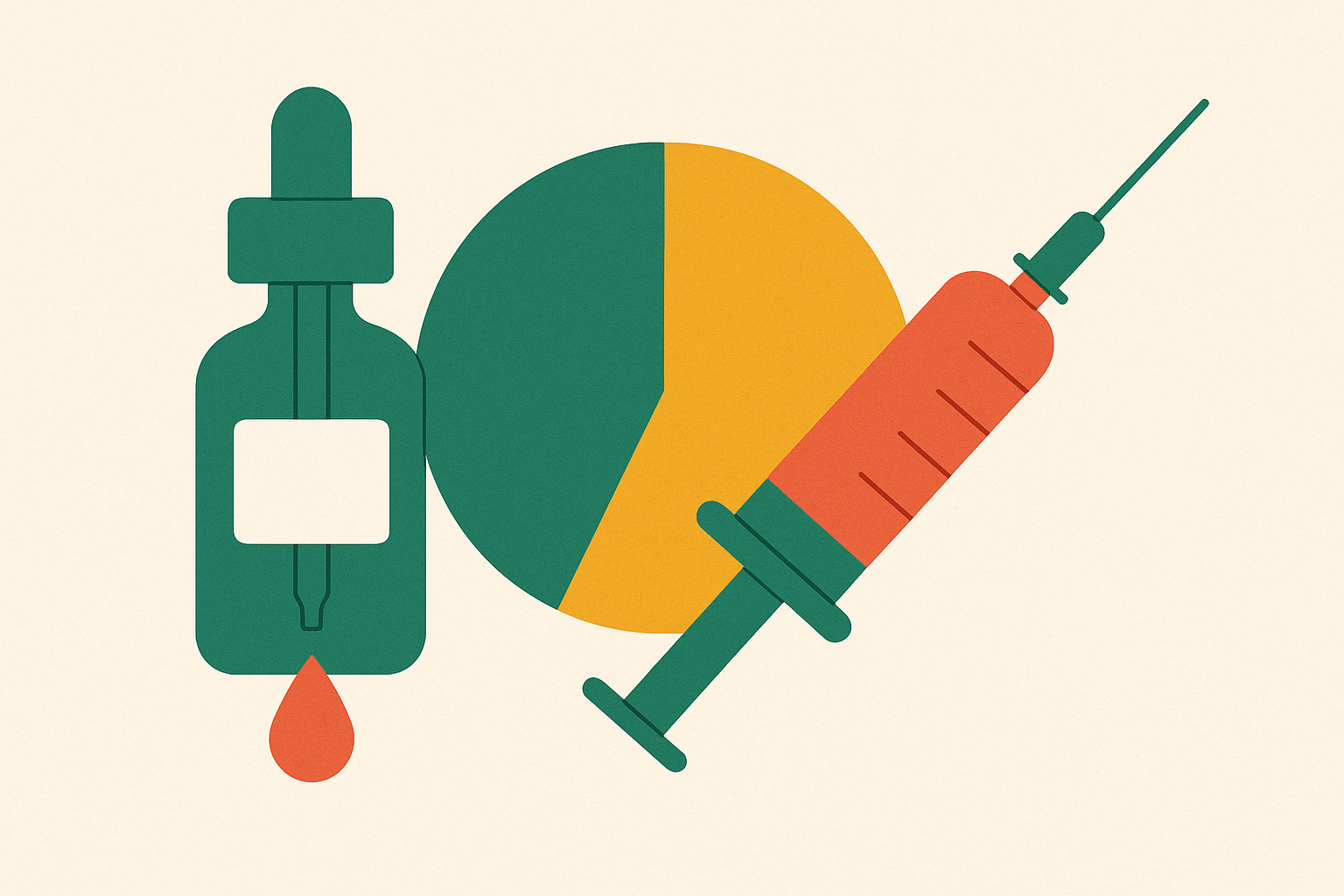
SLIT drops and SCIT shots both retrain the immune system, and on paper they land in the same neighborhood for effectiveness. But look at safety data, allergen coverage, and who actually finishes treatment, and the two stop looking like twins. That gap, more than the topline efficacy number everyone quotes, is what should drive the decision. Picking based on peak efficacy alone means optimizing for the wrong variable.
Here's the mechanism worth understanding before any comparison makes sense. SCIT delivers allergen extract under the skin, while SLIT delivers it under the tongue, into tissue packed with a specific kind of dendritic cell primed to build tolerance rather than trigger a fight response. Different doors, same building: both routes push the immune system through the same sequence, a shift away from the TH2 allergic signaling pattern, a buildup of regulatory T cells and B cells pumping out interleukin-10, a drop in how hard allergen-specific T cells multiply, and an antibody class switch away from IgE and toward IgG4 and IgA.
That IgG4 shift is the crux of it. IgG4 acts like a decoy: it grabs the allergen before it can cross-link with IgE sitting on mast cells, and it engages an inhibitory receptor that tells those mast cells to stand down. IL-10 suppresses mast cell and eosinophil activity directly and nudges the class-switching machinery toward IgG4 instead of IgE, while TGF-beta works the regulatory T-cell side. None of this happens fast, since it's a gradual retraining, one dose at a time, over years, working on a different timescale than the immediate suppression an antihistamine provides. Because both treatments are aiming at the same biological endpoint, comparing them on efficacy is a fair fight, not an apples-to-oranges exercise.
What the clinical evidence actually shows about symptom reduction and lasting benefit
Start with SLIT, since it's usually the less familiar side of this comparison. A 2025 systematic review and meta-analysis covering 25 randomized controlled trials and 1,830 patients found liquid SLIT produced a statistically significant reduction in symptom scores against placebo. A 2010 Cochrane review backed this up: SLIT cut both symptoms and rescue-medication use compared to placebo, with no cases of anaphylaxis across the trials it analyzed.
SCIT's evidence base has had decades more time to accumulate data. That head start reflects timing more than certainty; the FDA-approved SLIT tablets on the market went through the same rigorous development process any prescription drug goes through.
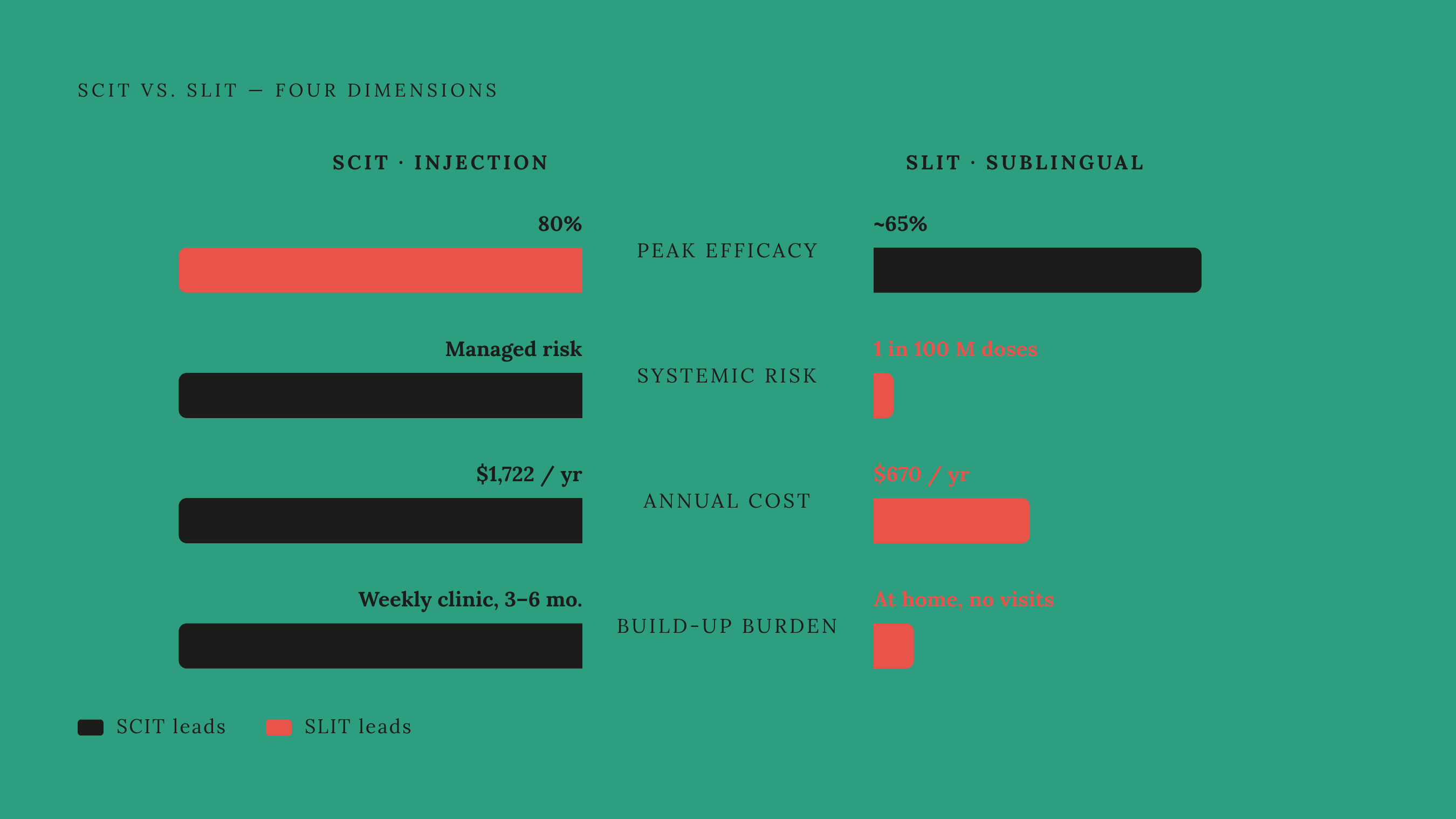
Line the two up and the effectiveness looks broadly comparable, though not identical. Comparative research puts shots around 80% efficacy for environmental allergens, with drops landing somewhat lower. Here's the part worth sitting with: for a patient managing day-to-day sneezing and congestion, that gap rarely translates into something they'd actually feel. The delivery route separates these two options far more than any difference in biological effect does, and that's the point most comparisons get backwards. They fixate on the efficacy gap and skip past the fact that both treatments need 3 to 5 years of consistent use before tolerance sticks, with relief persisting for years after treatment stops. That's the real cost of admission, and it's identical either way.
Where the data thins out is multi-allergen custom SLIT drops. Most of the strong head-to-head evidence compares single-allergen SLIT tablets against SCIT, so conclusions about custom multi-allergen drops lean more on clinical extrapolation than on trials built for that exact comparison.
Where the safety profiles diverge and why it changes the risk calculation
This is where the two treatments actually split. SCIT carries a real risk of systemic allergic reaction, which is why every injection happens in a clinical setting with emergency equipment on hand, and why patients sit in the waiting room for 30 minutes afterward before anyone lets them leave. That's a structural safety requirement built into how the treatment works.
SLIT's track record reads differently. Most reactions are local and mild, occurring at the sublingual site rather than systemically. Severe systemic reactions run at roughly 1 in 100 million doses, a figure drawn from a safety record spanning about 2 billion doses given worldwide, which is a large enough sample to call it a real pattern rather than a fluke.
Certain patients need a direct conversation with an allergist no matter which route they're considering: uncontrolled asthma, a recent anaphylaxis episode, or beta-blocker use are the usual flags. But be precise about what SCIT's risk actually means. It's a known, managed part of a supervised protocol that clinics run every day without incident for the overwhelming majority of patients, and none of this counts against the treatment's quality. What it does mean is that the safety profiles are genuinely different, and that difference is exactly why SLIT can go home in a bottle while SCIT has to happen in an exam room. Adherence, cost, who actually finishes treatment: trace all of it back to that one structural fact.
How allergen coverage and treatment format differ between the two options
Four allergens currently have FDA-approved SLIT tablets in the US: house dust mite (Odactra), Timothy grass (Grastek), a five-grass mix (Oralair), and short ragweed (Ragwitek). That's a narrow menu, and plenty of patients are sensitized to more than one thing at once. That's where custom multi-allergen SLIT drops come in: FDA-approved extracts prescribed off-label, built around a patient's actual sensitization panel instead of a single trigger.
SCIT is typically custom-mixed too, addressing multiple allergens in one regimen, with the dose built up gradually over 3 to 6 months before settling into a maintenance schedule. So personalization isn't the dividing line here; both can be tailored. What differs is where and how that tailoring gets delivered.
Take a patient dealing with dust mites, grass, and mold all at once. The approved tablets don't cover that combination, so custom drops or SCIT become the realistic options. And the build-up phase looks nothing alike between the two: SCIT means showing up once or twice a week for 3 to 6 months to reach maintenance dosing, while SLIT drops usually start low and get titrated upward at home, no clinic visits required for the ramp-up.
Why adherence rates matter as much as peak efficacy in real-world outcomes
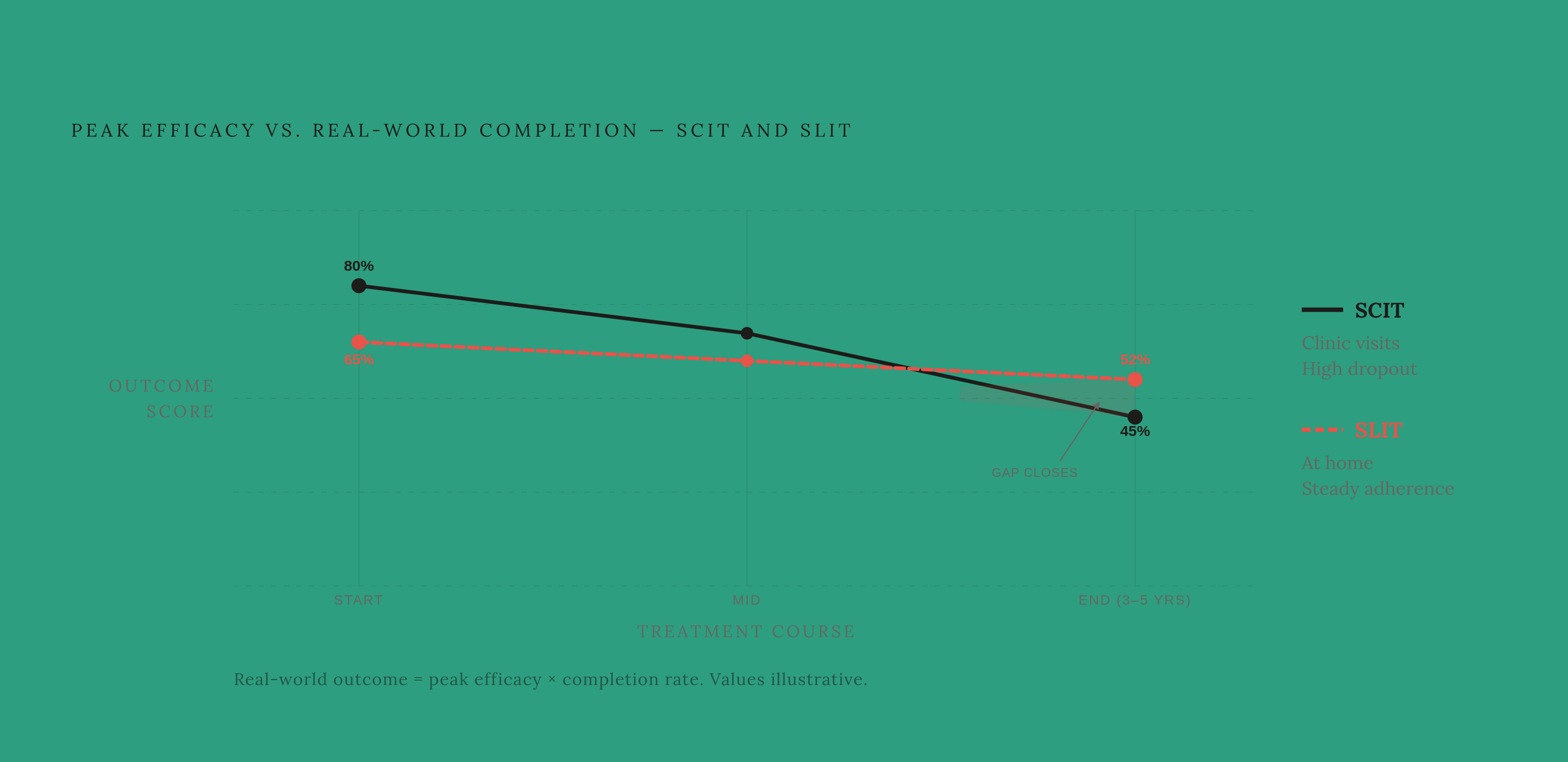
Does it matter that shots edge out drops on peak efficacy, if a meaningful share of patients on shots never make it to year three? Real-world effectiveness isn't just how well a treatment performs in a trial; it's efficacy multiplied by how many people actually finish the course, and on that second number, SCIT is working against itself.
The adherence problem is baked into SCIT's structure. The build-up phase alone can mean weekly office visits for up to six months, followed by monthly visits for years after. For anyone juggling a job, kids, or a long commute to the nearest allergist, that's a serious ask. This scheduling burden has been cited as a reason patients start looking at sublingual alternatives in the first place.
SLIT sidesteps the problem by design. Dosing happens at home, on the patient's own schedule, no clinic trip required. That's a different argument from raw potency, one about completion rates rather than dose-for-dose comparisons. Run the math anyway: shots at roughly 80% efficacy, but a chunk of patients quitting somewhere in year two once the visit schedule wears them down, versus drops landing somewhat lower on paper while more patients actually cross the finish line. The real-world gap narrows, and it might even flip, since the treatment with the lower peak-efficacy number could end up helping more people in practice. That should unsettle anyone who picks a treatment off peak-efficacy numbers alone, and it's the strongest argument in this whole comparison for defaulting to SLIT whenever adherence is in doubt.
The cost and coverage gap that shapes who actually gets treated
Money changes this calculation fast. One analysis put average insurance charges at $1,722.24 for a year of SCIT versus $669.50 for a year of SLIT, a gap that compounds across a 3-to-5-year course into thousands of dollars of difference by the time either treatment wraps up.
Coverage flips the picture depending on insurance status. Most plans cover allergy shots, often down to just a copay per visit, though that coverage comes with the in-office requirement attached. FDA-approved SLIT tablets are frequently covered too, but custom multi-allergen drops are a different story: most plans won't touch them, leaving patients paying directly. Cash-pay pricing for custom drops runs around $99 a month in some programs.
Here's the counterintuitive part, and it's the one people miss when they assume SLIT is automatically cheaper. A well-insured patient might pay less out of pocket for SCIT, copays and all, than for custom drops that insurance won't cover. Flip the insurance status and the math reverses: someone uninsured or underinsured often comes out ahead paying directly for SLIT drops rather than facing SCIT's $1,000 to $4,000 a year before insurance, or $150 to $300 per in-clinic visit. One detail softens the blow for out-of-pocket SLIT patients: the out-of-pocket cost is a fixed, predictable monthly figure rather than a series of surprise bills.
Which patient profiles each treatment suits and how to think about the choice
Neither treatment is flatly better; a patient's schedule, insurance, and allergen panel matter more than a trial's topline number. What decides it is a patient's specific sensitivities, how their week actually looks, what their plan covers, and how they feel about needles.
SCIT fits patients with solid insurance coverage who live near an allergist and have room in their week for regular visits. It suits people who want a clinician physically present through the whole process, and cases of severe, multi-allergen sensitivity where that extra few points of peak efficacy might genuinely matter.
SLIT, whether as an approved tablet or custom drops, fits a different set of circumstances. Patients whose jobs or family obligations make weekly clinic trips a non-starter. Patients who live far from a specialty allergist, or kids and adults who'd rather skip the needles entirely. Patients paying out of pocket who need the price up front instead of finding out after a bill arrives. It also fits anyone whose allergen profile happens to line up with one of the four FDA-approved tablets, giving them an approved product without needing a custom formulation.
Telehealth has changed some of this math. Wyndly, for instance, is a direct-to-consumer allergy clinic that mails sublingual drops or tablets to patients after a virtual visit. Virtual consultations and expanded access to at-home testing have chipped away at the geography-and-scheduling wall that used to keep immunotherapy out of reach for anyone who didn't live near a specialty clinic. Somewhere around 81 million Americans carry a diagnosis of seasonal allergic rhinitis, and a large share never start immunotherapy of either kind. For plenty of that group, the logistics of getting treatment, especially SCIT's, get in the way before the immune system ever gets a chance.
Both paths use the same biology, both demand years of patience, and both deliver relief that outlasts the treatment itself. The decision comes down less to which one wins on paper and more to which one a patient can actually stick with. That's worth working through directly with a board-certified allergist or a telehealth physician who can run the sensitization testing and map out what actually fits.