Allergy Shot Cost Without Insurance
The true cost of allergy shots extends far beyond annual injection fees.
There is a number that circulates widely in online allergy forums and patient-facing health articles: somewhere between one thousand and four thousand dollars per year. That figure gets repeated so often it starts to feel authoritative. And in a narrow, technical sense, it is not wrong. It describes the recurring cost of the shot phase, once you are already in treatment, already past the diagnostic work, already holding a vial of custom serum. For an uninsured patient trying to decide whether to start allergy shots, that number answers the wrong question entirely.
The right question is not what a single year of shots costs. It is what the complete financial commitment looks like across three to five years, from the first skin prick to the last maintenance injection. Those are different calculations, and they produce very different answers.
The upfront costs before the first injection: testing and serum preparation
Before any therapeutic dose enters your arm, two things have to happen: your allergen profile gets mapped, and a serum gets built to match it. Neither is free, and neither is optional.
Allergy testing, depending on whether your clinician uses a skin prick panel or a blood draw, and depending on how many allergens get screened, runs somewhere between sixty and three hundred dollars for uninsured patients. The skin prick test is typically the less expensive route, but the breadth of the panel drives the cost more than the method does. If you live somewhere with high mold burden, significant grass and tree pollen overlap, and a household pet, your clinician is testing for more variables, and the cost reflects that.
Serum preparation is where costs jump. The serum is custom-formulated to your specific sensitization profile; it is not an off-the-shelf product. Initial vial preparation typically runs around six hundred dollars. Combined, the pre-treatment phase, testing plus serum, can range from five hundred to two thousand dollars depending on the complexity of your allergen picture.
These costs are largely non-recurring. You pay them once, at the front end. But that structural feature carries a risk that patients rarely consider before signing on: if you start treatment and then stop after a few months, the upfront cost is already fully spent, against only partial benefit. The economics of an incomplete course are punishing because those dollars do not prorate backward.
How the buildup phase drives visit frequency — and early costs
The buildup phase is the most visit-intensive period of the entire protocol. Shots go in one to three times per week, with a hard ceiling on how long the gap between doses can stretch. The interval constraint exists because the immune system needs consistent, incremental antigen exposure to develop tolerance. Skip too many visits, or let the gap run too long, and the protocol resets. That is not a bureaucratic inconvenience; it is immunology.
For the uninsured patient, that visit cadence translates directly into cost accumulation. Administration fees per visit, the fee the clinic charges to administer the shot and monitor you afterward, run between twenty and one hundred dollars at the self-pay rate, depending heavily on geography and clinic type. Urban academic medical centers often price differently than community allergy practices. Some clinics offer an uninsured or self-pay discount; many do not.
One vial of serum covers roughly ten injections. At weekly cadence, you are burning through serum relatively quickly, and each new vial carries its own cost. When you add the administration fees across a full year of buildup, annual costs can reach between one thousand and five thousand dollars, with the range reflecting mostly where you fall on the visit fee spectrum and how quickly your clinician advances your dose.
The buildup phase is the most expensive period by unit of time. That is worth holding in mind because it is also the phase where clinical benefit is least apparent. Patients are paying the most, feeling the least improvement, and operating under a schedule they cannot compress without consequence.
What the maintenance phase costs and how long it runs
Once you reach your target dose, the cadence drops to every two to four weeks. That is a meaningful reduction in visit frequency, and it brings per-month cost down considerably. The problem is duration. Maintenance runs for three to five years from the point treatment begins, and in many responders, the meaningful symptom relief that justifies the whole enterprise does not arrive until the second year.
That gap between when you start paying for maintenance and when the treatment delivers its most tangible returns is worth sitting with. The first year of maintenance can feel financially sustained without much clinical reward. Patients who abandon treatment at that point have paid through the most expensive period while exiting before the compounding benefit of immune modification becomes most apparent.
Annual cost during maintenance, for an uninsured patient, still falls somewhere in the one thousand to four thousand dollar range. The lower visit frequency reduces the administrative fee burden, but the serum cost continues, and the timeline ensures that the maintenance phase, despite its lower per-month cost, typically represents the largest share of total lifetime spending simply by virtue of how long it runs.
The indirect costs that rarely appear in any published estimate
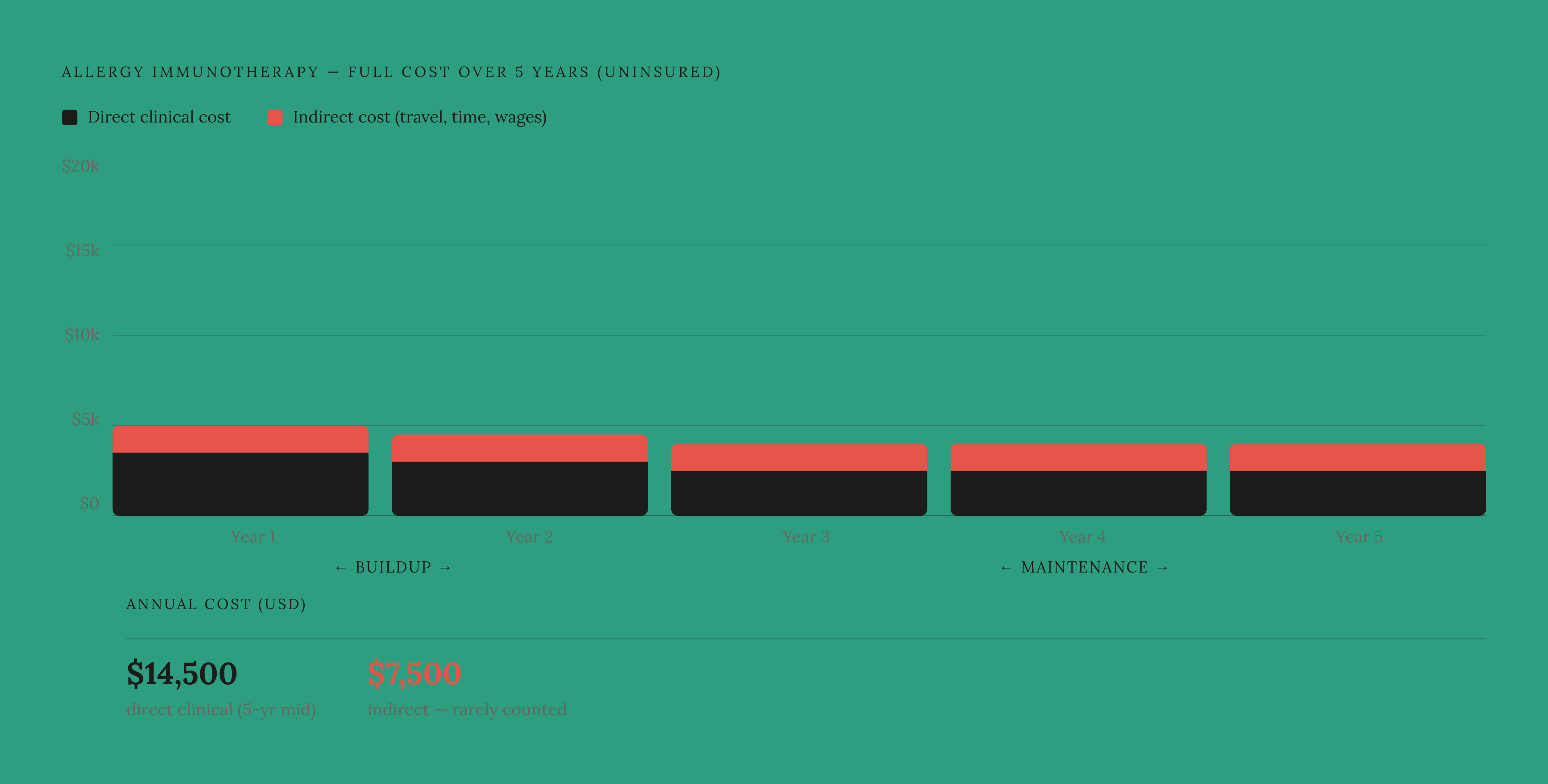
Every allergy shot requires a trip to a clinic. Every trip requires travel. And every visit includes a mandatory observation period of thirty to sixty minutes, because anaphylaxis risk in the immediate post-injection window is real and the protocol accounts for it. Add wait time, and a visit that takes thirty minutes on the calendar often consumes ninety minutes of actual time.
Over three to five years of injections, those ninety-minute blocks compound into something substantial. For patients with salaried employment and flexible schedules, the time cost is an inconvenience. For patients with hourly jobs, it is a concrete financial loss with every visit.
Transportation and parking add another layer, particularly for patients who do not live close to an allergist. Rural patients in areas without local allergy coverage drive significant distances; the indirect costs in those cases can exceed what the clinic charges for the shot itself.
When you aggregate travel costs, parking, and time value across a full treatment course, indirect costs for some patients can reach five thousand to ten thousand dollars over the complete arc of treatment. That is not hypothetical inflation; it is an accounting of what the protocol actually demands. It also partially explains a pattern that any working allergist has observed: patients who stop treatment before completing the protocol often do not quit because they cannot afford the injection fee. They quit because the logistics of sustained visit attendance become incompatible with the rest of their lives, and that logistical failure has financial consequences.
What the insured patient pays — and what that gap reveals about the uninsured burden
An insured patient with coverage that includes allergy immunotherapy typically pays a copay of ten to forty dollars per visit. Annual out-of-pocket exposure, depending on deductible structure and plan design, falls between six hundred and twelve hundred dollars.
Compare that to the full uninsured cost, including indirect expenses, and the gap is not marginal. It is structural. The insured patient is making a fundamentally different financial decision than the uninsured patient, even when both are sitting in the same waiting room.
Coverage, however, is not universal. Some plans exclude allergy immunotherapy outright; others require prior authorization or apply the cost against a deductible the patient does not reach. Certain states have mandated coverage for allergy shots, which provides a backstop for insured patients who would otherwise face denial. Uninsured patients in states without those mandates have no backstop of any kind.
The insured-versus-uninsured comparison is instructive not because it argues against the uninsured patient pursuing treatment, but because it makes visible what the uninsured patient is actually absorbing. Every cost layer that an insurer would otherwise negotiate and partially cover lands in full on the patient. That is the decision being made, and it should be made with clarity about what it contains.
How sublingual immunotherapy compares on cost for the uninsured patient
Sublingual immunotherapy, specifically the custom allergy drops prescribed off-label and self-administered under the tongue, typically runs between one hundred and three hundred dollars per month without insurance, or twelve hundred to thirty-six hundred dollars annually. That range is comparable to allergy shots, and in some cases lower, once visit fees are factored into the shot-side calculation.
The structural distinction matters more than the raw price comparison. Drops are self-administered at home. That single difference eliminates the per-visit administration fee, removes the mandatory observation period, and eliminates the transportation and time costs entirely. For an uninsured patient who lives far from an allergist or holds a job that makes regular clinic attendance difficult, the indirect cost difference alone tips the economic calculation toward drops.
Insurance coverage for custom sublingual drops is limited; many insurers categorize them as elective rather than medically necessary, which puts the insured and uninsured patient on more similar footing when comparing drops to shots. FDA-approved sublingual tablets, which exist for specific allergens including grass pollen, ragweed, and dust mites, carry a clearer regulatory standing than custom drops, though the tablet option covers a narrower allergen range.
The 2024 American Academy of Otolaryngology–Head and Neck Surgery Foundation guidelines issued a strong recommendation for immunotherapy, including sublingual immunotherapy, for patients with allergic rhinitis whose symptoms are inadequately controlled, with a minimum three-year treatment duration for those who respond. That guidance gives sublingual immunotherapy comparable clinical standing to shots in the relevant patient population. The comparison is competitive on the evidence.
Why OTC medications are cheaper upfront but not a cost-equivalent alternative
Generic loratadine, as of May 2026, runs approximately four dollars and ninety-seven cents per month through discount pricing programs. Generic cetirizine is slightly higher, around eight dollars and seventy cents per month. These numbers are not trivial in the context of a cost comparison; they represent the lowest accessible price point for allergy symptom management, with no required visit, no monitoring period, no serum preparation.
Generic montelukast runs approximately eight dollars and seventy-three cents per month, though it carries an FDA boxed warning for neuropsychiatric events and is no longer considered first-line by current guidelines. That context matters when patients are browsing options.
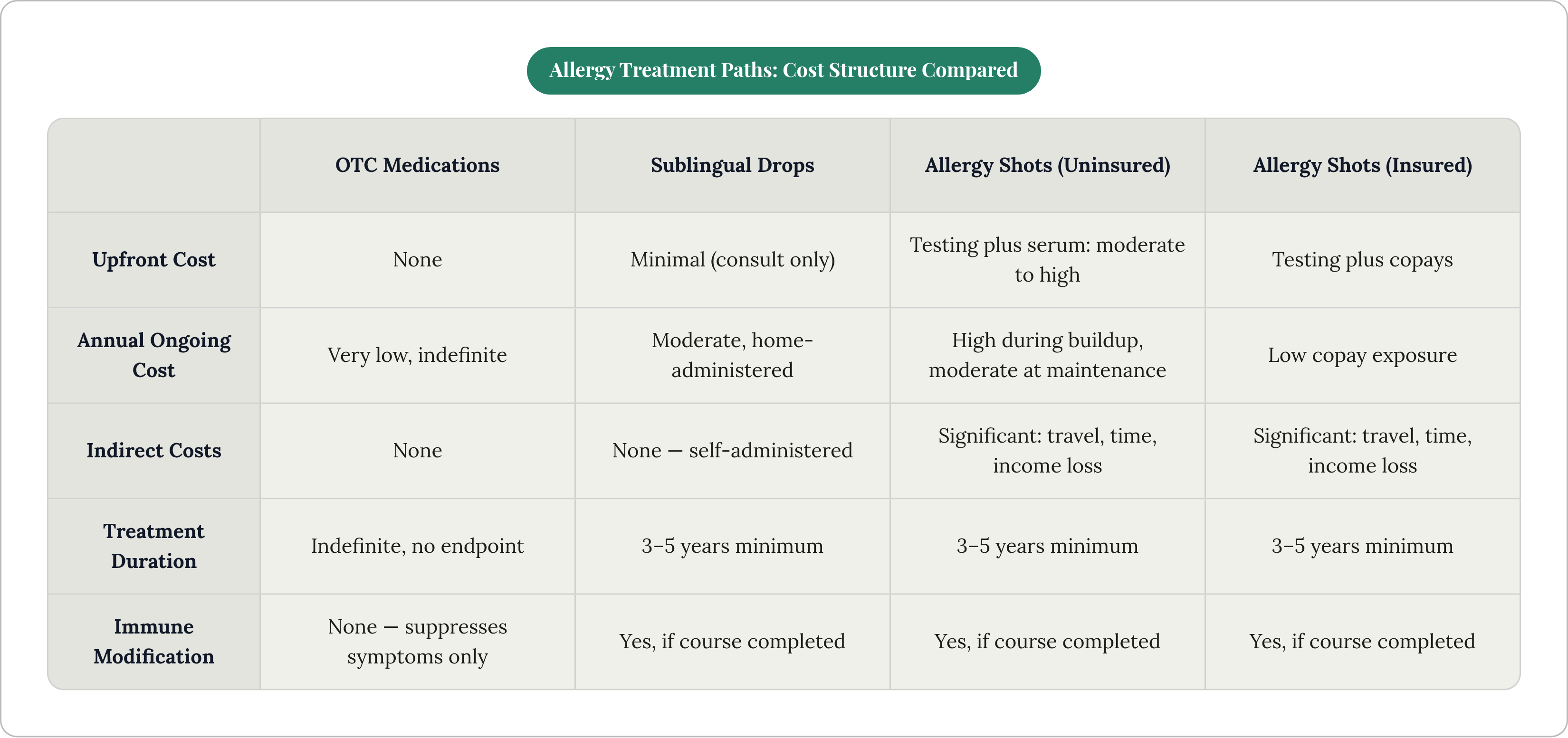
The structural limitation of antihistamines and related OTC options is not their cost per unit of time. It is that they have no endpoint. A patient who uses antihistamines continuously for five years spends far less annually than the patient undergoing immunotherapy, but those annual costs never stop accumulating. Immunotherapy is predicated on modifying the immune response, not suppressing the symptomatic consequences of it. Once the course is complete and tolerance is established, many patients can reduce or eliminate ongoing medication use. The OTC path has no analogous finish line.
There are downstream costs worth naming as well. Untreated or incompletely managed allergies are associated with chronic sinusitis, disrupted sleep architecture, reduced occupational productivity, and in patients with concurrent asthma, more frequent acute episodes. These downstream costs are difficult to quantify precisely, but they are not trivial.
The clear framing is this: OTC medications represent the lowest short-term annual cost and an indefinite financial commitment. Immunotherapy, whether shots or drops, represents the highest short-term cost with a defined endpoint and the realistic possibility of lasting immune modification. These are different bets, and an uninsured patient deserves to see them framed that way, not as a hierarchy where one option is obviously correct, but as a choice with different risk profiles and different time horizons.
How to think about total cost before committing to allergy shots without insurance
The most useful thing an uninsured patient can do before starting treatment is refuse to use a per-visit fee as the primary unit of analysis. The per-visit fee is the smallest component of a multi-year, multi-layer commitment.
Build a full-cycle estimate instead. Start with testing and serum preparation. Add visit fees multiplied by visit frequency across the buildup phase. Add visit fees multiplied by maintenance frequency across the maintenance years. Then add an estimate of your indirect costs: commute time, transportation, parking, and any income loss from appointments that pull you off an hourly job. That sum, not the per-visit number, is the decision you are making.
Before starting at any clinic, get clear answers to a specific set of questions. What is the per-visit administration fee for self-pay patients? What does initial serum preparation cost, and what is the expected frequency of new vials? Is there a self-pay discount or a payment plan available? What is the expected duration of the buildup phase before maintenance begins? Clinics vary meaningfully on all of these, and the variation is negotiable more often than patients realize.
If clinic visits present a logistical obstacle, price out the sublingual drop option with the same rigor. For some patients, the indirect cost difference between drops and shots closes the apparent price gap between the two modalities entirely.
If you have access to an FSA or HSA, both allergy shots and sublingual immunotherapy are eligible expenses. That does not reduce the nominal cost, but it reduces the effective after-tax cost, which matters across a multi-year commitment.
None of this argues against allergy shots. For the right patient, a completed course of subcutaneous immunotherapy represents one of the more durable investments in long-term health available in allergy medicine. But a three-to-five-year financial commitment entered with an incomplete picture of what it actually costs is one of the most common reasons patients abandon treatment partway through, having spent the most expensive phase of the protocol while forfeiting the compounding benefit they paid to reach. Eyes open from the start is not pessimism. It is the condition under which a good decision becomes possible.