Does Insurance Cover Allergy Shots and Immunotherapy
Coverage is conditional, partial, and often costlier than patients expect once fees add up.

Insurance coverage for allergy shots is real, but "covered" doesn't mean what most people think it means. It means conditional, partial, and often a lot more expensive than the word suggests once co-pays, vial fees, and documentation delays enter the picture. This piece looks only at environmental allergy immunotherapy, meaning allergy shots (SCIT) and sublingual immunotherapy (SLIT), not cancer immunotherapy, which is a completely different category of medicine. An estimated 81 million Americans carry a diagnosis of seasonal allergic rhinitis, and the condition drives an estimated $34 billion in annual economic costs, so whether and how insurers cover this treatment matters to far more than a niche group. What follows moves from what insurers technically approve, to what patients actually pay, to where the coverage map has holes, and finally to what to calculate before picking a treatment path.
How insurance coverage for allergy shots is structured, and what triggers it
Most major commercial insurance plans recognize subcutaneous immunotherapy, or SCIT, as a legitimate medical treatment. That's the good news. The catch is that recognition isn't the same as automatic payment. Coverage kicks in only after a patient clears a few specific hurdles.
Insurers generally want a formal allergy diagnosis first, usually through skin prick testing or bloodwork, not just a patient's self-report of sneezing every spring. A physician also has to document medical necessity, and many plans require prior authorization, so the provider has to submit a request and get a green light before the first shot is ever given. On top of that, the shots themselves have to happen in a clinical setting, administered by a qualified provider. Home-administered SCIT doesn't make the cut on most plans.
Blue Cross NC is a useful example of how specific this gets. Its policy covers SCIT for patients with demonstrated hypersensitivity or symptoms severe enough that medication and avoidance strategies aren't working, but it explicitly labels home-administered shots as investigational and excludes them.
Medicare draws its own lines, and commercial plans often follow a similar logic, so the same lines are useful to know even for a reader not on Medicare. Medicare approves shots for allergic rhinitis, allergic conjunctivitis, stable allergic asthma, insect-sting hypersensitivity, animal dander sensitivity, and mold-induced rhinitis. It considers immunotherapy investigational, and won't pay, for food allergies, nonallergic asthma, or migraines.
The money mechanics under Medicare Part B in 2026: a patient pays the $283 annual deductible first, then 20% coinsurance on the Medicare-approved amount for each visit. Medicare Advantage plans have to cover at least what Part B covers, but they typically swap that 20% coinsurance for a fixed copay instead. A Medigap policy can pick up that 20% for patients who have one.
There's also a clock running in the background. Medicare will stop paying for shots if a patient shows no measurable benefit after two years, judged by things like reduced symptoms, better allergen tolerance, or less reliance on medication. So coverage isn't just conditional at the start. It's conditional the whole way through.
Approval, in other words, is the opening chapter of the cost story, not the ending.
The documentation burden that delays, and sometimes kills, approved coverage
Getting approved doesn't mean getting paid, and that gap has gotten wide enough that the allergy medical community pushed back on it directly. In November 2024, three professional medical associations representing allergy specialists jointly published guidance aimed squarely at insurers, spelling out what documentation should reasonably be required for allergen immunotherapy claims.
The finding driving that guidance: payers had been asking for documentation described as "multiple, detailed, and both highly burdensome to the physician and generally unnecessary." The consequence wasn't abstract. It meant significantly delayed payment, or in some cases outright denial, for procedures that were medically appropriate to begin with.
The billing codes at the center of the dispute are CPT 95165, 95115, and 95117. Code 95165 covers the antigen preparation, the multi-dose vials that get mixed for a patient. The other two cover the actual injection visits, single or multiple. When insurers flag these codes for extra scrutiny, the paperwork stacks up fast.
So what counts as reasonable, according to the societies? Identification of the treating physician and the patient, a brief note on clinical indication, a description of the treatment plan and its start date, and notes on how the patient is responding at routine visits. That's a fairly modest list. The fact that insurers were routinely asking for more than that is exactly what triggered the pushback.
For patients, the practical effect is this: even after prior authorization clears, a claim can still stall over a documentation dispute between the provider's office and the insurer. Patients often get caught in the middle, not because their care wasn't approved, but because a chart note wasn't formatted the way a particular payer wanted it. The 2024 guidance is a signal in itself. When three major medical societies coordinate to tell insurers to back off excessive paperwork, that usually means the problem had gotten bad enough to affect a meaningful share of patients, not just a handful of edge cases.
What "covered" allergy shots cost once co-pays, vials, and visit fees are counted
Here's where the arithmetic starts to matter. A lot of plans charge a co-pay of up to $20 per shot. That number looks small in isolation. Stretched across a multi-year treatment course, it stops looking small at all.
Run the numbers on a weekly shot schedule: $20 per visit, once a week, for three years, comes out to $3,120 in co-pays alone, before a single vial fee or facility charge gets added. And most allergists actually use two separate serums per session, to keep the allergen proteins from degrading when mixed together, which can push the co-pay to $40 a visit. At that rate, three years of shots runs $6,240 in co-pays, full stop, before anything else.
What does treatment cost without insurance in the picture? SCIT typically runs $1,000 to $4,000 a year out of pocket. A 2021 study of allergy shot claims found the average claim landed between $748 and $849, with roughly one in five claims topping $1,000. One national allergy clinic's cost breakdown, compiled by GoodRx, showed a two-vial patient paying $29 per visit, twice weekly for six months and then twice monthly for the next six, adding up to roughly $4,132 for a single year of treatment before any insurance adjustment kicked in.
None of that includes the costs that are absent from a bill. Every shot visit requires a 20 to 30 minute observation period afterward, a safety precaution against delayed allergic reactions. That's real time, on top of the drive there and back, parking, and whatever hours get lost from work. The build-up phase alone runs three to six months, with one to two visits every week. After that comes the maintenance phase, typically three to five years long. All told, a full course of SCIT can stretch past four years once build-up and maintenance are combined.
A patient resource from a professional allergy specialty association states that patients get "lulled into a false sense of security" by the word covered, assuming shots will cost less, before running into the actual co-pay math laid out above.
Where insurance coverage stops entirely: the sublingual immunotherapy gap
Sublingual immunotherapy, or SLIT, involves drops placed under the tongue instead of injections. Most commercial insurance plans don't cover SLIT drops, and Medicare excludes them outright. FDA-approved SLIT tablets are a different story and are generally covered, which raises an obvious question: why the split?
FDA approval is the hinge the whole gap swings on. Tablets exist for grass, ragweed, and house dust mites, and each of those has gone through the clinical trial process required for FDA approval. SLIT drops, the liquid version, haven't gone through that same FDA approval process for most allergens, and that's the primary reason insurers decline to pay for them. Medicare excludes SLIT drops, and FDA approval is absent for the drop formulation across most allergens.
Blue Cross NC's policy treats home-administered subcutaneous shots as investigational, and SLIT drops run into a similar classification wall across many other plans.
But does that mean SLIT doesn't work? The clinical evidence says otherwise. Multiple meta-analyses show SLIT meaningfully reduces allergic rhinitis symptoms and cuts down on how much anti-allergic medication patients need. Its safety record is strong too: severe systemic reactions are rare, occurring at roughly one in 100 million doses. So the coverage gap isn't really a verdict on how well SLIT works. It's a reflection of a regulatory technicality, the difference between meeting FDA drug-approval standards in tablet form versus drop form.
What that means for a patient is straightforward, if not exactly welcome: SLIT drops are typically paid for entirely out of pocket. But that number needs to be weighed honestly against what "covered" shots actually cost once every co-pay and vial fee gets added up, not against some idealized zero-dollar version of insurance.
Comparing the real costs of allergy shots and sublingual immunotherapy when coverage is accounted for honestly
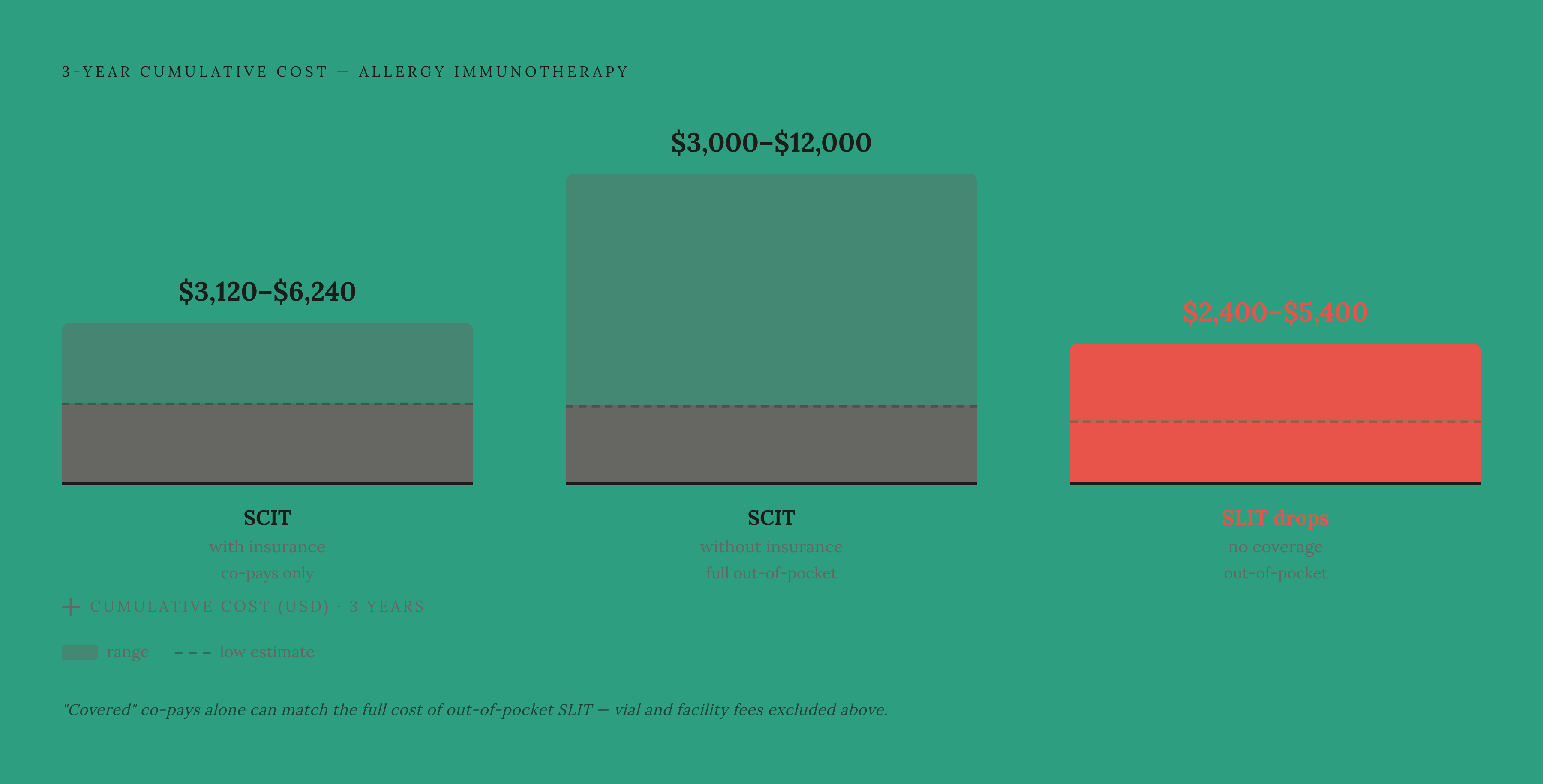
Put the two paths side by side. SCIT, paid fully out of pocket, runs $1,000 to $4,000 a year. Once insurance co-pays get factored in over a three-year course, the co-pay total alone can reach $3,120 to $6,240, depending on whether a session uses one serum or two. SLIT drops, by comparison, run $800 to $1,800 a year. FDA-approved tablets vary in price, and telehealth-delivered customized sublingual immunotherapy has been priced at up to $200 a month in cost-comparison data.
Efficacy is part of this comparison too, and it's a fair question to ask before assuming cheaper automatically means worse. SCIT produces significant improvement in about 80% of hay fever patients, and roughly 60% hold onto that benefit permanently after three to five years of treatment. SLIT, per data from a professional allergy specialty association, performs at around 90% of the effectiveness of shots for most allergens. That's a narrow gap for a treatment that skips the weekly clinic visit entirely.
And the visit burden is where the two paths really diverge. SCIT means a clinic trip for every single dose, plus a mandatory 30-minute observation window, repeated for years. SLIT is typically self-administered once a day at home; missing a dose here and there doesn't force a restart of the whole protocol the way missing shot appointments can complicate a build-up schedule. After starting, it moves home with the patient.
There's also a quieter financial lever worth checking: patients with FSA or HSA accounts should confirm with their plan administrator whether out-of-pocket SLIT costs are eligible expenses.
So which one actually costs less? It depends entirely on the plan. A patient with strong insurance and low co-pays may genuinely come out ahead with covered shots. A patient facing high co-pays, a steep deductible, or a long drive to the nearest allergist's office may find that out-of-pocket SLIT comes out even, or cheaper, once every visit and every hour of lost time gets counted. Telehealth allergy care adds another data point here: virtual options range from around $30 a month for prescription antihistamines up to $200 a month for customized sublingual immunotherapy, both well under the $150 to $300 that a single in-clinic shot visit can cost.
What undiagnosed or undertreated allergies cost beyond the clinic bill
Here's a detail that rarely makes it into the insurance conversation: many allergy sufferers never connect symptoms like fatigue, brain fog, congestion, and poor sleep back to an underlying allergy at all. They just reach for whatever's on the drugstore shelf.
That reflex isn't free, either. Over-the-counter allergy medication runs $25 to $250 a year, and that's a bill that repeats every single year, indefinitely, without ever addressing the immune response causing the symptoms in the first place.
Histamine release drives the fog. Allergen exposure triggers a histamine release, which causes nasal congestion and sinus pressure. That pressure can restrict airflow enough to contribute to mental cloudiness and trouble concentrating, something a lot of people write off as just being tired.
Sleep takes a hit too, and it compounds. Nasal congestion disrupts sleep across the night. Less deep sleep means more daytime cognitive impairment the next day. And the older antihistamines many people reach for to manage symptoms can further dull focus and mental sharpness, adding to the cognitive impairment they were meant to fix.
Allergic conditions contribute to missed workdays and lower productivity, costs that never appear on an insurance explanation of benefits but accumulate quietly year after year of undertreated symptoms. So the path that looks cheapest on paper, cycling through OTC drugs indefinitely rather than dealing with insurance paperwork, is often the most expensive path once lost productivity, poor sleep, and diminished quality of life get counted.
The practical steps to understand what your plan covers before starting treatment
Start with something in writing. Call the insurer and ask directly whether immunotherapy is covered under the plan, then request that answer in writing rather than relying on whatever a call-center representative says over the phone. Verbal answers have a way of not holding up later.
From there, get specific. Ask whether prior authorization is required, and exactly what documentation the insurer expects to see. Ask what the co-pay is per injection visit, not per treatment course, and clarify whether a two-serum session gets billed as one co-pay or two. Ask whether the antigen preparation fee gets covered separately from the fee for administering the shot itself. And confirm whether the allergist is in-network, since going out-of-network can quietly change what "covered" ends up meaning in practice.
Ask about SLIT too, specifically whether any FDA-approved tablets, for grass, ragweed, and dust mite, are generally covered by insurance. That benefit sometimes runs on entirely different rules than the medical benefit, so check both.
Then do the multi-year math. Take the per-visit co-pay and multiply it out across the full expected treatment span, three to five years, rather than judging the cost off a single visit's price tag. If standard insurance won't touch SLIT, check FSA or HSA eligibility, since physician-directed at-home programs sometimes qualify even when traditional coverage doesn't.
Telehealth allergy care can be a reasonable starting point before committing to any of this. A virtual consultation can initiate a treatment plan with far fewer clinic visits, which lowers the barrier to actually getting real numbers before signing on for years of shots.
The question to ask isn't what the plan says is approved. It's what gets spent every year, across every year of treatment, counting the time as well as the money, not just what shows up as "covered" on a piece of paper.
Sources
- Allergy Shots: How Much Do They Cost, and Do You Need Them? - GoodRx
- Hidden Costs of Allergy Shots - AAOA Patient Resources
- New Guidelines for Insurers Help Patients Receive Necessary Allergen Immunotherapy Treatment - ACAAI Patient
- Are Allergy Shots Covered by Insurance? | HeyAllergy
- Article - Billing and Coding: Allergy Immunotherapy (A57472)
- medicare.tools
- bcbsnc.com
- LCD - Allergen Immunotherapy (L36240)