True Lifetime Cost of Managing Allergies With Medications vs Immunotherapy
Immunotherapy costs more upfront but ends, while medications run indefinitely.

About 81 million Americans carried a seasonal allergic rhinitis diagnosis in 2021, roughly 26% of adults and 19% of children, according to AAFA. Most of them are doing the same thing: reaching for another box of antihistamines, another nasal spray, another year of managing symptoms instead of treating the cause. That's not a personal failing. It's a structural default, because medication is what gets handed to patients first, and few people ever stop to ask what that default actually costs over ten or twenty years. This piece runs that math, and lays out the other path: a finite immunotherapy course that ends, versus a medication habit that, by design, never does.
Allergic rhinitis ranks as the sixth leading cause of chronic disease in a national health system, per Empire Medical Training. That's not a footnote. It's the frame for everything that follows.
What allergy medications do, and what they don't
Start with the mechanism, because it explains everything downstream. An allergen (pollen, dust mite droppings, pet dander) enters the body and triggers mast cells to degranulate, releasing histamine. Histamine is what produces the sneezing, the itchy eyes, the congestion. Antihistamines work by blocking histamine receptors after that release happens.
That's the whole job. They intercept a signal already in motion.
They don't touch the sensitization that caused the immune system to flag ragweed pollen as a threat in the first place. Every allergy season, the same trigger produces the same overreaction, and the same pill blocks the same receptor. Nothing about that loop changes year over year. Medication suppresses the response episode by episode; it doesn't retrain the system generating the response.
Even the "non-drowsy" options carry a cost most people don't factor in. Cetirizine and loratadine, both marketed as non-sedating, still cause drowsiness in a meaningful share of users, costing that slice of users focus, productivity, or safety margin on a drug supposed to be the easy option. That's not a rare fluke. It's a real slice of users losing focus, productivity, or safety margin (driving, operating equipment) to a drug that's supposed to be the easy option.
So if medication doesn't fix the underlying problem, then every year spent on it is a year of spending with nothing to show for it once the season passes. That's the treadmill: pay again, get relief again, arrive back at square one again.
The compounding annual cost of staying on medications
Add it up the way an actual allergy sufferer would live it. OTC antihistamines through spring. A nasal spray for the tougher weeks. Decongestants when congestion peaks. Eye drops for the itching. For people allergic to dust mites or pet dander, this isn't seasonal at all, it runs year-round.
Layer in the doctor visits. Prescription-strength options, or a bad flare that needs medical attention, mean co-pays on top of the OTC spend. These aren't one-time costs. They repeat every year the underlying allergy goes untreated.
Allergic rhinitis affects somewhere between 20% and 40% of Americans, depending on the source. Now stretch that across a lifetime. Someone who starts managing symptoms in childhood or early adulthood and keeps going for decades is looking at cumulative out-of-pocket spending that runs into the thousands, potentially tens of thousands, of dollars, depending on how much of that spend is OTC versus prescription.
FSA and HSA accounts help here. Many allergy medications qualify, which softens the effective cost with pre-tax dollars. But that's a discount on a bill that never stops arriving. It doesn't change the fact that the spending is perpetual by design.
And medication cost is the visible part. Medication cost is the visible part, but the expensive part doesn't appear on a receipt.
The costs most allergy sufferers never count
Sleep is the first casualty most people don't connect to their allergies. Research has found that people with untreated allergic rhinitis wake up more often overnight and get less deep sleep than people without it. Deep sleep is when the brain consolidates memory and recovers cognitively. Lose it night after night, and the deficit doesn't reset by morning.
Congestion is the mechanism. It fragments sleep, pushes people into mouth breathing, and increases snoring. Interrupted sleep, repeated often enough, causes brain fog the next day. That fog doesn't stay contained to the bedroom.
Consider what that means for a working adult. Someone managing ongoing inflammation, disrupted rest, and maybe a drowsy antihistamine on top of it isn't operating at full capacity through allergy season. That's not a minor inconvenience. It's a recurring hit to how well someone does their job, every year, for as long as the allergy stays unmanaged.
Kids carry a version of this too. A child who seems distracted or unfocused in class might be dealing with poor sleep driven by nighttime congestion, not an attention problem at all. Academic underperformance from something as fixable as sleep disruption has consequences that stretch well past the semester it happens in.
There's a mental health dimension as well. Chronic, untreated allergy symptoms and the constant discomfort and lifestyle limits that come with them can take a toll on overall wellbeing. And there's a dental angle few people expect: sinus pressure from seasonal allergies is a well-documented cause of referred pain in the upper molars, while chronic mouth breathing dries out the mouth and raises cavity risk.
None of this is a worst-case scenario. It's the ordinary, unremarkable outcome of an allergy that gets managed indefinitely and treated never. Once that full cost is visible, medication starts looking a lot less like maintenance and a lot more like a slow leak.
So what does the other path actually cost, and how long does someone have to stay on it?
What immunotherapy costs, and how long it runs
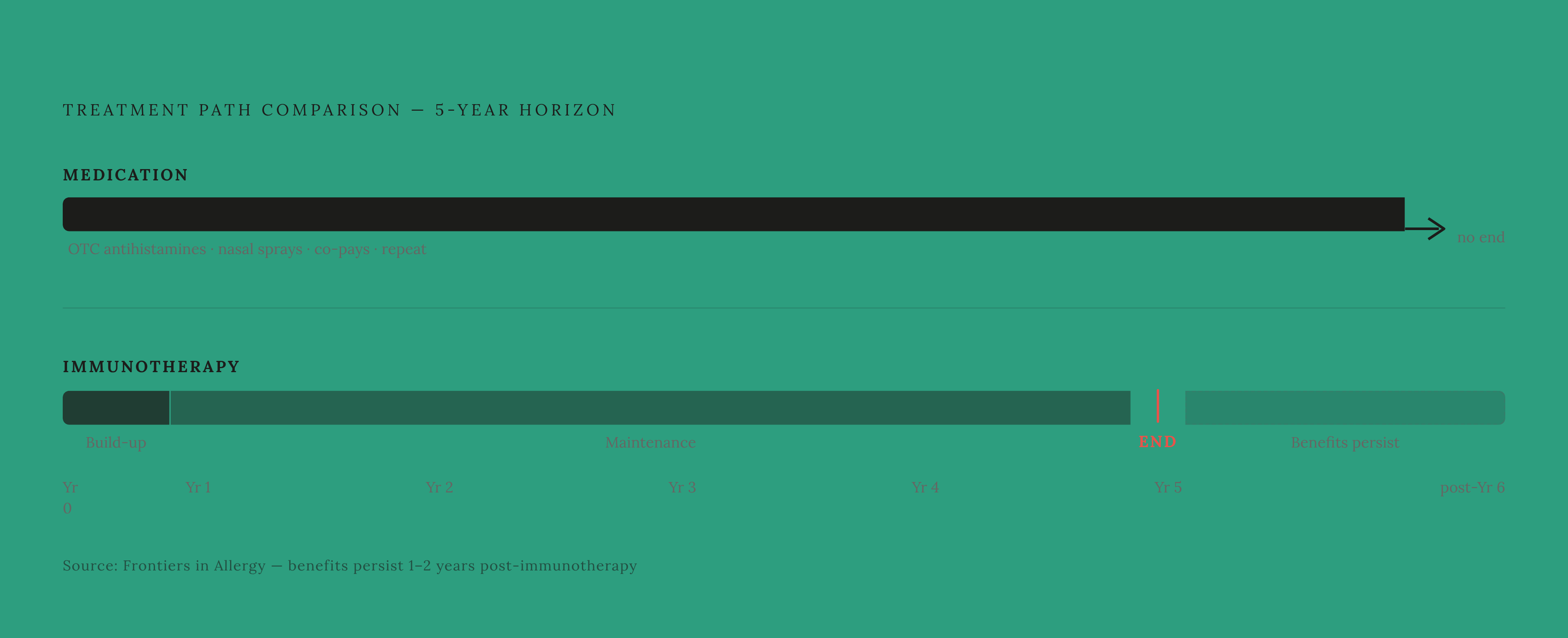
Immunotherapy runs on a fixed timeline: 3 to 5 years total, split into a build-up phase and a maintenance phase, according to sourcing from AllerDogs and YourHealthMagazine. That's the whole course. There's an end date built into the plan from day one, which is already a different proposition than medication.
Allergy shots (SCIT) follow a clear cost structure. Build-up phase: weekly injections, running $20 to $100 per shot, for roughly 3 to 6 months. Maintenance phase: $100 to $300 a month for the remaining 3 to 5 years. Some allergists use two shots per visit, and at $40 a session, that works out to $6,240 over 52 weeks across three years, per AAO Allergy sourcing.
That figure doesn't include the costs sitting outside the price sheet: time off work for weekly appointments, gas or transit to get there, the opportunity cost of a recurring Tuesday afternoon commitment for years.
Sublingual immunotherapy (SLIT) works differently. The first dose needs supervised administration, either in-office or through a telehealth visit with physician oversight. After that, dosing happens daily at home. That one design choice removes the weekly clinic visit that defines the SCIT experience for years three through five.
Telehealth-based SLIT programs, physician-guided and shipped to the door, change the access equation in a real way. Plans starting around $99 a month give patients a flat, predictable cost, and like most allergy treatment, it's FSA/HSA eligible.
The framing that matters here: immunotherapy is a finite expenditure with a known endpoint. Medication spending has no endpoint, by design. But a lower price tag only matters if the treatment actually works, so the next question is what the evidence says.
What the clinical evidence says about immunotherapy outcomes
Patients who complete a full course of immunotherapy report symptom improvement in the 80% to 90% range, per YourHealthMagazine sourcing. That's not a marginal edge over medication. That's a different category of outcome.
A narrative review in Frontiers in Allergy backs this up with randomized controlled trial data: grass and house dust mite SLIT tablets produce clinically meaningful reductions in both symptoms and medication use. The benefits didn't vanish once treatment stopped, either. Patients held onto improvements for 1 to 2 years after finishing a 3-year course. Real-world cohort data in the same review found lower risk of new asthma onset, and reduced long-term medication use, in patients who'd gone through SLIT.
A systematic review in Current Therapeutic Research looked specifically at house dust mite SLIT and asthma control. Thirteen of 15 studies found significant improvement in asthma symptom control. Six of 8 studies measuring medication impact found a significant drop in inhaled corticosteroid dose, with some trials showing reductions over 300 micrograms a day.
Further back, a 2013 systematic review in JAMA found moderate-grade evidence supporting SLIT for allergic rhinoconjunctivitis, with no life-threatening events reported across the studies reviewed.
A distinction that runs through the clinical literature captures the difference: immunotherapy is the only intervention with the potential to restore immune function in allergic disease. Not manage. Restore. That word choice is doing real work.
Why immunotherapy spending produces lasting change while medication spending does not
Allergen immunotherapy changes how key immune cells respond to an allergen, shifts the body's antibody profile, and induces regulatory immune cells that calm the Th2 inflammatory cascade responsible." Allergen immunotherapy changes how key immune cells respond to an allergen, shifts the body's antibody profile, and induces regulatory immune cells that calm the Th2 inflammatory cascade responsible for allergic symptoms, according to research on allergen immunotherapy mechanisms.
Those Tregs do two things at once: they suppress IgE production (the antibody driving the allergic overreaction) while pushing B-cells to produce more IgG4. Over the course of treatment, the ratio between the two shifts, and the immune system's hypersensitivity to that allergen gradually eases.
SLIT leans on this directly. Daily dosing under the tongue builds tolerance through the oral mucosal route, which isn't a clever workaround. It's a deliberate use of how the body naturally develops tolerance to substances it encounters repeatedly in that environment.
That's why the Frontiers in Allergy review found benefits persisting 1 to 2 years after treatment ended. Medication spending buys relief for exactly as long as the dose is active in the body, and not one day longer. Immunotherapy spending buys a change in how the immune system responds, and that change keeps paying out after the last dose.
A secondary payoff is reduced asthma risk. Asthma medication carries its own ongoing cost, so avoiding that path in the first place produces savings that never appear on an immunotherapy invoice but are visible in a life not spent managing a second chronic condition.
That's the biological case for calling this an investment rather than a purchase. But choosing immunotherapy still means choosing between two very different day-to-day experiences, SCIT and SLIT, and that choice is practical, not just medical.
Allergy shots vs. sublingual drops: how the two immunotherapy paths differ in practice
SCIT means weekly in-office injections through the build-up phase, plus a required observation period after each shot, because rare anaphylactic reactions, while uncommon, are a real risk with injected allergens. Time, transportation, and scheduling around that weekly visit are baked into the treatment from month one.
SLIT flips that structure. The first dose happens under in-office supervision, and every dose after that is administered at home, daily, by the patient. For most of a 3 to 5 year course, that removes the weekly clinic trip entirely.
Allergen coverage differs too. SCIT can address pet allergies, pollen, mold, dust mites, and stinging insect venom. FDA-approved SLIT tablets currently cover dust mite, Timothy grass, a five-grass mix, and short ragweed. SLIT liquid drops, used off-label under physician guidance, can extend to a broader allergen list.
For someone whose job doesn't bend around a weekly mid-day appointment, or whose family schedule is already stretched thin, SLIT removes a real structural barrier. That's an access and adherence argument as much as a comfort one; treatment someone can actually stick with for three years beats treatment they quietly abandon after eight months.
Safety screening still matters regardless of path. SLIT isn't appropriate for everyone: uncontrolled asthma, a history of eosinophilic esophagitis, or a prior severe systemic reaction to SLIT are contraindications a physician needs to rule out before starting. That's exactly why doctor-guided treatment, not self-directed dosing, is the standard here.
Telehealth-delivered SLIT, physician-guided, personalized to the patient's allergen profile, and shipped directly to the door, is arguably the most workable version of this whole path for a working adult trying to fit treatment into an already full life.
How to think about the break-even point between the two paths
At what point does a finite immunotherapy course cost less than the medication path it replaces? That's not a rhetorical question, it's arithmetic, and it should be run honestly.
On the medication side, the tally includes annual OTC and prescription spend, doctor co-pays, lost productivity from drowsiness or poor sleep, and the downstream costs, dental work, sleep treatment, mental health care, that trace back to unmanaged symptoms.
On the immunotherapy side, the tally includes the program cost across 3 to 5 years, any upfront allergy testing or consultation fees, and the time cost of the build-up phase.
One variable does more to tip that balance than any other: how many years of allergy suffering are still ahead. Someone diagnosed at 25 is looking at a completely different lifetime medication bill than someone who starts symptom management at 55. The earlier the diagnosis, the more years the treadmill has left to run, and the more a finite course looks like the cheaper long-run bet.
FSA and HSA eligibility applies to immunotherapy programs too, telehealth-based SLIT included, which trims the effective out-of-pocket cost further with pre-tax dollars.
None of this is a claim that immunotherapy is free or instant. It isn't, because it's finite, in a way the medication path structurally is not, and that distinction is the entire argument. But it's finite, in a way the medication path structurally is not, and that distinction is the entire argument.
So the real question left standing isn't whether immunotherapy works in the abstract. It's whether a given reader is actually a fit for it.
Who is a good candidate for immunotherapy and what the first step looks like
Broadly, both adults and children with a confirmed environmental allergy diagnosis, allergic rhinitis or rhinoconjunctivitis, are candidates. SLIT tablets specifically carry a regulatory indication for ages 5 to 65.
The strongest candidates tend to share a pattern: years of medication management with no real improvement, allergy symptoms that interfere with sleep, work, or daily quality of life, or a lifestyle where weekly in-office injections simply aren't realistic to sustain for years.
Screening isn't optional. Conditions like uncontrolled asthma or a history of eosinophilic esophagitis rule out SLIT for some patients, which is exactly why a physician needs to evaluate candidacy before treatment starts. This isn't something to self-direct.
Getting to that evaluation has gotten easier. At-home testing, a finger-prick sample paired with a virtual consultation, makes getting a confirmed diagnosis and a personalized treatment plan far more accessible than the traditional in-office allergy panel used to be.
The first step, really, is just finding out what's actually causing the reaction. A striking number of longtime allergy sufferers have never had that confirmed. They've been guessing, medicating around a diagnosis they never got, for years.
Every year spent on the medication treadmill is money and health spent without ever accumulating toward a fix. The immunotherapy path costs real money too, but it has an end, and what it leaves behind after that end is a body that responds differently than it used to. One of these paths compounds a cost. The other compounds a result.
Sources
- Sublingual Immunotherapy (SLIT) Evidence & Guidelines Hub (2025)
- Frontiers | Sublingual allergen immunotherapy: evidence from randomized trials, real-world studies and meta-analyses
- The Efficacy of Sublingual Immunotherapy in Patients With House Dust Mite Allergic Asthma—A Systematic Review - ScienceDirect
- What Kind of Allergy Immunotherapy Is the Most Cost Effective? 2026
- Allergy Immunotherapy Cost 2026: Shots, Tablets & Savings
- yourhealthmagazine.net
- aaoallergy.org