Using FSA and HSA Funds for Allergy Treatment
Immunotherapy offers a permanent cure where medication only masks symptoms year after year.

More than 82 million Americans deal with environmental allergies as of 2024, and a good chunk of them have no idea that their afternoon brain fog, their sinus headaches, or their broken sleep traces back to pollen or dust mites. Most people default to the same routine: grab an antihistamine, grab a nasal spray, pay for both with FSA or HSA dollars, and repeat the cycle every year without asking whether there's a better use of that money. There is. FSA and HSA accounts cover allergy testing and immunotherapy, not just pharmacy runs, and that difference matters both medically and financially.
What FSA and HSA accounts cover in the allergy category
FSAs and HSAs aren't the same animal, even though people talk about them interchangeably. An FSA comes through an employer, and the money is generally use-it-or-lose-it by year's end. An HSA pairs with a high-deductible health plan, and the balance rolls over year after year, building up for as long as the account stays open. Both are funded with pre-tax dollars. Every eligible dollar spent costs less than a dollar out of pocket, once the tax break is factored in.
Most people know the obvious eligible items: antihistamines, both over-the-counter and prescription, nasal corticosteroid sprays, decongestants. Fewer people realize the list goes much further. Allergy testing, whether it's a skin test or a blood test measuring IgE antibodies, qualifies. So do doctor visits and telehealth consultations. So does prescription immunotherapy, whether it's delivered as a shot under the skin or as drops under the tongue.
That last point deserves attention. FDA-approved sublingual immunotherapy tablets are prescription products, which puts them squarely in FSA/HSA-eligible territory. Sublingual drops prescribed by a physician fall under the same prescription medicine category. Even the telehealth visit that gets someone tested and started on a treatment plan counts as an eligible expense.
The math gets interesting. Spend FSA or HSA money on medication year after year, and the tax advantage resets every twelve months, tied to whatever was bought that year. Applying the same pre-tax dollars to a multi-year immunotherapy course instead compounds the advantage across years toward an outcome that doesn't need repeating. Same tax break, very different destination for the money.
Why antihistamines and nasal sprays are a poor long-term use of health spending accounts
Every common allergy medication share the same basic limitation: they treat the symptom, not the immune response causing it. Stop taking the pill, stop taking the spray, and the relief stops with it. That's not a flaw exactly; it's just what these drugs are built to do. If the underlying problem never changes, the question is how many years of pre-tax dollars are going toward managing something that could instead be resolved.
The Mayo Clinic states that first-generation antihistamines like diphenhydramine and chlorpheniramine cause drowsiness, and that drowsiness carries real consequences for anyone driving or trying to stay sharp at work. Second-generation antihistamines get marketed as non-sedating, which sounds like a fix, but cetirizine and loratadine still cause drowsiness in roughly 10% of people who take them. So the "non-drowsy" label comes with an asterisk that a lot of buyers never see.
Older antihistamines can worsen the fatigue and concentration problems that untreated allergies already cause, which is the irony: the treatment produces the same effects as the disease it's meant to fix. Older antihistamines can actually worsen the fatigue and concentration problems that untreated allergies already cause, so the treatment and the disease start to look a lot alike from the inside.
Nasal sprays carry their own tradeoffs. Corticosteroid sprays work well for ongoing or seasonal hay fever, but long-term use has been linked to drying, cracking, and even bleeding of the nasal membranes. Decongestant sprays are recommended for no more than three days of use, full stop, because going longer risks a condition called rhinitis medicamentosa: rebound congestion that leaves the nose more blocked than before the spray was ever started. Antihistamine nasal sprays can produce a similar rebound effect with extended use.
Then there's montelukast, the generic version of Singulair, running around $8.73 a month. Cheap, sure. But it carries an FDA boxed warning for neuropsychiatric events and isn't considered a first-line option anymore. FSA and HSA dollars are going toward drugs with real side-effect profiles that never touch the actual disease. That's not a great trade when better-covered options exist.
The health costs of untreated allergies that keep accumulating while medications mask the problem
Histamine doesn't just make someone sneeze. It inflames the sinus and nasal linings, restricts airflow, and often pushes people into mouth breathing at night, which fragments sleep in ways that build up over time. Research on untreated allergic rhinitis has linked the condition to more frequent nighttime waking and reduced deep sleep.
Deep sleep is when the brain consolidates memory and does most of its recovery work. Disrupt that stage night after night, and the daytime brain fog and concentration problems compound. Many people chalk this up to stress or overwork, never connecting the dots back to a runny nose they've had since March.
The knock-on effects don't stop at fatigue. Chronic sleep disruption can weaken the immune system's ability to resolve the very inflammation causing the allergic reaction in the first place, a kind of feedback loop where the body never quite catches up. Add to that the toll of living with constant physical discomfort: chronic, untreated allergies can contribute to symptoms of depression simply from the cumulative weight of feeling bad every day. For anyone with asthma, allergen exposure can also trigger or worsen attacks, driving up inhaler use and, in worse cases, trips to the emergency room.
The CDC reported that allergic conditions contribute to missed workdays and reduced productivity nationwide. None of this appears on a receipt for antihistamines, but it's real cost, and it's exactly the kind of cost FSA and HSA accounts exist to help offset. Treating the root cause early, rather than managing symptoms indefinitely, is where that offset actually pays off.
How sublingual immunotherapy works and what the clinical evidence shows
Sublingual immunotherapy, or SLIT, works by giving the immune system small, gradually increasing doses of whatever allergen is triggering the reaction, dosed under the tongue. Over time, this shifts the immune response toward tolerance instead of alarm. At the cellular level, it induces a subset of regulatory T cells that release an anti-inflammatory signaling protein and produces measurable suppression of T-cell responses, a completely different mechanism from an antihistamine blocking a histamine signal after the fact.
A narrative review in Frontiers in Allergy, published September 14, 2026, described allergen immunotherapy as the only potentially disease-modifying treatment available for IgE-mediated respiratory allergy. The review pointed to strong randomized controlled trial evidence showing meaningful reductions in symptoms and medication use, with benefits persisting after a multi-year treatment course ended. Relief persists after the treatment stops, unlike a spray that stops working the moment it's set down.
A separate umbrella review covering 20 systematic reviews and meta-analyses, published in European Archives of Oto-Rhino-Laryngology in 2025 and 2026, found SLIT delivers favorable improvement in symptom scores and medication use for allergic rhinitis, with generally acceptable safety. Real-world data adds another layer: cohorts following SLIT patients report a reduced risk of developing new asthma and lower long-term medication use down the road.
The pediatric evidence has also caught up. A Phase III trial published in Lancet Regional Health, Europe in 2025 tested SQ house dust mite SLIT tablets in children with allergic rhinitis and rhinoconjunctivitis. A separate 2025 pivotal Phase III trial, published in Allergy (issue 80, pages 795 to 806), found SQ tree SLIT tablets effective and well tolerated in children too.
Safety is where SLIT separates most clearly from allergy shots. Subcutaneous immunotherapy carries a risk, rare but real, of systemic anaphylactic reactions. Shots require in-office administration and observation every single time. SLIT starts under medical supervision but continues at home after that, and its safety profile is considerably more favorable. Full immune tolerance usually takes three to five years of treatment, though many patients notice improvement within the first few months. SLIT can address dust mites, grass, ragweed, tree pollen, pet dander, and mold, but FDA-approved SLIT tablets only cover dust mites, ragweed, and certain grasses. Tree pollen and pet dander are addressed through off-label drops instead. Clinical trials are also underway looking at SLIT for food allergies.
Allergy shots versus sublingual drops: comparing what FSA/HSA dollars buy
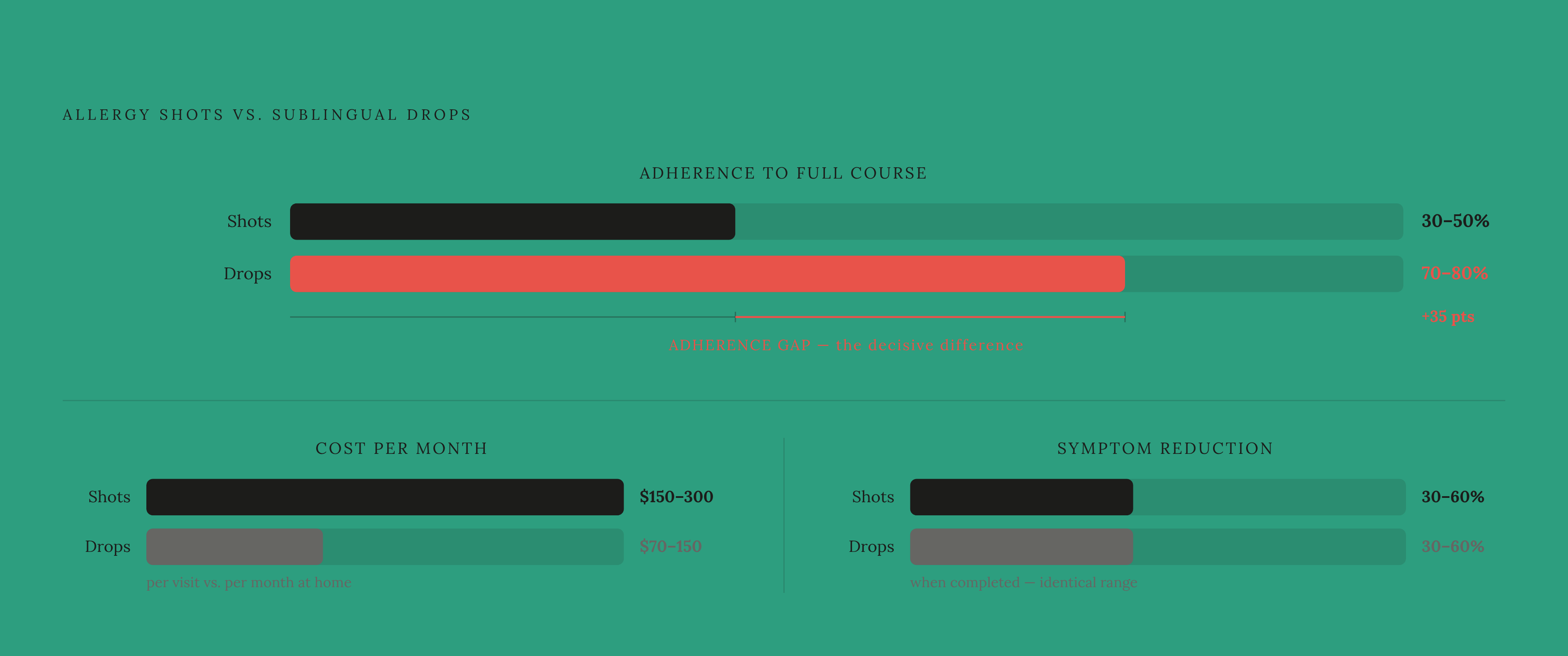
Both routes work. Across published clinical studies and systematic reviews, shots and drops both produce symptom reductions in the range of 30 to 60% for most patients. So the real comparison isn't about whether one is medically superior, it's about what each one demands from the patient, and by extension, what it demands from an FSA or HSA balance.
Shots have real advantages. They've been used longer, they tend to work a bit faster during the initial build-up phase, and they're broadly covered by insurance when administered in-network. But the tradeoff is logistics: shots require frequent clinic visits during build-up, followed by ongoing maintenance visits that continue for an extended period. Each visit costs time, transportation, and a copay on top of that, and traditional allergy shots run $150 to $300 per in-clinic visit.
That logistics burden is visible directly in the numbers. Drops show completion rates of 70 to 80%, versus 30 to 50% for shots. A treatment abandoned halfway through delivers none of its lasting benefit, no matter how it was paid for, so adherence isn't a minor footnote here, it's arguably the deciding factor.
Sublingual drops run $70 to $150 a month without insurance and get taken at home, no clinic visit required once treatment starts. FDA-approved sublingual tablets run higher, $200 to $400 a month, and since each tablet only treats one allergen, patients dealing with multiple sensitivities may need several tablets or find custom drops more practical for their situation.
Both drops and tablets are prescription products, which makes both FSA/HSA eligible. Paid for with pre-tax dollars, the real out-of-pocket cost drops noticeably, and exactly how much depends on the individual's tax bracket. Convenience and adherence reinforce each other here too: removing the clinic visit removes the single biggest reason people quit shots early. FSA/HSA dollars spent on drops have a better shot at actually reaching the finish line and delivering the lasting result the treatment promises.
How at-home allergy testing fits into the FSA/HSA-funded path to treatment
Most at-home allergy tests work off a finger-prick blood sample, measuring IgE antibodies, the immune markers tied to allergic reactions. The sample goes to a CLIA-certified lab, and results typically come back within a few business days to a week through a secure digital dashboard. Panels commonly screen for a broad range of aeroallergens, and newer kits from around 2025 onward integrate with mobile symptom-tracking tools that bridge the gap between self-testing and actual clinical care.
Accuracy matters here, and there are real limits. Skin tests and blood tests are well-established tools for identifying specific allergies. At-home IgE tests can accurately flag sensitivities, but a test result by itself isn't a diagnosis. A clinician still needs to interpret the results and connect them to symptoms and history.
That's actually good news for the FSA/HSA angle, since it means the clinical piece and the testing piece both qualify. At-home testing kits ordered through a physician are FSA/HSA eligible, and so is the telehealth consultation used to review the results and build a treatment plan around them.
A virtual consultation, which is eligible, leads to an at-home finger-prick test, also eligible, which leads to a personalized prescription for immunotherapy drops or tablets, eligible again. Every step of that chain can run on pre-tax dollars. Compare that to the alternative: an in-office allergist workup with skin prick testing and multiple follow-up visits typically costs considerably more and eats up time off work that the at-home path simply doesn't require. Some telehealth allergy providers, including those with board-certified physicians guiding care, offer initial consultations at accessible starting prices, sometimes around $49.99, which lowers the barrier to entry even before any FSA or HSA reimbursement kicks in.
Making the most of FSA and HSA funds across a multi-year immunotherapy course
Timing matters more with an FSA than most people realize. The full year's funds are available on day one of the plan year, but they generally expire at year's end, aside from limited grace periods some employers offer. Someone starting immunotherapy in the fall can tap FSA funds right away and then re-elect the following year to keep covering the next phase of treatment.
HSAs work differently, and that difference favors long treatment courses. Funds roll over from year to year and can build up across multiple years, so an HSA holder can set aside a balance earmarked specifically for a multi-year immunotherapy course. Once a meaningful balance accumulates, it continues working toward covering future treatment costs, and over several years, even modest growth chips away meaningfully at the total cost of treatment. That's not something an FSA can offer, given its use-it-or-lose-it structure.
Insurance and FSA/HSA funds aren't competing for the same dollar, either. Where insurance partially covers immunotherapy, which happens more often with FDA-approved tablets than with drops, FSA or HSA funds can cover whatever's left over. They work together rather than against each other.
A few practical steps make the difference between funds sitting unused and funds actually doing their job:
- Confirm the telehealth consultation fee is FSA/HSA eligible, which it is when medically directed
- Confirm the at-home test kit qualifies, which physician-ordered kits do
- Get a written prescription for the immunotherapy drops or tablets, since that's the gateway to eligibility
- Keep every receipt and explanation-of-benefits document, since some FSA administrators ask for documentation on immunotherapy claims specifically
- HSA holders can plan their contributions around anticipated treatment costs each year to get the full pre-tax benefit applied to early monthly payments
None of this is really about whether allergy treatment is affordable. It's already sitting inside an account most people are funding anyway. The real question is whether that money keeps going toward medication that has to be bought again next year, and the year after that, or whether it gets redirected toward a treatment with an actual endpoint, backed by clinical evidence for meaningful, sustained symptom reduction.
Sources
- Frontiers | Sublingual allergen immunotherapy: evidence from randomized trials, real-world studies and meta-analyses
- Efficacy and safety of Sublingual immunotherapy for allergic rhinitis: an overview of systematic reviews and meta analyses | European Archives of Oto-Rhino-Laryngology | Springer Nature Link
- hsastore.com
- hsastore.com