Sublingual Immunotherapy Duration and Long-Term Remission Rates
Three years of treatment locks in lasting immune tolerance that survives after stopping.
Most people start sublingual immunotherapy chasing one thing: fewer sneezing fits, less congestion, a break from the antihistamine grind. What they're rarely told upfront is how long the process actually takes, or what happens the day they stop. Symptom relief and immune remission run on two different clocks, and mixing up the two is exactly what separates the person who quits at month fourteen from the one who comes out the other side changed.
What sublingual immunotherapy is actually doing to the immune system during treatment
SLIT tablets and drops sit under the tongue and get picked up by a specific set of cells: Langerhans cells, myeloid dendritic cells, macrophages, all clustered in the oral tissue. Without any danger signal attached to the allergen, these cells nudge the immune system toward tolerance instead of alarm. That's the whole premise of the treatment.
Underneath that, a few concrete shifts happen. The immune response moves away from the TH2 pattern that drives allergic reactions and toward a TH1 pattern. Regulatory T cells and regulatory B cells specific to the allergen start showing up. The antibody response changes character too: IgE, the antibody that triggers allergic symptoms, gets dialed down, while IgG4 and IgA rise. Think of IgG4 and IgA as blockers; they grab the allergen before mast cells and basophils ever get the signal to fire.
Two signaling molecules do most of the work here. IL-10 suppresses allergen-specific IgE while pushing IgG4 production up. TGF-beta drives IgA. Research on ryegrass pollen SLIT, published in peer-reviewed immunology literature, found increases in ryegrass-specific IgG2 and IgG4, more IgG2-positive and IgG4-positive memory B cells, and shifts in regulatory immune cell populations. All of it tracked with how well patients actually did clinically.
This is a slow rebalancing, cell population by cell population, antibody class by antibody class. Sublingual dosing doesn't cause meaningful systemic exposure to intact allergen, and the tolerogenic mechanism works by redirecting the immune response rather than amplifying alarm signals. Here's what most people get backwards: they assume the nasal spray and the tablet are doing the same job, just at different speeds. A nasal spray or antihistamine works on a different layer entirely. It blocks the downstream chemical cascade, the histamine release, the swelling, but leaves the TH2 bias and the IgE machinery untouched. Stop the medication, and the wiring underneath sits exactly where it started. The tablet, by comparison, rebuilds the response over years.
How the timeline of immune changes maps onto clinical response
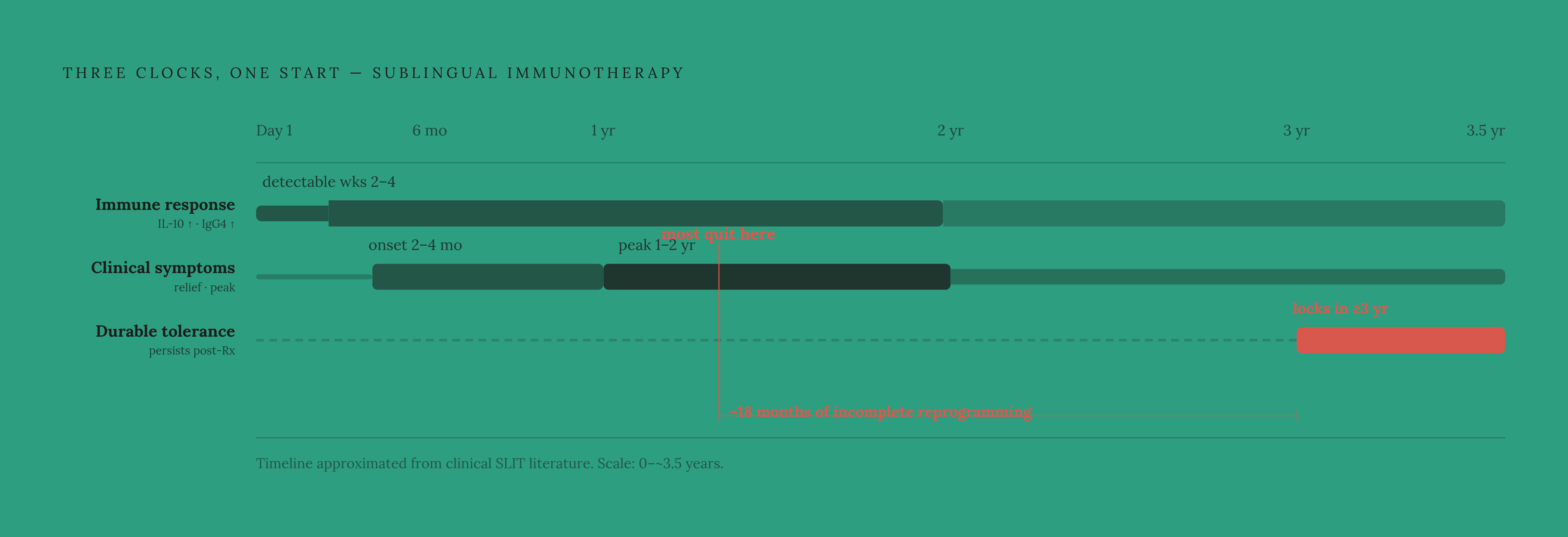
Patients get tripped up right here: the immune system starts responding almost immediately, but symptoms take much longer to catch up, and true tolerance takes longer still. Three separate clocks, running at three separate speeds.
Guidelines built from published trial data lay out the phases. Early in treatment, IL-10 rises, and allergen-specific IgE and IgG4 become detectable on bloodwork even though the patient may not feel any different yet. Somewhere between two and four months, clinical benefit starts to show: patients begin to notice actual symptom change. Peak effect, the point of maximal symptom and medication reduction while still on active treatment, lands around one to two years. But immunologic tolerance, the kind that sticks around after treatment stops, doesn't cross its threshold until at least three years in.
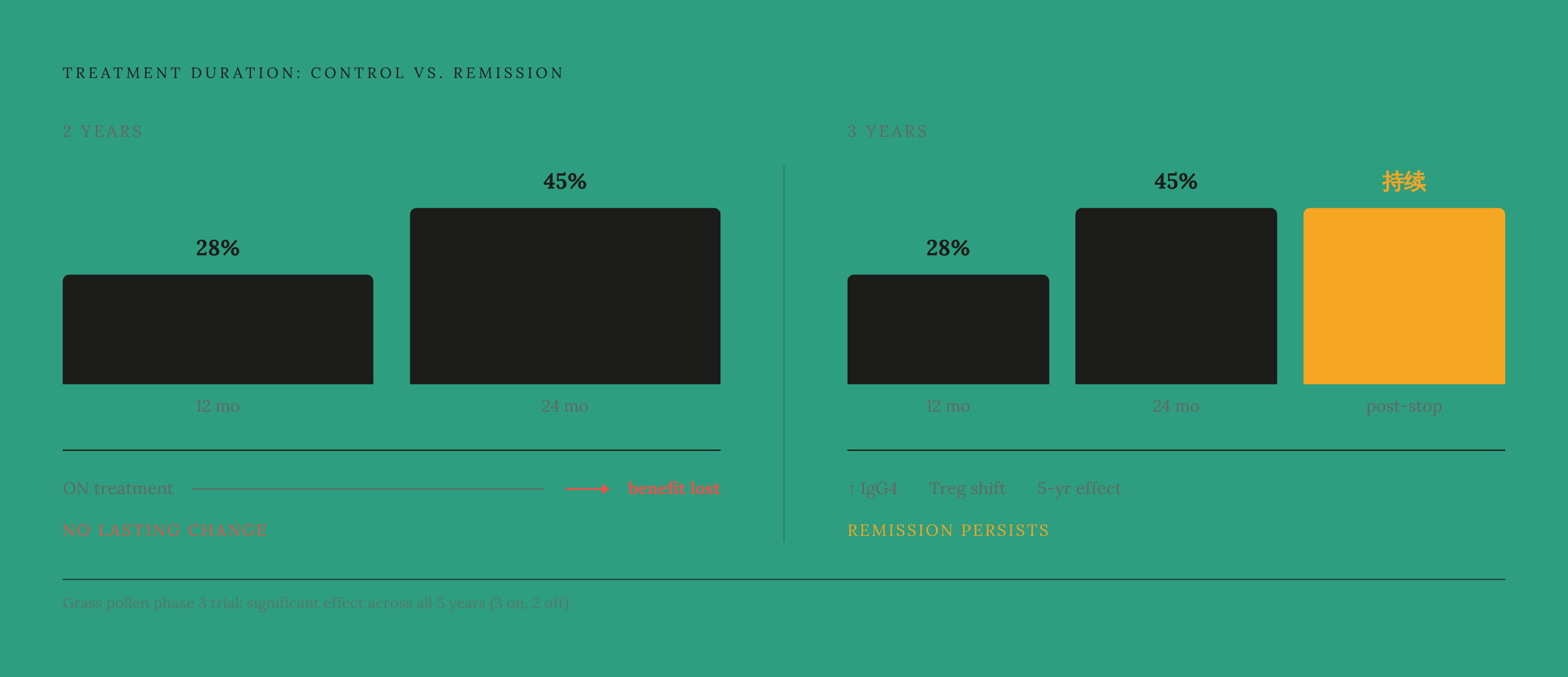
A telemedicine cohort study following 2,897 patients, with a median follow-up of 20 months, put numbers on this arc. Clinically meaningful improvement, defined as at least a 30-point drop on the symptom scale, showed up in 28% of patients by 12 months. That climbed to 45% by 24 months. Symptom scores dropped by 10.1 points on average at the six-month mark, with smaller declines continuing after that. Patients who started with worse symptoms tended to respond sooner (hazard ratio of 2.95), and medication use kept dropping the longer people stayed on treatment (odds ratio of 2.31 per twelve months).
So what does that mean for someone actually going through this? If symptoms are severe at baseline, relief may come faster. If they're mild, the arc runs slower, but the destination doesn't change. The real danger sits at the twelve-to-eighteen-month mark, when symptoms have often eased up enough that patients feel done. That's exactly the point where clinical benefit is peaking but immunologic tolerance hasn't locked in yet. Stopping there means giving up the one part of the treatment meant to outlast the treatment itself.
Why three years is the evidence threshold — and what two years of treatment cannot achieve
Published guidelines land on the same number: three years, minimum, whether the immunotherapy is injected or given sublingually. That agreement isn't arbitrary. It comes from watching what happens when people stop early, and the pattern is blunt enough that anyone shopping for a shortcut should hear it plainly: two years of treatment does not deliver half of a three-year benefit. The shortfall runs much deeper than the math suggests, and this is where the whole "just do two years and see" instinct falls apart.
A study published in the Journal of Allergy and Clinical Immunology looked directly at this gap. Two years of treatment produced real symptom benefit while patients were still on it. But once treatment stopped at two years, that benefit didn't hold. Three years of treatment produced both clinical benefit and immunological markers of tolerance that stuck around for at least two to three years after the last dose.
That's the whole argument for duration in one comparison. Two years buys temporary control. Three years buys a shot at remission that keeps running after the tablets stop.
Worth being precise about what "at least three years" actually means: it's a floor, not a ceiling. Some patients keep going past three years and see added benefit. Three years is the minimum needed to lock in durable immune reprogramming, and it shouldn't be mistaken for a target date circled for stopping. Anyone starting SLIT should hear this distinction before day one, not discover it by trial and error at month twenty. Patients who understand the three-year floor going in are the ones who tend to actually reach it.
What remission after SLIT actually means and what the phase 3 trial evidence shows
Remission here means symptom control and reduced medication need that outlasts the treatment itself. It's a documented post-treatment state, observed in trial data, not a guaranteed outcome for every patient. Antihistamines and nasal sprays were never built to touch the underlying immune process in the first place, so this kind of lasting effect sits outside what those drugs were designed to do.
Allergen immunotherapy stands alone on this point. It's the only treatment shown to change the natural course of allergic rhinitis rather than just mute its symptoms while active. That's a distinction worth sitting with, and it's the reason SLIT gets compared to disease-modifying drugs in other fields rather than to a stronger antihistamine.
Multiple phase 3 trials have shown long-term remission from SLIT. One key trial ran three years of daily treatment with a fast-dissolving grass pollen tablet in adults with seasonal grass pollen rhinitis, some with seasonal asthma layered on top. The result: roughly 30 to 40% improvement in combined symptom-and-medication score against placebo. Allergen-specific tolerance from three years of immunotherapy was sustained for at least two to three years after treatment cessation, according to published trial data.
The IgG4 detail carries weight beyond the symptom numbers; it's a measurable biological signature showing the immune system itself changed, not just what patients reported feeling. That said, remission isn't uniform. Depth varies by allergen, by baseline severity, and by how consistently the patient actually took the dose every single day.
How real-world patients experience the treatment arc over time
Trials show what's possible under controlled conditions. Real-world data shows what happens when regular patients, with regular schedules and regular lapses in perfect adherence, go through SLIT outside a research protocol.
That 2025 telemedicine cohort, average age 39, just over half female, about a quarter with comorbid asthma, gives a decent picture. Medication use dropped steadily as treatment went on, fewer drug categories needed month over month, which lines up with what the phase 3 data suggested about reduced pharmaceutical dependency over time. And the jump in meaningful improvement between year one and year two, 28% to 45%, says something on its own: patients who make it to the two-year mark are meaningfully better off than those who stop at one year. That 28% at twelve months isn't a verdict on the treatment. It's a midpoint, and treating it like a final grade is how people talk themselves into quitting early.
Pediatric data adds another angle. A cohort of 11,036 children, tracked over nine years, found allergen immunotherapy associated with 21% fewer asthma medications and 33% fewer new oral steroid prescriptions, compared to children who didn't get immunotherapy. Allergic rhinitis medication use dropped an additional 9% against controls.
The pattern of reduced medication burden over time extends to the large share of allergy patients who also carry an asthma diagnosis, a meaningful quality-of-life consideration. One honest caveat belongs here: randomized controlled trial evidence for long-term immunotherapy in allergic asthma specifically, as opposed to rhinitis, runs thinner. The signal is real. It's still filling in.
Factors that shape how quickly — and how completely — individual patients respond
Response isn't uniform, and a handful of variables explain most of the spread.
Baseline severity is one. Patients with worse symptoms starting out tended to hit clinically meaningful improvement sooner in the 2025 cohort, with a hazard ratio of 2.95. Allergen type matters too: grass pollen has the deepest remission data behind it, while perennial allergens like dust mites, pet dander, and mold have solid mechanistic support but a thinner post-treatment remission record. Comorbid asthma, present in about a quarter of the 2025 cohort, adds complexity, though outcomes still trend favorable. Age plays a role as well: pediatric data suggests earlier treatment may deliver stronger benefit for rhinitis, and earlier treatment in childhood may deliver stronger benefit more broadly.
But adherence is the biggest lever a patient actually controls, and it's the one most people underrate before they start. Daily at-home dosing cuts out the weekly clinic visit that makes allergy shots hard to sustain, but it swaps that barrier for a harder one: self-discipline across a multi-year stretch, including the off-season months when symptoms fade and motivation fades right along with them. Patients who go in already knowing about the three-year threshold tend to push through those low-symptom stretches instead of quietly letting the daily dose slide. That's arguably the single largest determinant of whether three years of mechanism turns into three years of actual treatment.
One more piece worth flagging: SLIT is allergen-specific. A plan built around a patient's actual, tested sensitization profile tends to outperform a generic one, and skipping that testing step to save time is a false economy. Anyone tempted to guess at their triggers instead of getting tested is gambling three years of daily effort on a hunch.
What happens after treatment ends — and who is most likely to stay in remission
Three years of SLIT produces measurable immune changes, elevated IgG4, a shifted regulatory T-cell profile, that persist for at least two to three years after the last dose, according to published trial data. The grass pollen phase 3 trial mentioned earlier is the clearest single piece of evidence for this: the treatment effect stayed statistically significant across all five years of the study, three years on treatment and two years off it.
Not everyone holds onto remission, though. Relapse happens, and insufficient duration of treatment is a documented risk factor — which is precisely why the three-year threshold exists. New sensitizations can also develop over time, since the treatment targets specific allergens rather than the entire allergic disease process. And a change in environment, a new pet, a move, a shift in local pollen exposure, can re-trigger symptoms in some patients regardless of how well the original treatment worked.
What durable remission looks like day to day: fewer or no seasonal symptoms, medication use that's dropped off or disappeared, no return of symptoms for at least two to three years post-treatment. Some patients finish the three-year course and stay symptom-free for years afterward. Others need an extended course or a second round somewhere down the line, and both outcomes sit within the normal clinical picture. Neither one counts as a failure of the treatment.
One frontier worth watching: early research into peanut SLIT in young children is tracking IgG4-to-IgE ratios for specific peanut proteins, Ara h 2 and Ara h 6, as possible predictors of remission. If that pans out, decisions about when a given patient can safely stop treatment could get a lot more precise than "three years, generally."
How to think about the three-to-five year commitment before starting
Three years sounds long mostly because it's measured against the short-term relief model of antihistamines and nasal sprays that most allergy patients have leaned on their whole lives. Measured against decades of seasonal medication cycles instead, the comparison shifts considerably, and the long course starts looking like the shorter road.
Anyone weighing whether to start should get a few things straight first. Noticeable symptom improvement usually takes two to four months, not two to four weeks; anyone expecting week-three results is measuring against the wrong clock and likely to quit right when the immune system is just getting started. Three years is the floor, and it deserves to be treated as such rather than as a target date to circle for stopping, since cutting out at two forfeits the one part of the treatment meant to last. Allergen testing before treatment isn't paperwork; it's what points the whole three-year investment at the right target instead of a generic one. Physician oversight across the full arc matters too, since the plan should shift as the response actually unfolds rather than stay frozen from day one.
The practical math helps the case along. At-home daily dosing cuts out the time cost of weekly injection visits, so while total duration runs long, the daily burden stays low. SLIT costs vary by plan and provider, which makes a multi-year course financially plannable rather than an open-ended expense, and telehealth-based SLIT removes the recurring clinic visit that makes in-office immunotherapy hard to sustain. And that 45% meaningful-improvement rate at 24 months from the 2025 cohort means most patients feel real relief well before hitting the three-year mark, which tends to make the back half of treatment easier to stick with.
Here's the calculation that actually matters: for someone managing years of symptoms with medications that never touch the underlying immune dysfunction, three years of SLIT offers a documented shot at remission that keeps running after the treatment itself stops. Two years gets you partway there and then lets go. Three gets you somewhere durable.