Telehealth Allergy Care vs In-Office Allergist Visits
Both paths rebuild your immune system, but one fits your life better.

Roughly 81 million people got diagnosed with seasonal allergic rhinitis in 2021, and environmental allergies broadly touch something like 30% of adults in the country covered here. adults. That's a lot of people deciding, often without much guidance, whether to book a specialist appointment or open an app. This piece lays out what each path actually involves, what the evidence says about the treatments behind them, and how to figure out which one fits a given person's life.
The stakes aren't small, either. Allergies cost that nation's economy something on the order of $25 billion a year by older estimates, which lands closer to $34 billion once you adjust for 2025 dollars. economy something on the order of $25 billion a year by older estimates, which lands closer to $34 billion once you adjust for 2025 dollars. And matters are worsening before they improve: pollen seasons are starting earlier and running longer, in some regions by 20 days or more, and the 2025 ragweed season stretched two to three extra weeks because frost showed up late. Triggers stack, too. Tree, grass, and weed pollens, dust mites, mold, pet dander. Most people with allergies aren't reacting to just one thing.
What in-office allergist care involves, and what it offers
Walking into an allergist's office for the first time follows a pretty standard path. Initial consultation, then skin-prick or intradermal testing to figure out what's triggering the reaction, then a diagnosis and a treatment plan built around that.
From there, treatment usually falls into two buckets. There's medication: prescription antihistamines and nasal sprays that manage symptoms day to day. And there's subcutaneous immunotherapy, better known as allergy shots or SCIT, which works differently: instead of just blocking symptoms, it exposes the immune system to small, increasing doses of the allergen over time so the body stops overreacting to it.
Does SCIT work? The data says yes. Alongside sublingual immunotherapy (SLIT), which the next section covers in more depth, SCIT has shown real reductions in symptoms and medication use for allergic rhinoconjunctivitis, with added benefit for some patients whose allergies come with asthma. But the timeline is long. Noticeable improvement generally takes 6 to 12 months, and a full course of shots runs for years, not months. That's the tradeoff baked into the in-office model: strong evidence, but a serious time commitment and a lot of visits to the clinic along the way.
How the patient experience differs with telehealth allergy care
Telehealth flips the logistics without necessarily changing the underlying science. A patient starts with a virtual consultation with a board-certified physician, then gets an at-home testing kit mailed to their door. Results come back, a treatment plan gets built around them, and the treatment itself, again, ships to the house.
The treatment options here center on sublingual immunotherapy, or SLIT, which comes in two forms. Custom allergy drops, tailored to a person's specific allergen profile, or FDA-approved sublingual tablets, which target a single allergen like grass pollen or dust mites. SLIT drops in custom drop form don't currently carry their own FDA approval as a finished product. Tablets are different. They're a separate, FDA-approved category, tested and cleared in that specific form. Neither fact should raise alarm bells. It's a matter of how each product got regulated.
Administration is where the day-to-day experience really splits from the in-office model. SLIT starts under a physician's guidance, but after that it becomes a daily habit done at home: a drop or tablet under the tongue, no clinic visit required. Unlike shots, SLIT does not require in-office observation after each dose, which is part of why home administration is considered appropriate. That single difference, no recurring visit to sit in a waiting room, is probably the most consequential thing separating these two paths for someone juggling a full-time job or a long commute to the nearest specialist.
The clinical evidence for sublingual immunotherapy
Allergen immunotherapy, whether delivered as shots or as sublingual treatment, is the only approach currently available that has a shot at actually changing the underlying immune response to an allergen. Antihistamines and nasal sprays mask symptoms. Immunotherapy retrains the system that's causing them. That distinction is the whole reason immunotherapy gets discussed differently than every other allergy treatment on the shelf.
For SLIT specifically, the trial evidence is solid. Randomized controlled trials on grass and house dust mite SLIT tablets show meaningful drops in both symptoms and medication use, and the benefits don't vanish the moment treatment stops. Studies have tracked sustained improvement for one to two years after patients complete a three-year course. Real-world data adds another layer: cohorts of SLIT patients show lower rates of new asthma onset and reduced long-term medication use compared to those managing symptoms without immunotherapy.
A 2024 Phase III trial, published in Lancet Regional Health Europe (Schuster et al.), tested a house dust mite SLIT tablet in children with allergic rhinitis or rhinoconjunctivitis, including kids who also had asthma. The trial confirmed both efficacy and safety in that population. That matters, because pediatric allergy treatment carries a higher bar for caution, and the data held up.
What the evidence doesn't show, at least not yet, is a shortcut. Three-plus years of sustained treatment still seems to be the price of durable, lasting immune change, whether the delivery method is a shot or a tablet under the tongue. Nobody's found a way around that timeline. So the real question for most patients isn't "which treatment works," it's "which one can I actually stick with for three years."
The concrete tradeoffs: cost, access, treatment timeline, and safety side by side
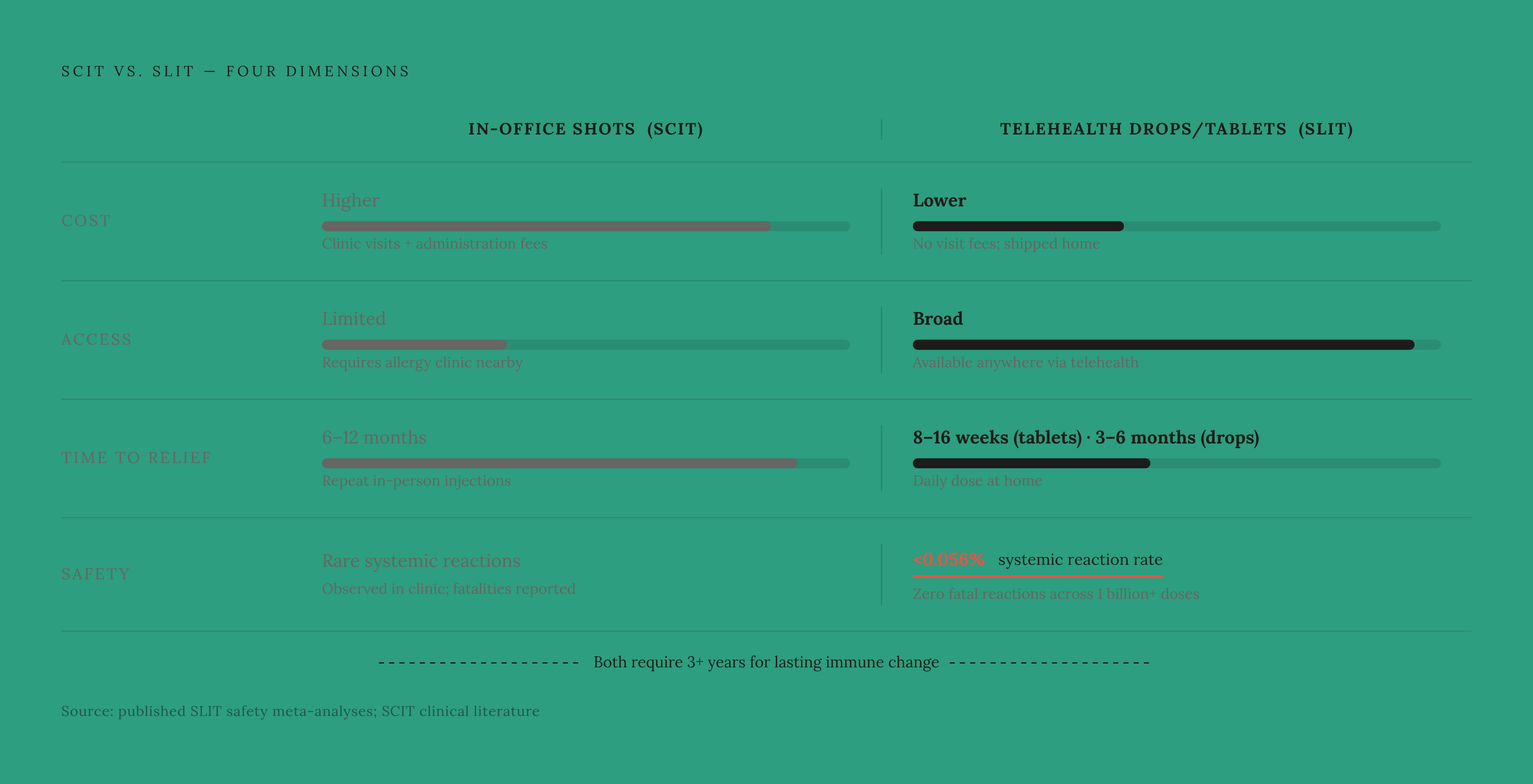
Break the decision down into four categories, and the pattern gets a lot clearer.
Cost. In-office care usually means specialist copays, testing fees, and per-visit injection costs stacked up over years, and the total often isn't obvious until well after treatment has started. Telehealth pricing tends to be more transparent upfront, is often FSA/HSA eligible, and generally runs lower per month. For the large share of allergy sufferers currently untreated because of cost, that difference can mean the gap between affording treatment and going without it.
Access. In-office treatment depends on living near an allergist, and specialist shortages mean long waits, or no real access at all, in a lot of regions. It also demands a schedule flexible enough for repeat visits over months or years. Telehealth needs nothing but an internet connection. That opens the door for rural patients and anyone else historically locked out by geography, since the treatment itself ships directly to the door.
Treatment timeline. SCIT brings noticeable relief in 6 to 12 months, with the full course running for years of in-person visits. SLIT drops tend to show initial improvement in 3 to 6 months. SLIT tablets can bring relief in as little as 8 to 16 weeks. But none of these numbers should be mistaken for a finish line: every form of immunotherapy needs a multi-year commitment, generally three years or more, to produce lasting disease modification.
Safety and monitoring. SCIT carries a rare but real risk of systemic reactions, including severe ones, and every shot appointment comes with a required in-office observation window after the injection. SLIT's safety profile looks different: systemic reactions occur in under 0.056% of doses, and across more than a billion doses administered, no fatal reactions have been recorded. That's part of why home administration is considered appropriate for SLIT and not for shots. Most people on SLIT experience something far more mundane: local irritation, itching in the mouth, mild swelling under the tongue. Annoying, sure, but temporary and not dangerous.
Who is the right candidate for each pathway
So who actually fits where? Telehealth is the newer option and the one people have more questions about, so start there.
Telehealth tends to make the most sense when the main complaint is allergic rhinitis, conjunctivitis, or other seasonal and perennial environmental allergy symptoms, the kind that don't come with complicating factors. It's also a strong fit when geography, work schedule, or cost make regular in-office visits genuinely impractical, or when the patient wants a treatment aimed at the root cause rather than a lifetime of symptom management. Comfort with self-administered daily treatment and virtual check-ins matters too. And for kids ages 5 through 17 who qualify for the FDA-approved house dust mite tablet, telehealth offers a validated pediatric option without the burden of repeat clinic visits.
In-office care earns its place in a different set of situations. Severe or poorly controlled asthma alongside allergic rhinitis often calls for SCIT's injection-based approach, where in-person monitoring is the clinically sound choice. Anyone with a history of anaphylaxis, or other complex immunological risk factors, needs the kind of observation only a clinic can provide. So does anyone who might need injectable biologics or procedures that simply aren't available outside a specialist's office. And when a diagnosis is genuinely unclear, hands-on physical evaluation isn't optional.
There's an honest middle ground, though. For most of the 81 million Americans diagnosed with seasonal allergic rhinitis, telehealth-delivered immunotherapy is clinically validated and logistically easier to sustain. The in-office visit isn't a clinical requirement for this group, it's a habit left over from how allergy care used to be structured, before at-home testing and tablet-based treatment existed. That habit is worth breaking for anyone it's currently keeping out of treatment. Getting tested and treated, through either path, still beats years of over-the-counter medication that never touches the immune response actually causing the problem.
The first steps in each pathway
The in-office route usually begins with a referral from a primary care doctor, or a direct booking with a specialist. Then comes the wait, which in areas with specialist shortages can stretch from weeks into months. After that: skin testing in the office, followed by a second visit just to go over results and lay out a treatment plan.
Telehealth moves faster on the front end. A virtual consultation is often available within days, followed by an at-home finger-prick testing kit that arrives by mail. The patient completes testing at home, and a personalized treatment plan comes back along with ongoing physician guidance, all handled remotely, with treatment shipped straight to the door.
Whichever path someone's leaning toward, a few questions come first. What allergens is the testing actually covering? Does the proposed treatment address the root cause, or is it just managing symptoms? What's the realistic timeline before meaningful improvement appears? And what does this cost in total, and is it FSA or HSA eligible?
One thing holds true no matter which door someone walks through: lasting immune change takes years of sustained treatment, full stop. The treatment that actually works is the one a person will stick with for the long haul. For most people staring down this decision, that's less about which option is medically superior on paper, and more about which one fits into an actual, average week.