Regional Pollen Season Calendars Across the United States
Know your region's actual pollen calendar, not the generic spring-and-fall myth.
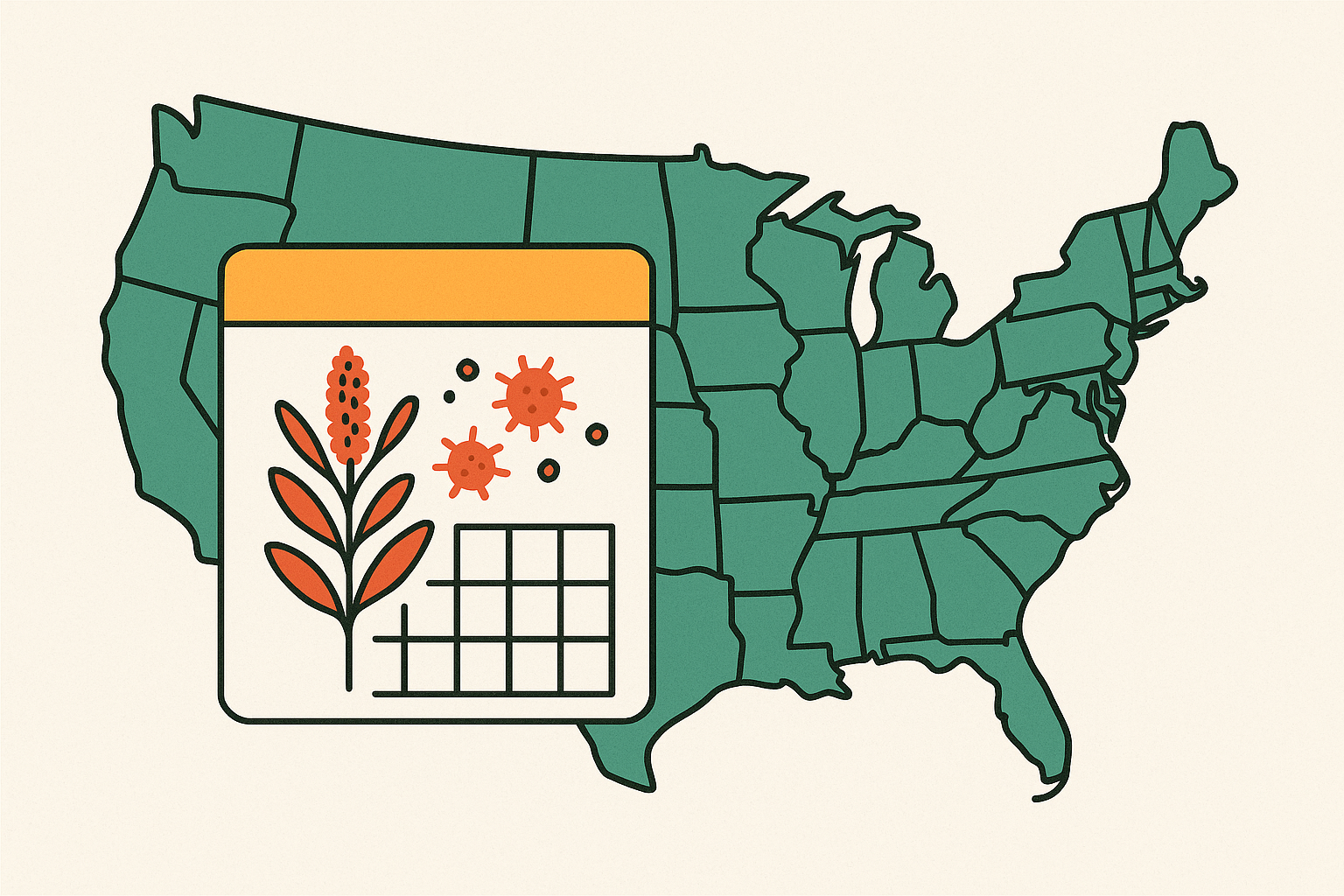
Allergic rhinitis affects up to 60 million Americans, and most of them got handed the same generic advice: allergy season runs spring and fall, take an antihistamine, wait it out. That advice fails almost everyone, because pollen doesn't run on one national clock. A Texan sneezing through cedar fever in January and a Minnesotan who hasn't touched a tissue by April are both reading their own weather correctly. Latitude, elevation, local plant species, and frost dates push a city's pollen peak around by weeks, sometimes months. Figuring out your region's actual calendar is step one in understanding why your symptoms never quite match the display at the drugstore.
The sequence of the three pollen waves across a calendar year
Pollen comes in three separate waves, not one long season, and they overlap more than most people think.
Tree pollen goes first, showing up in late winter and running through spring, driven mostly by warming air and longer daylight. As tree season fades, grass takes over, running late spring into summer, with peak timing depending on which grass species dominate locally. Then weeds take the fall shift, and ragweed is the heavyweight: a single plant can release enormous quantities of lightweight pollen grains carried far on wind currents. That's why someone can react to ragweed without a ragweed plant anywhere nearby.
Outdoor mold spores don't wait their turn. They run through all three waves, spiking when grasses die back in mid-summer, then again in fall as leaves and plant matter decompose. Indoor allergens run year-round, but people notice them more in cold months simply because they're stuck inside more. Dust mites, pet dander, and indoor mold are the main culprits there.
For anyone sensitive to both tree and grass pollen, spring doesn't feel like two seasons. It feels like one long one. And September might be the roughest month of the year for people sensitized to multiple allergens, since ragweed peaks right as other weeds and outdoor mold are still going strong. Geography shifts the timing of these three waves considerably, and that's where regional calendars start to matter.
How scientists measure pollen seasons, including what the data can and cannot tell you
A study led by CDC researchers, working with the AAAAI's National Allergy Bureau (NAB), built the first nationally standardized pollen dataset for the country's monitoring network. It draws on more than 1.17 million pollen observations from 131 monitoring locations across 42 states, spanning 2003 through 2024. That's a lot of data, and it's the backbone for most of the regional patterns below.
The study defines a season's start using the "3-day consecutive method": the main pollen season begins after the first stretch of three straight days above 1.0 pollen grain per cubic meter, and ends after the first three straight days back below that line following the peak. Clean, repeatable, and well suited to what a national dataset needs.
But only 42 NAB stations were actively reporting in recent years of the dataset. That leaves real gaps, especially in rural areas and mountain regions where terrain shifts over short distances. A regional calendar works best as a planning tool. If it says April is peak tree season for your metro area, that might be dead accurate downtown and completely wrong for a suburb ten miles out with a different tree canopy. Use the regional pattern to know what's coming, then check a local pollen forecast on the days that actually matter.
The South and Gulf Coast: the country's earliest and longest pollen exposure
Tree pollen starts earlier here than almost anywhere else in the country, and January is not the quiet month people assume. Cedar and juniper trees release pollen in warmer Southern climates as early as mid-winter.
Central Texas runs its own extreme version of this. Ashe juniper, known locally as mountain cedar, dumps heavy pollen loads in January, and "cedar fever" has become a distinct, locally brutal winter allergy event that has nothing to do with spring.
By February, juniper, cedar, elm, maple, and cypress pollen spread across the South and Southwest, while alder does its own thing in the Pacific Northwest and along the West Coast. March adds oak, ash, poplar, and mulberry to the Southern and Mid-Atlantic mix. Grass season can arrive in April along the Gulf Coast and in Florida, with Bermuda grass among the early movers.
By April, Southern tree pollen may already be tapering off just as northern states hit their stride. The country runs several allergy seasons at once, on different clocks, so a national calendar can't serve everyone well. For anyone in the South, starting allergy management in January isn't overreacting. Given how long the season actually runs, it's just accurate. Wait until March, and a meaningful portion of the exposure window is already gone.
The Southeast and Mid-Atlantic: spring compression and the April-May crunch
April is the big tree pollen peak across most of the eastern and central part of the country. Oak, birch, maple, hickory, ash, sycamore, poplar, and elm all peak in the April window, which is a big part of why that month feels so miserable for so many people.
May doesn't bring relief. It brings the tree-and-grass overlap, arguably the toughest stretch of the year for anyone sensitive to both: leftover tree pollen mixing with timothy, orchard, ryegrass, fescue, bluegrass, and Bermuda grass. Certain tree species continue releasing pollen into May as well, stretching tree exposure right into grass season.
Much of the Mid-Atlantic region sees overlapping tree and early grass activity extending through May and into June. Mold climbs in May as temperature and humidity rise together. For anyone sensitized to multiple allergen types in this region, April through June can feel like one unbroken stretch of bad days, even as the actual culprit keeps changing underneath.
The Northeast: a compressed spring that starts late and hits hard
Tree pollen shows up around April in the Northeast. Colder winters and later frost dates hold the season back compared to the South, but that doesn't make it gentler once it arrives.
New York sees its highest pollen levels from April to June, with grass peaking in May and June. Because spring starts later here, the gap between tree season ending and grass season beginning shrinks. The waves stack tighter, leaving less breathing room between them. AccuWeather's 2024 seasonal outlook forecast an "intense and prolonged" grass pollen season for the interior Northeast and Midwest.
Ragweed arrives mid-to-late August and sticks around through October, often stretching well past what most people think of as "fall allergy season." Anyone who's moved from the South to the Northeast tends to underestimate spring allergies here, mostly because the calendar starts later. Once it kicks in, though, the intensity can rival anything the South deals with.
The Midwest: wide-open geography and the summer grass belt
Wisconsin's pattern is a decent stand-in for the broader upper Midwest: colder climate, later start, tree pollen beginning around April, grass peaking May through June.
The interior Midwest showed up alongside the Northeast in AccuWeather's 2024 forecast for an intense, prolonged grass season, driven by cool-season grass species common to those regions. Ragweed is a significant presence here. Combine an agricultural landscape with open wind patterns, and ragweed pollen can disperse well beyond the fields where it originates.
Outdoor mold becomes a real issue once grasses decline in mid-summer, then rises again in fall as decaying plant matter releases spores. The Midwest's open geography doesn't do sufferers any favors either, offering little to interrupt the wide movement of airborne pollen across the region.
Texas and the South-Central states: a region running two seasons at once
Texas runs two separate allergy years back to back. Spring brings oak and elm tree pollen. Then fall and winter bring a second, entirely distinct season built around mountain cedar.
Ashe juniper pollen in Central Texas peaks around mid-January and tapers as winter progresses, flipping the calendar most of the country lives by: for many Texans, midwinter is the worst allergy stretch of the year. Pecan and hickory add to the regional tree-pollen load. Ragweed pollen appears in late summer and fall as usual, and by the time fall rolls around, ragweed exposure is winding down just as cedar season begins building toward its mid-December start.
Texans who rely on a generic national allergy calendar get blindsided twice a year: once in winter from cedar, once in fall from the ragweed-to-cedar handoff. Neither ambush appears in a calendar built around the rest of the country's timing, which is exactly the problem with treating "allergy season" as one national event instead of a dozen local ones.
The Mountain West and Rockies: elevation as the dominant variable
Elevation changes everything here. Lower valleys can hit spring tree pollen weeks before alpine areas sitting at the exact same latitude, simply because air warms differently at different heights.
Grass pollen actually ran near or below historical averages across most of the Plains, Rockies, and into the Southwest in 2024, according to AccuWeather. That's a real contrast to the elevated grass forecasts for the Northeast and Midwest that same year. Weed allergens dominate fall symptoms in the drier mountain and high-desert zones instead, with sagebrush, mugwort, pigweed, amaranth, and Russian thistle among the notable sources.
Dry western climates raise weed pollen counts in fall without the humidity-driven mold spike that hits the East around the same time. That's a real blind spot in allergy resources built mostly around Eastern patterns. Add in tree pollen that varies in timing with elevation across the region, and the Mountain West ends up needing its own map.
The Pacific Coast: mild winters, grass-heavy summers, and the marine-layer effect
Mild coastal winters let alder, cypress, and other trees start releasing pollen in late winter, earlier than most of the country, though nowhere near the extremity of Central Texas cedar.
Parts of Washington and Oregon saw elevated grass pollen levels all summer in 2024, according to AccuWeather. Cool, moist coastal air supports a long cool-season grass run that can push well into August. Southern California plays by different rules entirely: a short, dry Mediterranean spring, with Bermuda grass and other warm-season grasses active year-round in irrigated areas.
Weather on any given day here can swing pollen counts from one extreme to the other. Onshore marine air suppresses pollen counts, while dry offshore winds send counts spiking fast, the Santa Ana pattern in Southern California being the clearest example. Mold follows its own coastal split too: the Pacific Northwest's wet climate keeps mold exposure fairly constant, while drier inland California doesn't see the same pattern. National pollen calendars are, at best, a rough sketch for the Pacific Coast. Lean on one instead of a local, weather-driven forecast, and daily swings this sharp will catch a person off guard.
Climate change's shifting effect on the regional calendars readers grew up with
Warmer temperatures, higher CO2 levels, shifting rainfall, and fewer frost days are stretching pollen seasons longer and making them more intense across most of the country. That's already visible in the data as a trend already logged.
A longer gap between the last spring freeze and the first fall freeze gives plants more time to leaf out, flower, and release pollen, stretching the season from both ends at once. Rising CO2 doesn't just warm the planet. It fuels plant growth and boosts pollen output directly, an effect researchers have found to be especially pronounced in aggressive species like ragweed.
Spring arrives earlier in many regions now, and fall ends later. In some southern climates, certain plants produce pollen almost year-round at this point. If symptoms feel worse than they did five or ten years ago, or if they're starting earlier than they used to, that lines up with a documented trend, not a coincidence or a fluke immune system. In practice, that means getting ahead of the season rather than waiting for a peak that used to arrive on schedule and increasingly doesn't.
Why tracking your region's pattern still leaves a gap that requires an additional source to fill
Knowing your region's pollen calendar explains the timing of symptoms. It does nothing to change how the immune system reacts to the allergens causing them, so relief lasts only until the medication wears off and the underlying reaction resumes.
Up to 30% of the general population deals with allergic conjunctivitis, a good reminder that allergy symptoms reach well beyond a stuffy nose and hit plenty of people who don't think of themselves as "allergy sufferers" at all. Many people who've clocked their own seasonal pattern still treat each year's arrival as unavoidable, cycling through antihistamines and nasal sprays that manage symptoms without touching the underlying sensitization. Medication gets someone through the season. It doesn't retrain anything, so the next season starts the cycle right back at zero: same symptoms, same timing, same reach for the same bottle.
Sublingual immunotherapy (SLIT) works differently. It exposes the immune system to small, controlled amounts of a specific allergen over time, gradually shifting the immune response away from the IgE antibodies that drive allergic reactions and toward protective IgG4 antibodies instead. FDA-approved sublingual tablets currently cover grass, ragweed, and house dust mite allergens, which lines up with the major pollen types driving most of the regional patterns above.
Treatment gets built around the specific allergens a person actually tests positive for, the ones relevant to where they actually live. Because SLIT is taken daily at home, it fits people whose regional season runs six months or longer, without the repeat clinic visits that in-office allergy shots require over that same stretch. Knowing which pollen types peak in your region, and exactly when, gives an allergy-care provider what they need to build a treatment plan timed to actual exposure.
Sources
- Pollen Season Timing and Concentrations in the United States: Developing a Standardized Pollen Dataset Using Data from the National Allergy Bureau (NAB) (2003–2024)
- US allergy forecast for 2024 calls for 3 peaks in pollen
- What Allergies Are Bad This Month? U.S. Pollen Calendar
- U.S. Allergy‑Season Atlas 2025: Peaks, Pollens, and Winter Patterns by State
- Seasonal Allergy Guide by Region | Family Allergy and Asthma
- filterbuy.com
- climatecentral.org
- wyndly.com