Seasonal Allergy vs Cold Symptoms in Spring and Fall
Learn the five specific signs that distinguish seasonal allergies from a cold.
Both conditions give you a runny nose, a stuffy nose, sneezing, and that particular feeling of being quietly dismantled. Both wreck sleep. Both drag on long enough to make you mildly useless for days at a stretch. That shared presentation isn't a diagnostic quirk. It reflects something real about how the body responds to a perceived threat, whether that threat is a virus or a speck of oak pollen.
Here's what's actually happening. When a virus enters the respiratory tract, the body mounts an inflammatory response. When an allergen binds to mast cells in the nasal lining, those cells release histamine, which kicks off its own inflammatory cascade. Different mechanisms, yes, but they recruit many of the same physical outputs: mucus production, vascular dilation, tissue swelling. The result looks and feels remarkably similar from the inside, especially in the first day or two.
Clinicians who want to distinguish the two with confidence don't rely on overall impression. They look for specific criteria. And those criteria, for the record, are learnable by anyone willing to pay attention.
The Symptom Patterns That Point Clearly Toward Allergies
Start with the eyes. Watery, itchy eyes are a hallmark of allergic response and uncommon with a cold. If you're rubbing your eyes as often as you're blowing your nose, that asymmetry is worth noting.
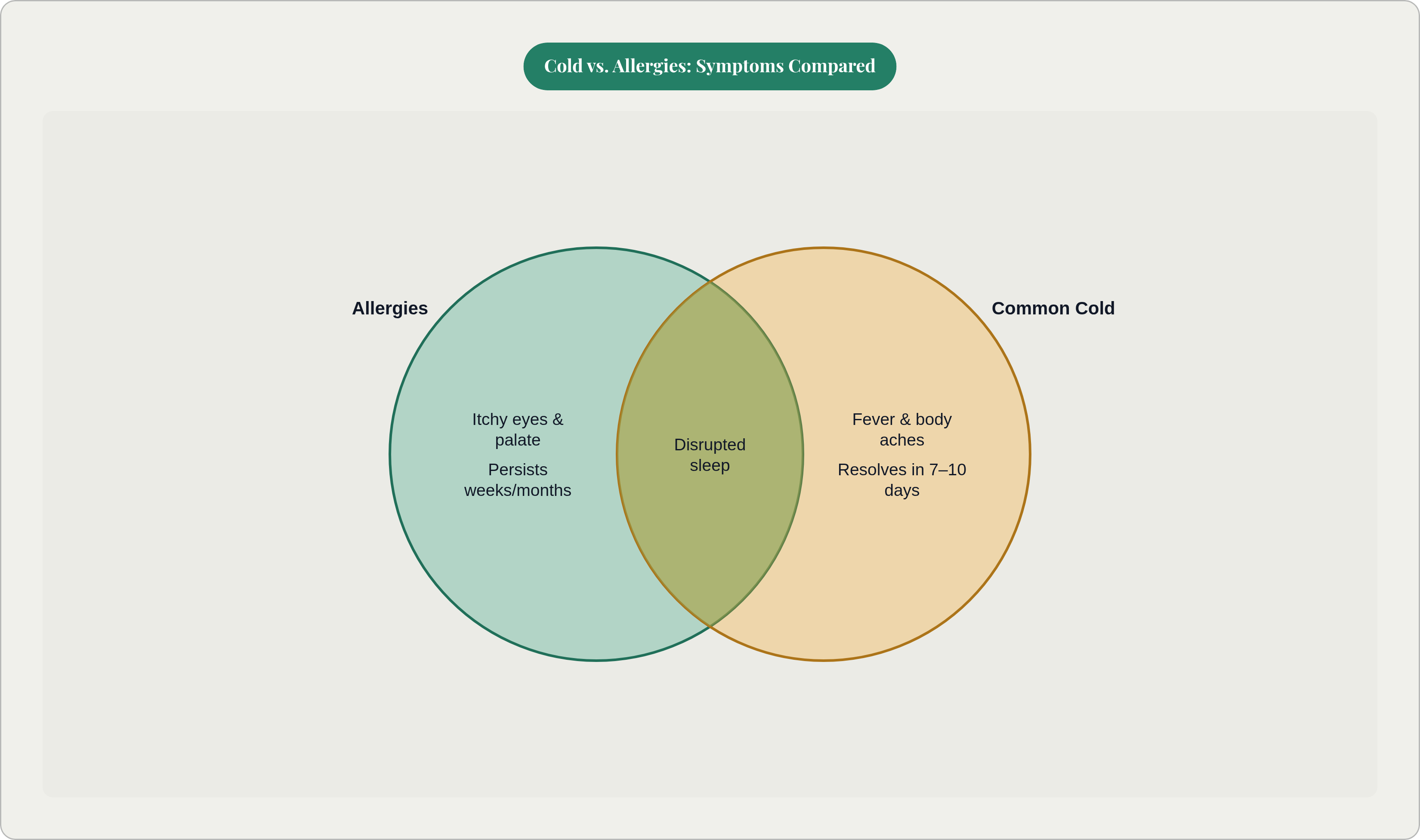
The itching rarely stays contained to the eyes, either. Allergies frequently produce itching at the roof of the mouth, the throat, and inside the nasal passages. That constellation, itchy eyes plus itchy palate plus itchy nose, is a signature of histamine activity. A cold rarely produces that particular sensory pattern.
Mucus color is another indicator people undervalue. Allergic rhinitis produces clear mucus, and it stays clear, even weeks into symptoms. It doesn't transition the way it does with a cold.
Allergies don't cause fever. They don't cause body aches. If either of those is present, the probability shifts hard away from an allergic cause.
Timing of onset is diagnostically useful in a way most people don't appreciate. Allergy symptoms begin within minutes of exposure because there's no pathogen replicating, no incubation period. You walk into a high-pollen environment and your immune system reacts. That rapid onset, tied to a specific place or exposure, is a pattern worth filing away.
Duration is the most underappreciated differentiator. Allergy symptoms persist as long as the trigger is present, which can mean weeks or months, well outside the window of any common cold. I've talked with people who described a cold that just wouldn't quit for six weeks. They weren't describing a cold.
Finally: if symptoms reliably improve indoors, on rainy days, or when you leave a particular area, your immune system is telling you something specific about its trigger. Colds don't respond to weather or geography that way.
The Symptom Patterns That Point Clearly Toward a Cold
Colds build. Most people notice a scratchy throat first; congestion develops next; other symptoms accumulate over one to three days. That escalating, sequential pattern reflects a virus establishing itself and the body ramping up its response. It has a different temporal shape than the near-immediate onset of an allergic reaction.
Mucus behavior also changes mid-illness with a cold. It starts clear and typically becomes yellow or green as the immune response intensifies. This trips people up, because yellowed or greenish mucus doesn't automatically mean a bacterial infection requiring antibiotics; it's a normal part of viral progression. But the color transition itself, from clear to colored over several days, is a cold signal, not an allergy one.
Fever and body aches belong to cold territory. Even a low-grade fever meaningfully shifts the calculus. Allergies simply don't produce those systemic responses.
Sore throat can appear with both conditions, but the quality differs. A cold produces a raw, sometimes quite painful throat. Allergies can cause mild irritation through postnasal drip, but it's less severe and often clears after swallowing something. If the sore throat is prominent rather than a minor annoyance, a cold is the more probable explanation.
Colds resolve in roughly seven to ten days. Symptoms still running strong at day twelve or fifteen, with no real trajectory toward improvement, are not behaving like a cold.
Context matters here too. If people around you at home or at work are cycling through similar symptoms, viral transmission is a more plausible explanation than coincidental allergen exposure for everyone in the same space.
A Quick-Reference Decision Framework Using the Five Most Reliable Differentiators
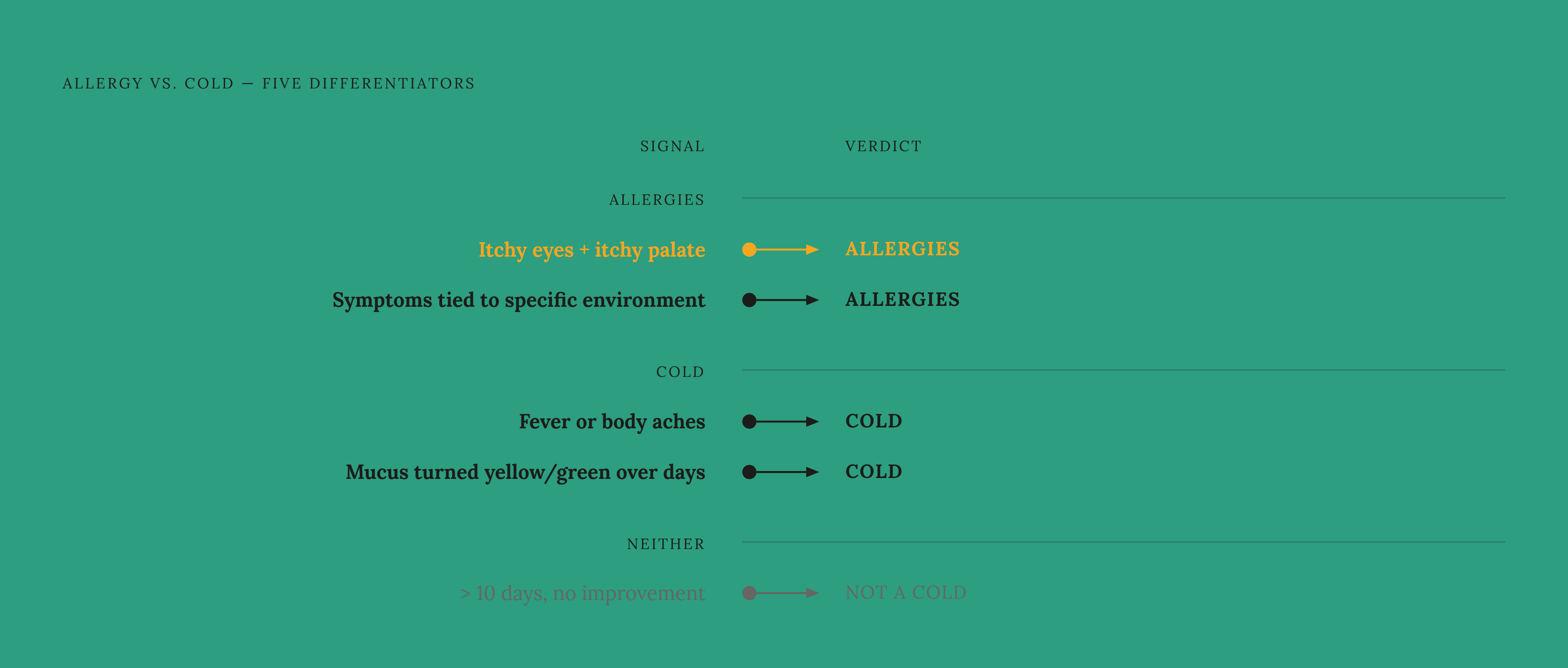
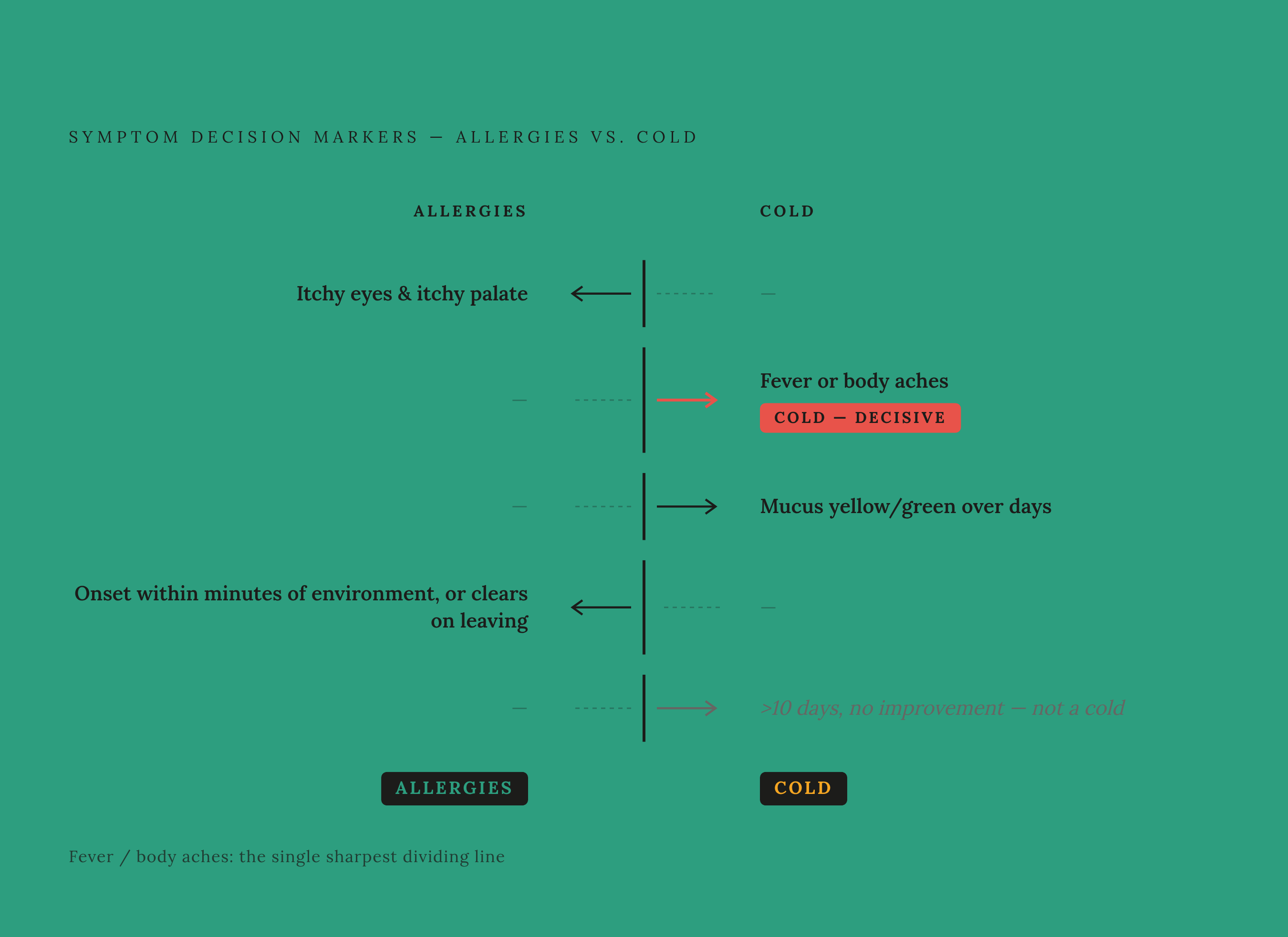
Think of this as a logic chain rather than a checklist. These five markers do the most reliable work.
Itchy eyes and an itchy palate together: allergies become the leading hypothesis. That combination is specific enough to carry real diagnostic weight.
Fever or body aches: shift toward a cold. That's it.
Mucus that started clear and turned yellow or green over several days: that progression points toward a cold.
Symptoms that began within minutes of entering a specific environment, or improved noticeably when you left it: that's allergen exposure.
Symptoms lasting more than ten days with no meaningful improvement: you're no longer in cold territory. Undiagnosed allergies are a serious possibility, but so is a complication worth discussing with a provider.
The harder scenario is when both are occurring simultaneously. A person with confirmed seasonal allergies can catch a cold during allergy season, and the resulting picture is messier than either condition in isolation. The framework helps identify when something more complicated is happening, specifically when the symptom profile contains signals from both columns and refuses to fit neatly into either.
Some situations should end the self-diagnostic exercise entirely. A fever above 101°F, severe sinus pain with thick discharge, any shortness of breath or wheezing, or anything persisting beyond ten days without improvement: those warrant a clinical visit, not continued troubleshooting.
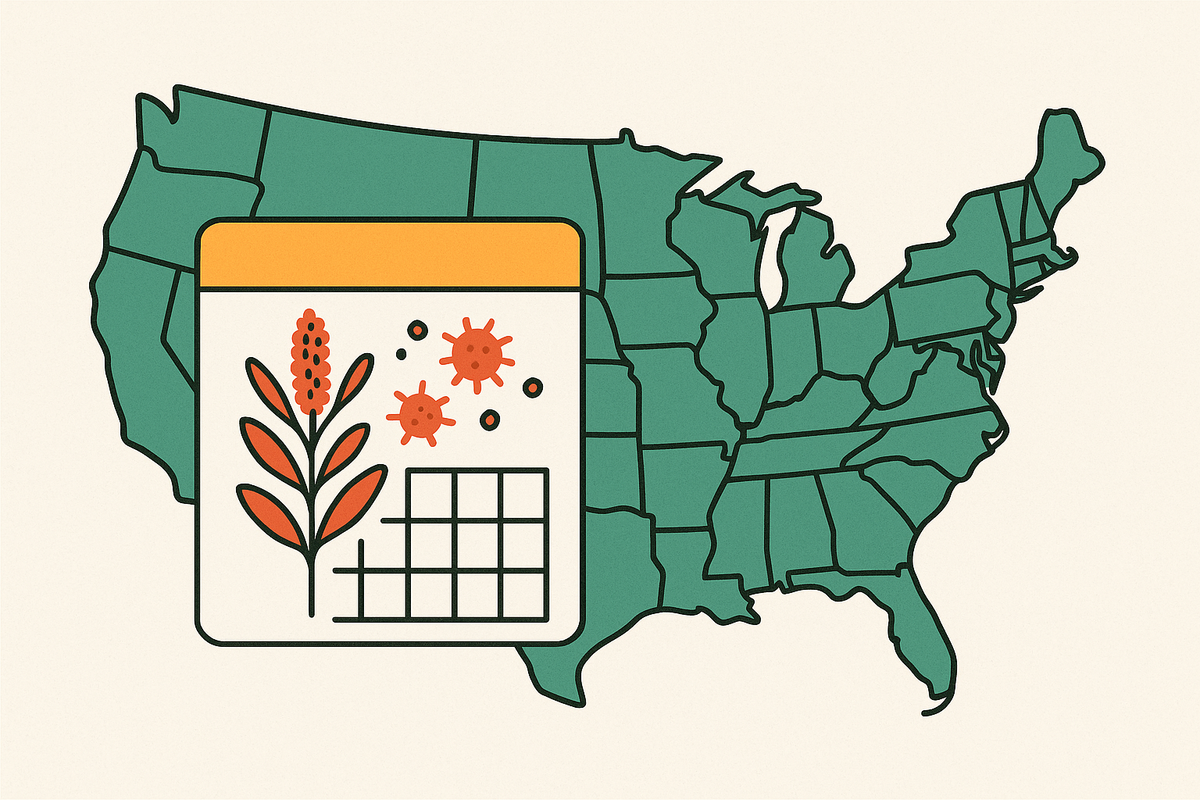
How the Spring Allergen Calendar Shapes What You're Reacting to Month by Month
Spring allergen season doesn't arrive as a single event. It unfolds in sequence, which is why some people feel perpetually unwell from February through June and come to believe they've been catching cold after cold for months.
The earliest tree pollens, alder and maple among them, begin circulating in February and March across much of the country. Symptoms appearing in that window get misread as the tail end of a winter illness or the beginning of a new one. The timing feels right for illness. There's no cultural script telling people to think about tree pollen in late February.
April is where the confusion peaks. Oak, hickory, mulberry, and willow are releasing pollen simultaneously, and cold viruses are still actively circulating. A person developing nasal symptoms in early April has no obvious seasonal anchor pointing in either direction.
As spring moves toward May, tree pollen fades and grass pollen takes over. Bermuda, Timothy, and Kentucky bluegrass become the dominant triggers, and the sneezing and congestion continue through July in many regions. Someone tracking their symptoms across this span perceives a succession of separate illnesses. What they're actually tracking is the pollen calendar, whether they know it or not.
Worth noting: warmer temperatures and elevated atmospheric CO₂ have pushed tree pollen season's onset roughly 12 to 18 days earlier compared to a decade ago, with pollen loads estimated to have increased somewhere in the range of 10 to 20 percent over the same period. The window of allergy-versus-cold confusion now starts sooner than it used to, and the exposures are more intense when they arrive.
How the Fall Allergen Calendar Creates a Different but Equally Confusing Overlap
Fall's confusion mechanism works differently than spring's, but it's just as effective at obscuring what's actually happening.
Ragweed is the central character in fall allergy season. It begins releasing pollen in late summer and continues until the first hard frost. A single ragweed plant can produce a staggering volume of pollen, and that pollen travels up to 400 miles aerodynamically. Urban residents who assume they're insulated from rural sources are not. If ragweed is blooming within several hundred miles, you're in its range.
October compounds things. As fallen leaves accumulate and decompose, mold spore counts rise sharply. Now there are two distinct allergens active simultaneously, both capable of producing classic rhinitis symptoms. And September and October are also peak cold-transmission months, as school-age children return to congregate settings and seed viral transmission through every household they touch.
There's a secondary layer too, one that intensifies as temperatures drop. When heating systems activate and people spend more time indoors with windows closed, dust mites, pet dander, and household mold become more significant contributors. Someone attributing their October symptoms to illness may be reacting to their own home environment, year after year, without ever recognizing the pattern.
Climate data suggests ragweed seasons are extending, running 17 to 21 days longer than pre-2010 averages across parts of the Midwest and Northeast. More days of high-level ragweed exposure, coinciding with elevated mold counts and peak viral transmission. The layers compound each other.
If you have an "October cold" that returns with reliable annual precision, that seasonal recurrence is the clearest retrospective signal in the entire symptom profile.
Why Repeatedly Misidentifying Allergies as Colds Has Real Health Consequences
Untreated nasal congestion from allergies disrupts sleep in ways that accumulate. Swollen nasal tissues encourage mouth breathing, which fragments the deeper stages of sleep and produces the kind of morning grogginess that more hours in bed doesn't fix. People with untreated allergic rhinitis consistently report impaired cognitive function during symptomatic periods and attribute it to stress, a heavy workload, or just "that time of year."
Histamine's effect on neurotransmitters, reduced cerebral oxygenation from persistent congestion, and accumulated sleep disruption interact in ways that aren't obvious or traceable. Someone who describes feeling mentally dull every fall, or who notices poor concentration each spring and blames a busy season, is experiencing an allergy-driven cycle that has nothing to do with either.
Untreated allergic inflammation also increases susceptibility to secondary infections. Mucus trapped in sinuses by swollen tissue creates conditions favorable to bacterial growth. Sinus infections requiring antibiotics are a known downstream complication of unmanaged allergic rhinitis. In people with asthma, the stakes climb higher: allergen exposure can trigger or worsen attacks, and someone who doesn't recognize their October sneezing as an allergic episode isn't protecting their airways accordingly.
The medication mismatch is its own problem. Antihistamines do essentially nothing for a viral infection. Decongestants and cold remedies suppress some allergy symptoms temporarily but leave the underlying immune sensitization intact. Year after year of the wrong treatment is year after year of the same conversation in front of the drugstore shelf.
And the longer someone attributes recurring allergy symptoms to "getting sick a lot," the more entrenched that misconception becomes. These sensitivities don't resolve on their own. For many people, they intensify.
What Accurate Diagnosis Actually Opens Up, Beyond Just Knowing What You Have
Getting the identification right is not an endpoint. It's an access point to a different set of questions.
If symptoms point toward allergies, the useful next step is identifying specific triggers. Knowing which pollens, molds, or indoor allergens are actually driving your immune response replaces seasonal guesswork with a confirmed profile. That information changes behavior in concrete ways: timing outdoor activity around pollen counts, managing indoor air quality during peak mold season, stopping the cycle of spending money on remedies aimed at the wrong problem.
Over-the-counter antihistamines and nasal corticosteroid sprays manage symptoms reasonably well and remain appropriate short-term tools. But as a long-term strategy, they suppress without solving. The immune sensitization that makes you react to ragweed or oak pollen is still fully intact the moment the medication wears off.
Sublingual immunotherapy works upstream rather than downstream, gradually reducing the sensitivity that causes allergen exposure to trigger symptoms, rather than simply dampening the symptomatic output after the fact. Administered as drops or tablets under the tongue, it's become accessible through telehealth pathways that don't require weekly clinic visits. It isn't the right tool for every situation. But for someone with confirmed specific sensitivities who wants something beyond seasonal symptom suppression, it's a categorically different kind of intervention than what's available on the pharmacy shelf.
The larger point, though, is this: correctly distinguishing a fall or spring allergy from a cold matters beyond the medication aisle, though that matters too. It's the entry point to a more consequential question, whether years of recurring "colds" have actually been undiagnosed allergies that are addressable at their source. Most people never ask that question. It's worth asking.