How to Stop Allergy Symptoms at Night
You can spend a moderately tolerable afternoon and then wake at 2 a.m. completely congested, eyes itching, throat raw. The bedroom didn't change. You did, physiologically, and that distinction matters more than most people realize.
Histamine production follows a circadian pattern, rising in the late evening and through the night. Your inflammatory response is already primed before a single allergen enters the picture. Cortisol, a natural anti-inflammatory, hits its lowest levels overnight, so the immune system has less internal suppression precisely when your exposure to bedroom allergens is greatest. Two biological factors converging, neither of them visible, neither of them fixed by vacuuming more often.
Then there's the mechanical reality of lying down. Upright, gravity helps blood drain away from nasal tissue. Horizontal, that drainage slows, blood pools, tissue swells. A nose that was 30 percent blocked at dinner can be 70 percent blocked by midnight. Forced to mouth breathe, you bypass the nose's entire filtering function, pulling particles directly into the lower respiratory tract on dry, unfiltered air.
But what if the room itself is clean — no visible dust, no pets, freshly washed sheets? Why exactly does this happen even then? An allergen load that produces tolerable symptoms during daylight can generate significant obstruction and inflammation overnight. The room hasn't worsened. Your biology has. This is why even a clean bedroom doesn't fully resolve the problem for people with sensitized airways: the body is primed to amplify the reaction during sleep, regardless of what's actually in the room.
The specific allergens that concentrate in bedrooms
The bedroom is one of the highest-density allergen environments most people occupy, which is counterintuitive. We think of outdoor air as the hazard. We think of pollen seasons and springtime windows. But you spend roughly a third of your life in one room, in close contact with the same surfaces, breathing the same recirculated air.
Dust mites are the canonical example. They live in mattresses, pillows, and upholstered surfaces, thriving in the warm, humid microclimate that a sleeping body creates inside bedding. Eight hours of sleep is eight hours of breathing aerosolized mite proteins directly at the source.
Pet dander is more complicated than most people realize. The allergen isn't the fur; it's proteins from skin oil glands and dried saliva, particles small enough to remain airborne for hours and settle on every surface in a room. Banning pets from the bedroom helps, but the improvement isn't immediate. Dander persists on surfaces for months. People who restrict the pet and notice no difference often conclude they weren't allergic to begin with. Frequently, they just didn't wait long enough, or clean thoroughly enough.
Mold is a perennial trigger that masquerades as seasonal allergies. The source is usually a bathroom or a poorly ventilated adjacent space. Because mold spores are present year-round, someone reacting to them won't make the seasonal association that helps with pollen identification. Persistent nighttime symptoms that fail to follow a seasonal pattern and fail to respond to antihistamines are worth evaluating for mold specifically.
Pollen, despite being outdoor in origin, becomes a bedroom allergen through ordinary transfer. Hair, skin, and clothing carry it from daytime exposure directly onto pillowcases. Open windows during high-count periods concentrate outdoor pollen inside overnight. The mechanism is simple; the fix is behavioral.
Cockroach allergens are underreported to a degree that surprises people when they first encounter the data. The allergenic proteins come from saliva, fecal matter, and shed exoskeleton fragments, and they're potent aeroallergens, present in a large majority of U.S. households, with disproportionately high concentrations in urban environments. The trigger is invisible, which is exactly why it gets missed.
Bedroom changes that meaningfully reduce nighttime allergen exposure
Reducing allergen load is the first track of any serious approach to nighttime symptoms. These interventions move the needle, done properly. Their ceiling is also real.
The single highest-impact change is allergen-proof encasements on mattresses, pillows, and duvets. Not hypoallergenic in the marketing sense; actually allergen-proof, with tight weave ratings designed to block mite proteins. Paired with hot-water washing of exposed bedding weekly, because mites survive cold water. This one intervention, done correctly, can substantially reduce overnight mite exposure for the hours that matter most.
Humidity control addresses mite and mold populations at once. Both thrive above roughly 50 percent relative humidity. A dehumidifier in a damp bedroom, or consistent air conditioning use in humid climates, degrades the conditions mite populations need to sustain themselves. There's a temptation to over-humidify in dry winter months to help the airway, which is understandable; it also helps mites and mold more than it helps you.
HEPA air purification, run continuously or at minimum during the hours before and during sleep, captures airborne dander, mold spores, and pollen before they're inhaled. The filter needs to be cleaned or replaced on schedule. A clogged HEPA filter is largely decorative.
Pet and pollen protocols require behavioral consistency over months, not days. Pets out of the bedroom, with the understanding that surface cleaning needs to continue well past the point where you'd expect results. Showering and changing clothes before bed during pollen season. Windows closed on high-count nights. None of this is complicated; all of it requires the kind of sustained attention that is harder than it sounds.
Flooring is worth naming directly: carpets trap and retain allergens in ways hard flooring doesn't. If there's carpet in the bedroom and significant nighttime symptoms, that's a real variable even if replacing it isn't immediately feasible.
All of this reduces the allergen load. It rarely eliminates it. Someone with sensitized airways will still react to lower exposures, especially given the biological amplification that occurs during sleep. Environmental control is necessary and, frequently, insufficient on its own.
What disrupted sleep actually costs, beyond feeling tired
The congestion and sneezing are obvious. The downstream costs are less visible, and they compound quietly over years in ways that are hard to attribute correctly.
Nasal obstruction forces mouth breathing, which dries and irritates the airway, worsens inflammation, and creates a feedback loop that deepens through the night. Fragmented sleep reduces time in the restorative stages that support memory consolidation and physical recovery. The cognitive sequelae — the brain fog, the difficulty concentrating, the irritability — are documented clinical findings in people with untreated allergic rhinitis, not lifestyle complaints or personality traits.
It is also worth considering the misattribution problem embedded in all of this. Fatigue is one of the most common presenting complaints in primary care. Allergies are frequently overlooked as the driver, especially when symptoms fluctuate or blend into general tiredness. The presentation gets attributed to stress, aging, or poor sleep hygiene. Years pass. The actual cause goes unexamined.
Nasal inflammation has a documented bidirectional relationship with sleep-disordered breathing. In people already prone to snoring or obstructive sleep apnea, untreated nasal inflammation worsens the condition in ways that are clinically significant, not marginal. These aren't separate problems; they're interactive ones.
Over the long term, chronic sleep disruption from allergies has been associated with mood decline, and in more severe cases, with depressive symptoms. The allergy is not just a nasal problem. It is a quality-of-life problem whose mechanism runs directly through sleep, night after night.
Why antihistamines and nasal sprays fall short at night
A lot of people have been managing nighttime symptoms with medication for years and still wake up congested. The pattern persists not because the medications are fraudulent but because of what they're actually doing, and what they're not.
First-generation antihistamines, the diphenhydramine products found in most nighttime cold-and-allergy products, cause sedation. They appear to help sleep, but they suppress sleep quality and cognitive clarity in ways that compound the problems allergy sufferers are already experiencing. You may sleep through the sneezing. You will not sleep well. That distinction is important.
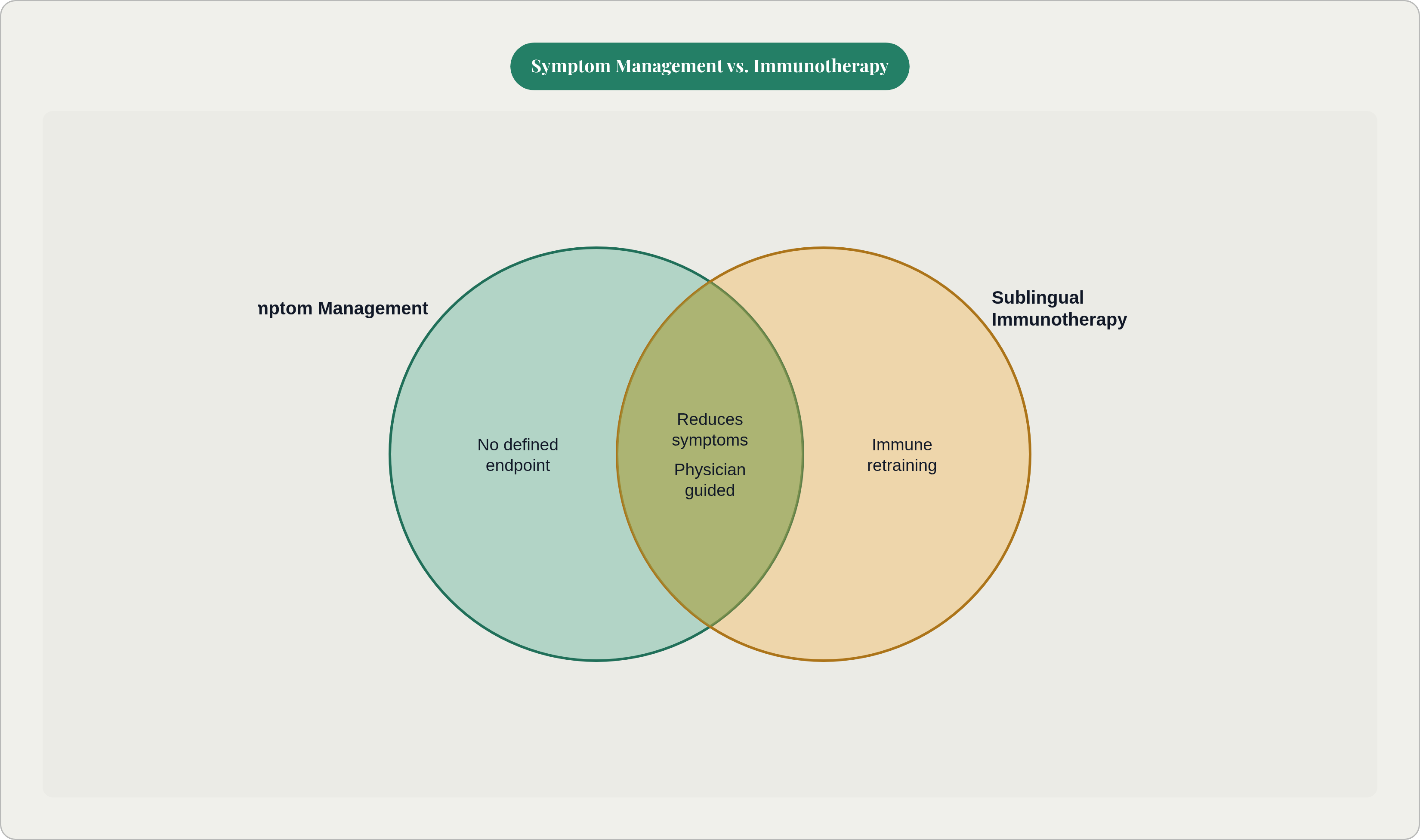
Second-generation antihistamines are better: less sedating, longer-lasting, fewer cognitive effects. But they operate on the same principle. They block histamine receptors downstream of the immune response. They do not lower the allergen load in the room, and they leave untouched what the immune system does when it encounters that load. The allergy remains intact; the symptom is muted.
Intranasal corticosteroid sprays are the preferred maintenance therapy under current clinical guidelines, more effective than antihistamines alone for nasal symptoms and better still when combined. Even so, they address downstream inflammation. Long-term corticosteroid spray use is associated with nasal membrane drying, irritation, and in some cases bleeding; not a reason to avoid them, but a reason to use them with some awareness of what's happening over time.
Montelukast, which some patients have been on for years, now carries an FDA boxed warning for neuropsychiatric events and is no longer recommended as first-line treatment under current guidelines. Anyone started on it some years ago who is still taking it routinely is worth a current conversation with their prescribing physician.
The fundamental ceiling with all of these: they manage the reaction. None modify the immune response producing it. The allergy persists. The medications must continue. There is no defined endpoint, because this model isn't really treatment; it's suppression, indefinitely extended. That raises an important question: if suppression is the only mechanism available in this category, what would it look like to actually address the underlying cause?
How sublingual immunotherapy addresses the root cause behind nighttime symptoms
What conventional medications leave untouched is the immune response itself. To understand why this works, we must first look at what that response actually is and how it gets established in the first place.
Sublingual immunotherapy, SLIT, works through a different mechanism entirely. Small, controlled amounts of allergen are introduced under the tongue daily. The mucous membranes there contain immune cells, including dendritic cells, that take up the allergen in a way that promotes tolerance rather than reaction. Over time, T-cells learn to recognize the allergen as harmless. The immune alarm that fires every time you inhale a dust mite protein is gradually recalibrated, not chemically overridden.
The result isn't a suppressed reaction. It's a diminished or absent reaction, because the immune system has been retrained.
SLIT has demonstrated effectiveness for the aeroallergens most responsible for nighttime symptoms: house dust mites, grass and tree pollen, ragweed, certain mold spores. A three-year course showed durable improvements in allergic rhinitis symptoms, with benefits persisting into the two years after treatment ended, according to a study published in April 2025 via ScienceDirect. Symptom-suppressing medications cannot produce outcomes that persist after discontinuation, because they were never addressing the underlying sensitization.
A 2025 meta-analysis published through PMC and Frontiers in Allergy confirmed clinical effectiveness and safety of SLIT-liquid across allergens and age groups, with low rates of adverse events and high patient adherence. Adherence matters here specifically because this is a daily treatment over a multi-year course. People who stay inconsistent get diminished outcomes.
Many patients notice meaningful improvement within weeks to months. Durable relief typically requires roughly three years of consistent treatment under physician guidance. That's a longer timeline than opening a box of antihistamines, and shorter than indefinite symptom management, which is otherwise the only alternative on the table.
SLIT doesn't replace bedroom hygiene. The two approaches work better together: reducing the allergen load while retraining the immune system is more effective than either alone.
What the at-home, telehealth model means for people with nighttime symptoms
Traditional allergy immunotherapy requires in-clinic injections, frequent visits during the build-up phase, and observation periods after each shot. For many working adults, that schedule is structurally incompatible with how their lives run. A meaningful number of people who would benefit from immunotherapy haven't started it, not because they weighed the options and declined, but because they never found a practical way in.
At-home SLIT changes that. Drops or tablets taken daily, wherever the patient is, without a clinic visit to administer. The logistical friction that keeps people from beginning is substantially reduced.
One might argue that removing the clinic visit also removes a layer of medical oversight — and that's a fair concern to sit with. The medical rigor doesn't disappear in this model, though. At-home finger-prick testing identifies the specific allergens driving symptoms, and that personalization matters because immunotherapy works only when it targets the right sensitizations. A virtual consultation with a board-certified allergist interprets those results and builds the treatment plan. The physician relationship moves to a more accessible format; it isn't replaced.
FSA and HSA funds are eligible for allergy testing and treatment costs, a practical consideration for anyone comparing ongoing medication expenses against a defined treatment course with a known endpoint.
Every season of untreated nighttime symptoms is another season of fragmented sleep, compounding fatigue, and continued immune sensitization. Symptom management runs indefinitely, by design. Immunotherapy has a defined course, with outcomes that continue after treatment ends. Those are different propositions, and the difference is worth thinking through carefully before defaulting to another year of the same approach.