Cold vs Allergies Symptom Differences
Fever and itching reveal whether you're fighting a virus or a false alarm.
The mechanism is worth understanding first, because it reframes everything else.
When a cold virus enters your body, your immune system recognizes a real threat and responds accordingly. Inflammation, mucus production, tissue swelling: these are purposeful, targeted responses to a pathogen your body is actively working to eliminate.
An allergic reaction runs the same process with one fundamental difference. There is nothing actually there. Your immune system has misidentified something harmless, pollen, pet dander, dust mite debris, as an invader, and it deploys the same chemical cascade it would use against a virus. Histamine floods the tissues. Nasal passages swell. Mucus accelerates. The surface presentation looks nearly identical because the underlying immune machinery is identical.
That shared chemistry is why the confusion persists so stubbornly. The causes are entirely different, but those causes reveal themselves in specific, observable ways once you know where to look.
One distinction worth establishing before we get into symptoms: a cold is contagious, an allergy is not. If everyone in your household gets sick within a few days of each other, that's a viral pattern. If you're the only one suffering while the people around you are completely fine, that's worth paying attention to.
The Symptoms Colds and Allergies Share
The overlap is real, and understating it would be misleading.
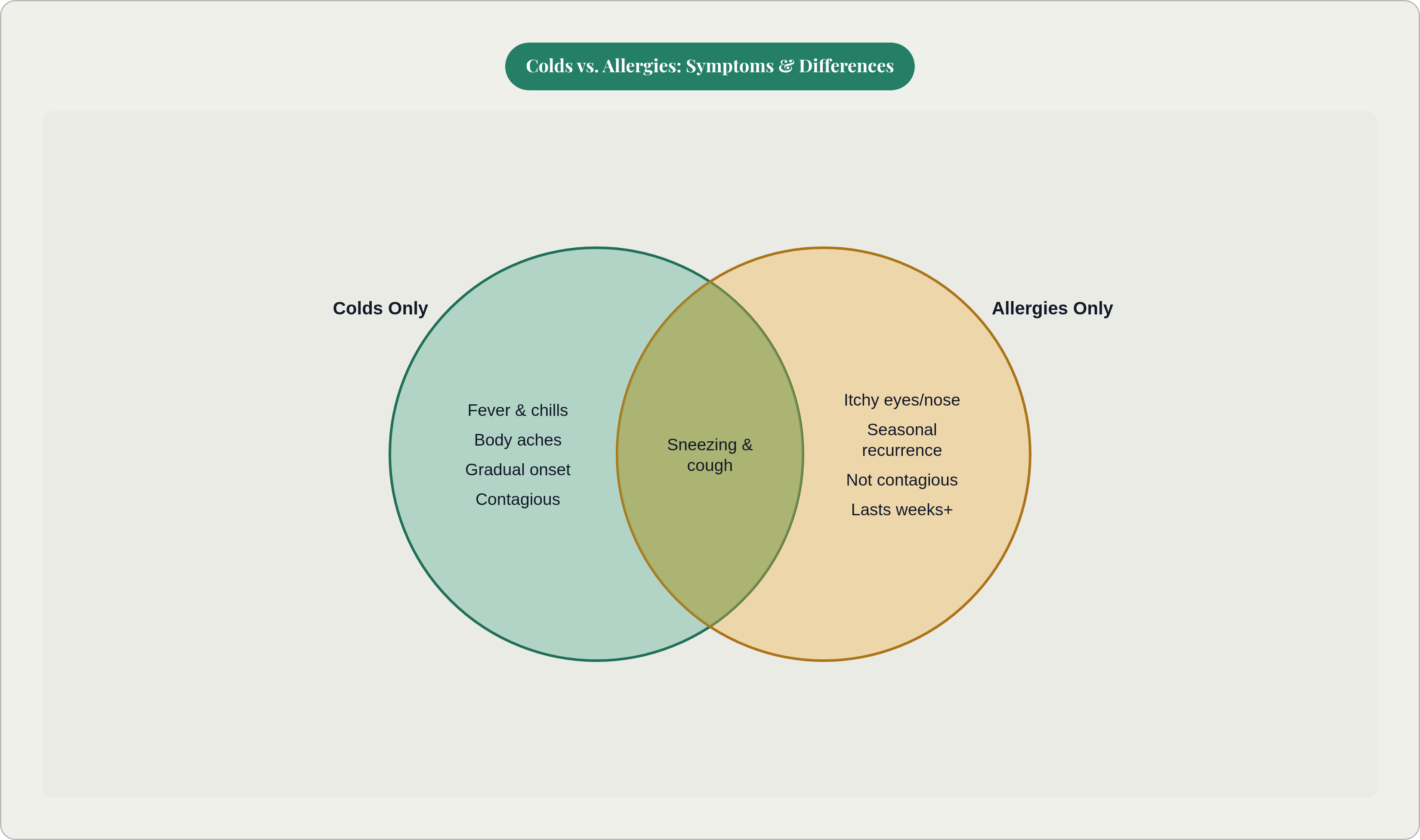
Runny nose, stuffy nose, sneezing: present in both conditions, and convincingly so. Coughing appears in both. Fatigue accompanies both, and not trivially. Allergic inflammation is physiologically draining in ways that go beyond inconvenience, because your immune system is running a sustained false alarm, and that costs real energy. A sore throat shows up in both conditions too, though from different mechanisms: viral irritation in one case, post-nasal drip in the other.
None of this is a quirk or an edge case. The overlap is the whole problem, which is exactly why the differences are worth taking seriously.
The Symptom Differences That Reliably Separate the Two Conditions
Fever and chills. Fever is uncommon even with a cold, but it can occur. With allergies, it does not happen. Your immune system is fighting no pathogen, so it skips the thermoregulatory response that produces fever. If you have a fever alongside nasal symptoms, you can effectively rule out a pure allergic episode.
Itching. Itchy eyes, itchy ears, an itchy nose or throat: these are characteristic of allergic response and rare with a viral infection. Watery, itchy eyes in particular are almost never a cold symptom. If itching is part of the picture, allergies deserve serious weight.
Body aches. Muscle aches are possible with a cold; they are essentially absent with allergies. If you feel like you've been hit by a truck alongside the nasal symptoms, that pattern points toward infection.
Mucus color and cough character. With a cold, mucus typically starts clear and then thickens, yellowing or turning green as the infection progresses and immune cells accumulate. Allergy mucus stays clear and thin, because there's no actual infection generating cellular debris. The cough behaves differently too: a cold produces a wet, productive hack, while an allergy cough produces a persistent tickle at the back of the throat, driven by post-nasal drip rather than anything in the lungs.
Onset speed. Cold symptoms build gradually over several days as the virus replicates. Allergy symptoms arrive within minutes of exposure. If you walk outside on a high-pollen morning and your nose is running before you've reached the end of the driveway, the speed itself is informative.
Duration and Timing as the Most Practical Diagnostic Tools
Colds resolve. The body clears the virus, and symptoms typically wind down somewhere between three and fourteen days. Allergies don't resolve on their own, because the trigger hasn't been removed. As long as the allergen is present, the immune response continues, sometimes for days, sometimes for an entire season.
Practical rule: if what you're calling a cold is still going strong after two weeks, you should be questioning the diagnosis.
More telling is the recurrence pattern. Colds happen randomly across the calendar year, tied to whoever coughed near you on the subway or passed something around the office. Allergy flares happen predictably, at the same time each year or in the same environments. If you "get sick" every April, every September, or every time you visit a friend who has a cat, that's not random viral exposure.
Someone who has had three "colds" in a single spring very likely has unmanaged seasonal allergies. Three distinct viral infections in eight weeks would require remarkable bad luck. A sustained allergic response to tree pollen requires nothing more than going outside.
How Seasonal and Environmental Timing Helps Identify the Allergen Behind the Symptoms
Once you've identified a recurrence pattern, the season itself becomes a diagnostic tool.
Tree pollen dominates in spring. Grass pollen peaks in late spring through early summer. Ragweed, one of the most potent and prevalent allergens in North America, runs from late summer through fall. If your symptoms arrive like clockwork every September, you're not fighting a rhinovirus.
Indoor allergens operate differently. Dust mites, mold, and pet dander worsen in winter, when people spend more time inside and furnace systems circulate dry, particle-laden air through enclosed spaces. Someone whose symptoms reliably worsen in January, or who feels noticeably better after a weekend outdoors than after a night at home, has a useful environmental signal right in front of them.
There's a simple exercise worth trying: pull up a publicly available pollen calendar and cross-reference it against your own symptom history. If your worst years have aligned with documented pollen peaks in your region, that correspondence deserves some scrutiny.
When Untreated Allergies Compound into More Serious Problems
The misdiagnosis becomes consequential, not merely inconvenient, when you trace what chronic, unaddressed allergic inflammation actually does to the body over time.
Persistent nasal congestion impairs sinus drainage. Mucus gets trapped. That stagnant mucus becomes an environment where bacteria can proliferate, creating a direct physiological pathway to recurrent sinus infections. Someone who believes they're catching a lot of colds is experiencing allergy-driven congestion that's setting up secondary infections, a cycle that does not resolve because the root cause is not addressed.
Persistent nasal obstruction also drives mouth breathing, particularly during sleep. Mouth breathing produces dry, irritated tissue, disrupts sleep architecture, and leaves people waking up more exhausted than when they went to bed.
The cognitive effects are underappreciated. The brain consumes a disproportionately large share of the body's oxygen relative to its size; even modest, sustained reduction in oxygenation from chronic congestion produces noticeable effects on concentration and processing. Compound that with sleep fragmentation and the neurological disruption of sustained histamine activity, and you get what clinicians sometimes call allergy brain fog, a persistent cognitive sluggishness that people attribute to stress, poor sleep, or just getting older, rather than to pollen.
For people with asthma, the stakes are higher still. The immunological hyperreactivity underlying allergic rhinitis and asthma are closely related, and neglecting one aggravates the other.
What to Do When the Pattern Suggests Allergies Rather Than Colds
Start with your own history. Map your symptom record against the differentiators above: duration, the presence or absence of fever, the presence or absence of itching, onset speed, recurrence pattern. If your symptoms exceed two weeks, involve itching, produce no fever, and return at the same time each year, the case for allergies over colds is strong.
At-home allergy testing can identify specific triggers without a clinic visit, which makes the seasonal calendar immediately actionable. Knowing you're allergic to oak pollen, rather than just knowing you feel terrible every April, transforms vague seasonal dread into something you can work with.
It's worth understanding the difference between symptom management and treatment. Antihistamines and nasal sprays address the presentation: the runny nose, the itchy eyes, the congestion. They don't address the underlying immune misreaction. That distinction matters for someone who has been managing symptoms with over-the-counter remedies for years without ever questioning the diagnosis.
The alternative, targeting the mechanism rather than the surface, is sublingual immunotherapy. The principle is incremental desensitization: exposing the immune system to controlled, progressively increasing amounts of the allergen over time, gradually retraining the response so the trigger no longer produces symptoms. Research following children over multi-year courses of sublingual immunotherapy has found sustained symptom reduction even after treatment ends; children on symptomatic medication alone, by contrast, rebound once the medication stops.
If you've recognized your own pattern anywhere in this, the next step is straightforward: get tested, identify the specific triggers, and work with a physician who can build a treatment plan around those particulars.