Perennial vs Seasonal Allergies in Adults
Know which type you have to avoid treating the wrong problem at the wrong time.

Perennial and seasonal allergies get lumped together as one thing, "allergies," but they run on different triggers and different clocks. Mix them up and you end up treating the wrong problem at the wrong time of year, using tools that were never built for that job. I've spent years walking patients through this exact distinction after they've spent years guessing on their own, so let's get into it.
Year-round sneezing and congestion points toward perennial allergies, meaning triggers that live in your environment every day rather than following a pollen calendar. The most common culprits are dust mites, animal dander, cockroaches, and indoor mold; dust mites alone showed a 38% sensitization rate in a 2019 dataset of over 100,000 patients, which rivals any single seasonal pollen trigger. The clearest clues are symptoms that worsen in the bedroom, flare after vacuuming or disturbing upholstered furniture, or spike around animals regardless of the season. That said, many adults carry both perennial and seasonal sensitizations at once, so if your symptoms never fully clear even between pollen seasons, both may be running simultaneously, and a blood or skin test covering indoor and outdoor allergen panels is the only way to know which specific proteins your immune system is actually reacting to.
In 2021, about 81 million Americans — roughly 26% of adults — carried a diagnosis of seasonal allergic rhinitis alone. Add perennial cases on top of that, and you've got a huge share of adults juggling some mix of both. Figuring out which one you actually have is the real starting point. Skip that step and you're just masking symptoms until they come back, and if you've lived through that cycle, you already know how old it gets.
The specific triggers behind each type, and how sensitization actually breaks down in the population
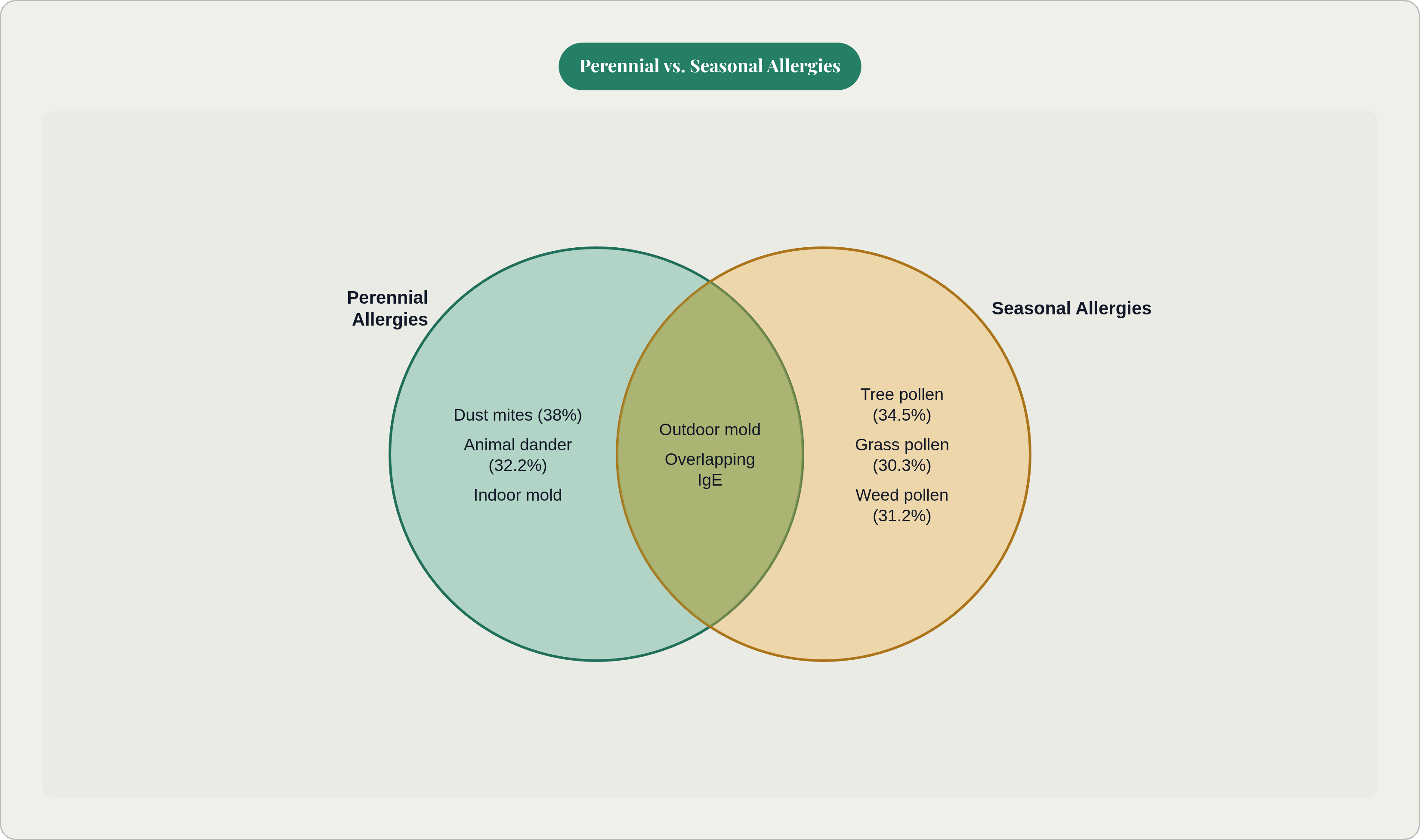
Perennial allergies come from stuff living in your house every day of the year. Dust mites sit at the top of that list. A 2019 study pulling from Quest Diagnostics data on 107,877 patients found a 38.0% sensitization rate, which makes them about as common a trigger as you'll find anywhere. Animal dander trails close behind at 32.2% in that same group. The allergen there is proteins in dander and dried saliva, not the fur itself; that's why even a hairless cat can wreck someone's sinuses.
Cockroaches don't get talked about enough, but they're a real perennial trigger, especially in apartments and older buildings with shared walls. Indoor mold rounds out the list, and it's the sneaky one, because the sources hide well: grout lines in bathroom tile, damp basement corners, the inside of HVAC ducts nobody's checked since the place was built.
Seasonal triggers follow the calendar like clockwork, by contrast. Trees came in at 34.5% sensitization in that same 2019 dataset and usually open the year in spring. Grasses hit 30.3% and peak early summer. Weeds run 31.2% and take over late summer through fall. Outdoor mold sits lower at 19.7% but spikes during wet stretches and after leaves drop. That last one says something worth sitting with: mold doesn't respect the indoor-outdoor line the way other allergens do. It's perennial indoors and seasonal outdoors, both at once, in the same organism.
Line these numbers up and something jumps out. Dust mites and animal dander rival or beat any single seasonal trigger on their own, so the idea that seasonal allergies are automatically the bigger problem doesn't hold up against the data. Once frost kills off outdoor pollen, indoor allergens take over completely, so winter is rarely a clean break for anyone with a perennial component. That pattern plays out regularly in practice: someone convinced they only have spring allergies turns out to carry a dust mite sensitization that has been running quietly underneath the whole time. Add in longer, warmer pollen seasons across a lot of U.S. regions now, and the line between "outdoor allergy season" and "indoor allergy season" keeps blurring further.
Why many adults have both types at once, and how overlapping triggers complicate self-diagnosis
Having both is common. Arguably it's closer to the rule than the exception. A lot of people who test positive for seasonal allergens also test positive for perennial ones, and the research backs up that the burden compounds instead of averaging out: sensitization to more than one perennial allergen raises the prevalence of both allergic rhinitis and asthma.
That creates a specific kind of confusion. Somebody who deals with symptoms all year but gets noticeably worse every spring will usually assume spring is the whole story. They miss that dust mite or dander symptoms have been humming along quietly the whole time, underneath the more dramatic seasonal spike. Flip it around: someone who blames every sniffle on their cat might miss a fall weed pollen layer stacking right on top of that.
Sensitization also shifts over time. Somebody sensitized to one tree species can pick up a new sensitivity to grasses or weeds years later, no warning given. Your allergy profile at 25 isn't your allergy profile at 40.
So what do you actually do with that? Symptom diaries, cutting out a pet, swapping detergents, trial and error in general, all of it sounds reasonable on paper. But it rarely untangles overlapping triggers with any real reliability, because pattern recognition only gets you partway there. A structured test covering both indoor and outdoor panels gives you a far more reliable read on what you're actually reacting to. We'll get to why that matters more than most people think.
How do you know if year-round sneezing and congestion is allergies or something else?
Sneezing, runny nose, congestion, itchy watery eyes, postnasal drip, coughing: both types produce every bit of it. Symptom type alone won't tell you which one you're dealing with. Timing carries most of that weight instead.
Symptoms that show up and clear out in rhythm with pollen season point toward seasonal. Symptoms that hang around through winter, or flare in specific rooms, around animals, or right after cleaning, point toward perennial.
A few clues strengthen the perennial case:
- Worse in the bedroom, since dust mites concentrate in mattresses and pillows
- Worse after vacuuming or disturbing couches and other upholstered furniture
- Worse around a pet no matter the season
- Worse in damp, musty spaces
A couple point toward seasonal instead:
- Shows up suddenly in the same months every year, then resolves once that pollen clears
- Reliably worse outdoors, better indoors
Watch for the overlap pattern too, since it's the one people miss most: symptoms that spike seasonally but never drop back to zero in between. That lingering baseline is usually the perennial piece, and the spike riding on top of it is seasonal. If you're dealing with unexplained asthma symptoms or a cough that won't quit, pay close attention here. House dust mite and cat dander are the two allergens most tightly linked to allergic rhinitis and asthma showing up together.
The downstream health effects that go unrecognized when perennial allergies are missed or misattributed
Perennial allergies carry a chronic health risk that seasonal ones mostly don't, for one simple reason: they never switch off. The inflammation runs continuously instead of in bursts, and that adds up over months and years in a way an eight-week spring flare-up just doesn't.
Brain fog is the clearest example, and it runs through three separate paths. Histamine doesn't just act on your nose; it's also a neurotransmitter, and it disrupts alertness and sleep regulation directly. Then there's oxygen: the brain uses roughly 20% of the body's oxygen supply despite being a small fraction of total body weight, so even modest congestion cutting into airflow can dent how clearly you think. Sleep itself takes the third hit. Untreated allergic rhinitis leads to more nighttime awakenings and less deep sleep, which undercuts memory consolidation and next-day mental recovery.
Nasal blockage pushes people into mouth breathing at night, which fragments sleep further, which worsens morning fog, which sets up the same cycle the next night. Perennial sufferers don't get a seasonal pause to reset that cycle. It just keeps running.
Medication complicates things instead of simplifying them. Older, sedating antihistamines dull cognition on their own, so the under-treated patient and the patient on the wrong medication can both end up foggy, just by different routes. A 2026 Frontiers in Allergy review ties allergic rhinitis to reduced work productivity, lower quality of life, and heavier healthcare use across the board.
Why does this fly under the radar for so many adults? Fatigue, poor focus, and morning grogginess get chalked up to work stress, bad sleep habits, or just getting older. Nobody thinks to trace it back to allergies unless something specific points them there, and most people never get that specific something.
What an allergy test actually shows, and why testing both indoor and outdoor panels changes the picture
A standard allergy test measures specific IgE, your immune system's antibody response to individual allergen proteins. Beyond confirming that you have allergies, it tells you exactly which proteins your body reacts to: Timothy grass, dust mite, cat dander, short ragweed, whatever it turns out to be.
Panel scope changes what you find, and this is where a lot of testing falls short. Test only for tree, grass, and weed, and a dust mite or dander sensitization sitting underneath never shows up. Test only for the obvious pet or dust trigger, and you'll miss the seasonal layer behind your annual spring or fall spike. A panel covering both indoor and outdoor allergens is the only setup that catches overlap, and given how common overlap turned out to be in the last section, that's not a small detail.
Testing has also gotten a lot easier to get done than it used to be. Finger-prick blood tests now check IgE levels without a clinic visit, with a physician reviewing results that can span the full range of perennial and seasonal allergens.
What changes once you have results in hand? You know exactly which allergens to target if you move into immunotherapy. Year-round symptoms that felt like a mystery suddenly have an explanation attached. And testing sometimes turns up sensitization to things nobody suspected, dust mites in someone who was sure they only had spring hay fever, say. It can even flag sensitization before it's causing real symptoms, and catching it that early tends to make treatment work better down the line.
Why antihistamines and nasal sprays manage symptoms without resolving the underlying sensitization — in either type
Antihistamines block histamine at the receptor. Nasal sprays cut down inflammation locally. Both give real relief, genuinely, but that relief only lasts as long as the medication stays in your system. Stop taking it and symptoms come right back, because neither treatment touches the immune response generating the histamine and IgE in the first place. Sensitization stays fully intact underneath, untouched by any of it.
Perennial sufferers feel that limitation differently than seasonal ones do. Someone taking a daily antihistamine for eight weeks each spring has an endpoint in view. Someone leaning on the same approach for a perennial trigger is looking at daily medication indefinitely, with no season to look forward to when it ends.
There's a second problem stacked on top. Sedating antihistamines add their own cognitive dulling right onto the allergy-driven brain fog covered above, so patients feel worse and blame the allergy, when part of what they're feeling is the drug itself. Nasal corticosteroid sprays work well, but they need daily consistency to hold. Skip a few days and symptoms creep back, because the underlying sensitization never moved an inch.
That 2026 Frontiers in Allergy review states it plainly: conventional pharmacotherapy gives symptomatic relief without modifying the underlying immunologic mechanisms of allergic disease. A lot of adults get stuck here, upping the dose, adding a second medication once the first stops feeling like enough, never once touching the root cause sitting underneath both.
How immunotherapy addresses both perennial and seasonal sensitization at the immune level
Immunotherapy works on the immune system itself, not just the symptoms it throws off. Regular low-dose exposure to an allergen under the tongue trains T-cells to recognize that allergen without sounding an alarm. Over time, that recalibrates the whole response: IgE production drops, protective IgG goes up, regulatory T cells get more active.
This covers both allergy types at once, which is the part people find surprising. FDA-approved sublingual immunotherapy (SLIT) tablets target specific major allergens directly: Odactra for house dust mite, Grastek for Timothy grass, Oralair for a five-grass mix, Ragwitek for short ragweed. That's perennial and seasonal triggers handled through the same method. Off-label SLIT drops, multi-allergen liquid extracts, allow for personalized combinations that hit several sensitizations at once, which matters a lot given how much overlap shows up in practice.
The evidence holds up under real scrutiny, too. High-quality systematic reviews, including a Cochrane analysis, show clinically meaningful drops in both symptoms and medication use compared to placebo, with no anaphylaxis recorded across the trials analyzed. The safety profile compares well against allergy shots. The Journal of Allergy and Clinical Immunology: In Practice, in a June 2024 piece, confirmed the evidence base for immunotherapy's effectiveness in allergic rhinitis and asthma tied to seasonal pollens, dust mites, animal allergens, and certain mold spores.
Timelines matter here, and I'd rather be upfront about them than oversell the speed. Many patients notice some improvement somewhere between 4 and 24 weeks in. Durable relief, the kind that sticks around after you stop treatment, typically takes about three years of consistent therapy under a physician's guidance. That's a slow build, and there's no shortcut around it worth pretending exists.
One practical distinction worth knowing: SLIT gets taken daily at home, no weekly clinic visits, no sitting in a waiting room after an injection watching the clock. For perennial sufferers who need treatment covering the whole year, that difference shapes daily life more than it sounds like it would.
Using your symptom pattern and timing to identify which type — or combination — applies to you
Start simple. Symptoms confined to a defined seasonal window that clear out fully between seasons point toward a mostly seasonal profile. Symptoms that never fully go away, or that flare in specific rooms, around pets, or straight through winter, point toward a perennial piece, and it might be the dominant one. Symptoms that spike seasonally but never drop to zero in between suggest both are running at once.
This trips people up constantly, so it's worth saying again: sneezing, congestion, and itchy eyes don't distinguish the types on their own. Timing and environment carry most of the actual diagnostic weight.
A few red flags suggest your allergy burden runs deeper than you've given it credit for:
- Morning congestion or grogginess showing up on a regular basis
- Concentration problems or fatigue you can't otherwise explain
- Symptoms that feel like a cold that never quite ends
- Sleep that never actually feels restorative
Even a sharp, honest read of your own pattern has a ceiling, though. It can point you toward seasonal, perennial, or both, but it can't name the exact allergens driving it, and it won't catch a sensitization you haven't connected to any symptom yet. That gap is what testing closes: the bridge between noticing a pattern and actually doing something about whatever's causing it.