Oral Allergy Syndrome Diagnosis and Triggers
Heat breaks down the pollen proteins that trigger itching in your mouth when you eat raw produce.

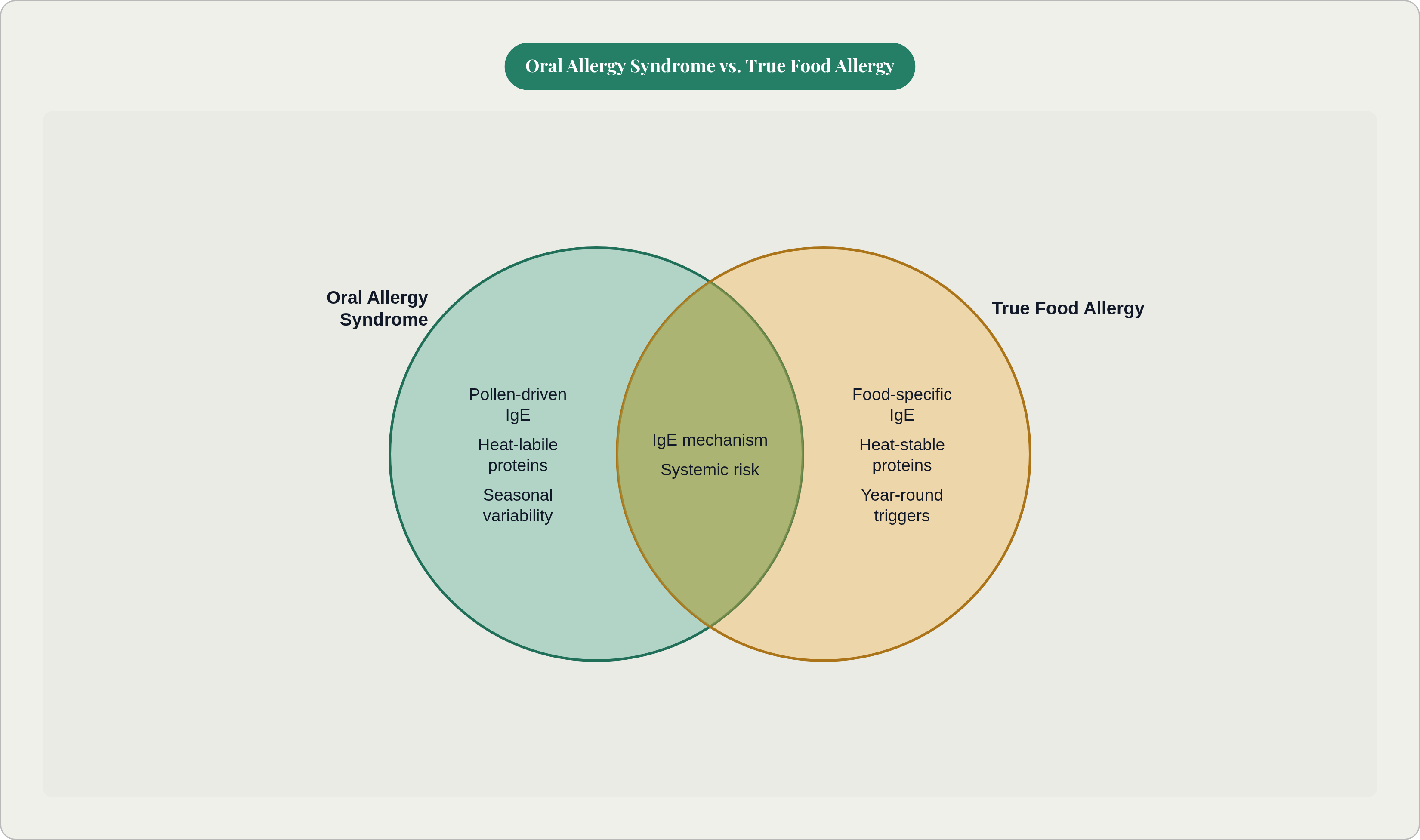
Oral Allergy Syndrome is not a food allergy. Rather, it is a pollen allergy that announces itself in your mouth. That distinction changes everything about how you find it, what you do about it, and whether what you're doing actually helps.
To understand why this works, we must first look at what happens during repeated pollen exposure. Your immune system produces IgE antibodies calibrated to specific pollen proteins. Standard sensitization, nothing unusual. The problem starts when you eat a raw food containing a protein that is molecularly similar, in shape, to the pollen protein your immune system has already flagged. Your IgE antibodies don't distinguish cleanly between the two. They bind to the food protein in your oral mucosa, trigger mast cell degranulation, histamine releases locally, and you get that characteristic itch and tingle right where the food touches tissue.
The most well-studied version of this is the Bet v 1 protein from birch pollen. Structural homologs of Bet v 1 appear in apples, carrots, celery, peaches, and hazelnuts. If you're sensitized to birch, your immune system has already learned to recognize that protein shape. It finds it everywhere.
Cooking breaks this. Heat denatures these plant proteins, unfolding their molecular structure until the IgE no longer recognizes them as a threat. That's why most people with OAS can eat the same food cooked with zero reaction. Stomach acid does similar work further down, which is why symptoms stay localized to the mouth and throat rather than cascading into systemic reactions in most cases.
One caveat worth sitting with: not all cross-reactive proteins are heat-labile. Lipid transfer proteins and gibberellin-regulated proteins survive both cooking and digestion. Patients sensitized to these face a meaningfully different, more serious risk profile, one that can include systemic reactions. It's the exception to the general pattern, but it warrants a real conversation with an allergist rather than a footnote.
Which Pollen Allergies Produce Which Food Reactions
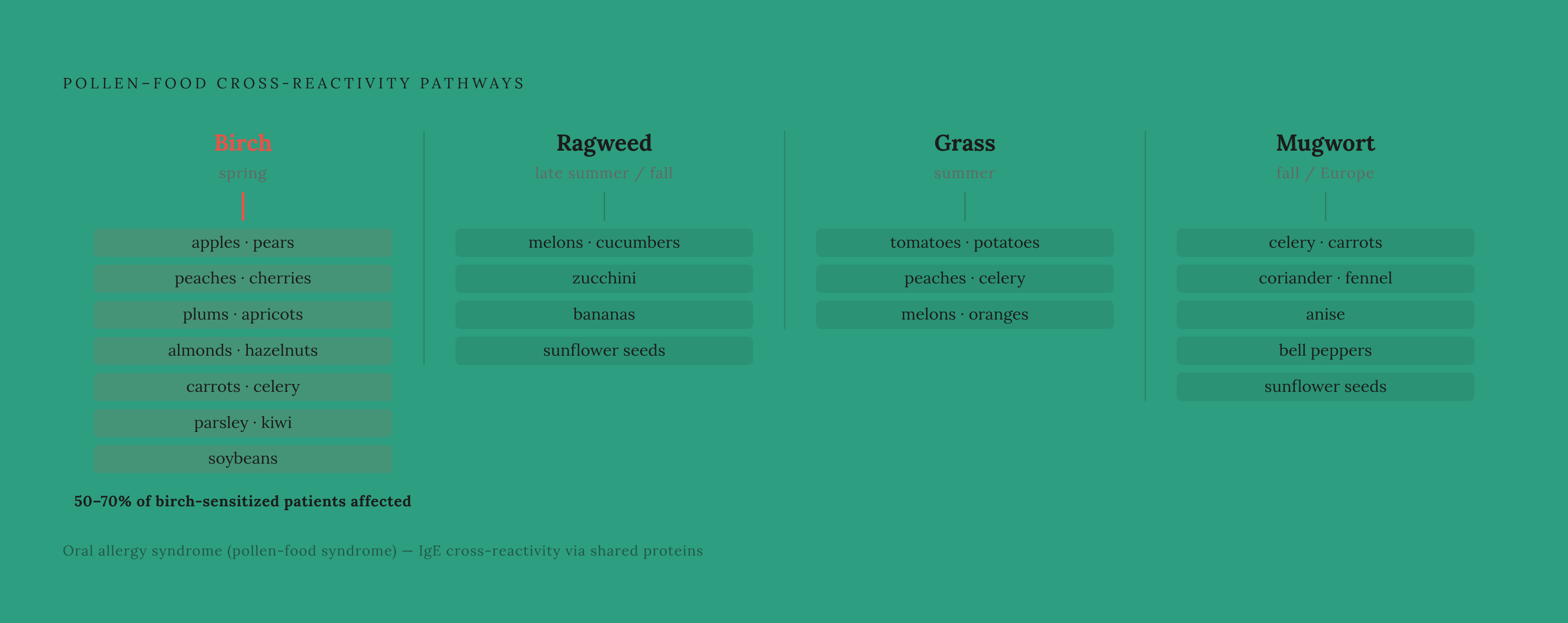
Three major pollen families drive the majority of OAS cases. The seasonal timing of your reactions is often the first real clue about which one is at the root.
Birch pollen peaks in spring and produces the broadest, best-documented cross-reactive food group. Up to 75% of adults with birch allergy also react to apples or celery, and OAS occurs in somewhere between 50 and 70% of patients specifically sensitized to birch. The food list is long: apples, pears, peaches, cherries, plums, apricots, almonds, hazelnuts, carrots, celery, parsley, kiwi, soybeans. If your spring hay fever is significant and you find yourself reacting across multiple raw fruits and vegetables at once, birch is the likely culprit.
Ragweed peaks in late summer and fall, and it cross-reacts with an entirely different group: melons, cucumbers, zucchini, bananas, sunflower seeds. The timing isn't coincidental. When September melon reactions spike, ragweed season is at its peak. The structural overlap between ragweed proteins and cucurbit proteins is the mechanism; the seasonal correlation is the signal most patients never consciously make.
Grass pollen runs through summer and is less tidily mapped than birch. Cross-reactivity with tomatoes, potatoes, peaches, celery, melons, and oranges is documented, but individual sensitivity varies considerably. There's less predictability here, which makes it harder to work backward from symptoms alone.
Mugwort and other weed pollens, particularly relevant in Europe but increasingly documented in the United States, cross-react with celery, carrots, spices like coriander, fennel, and anise, bell peppers, and sunflower seeds. The celery-mugwort-spice syndrome is a recognized clinical pattern with its own constellation of triggers.
If your reactions cluster around a particular season and a specific food group, that pattern is pointing directly at an underlying pollen.
What OAS Actually Feels Like and Why It's Easy to Misread
The hallmark presentation is itching, tingling, or burning of the lips, tongue, palate, and throat, beginning within minutes of eating a raw trigger food. Mild swelling of the lips or tongue can occur. Some patients develop short-lived blisters or red patches on the oral mucosa. Then, typically within 30 minutes of swallowing or removing the food, symptoms resolve on their own.
That localization and rapid resolution are defining features. They are also exactly why OAS gets misread so consistently.
The food is the obvious suspect, because the reaction is immediate and the food is in your hand. People self-diagnose, eliminate the food, and never investigate further. Clinicians without allergy training sometimes document a food intolerance and move on. Because symptoms are often mild enough that people simply avoid the trigger without seeking care, OAS flies under the radar for years, sometimes decades.
Seasonal variability makes this worse. Symptoms frequently intensify during peak pollen season and disappear entirely off-season. Someone who reacts to raw apples in April but tolerates them fine in November doesn't register a pattern; they assume the apples were unusually fresh or acidic. The pollen connection never surfaces.
The reactions that warrant immediate medical attention are categorically different: hives, abdominal pain, vomiting, difficulty breathing, dizziness. These suggest systemic involvement, either from a heat-stable protein or a co-existing true food allergy, and they require emergency evaluation. Knowing the difference matters, both for safety and for avoiding unnecessary alarm when you're dealing with an oral tingle that resolves in twenty minutes.
How OAS Is Diagnosed and Why the Process Starts With Pollen, Not Food
Diagnosis is primarily clinical, which is both its strength and its liability. A careful history, which foods trigger symptoms, when reactions occur relative to pollen season, which airborne allergens the patient already knows about, is usually enough to form a strong working hypothesis before any testing happens. In a patient with known seasonal allergic rhinitis who reports mouth tingling after eating raw apples or carrots, the picture is already fairly legible.
Skin prick testing confirms the cross-reactive pattern, but method matters more than most patients realize. Standard commercial food extracts often contain denatured proteins, meaning the labile, cross-reactive proteins that actually drive OAS are no longer present in their original form. Prick-to-prick testing with fresh food, pressing the lancet directly into the raw food before pricking the skin, is substantially more sensitive for OAS. Testing the relevant pollens alongside suspected foods reveals which pollen is driving the cross-reactive IgE response.
Specific IgE blood tests for foods return negative or equivocal results in OAS patients for the same reason: labile proteins are often degraded in commercial test preparations. A negative food IgE result does not rule out OAS when pollen sensitization is present. This is the gap that opens up, frustratingly often, when the diagnostic process begins with food testing rather than pollen evaluation.
Molecular allergology adds precision where it's needed most. Component-resolved diagnostics can identify exactly which protein the patient's IgE is targeting, distinguishing labile Bet v 1 homologs, which carry low systemic risk, from heat-stable lipid transfer proteins, which carry higher systemic risk. That distinction has real implications for how aggressively to manage the condition.
Any patient with seasonal pollen allergy who reports oral or throat symptoms after eating raw fruits, vegetables, or tree nuts should be evaluated for OAS with pollen in mind, not just food.
Why Treating the Underlying Pollen Allergy Changes the Picture for OAS
Avoidance is the most common short-term strategy: peel the fruit, cook the vegetables, sidestep raw trigger foods during peak season. It works well enough as a stopgap. But how does this affect our original promise? Avoidance is not treatment; it's accommodation of an immune system error that continues running underneath.
Antihistamines provide limited utility for OAS specifically. The oral mucosa reaction is rapid, and by the time an oral antihistamine is absorbed into systemic circulation, symptoms have already resolved. Wrong tool for the timeline.
If OAS is downstream of pollen sensitization, then reducing the IgE response to pollen reduces the cross-reactive food response as well. This is not theoretical; it is what immunotherapy accomplishes. Sublingual immunotherapy exposes the immune system to controlled, incrementally increasing amounts of the pollen allergen until the IgE response is downregulated. T-regulatory cells are upregulated over time, protective IgG antibodies increase, and the IgE-driven reaction that produces both pollen symptoms and OAS food reactions is suppressed at its source.
The 2024 American Academy of Otolaryngology–Head and Neck Surgery Foundation clinical practice guidelines issued a strong recommendation for offering immunotherapy to patients with allergic rhinitis whose symptoms are inadequately controlled by medications or allergen avoidance, with a minimum treatment duration of three years for responding patients. For OAS patients, that recommendation carries additional weight. Treating the birch, ragweed, or grass pollen driving cross-reactive food reactions is not just managing airborne symptoms; it is addressing the root cause of why apples make your lips swell in April.
Sublingual immunotherapy's practical advantage is real: drops or tablets dissolve under the tongue daily at home, no clinic visits required. Subcutaneous immunotherapy, allergy shots, addresses the same root cause but requires regular in-office injections, a barrier that becomes more pronounced for patients who are only beginning to understand that their food symptoms were pollen-related all along. Both options are legitimate.
Steps a Person With Suspected OAS Should Take Now
Start by tracking the pattern. Write down which raw foods trigger symptoms, when reactions occur relative to the season, whether the same food cooked is tolerated without issue. This log is the foundation of any useful clinical conversation, and it tends to surface connections that weren't consciously registered before.
Don't stop at food elimination. If the pattern fits OAS, removing the food from your diet is the beginning of the investigation, rather than the end. That raises an important question: which pollen is sensitizing your immune system? And that question requires pollen testing, not a longer list of foods to avoid.
Get tested for pollen sensitization. At-home allergy testing can identify which specific pollens are driving IgE sensitization. Those results aren't just informational; they form the basis of a treatment plan that can reduce the underlying immune response, rather than simply mapping out a more elaborate avoidance strategy.
Understand that food avoidance alone doesn't treat anything. Removing apples from your diet does not reduce birch pollen IgE levels. The sensitization continues, and in some patients it broadens over time to include additional cross-reactive foods.
Consider immunotherapy. For patients whose OAS is tied to birch, ragweed, or grass pollen, sublingual immunotherapy directed at those pollens addresses the immune system error at its source, which is a meaningfully different outcome than rearranging your diet indefinitely.
An estimated 81 million Americans have been diagnosed with seasonal allergic rhinitis. Most are managing hay fever with antihistamines and avoiding certain foods without understanding that the two are connected. That's a lot of people optimizing around a symptom while the cause runs unaddressed. OAS gets diagnosed correctly when it's understood as a pollen condition first, and a food condition only in the sense that pollen eventually has to land somewhere.