at-home allergy testing kits: comparing providers on panel breadth, sample method, and physician review
Which finger-prick blood tests actually work and which ones don't.
81 million Americans got a seasonal allergic rhinitis diagnosis in 2021, and most of them never sat in an allergist's waiting room. At-home allergy kits filled that gap and turned into a multi-billion dollar business doing it. The real question is whether any of this hands you something a doctor can actually use.
I've spent a good chunk of the last few years reading lab certification fine print and swapping notes with people who've gone through this process themselves. The early skepticism was earned: that first wave of at-home tests was mostly novelty, spit in a tube, wait for a color-coded chart, feel vaguely informed, move on with your life. What's changed is that a newer crop of tests, built on finger-prick blood, CLIA-certified labs, and actual physician review, now uses the same biological markers as clinical IgE testing. Once you know where to look, the gap between the useful ones and the junk isn't hard to spot at all.
What a finger-prick blood test actually measures, and where other collection methods fall short
Most reputable at-home tests measure specific IgE antibodies, the same immune markers an allergist checks in a clinical blood draw. The standard collection method now is a finger-prick dried blood spot. Prick your finger, fill a small card or vial, mail it off, get results back in about a week.
Here's the part that doesn't get enough credit: blood-based sIgE testing usually doesn't require you to stop taking antihistamines first. If you're testing for allergies at all, odds are decent you're already on Zyrtec or Flonase. Skin-prick testing means pausing those meds for days before your appointment. Blood testing skips that step entirely, which sounds small until you're the one trying to white-knuckle through ragweed season without Claritin just to get tested for it.
Not every collection method holds up, though. Saliva-only tests measure different biological markers and aren't validated for detecting IgE allergic response, so I'd treat any saliva-based allergy claim with real suspicion. There are also gadgets out there claiming to detect allergies through pulse readings or electromagnetic signals; dig into the accuracy data and you'll find no credible evidence behind any of it. If a company can't tell you which antibody it's measuring, you already have your answer.
One distinction trips up more people than anything else: IgE versus IgG. Some kits, especially food sensitivity panels, test IgG antibodies instead, and IgG has nothing to do with allergic reactions. Elevated IgG usually just means you eat that food a lot, not that it's making you sick. That's part of why IgG testing doesn't get recommended for diagnosing food allergies. A lot of these panels are also lab-developed tests rather than FDA-regulated diagnostics, worth knowing going in, even if it isn't disqualifying on its own.
Last check before you trust any result: CLIA certification. It's a federal requirement for any lab running diagnostic tests on human specimens. Treat a kit without that certification as a curiosity rather than something you'd hand to a doctor. And even within finger-prick testing, how a lab stores and ships your sample introduces its own variability. Lab quality counts for nearly as much as the collection method itself.
How to read a panel: allergen count, allergen selection, and what actually triggers most people
Panel sizes in this category run from around 40 allergens past several hundred or more. That number alone tells you next to nothing. What matters is whether the panel covers what's actually likely to be bothering you.
A 2019 study using Quest Diagnostics reference lab data gives a decent baseline. Dust mites topped the list, with sensitization at 38.0% across all age groups. Animal allergens showed up most in early childhood. Mold and fungi had the lowest overall prevalence at 19.7%, but when mold sensitization does show up, symptoms tend to run worse than average. Tree and grass pollen sensitization, meanwhile, stayed elevated well into adulthood.
The American Academy of Family Physicians lists a standard set of core environmental triggers: tree pollen, grass pollen, weed pollen, mold spores, dust mites, cat dander, dog dander. Any panel worth your money should cover at least this much. Think of that as a floor, not a ceiling.
One trigger gets skipped more than it should. Cockroach allergen shows up in roughly 68% of U.S. households, more in urban areas, and it's a legitimate, common trigger that a surprising number of panels just don't bother testing for.
Bigger panels, the 80-to-100-allergen range and up, earn their place once you've ruled out the obvious stuff, or if you suspect something regional or job-related is going on. They cost more, too. Pricing in this category runs anywhere from $50 to $300, and a wider panel is only worth the premium if the extra allergens are plausible for your actual life. Testing for ragweed when you live somewhere ragweed doesn't grow just adds cost with nothing behind it.
Results usually land as a ranked dashboard: low, moderate, high reactivity. Here's where people get tripped up. A positive result means sensitization, meaning your immune system built antibodies to that allergen, but it doesn't confirm a clinical allergy. That gap between sensitization and diagnosis is exactly where physician review earns its place, and I'll get into why shortly.
Provider comparison: Everlywell, YorkTest, and myLAB Box across panel, sample method, and physician review
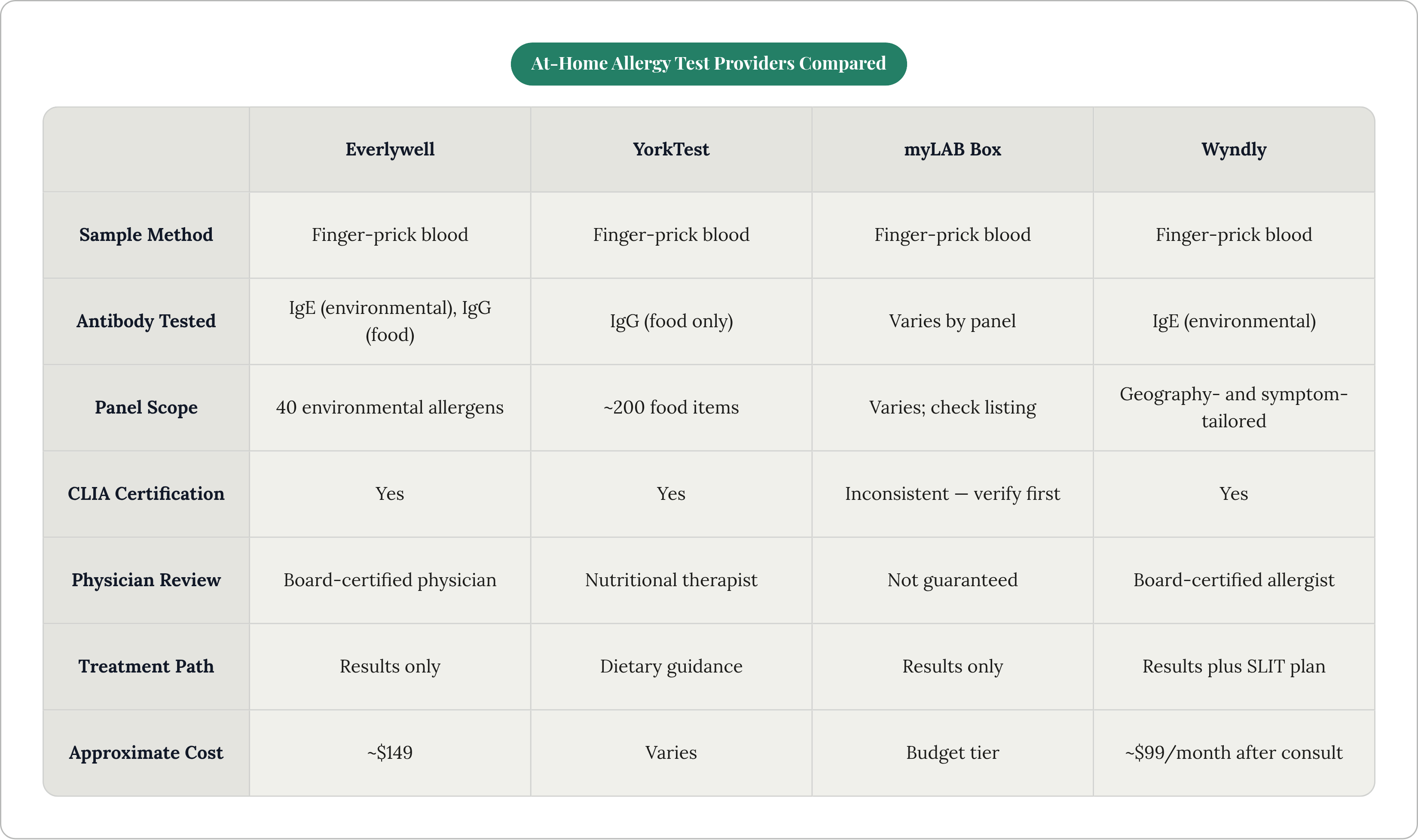
Everlywell's Indoor & Outdoor Allergy Test covers 40 common environmental allergens: tree, grass, and weed pollen, mold, dust mites, pet dander. Finger-prick collection, CLIA-certified lab, every result reviewed by a board-certified physician. Turnaround usually runs 3 to 5 days, list price sits around $149 though discounts show up often. It's not sold in every state (New York's a notable gap), and it won't diagnose food allergies. Across independent reviews, it's one of the more consistently trusted names for environmental IgE screening, largely on the strength of lab quality and physician oversight.
Everlywell also runs a Food Sensitivity Test covering 96 foods, and this one's IgG-based, so the earlier caveat applies directly. Still finger-prick, still CLIA-certified, still physician-reviewed, and FSA and HSA eligible, adults 18 and up only. Personally, I'd treat this one less as a diagnosis and more as something to bring up with a nutritionist.
YorkTest's Premium Food Sensitivity Test goes bigger on food, around 200 items through a finger-prick sample, and the company reports greater than 98% reproducibility across more than 500,000 tests run. Results land online within 7 days. A nutritional therapist reviews your results here, not a physician, and that distinction matters if you're after medical-grade interpretation rather than dietary coaching. Same IgG limitation applies.
myLAB Box is the budget option, and it reads like one. Turnaround varies by account of independent reviewers. CLIA certification shows up on some panels but not consistently across the line, so check before you buy. Physician review isn't guaranteed either; confirm on the current product page rather than assuming it's included. It's a fine choice if you're cost-constrained and you go in knowing you might be trading some clinical rigor for the lower price.
Why physician review is the criterion that separates a useful result from raw, uninterpretable data
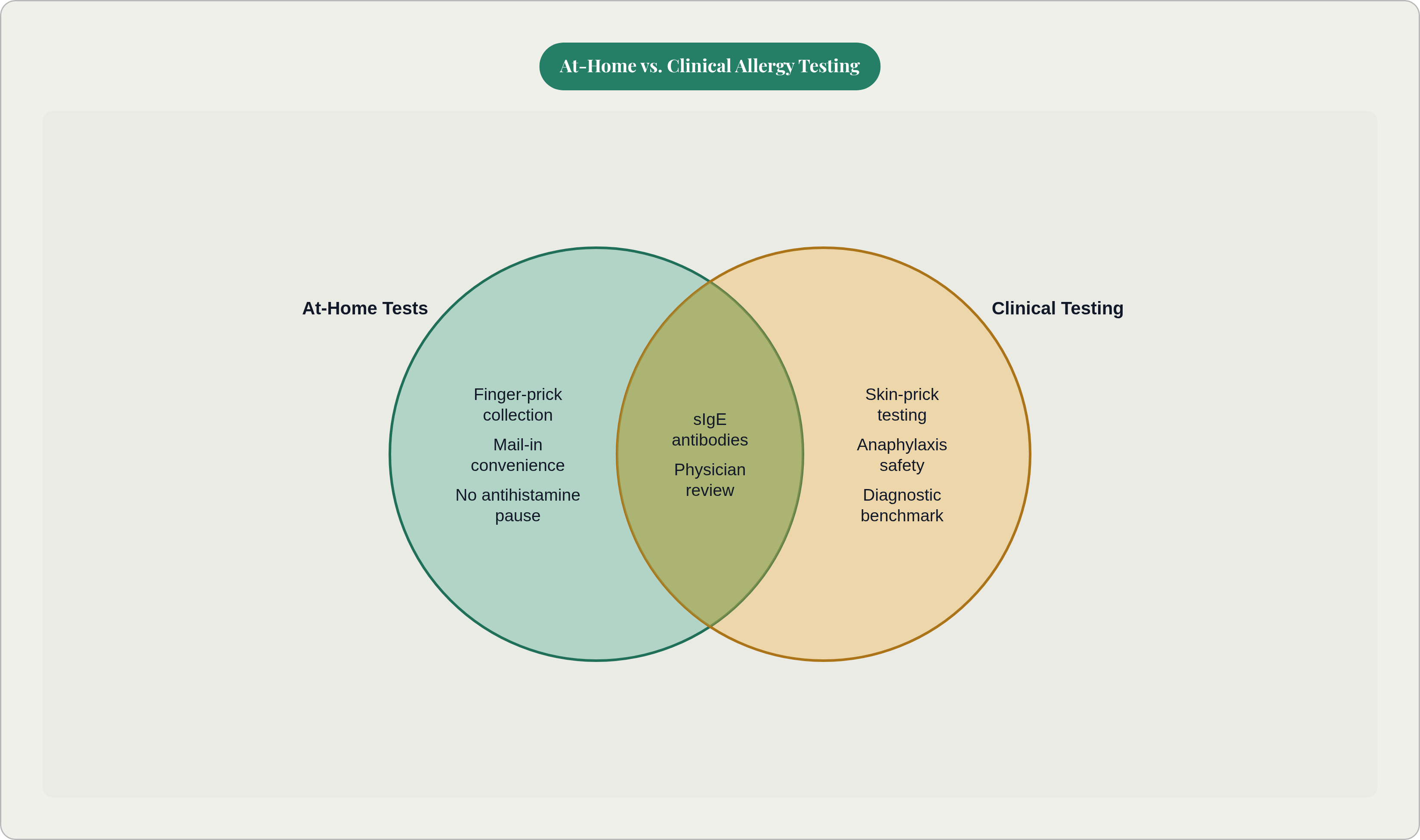
A positive sIgE result means your immune system made antibodies against something. It doesn't mean you have a clinical allergy that needs treatment. Sensitization without symptoms usually needs no intervention at all, and that's a distinction almost no raw data sheet bothers explaining.
In-office allergy testing runs at roughly 90% accuracy for common environmental allergens. That's the benchmark at-home kits should get measured against: a strong screening tool that points toward clinical follow-up, useful mainly as a step before diagnosis rather than a diagnosis in itself.
Say your results show moderate dust mite reactivity and high grass pollen reactivity. Which one's actually behind your symptoms? Does either even need treatment, and what would that treatment look like? A ranked list can't answer any of it. A physician can weigh those numbers against your real symptom history, catch the false positives, and tell you whether you need avoidance measures, more testing, or immunotherapy.
There's a real gap between physician review as a rubber stamp on a PDF and physician review where someone actually reads your case and hands you a next step. Some services push furthest on this front by producing an actual treatment plan on top of interpreting the test, so testing and clinical response happen as one process instead of two separate errands you have to chain together yourself.
Some newer kits are adding mobile dashboards to track symptoms over time, which helps as a bridge between self-testing and real care. Someone still has to be reading the results on the other end, though, or the dashboard is just a nicer-looking spreadsheet.
The accuracy ceiling of at-home testing and the symptoms that mean a kit isn't enough
At-home results are a starting point. In-office skin-prick testing with a board-certified allergist remains the diagnostic benchmark, especially for anything complicated or severe. And how a dried blood spot gets collected, stored, and shipped can introduce variability that a clinical blood draw doesn't have to deal with.
So when does a kit make sense as a first move? Persistent but mild-to-moderate symptoms, congestion, sneezing, itchy eyes, with no obvious trigger, fit well here. So does anyone who's never been tested and wants a baseline before booking a specialist. And if you're on antihistamines you can't realistically pause for a skin-prick test, blood-based sIgE testing sidesteps that problem entirely.
There are situations where a kit alone won't cut it, though. Anyone with a history of anaphylaxis needs in-office evaluation where epinephrine's on hand rather than a mail-in test sitting in a mailbox for two days. Complex, multi-allergen presentations often need a physician's judgment to sort out which trigger's doing what, since a ranked list can't do that work on its own. Kids with asthma as a comorbidity need clinical oversight as the primary path rather than a self-administered kit.
What gets missed most, though, has nothing to do with the test itself. A lot of people dealing with fatigue, brain fog, bad sleep, and chronic congestion never connect any of it to allergies. They chalk it up to stress, to getting older, to just having an off year. An at-home kit can be the moment someone realizes the root cause might be immune-related. But recognizing that doesn't fix anything on its own; if the test doesn't lead somewhere, you're right back where you started, just holding more data with no plan attached to it.
What to do once you have results: the path from reactivity data to lasting relief
A test result isn't a finish line. It's the input a physician needs to figure out what actually happens next.
For mild sensitization with rare symptoms, avoidance and some targeted environmental changes might be enough, and a physician can help calibrate what that looks like for your specific case. For moderate-to-high reactivity with symptoms that won't let up, antihistamines and nasal sprays only mask the reaction. They don't touch the underlying immune sensitivity, so the same triggers keep producing the same misery, season after season.
Sublingual immunotherapy, delivered as drops or FDA-approved tablets, is one of the few interventions with real evidence behind it for actually changing the immune response over time instead of just suppressing symptoms. It works by gradually desensitizing your immune system to the specific allergens your test flagged.
The sequence, practically speaking, goes like this: results identify which allergens are driving your reactivity, a physician reviews those results against your real symptom history, and a treatment plan gets built around your confirmed triggers rather than pulled off a shelf. Treatment then happens at home, daily, without weekly clinic visits.
Panel breadth, sample method, and physician review matter for exactly this reason. They decide whether your mid-range test ends with a folder of numbers you don't know what to do with, or a conversation with someone who actually tells you what those numbers mean and what to do next.