Skin Prick Test Procedure and What to Expect
Stop taking antihistamines before your appointment to get accurate results.

The single most important thing you can do before a skin prick test is stop taking antihistamines. This sounds obvious, but you would be surprised how many people show up having taken a Zyrtec that morning because they were symptomatic and figured they should at least feel comfortable for the appointment. That reasoning is understandable. It also guarantees bad data. The medication works by suppressing the exact immune response the test is designed to observe, so real allergies register as nothing, not because they are absent but because the drug already handled them.
Taking Zyrtec the morning of a skin prick test is a problem: the medication suppresses the exact wheal-and-flare immune response the test is designed to observe, so real allergies register as nothing. Heartburn medications fall into the same category as certain antidepressants, both can suppress that response just as effectively as obvious allergy pills, so everything being taken should be disclosed to the ordering provider. Arm lotion is also an issue, because topical products create a physical barrier that interferes with both the lancet and the allergen droplet; forearms need to be clean and free of any product before the appointment. As for the visit itself, a full hour should be built into the day: the procedure is fast, but the mandatory fifteen-to-twenty-minute wait for reactions to develop is non-negotiable, followed by the provider reading and recording results before the skin calms.
How long you need to be off depends entirely on which drug you are taking. Older antihistamines clear quickly. Newer, longer-acting formulations linger in ways the packaging does not always make obvious. Ask the provider who ordered the test, because this is not the place to estimate. The concern also extends further than your obvious allergy pills: certain antidepressants and some heartburn medications can suppress the wheal-and-flare response just as effectively. Disclose everything you are taking, not only what you associate with allergies.
Skin preparation is simple but easy to overlook. Show up with clean forearms, free of lotion, oil, or any topical product, because these create a physical barrier that interferes with both the lancet and the allergen droplet. Wear short sleeves, or something that rolls up easily. No fasting required for environmental allergen panels.
One logistical reality worth building into your day: this is not a quick visit. Budget a full hour. The procedure itself is fast, but there is a mandatory fifteen-to-twenty-minute wait for reactions to develop, followed by the provider reading and recording results before the skin calms. Arriving rushed does not compress that window.
What happens during a skin prick test, step by step?
The sequence is predictable once you have seen it, and it is less dramatic than most people anticipate.
The forearm is cleaned first, then small ink marks are placed on the skin, one per allergen, to label each test site. This matters because a standard panel can cover dozens of substances simultaneously, and without the marks, distinguishing which reaction belongs to which allergen becomes difficult.
A droplet of each allergen extract is placed near the corresponding mark. Then a thin lancet pricks or lightly scratches the skin at each site, introducing a tiny amount of allergen just below the surface. The lancet does not go deep. Most patients describe a small pinch repeated across the forearm. Brief, unremarkable.
Two controls go alongside everything else: a histamine control that should produce a reaction, confirming the test is working, and a saline control that should produce nothing, confirming the positive results are real and not just skin artifacts. Without those anchors, a positive is difficult to trust.
After the pricks, you sit still for fifteen to twenty minutes. Moving the arm or rubbing the sites can migrate allergen and skew readings. Positive sites itch during this window, sometimes noticeably, in a way that resembles a mild insect bite you are not allowed to scratch. That itching is expected; it is, in a narrow sense, the whole point. The provider reads results before the reactions subside, measuring wheals and comparing them to the controls. Everything typically resolves within an hour or two on its own.
The immunology behind the wheal: why the skin reacts the way it does
Understanding what the test is actually measuring changes how you read the results afterward.
Allergy sensitization begins the first time the immune system encounters a substance it misidentifies as a threat. That initial exposure prompts the production of IgE antibodies, which bind to mast cells residing in the skin's connective tissue. The mast cells are now primed. When the skin prick test re-introduces that allergen, the IgE molecules on those mast cells recognize it and trigger rapid degranulation: the mast cells rupture and release histamine and other inflammatory mediators into the surrounding tissue.
The result is the wheal-and-flare. A raised, pale, intensely itchy bump encircled by a spreading red halo. This is the same fundamental mechanism behind sneezing, nasal congestion, and itchy eyes in daily life; the skin prick test recreates it on a contained, observable scale.
Per the Australasian Society of Clinical Immunology and Allergy's 2025 skin prick testing guide, this reaction reflects specific IgE interacting with protein and peptide antigens on cutaneous mast cells. The wheal peaks around fifteen to twenty minutes post-application, which is precisely why the reading happens then. Wait longer and the skin begins to recover, producing inaccurate measurements.
Here is something that takes a moment to sit with: wheal size correlates roughly with the degree of sensitization, meaning a larger wheal suggests a stronger immune response to that substance. But sensitization exists on a continuum, not as a binary switch, and a larger wheal does not automatically translate to more severe real-world symptoms. That distinction (the gap between immune reactivity and lived experience) is where the clinical interpretation becomes complicated.
How to read what the results actually mean (and what they don't)
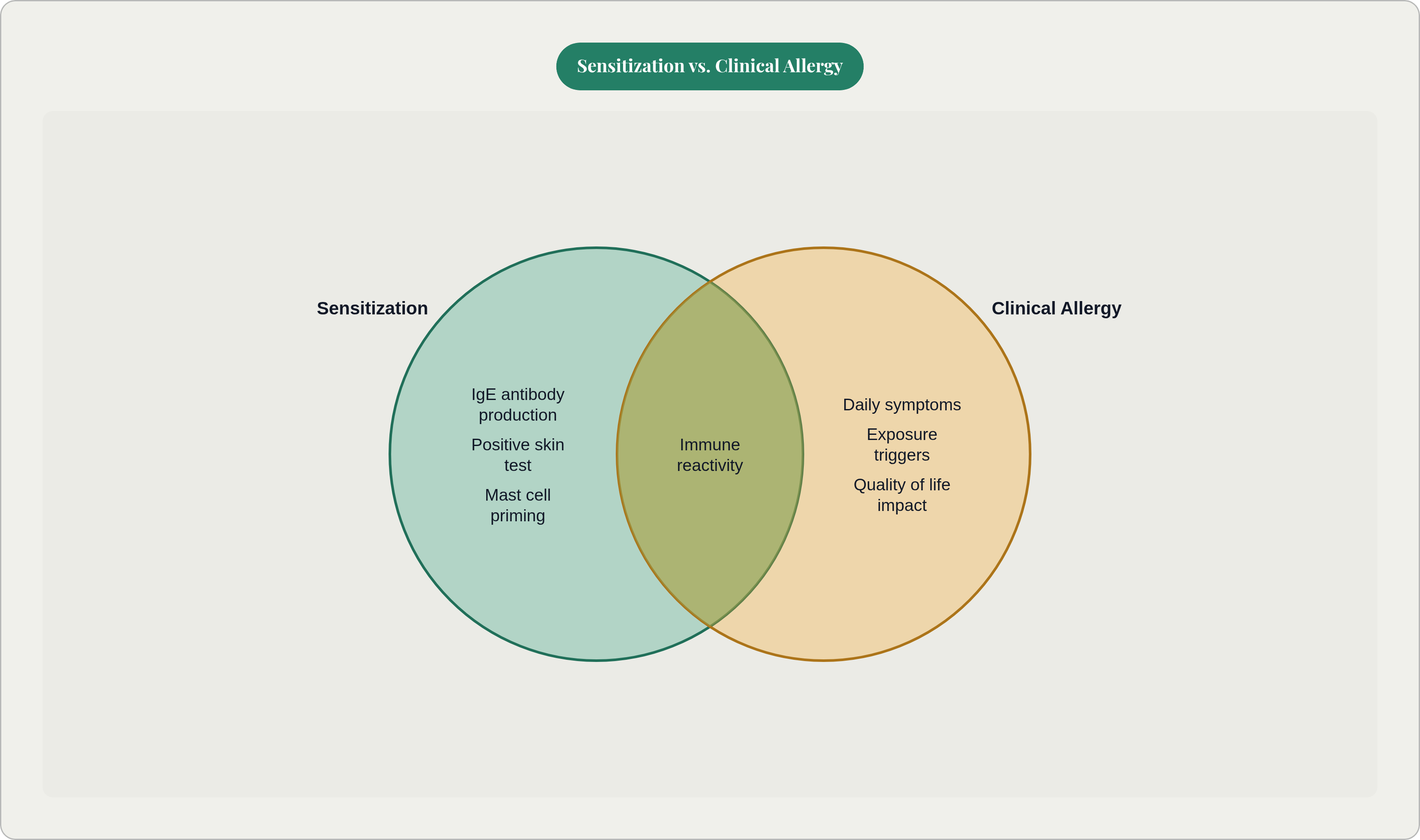
A positive result is a raised, red wheal at a test site. A larger wheal generally reflects greater sensitization. A negative result usually means no allergy to that substance, though a rare false negative is possible. That much is straightforward.
The caveat that changes everything: sensitization is not the same as clinical allergy. A patient can test clearly positive for cat dander and live comfortably with three cats, no symptoms whatsoever. The test identifies immune sensitization; it does not confirm that sensitization is actually producing symptoms in that person's life. A positive for cat dander in someone who has never been near a cat tells a different clinical story than the same result in someone with chronic nasal congestion who has owned cats for a decade. The biology is identical. The meaning is not.
This is why results cannot be interpreted in isolation. The provider's job is to correlate findings with symptom history, exposure patterns, and what the patient actually experiences day to day. Treating every positive as a confirmed, symptomatic allergy leads to over-treatment, unnecessary restriction, and patients avoiding things that were never actually making them sick. Per the Cleveland Clinic, a qualified allergist reviewing medical history alongside the test data is what converts raw results into something actionable.
When skin prick testing does not resolve the question, a more sensitive intradermal test will follow. For patients who cannot stop antihistamines before testing, or who have skin conditions that make surface testing impractical, specific IgE blood testing (sometimes called RAST testing) is an alternative that does not require the skin to react at all. That option matters practically: an inability to do a skin prick test does not stall the diagnostic process.
Which allergens are commonly tested and what a standard panel looks like
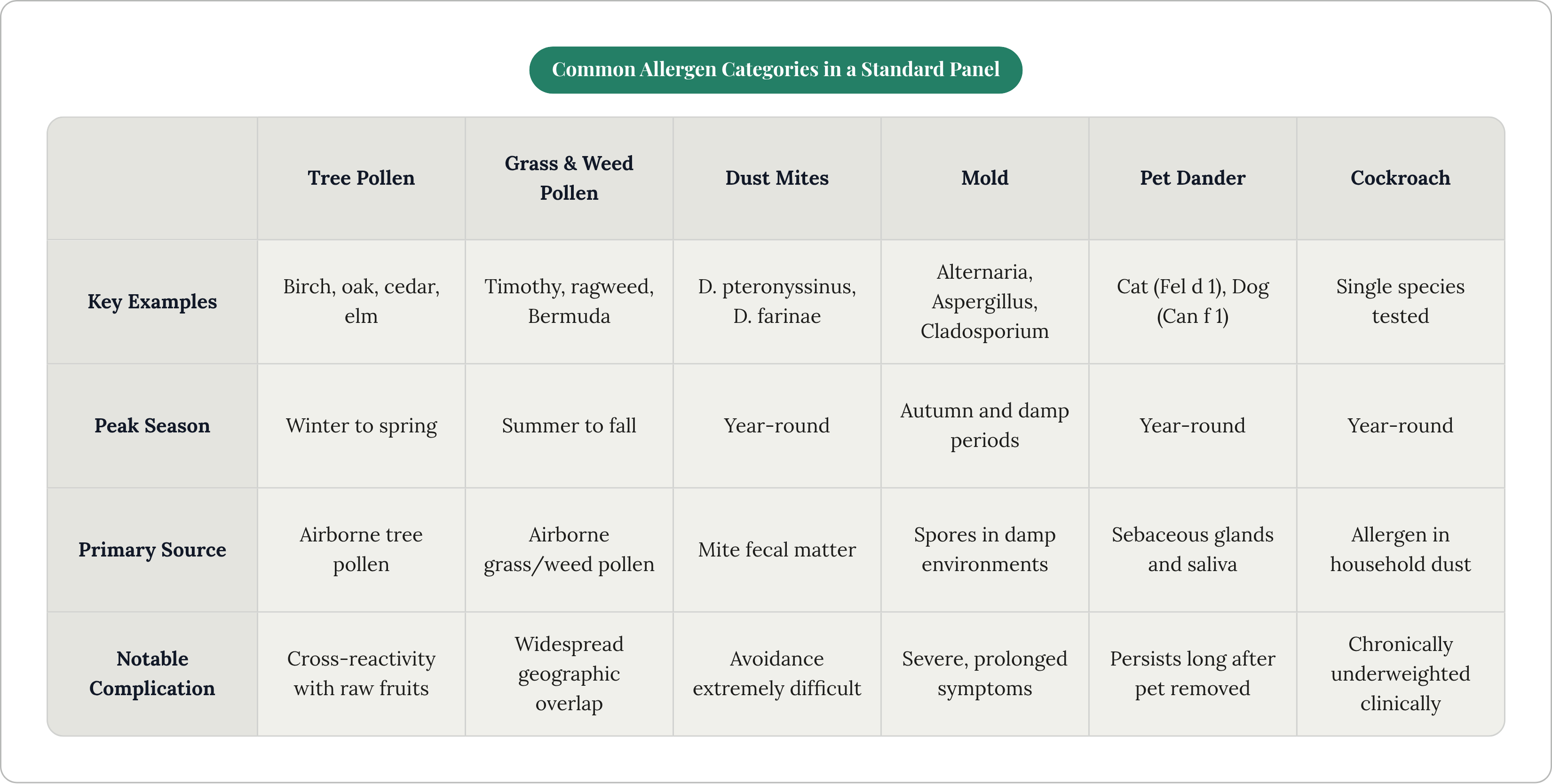
A standard environmental panel is organized around exposure patterns: what you breathe, where you live, what shares your space.
Pollens
Tree pollens are the dominant spring trigger. Birch, oak, maple, ash, elm, and cedar or juniper are typical inclusions. Cedar deserves specific mention because it is a major winter and early-spring trigger across Texas and the Southwest, which consistently surprises patients who assume allergy season follows a neat spring-to-fall arc. Cross-reactivity between tree species is also clinically significant: patients sensitized to birch frequently react to hazel and alder, and often experience symptoms eating certain raw fruits, driven by shared protein structures the immune system cannot distinguish between.
Grass pollens dominate summer. Timothy, Kentucky Bluegrass, Bermuda, Orchard, and Rye are common inclusions. Weed pollens, ragweed chief among them, drive late summer and fall.
Dust mites
Dust mite sensitization is the most prevalent finding across large laboratory datasets. Dermatophagoides pteronyssinus and D. farinae are the two principal species tested. The allergen itself comes from mite fecal matter, not the mites, and it lives year-round in bedding, upholstered furniture, and carpets. This is why dust mite allergies produce perennial rather than seasonal symptoms, and why meaningful avoidance is so difficult to achieve.
Mold
Common panel genera include Alternaria, Aspergillus, Cladosporium, and Penicillium. Mold sensitization appears less frequently than dust mite sensitization across patient populations, but mold-allergic individuals often experience more severe, prolonged symptoms. Exposure peaks in damp environments and during leaf decomposition in autumn.
Pet dander
Cat allergen is Fel d 1, produced in sebaceous glands and saliva, not fur. This is why so-called hypoallergenic cats still trigger reactions; the fur was never the problem. Dog allergen, Can f 1, is airborne and can persist in a home long after the animal has been removed, which matters when patients move into previously pet-occupied spaces and develop symptoms they cannot account for.
Cockroach
Around 68% of U.S. households contain cockroach allergen, per NIH data. This is a high-prevalence trigger that gets systematically underweighted in allergy workups, particularly in urban settings. Cockroach sensitization is a documented driver of pediatric asthma and deserves considerably more clinical attention than it typically receives.
Food allergens
Food panels use the same SPT method, but clinical interpretation is held to a stricter standard given higher false-positive rates. A positive result for a food must be correlated carefully with symptom history before any dietary restriction is recommended.
Safety during the test and what mild reactions to expect afterward
The physical experience is mild. The prick is brief and shallow. Positive sites itch during the wait and resolve on their own within one to two hours. Providers often apply a topical corticosteroid or antihistamine cream after reading results to ease discomfort. That is comfort care, not a response to anything alarming.
Anaphylaxis is very rare with skin prick testing. The amounts of allergen introduced are tiny, and the test is performed in a clinical setting precisely because staff are present to monitor and respond if needed. Patients with a history of severe anaphylaxis or poorly controlled asthma warrant additional precautions or physician review before proceeding.
For patients with eczema, psoriasis, or other skin conditions affecting the forearm, the upper back is often used as an alternative site.
The physical discomfort is the least of it. The harder part for most people is sitting still for fifteen to twenty minutes without scratching.
What happens after the results: the path from diagnosis to treatment
The provider reviews positive results against your symptom history and actual exposure patterns before recommending anything. Raw sensitization data without that context is, at best, a starting point, and a potentially misleading one.
Three directions typically follow.
Avoidance
Reducing exposure to confirmed triggers is sensible and often recommended as a first step, but it is incomplete as a standalone strategy, particularly for perennial allergens. You can encase your mattress, run an air purifier, vacuum meticulously, and still encounter meaningful quantities of dust mite allergen every day. Avoidance buys reduction, not elimination, and for most patients it is not a sustainable long-term answer on its own.
Symptom-management medications
Antihistamines and nasal corticosteroids address symptoms effectively. They do not address the underlying immune sensitization. AAFA estimates the annual economic burden of allergies at roughly $25 billion, driven substantially by ongoing medication costs and recurring healthcare visits. Managing symptoms indefinitely has a real cumulative cost (financial and otherwise), and that is worth naming plainly rather than glossing over.
Immunotherapy
This is the only treatment category that operates at the immune level, gradually reducing sensitization rather than suppressing its downstream effects.
Allergy shots, subcutaneous immunotherapy, are effective and well-documented. They require weekly in-office injections during a build-up phase, followed by monthly maintenance visits for several years. For many working adults, that logistical commitment is the friction point that prevents follow-through, not skepticism about efficacy but the practical reality of that schedule.
Sublingual immunotherapy, delivered as drops or FDA-approved tablets placed under the tongue, operates through the same desensitization mechanism but can be administered at home on a daily schedule. For patients who prefer to start the diagnostic process without an in-office test, at-home allergy testing measuring specific IgE levels is an alternative entry point that feeds into the same treatment pathway.
The skin prick test result is the input. Immunotherapy is what the result makes possible. Without a specific sensitization profile, a treatment plan cannot be meaningfully personalized; it is an educated guess dressed up in clinical language. Getting the test done is not the finish line. It is the first rigorous step toward a treatment that addresses the root cause, rather than layering symptom management (indefinitely) on top of an immune problem that has never actually been resolved.