at-home allergy test kits that include physician review and treatment pathways
Physician review transforms allergy test results into actual treatment plans.

82 million Americans got a seasonal allergic rhinitis diagnosis in 2024, according to the Asthma and Allergy Foundation of America. A lot more people are sneezing through April and calling it a cold that won't quit, because nobody ever handed them a test that actually goes anywhere. That's the real split worth understanding here: not whether you get tested, but what happens the day after your results come back.
What separates a clinical-grade at-home allergy test from a consumer curiosity kit
I've watched two people order what they thought was the same product and end up with completely different experiences. "At-home allergy test" gets stamped on both boxes, and most buyers don't figure out which one they bought until the results land and just sit there.
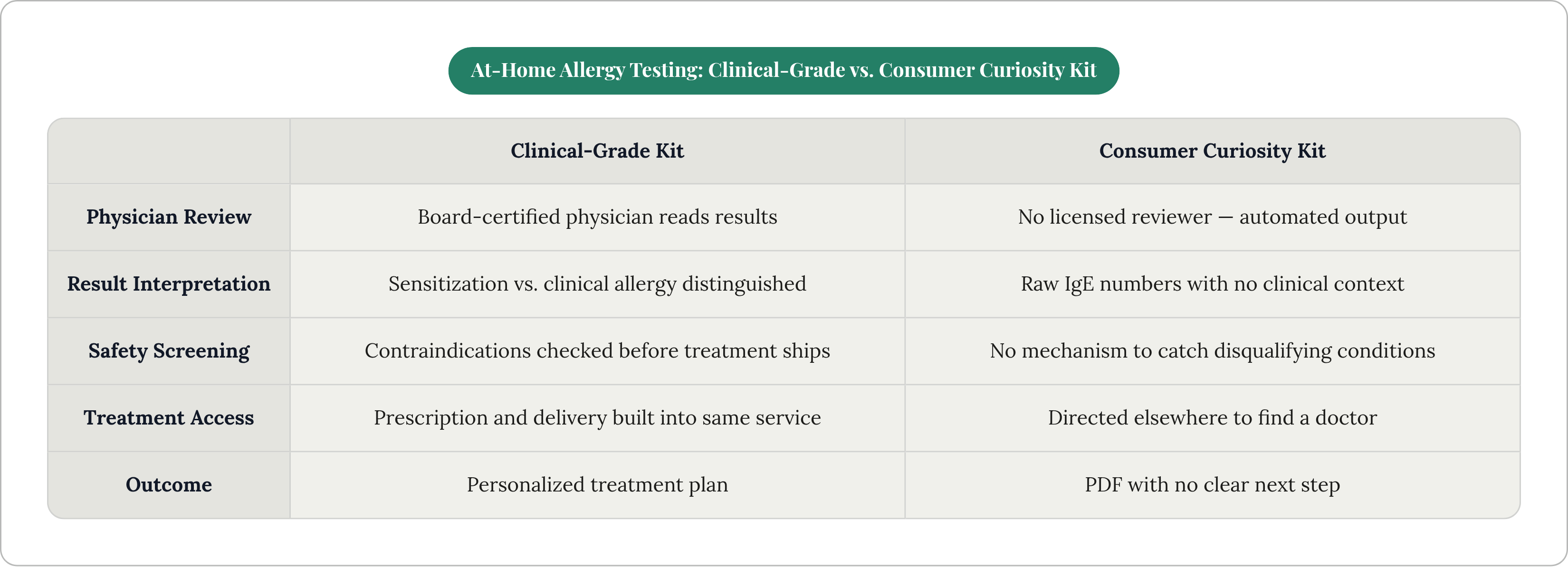
One version is a curiosity kit. Prick your finger, mail it off, wait a few days, and get back a report full of IgE numbers against a panel of allergens. Nobody licensed ever looks at it. Nobody connects your ragweed number to the fact that you can't sleep through September; you get a spreadsheet and, if you're lucky, a suggestion to go Google your own symptoms.
The other version starts the same way, finger prick, mail-in sample, but a board-certified physician actually reads the results against your history afterward. She's untangling two things people mix up constantly: sensitization, meaning your immune system made antibodies to something, and clinical allergy, meaning that something is actually making you miserable. Say your panel comes back positive for ragweed, tree pollen, and dust mites. Does that mean all three are wrecking your September? Probably not. You might be sensitized to five things and only two are doing real damage, and no spreadsheet on earth can tell you which two those are.
A physician can, because she's weighing lab numbers against when your symptoms flare, how bad they get, and whether asthma or eczema shows up in your history too. The clinical-grade version treats the test as a front door to treatment, not a dead end. Results feed straight into a recommendation, built as one connected process instead of two products bolted together after the fact.
How the at-home testing process actually works, step by step
I'll walk through what this looks like in practice, because the mechanics matter more than people assume.
It starts with a virtual consultation. You talk through symptoms, timing, severity, what you suspect, whether asthma or eczema is part of the picture, what you've already tried and given up on. This initial consultation runs a modest fee for a session with a board-certified physician, and the clinician uses it to pick the right allergen panel before a single lab number even comes back.
Next comes the blood draw, done at your kitchen table. A lancet, a small collection card, no needle, no waiting room chair. The panel usually covers tree pollens, grass, weeds, dust mites, mold, and pet dander. You mail the card to an accredited lab and wait a few days.
Then the physician reads the panel against everything you said in that first conversation. Which sensitizations line up with your actual symptoms, and which ones are just noise sitting on the page? What comes out the other end is a profile built from both pieces together, not lab work in isolation.
Last comes the treatment plan. Based on what turned up, the physician recommends a pathway and picks which allergens to target and which form of immunotherapy fits your case. If it's a match, personalized sublingual drops or an FDA-approved tablet get prescribed and shipped to you.
Compare that to the usual route into an in-office allergist: a months-long wait for an appointment, several clinic visits before treatment even starts, then a weekly injection schedule eating into your calendar for most of a year. The at-home version compresses most of that into a couple of weeks instead of a couple of seasons.
What the physician review step actually does — and why it can't be skipped
People treat this step like a rubber stamp, but it's actually where the whole thing either works or falls apart.
A raw IgE number doesn't mean much by itself; someone has to translate it. The same antibody level can mean something totally different in a patient with year-round congestion than in someone who just gets itchy eyes for two weeks every April. A physician lines up the sensitization pattern against symptom timing and severity, then sorts out which allergens are actually causing trouble and which are just riding along in the bloodwork. She's also positioned to catch things no panel flags on its own: food allergy overlap, a drug sensitivity, a structural nasal issue that has nothing to do with pollen at all.
This matters even more once immunotherapy enters the picture, because not everyone qualifies for sublingual immunotherapy. Uncontrolled or severe asthma rules it out, and so does a history of severe systemic reaction to SLIT, or a diagnosis of eosinophilic esophagitis. A consumer kit has no mechanism to catch any of that, since there's no one actually reading the chart. Physician review catches it before a treatment plan ships, not after something goes wrong.
The personalization runs deeper than most people expect walking in, too. Which allergens make it into the compound, how the starting dose gets calibrated against how severe the sensitization actually is, and whether an FDA-approved single-allergen tablet beats a custom multi-allergen drop for this particular patient are all judgment calls. Those decisions depend on someone weighing tradeoffs a spreadsheet simply can't sort through.
The relationship doesn't end once the prescription ships, either. Dose adjustments, symptom check-ins, safety monitoring: all of it runs across a treatment course that stretches years, not weeks. Review is the moment a diagnostic result turns into an actual medical decision, and everything after that depends on getting this part right.
The treatment pathways that open after a positive physician-reviewed result
Once someone's actually interpreted your result, two immunotherapy pathways tend to open up.
First, FDA-approved sublingual tablets: Odactra for dust mite, Grastek for Timothy grass, Oralair for a five-grass mix, Ragwitek for ragweed. Pre-measured doses, FDA-approved, and they work well if you're dealing with one dominant allergen and nothing else complicating the picture.
Second, custom sublingual drops, compounded to your specific profile. This is the option when you're sensitized to several things at once: pollen, dust mite, pet dander, mold, all mixed into a single daily dose. It's used off-label, but it's clinically well established, and it solves a problem tablets face structurally, since most people with environmental allergies aren't reacting to just one trigger.
What's actually happening under your tongue? Allergen proteins get picked up by dendritic cells, which carry them to your lymph nodes and present them to T-cells in a controlled way. Over time this nudges your immune system away from producing IgE, the antibody behind allergic reactions, and toward IgG4, which blocks the reaction instead. Regulatory T-cells get a boost too, all from one dose a day, at home, no clinic visit required once you're past the starting point.
So what does the evidence actually say? Published reviews put SLIT's symptom reduction somewhere between 30 and 60 percent for most patients, roughly on par with allergy shots, with fewer treatment-related side effects. A 2025 retrospective study on ScienceDirect followed 103 children with allergic rhinitis and atopic cough through three years of SLIT, and the gains held after treatment stopped. A control group of 48 kids on symptomatic drug therapy alone never got close to that durability. SLIT seems to actually retrain the immune system over time, something drug therapy alone hasn't managed to show.
Timeline-wise, plenty of people notice something in four to eight weeks, and most see real change somewhere between one and six months. Full, durable tolerance, the kind that outlasts the treatment itself, takes a three-to-five-year course. This isn't a quick fix, and nobody honest will tell you otherwise.
The multi-allergen piece matters specifically because at-home tests routinely turn up sensitivity to several things at once. Drops handle all of it in one daily dose instead of stacking three separate tablet prescriptions on top of each other. This model runs on personalized drops or FDA-approved tablets, prescribed by a board-certified physician, shipped to your door, plans starting at an accessible monthly rate, FSA and HSA eligible.
If your results don't support immunotherapy at all, a real physician review tells you that too, and points you somewhere else instead of leaving you holding a PDF you don't know what to do with.
How this compares to starting treatment through in-office allergy shots
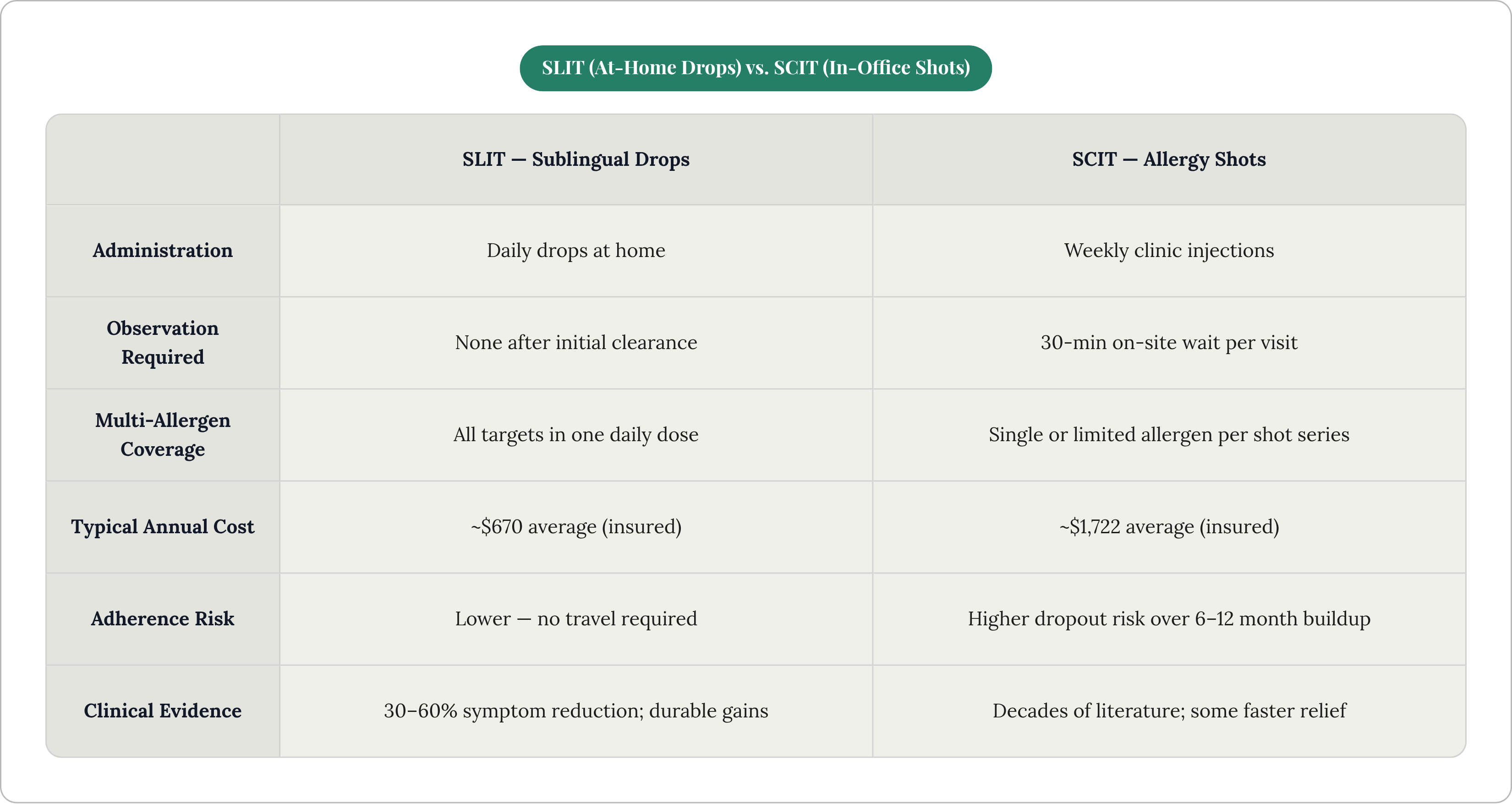
So how does this stack up against the old standby, allergy shots in a clinic?
In-office shots, SCIT, start the same way: skin testing or a blood draw builds the allergen panel. Then comes the buildup phase, one to two injections a week for six to twelve months, each requiring a 30-minute observation window on-site because of the risk of a systemic reaction, anaphylaxis included. After that, maintenance shots once a month for three to five years.
Shots have real advantages, and they're worth naming plainly instead of glossing over. Decades of clinical literature back them, and some patients feel relief faster during the buildup phase. Insurance coverage tends to be more established too, running $5 to $25 a visit when you're covered.
The at-home test-to-SLIT route has its own edge, and it's a practical one: no driving to a clinic, no working around office hours, no sitting in an observation room for half an hour waiting to make sure you don't react. Everything happens at home once you've started, and adherence tends to run higher because of it, which tracks. A weekly clinic commitment stretched across six to twelve months is a real dropout risk for working adults, for parents, for anyone whose job puts them on a plane three weeks a month.
Cost is where the gap really opens up. One cost-effectiveness analysis found average insurance charges of $1,722.24 a year for SCIT against $669.50 for SLIT. Even granting SLIT slightly lower efficacy, which the literature doesn't strongly support anyway, it still wins on cost per successful outcome. Without insurance, shots run $1,000 to $4,000 a year, plus $20 to $100 per injection. That's a real wall for a lot of families, not a line item to shrug off.
There's also an access problem underneath all of it that neither treatment can dodge. The U.S. is facing a projected shortfall of nearly 500 allergists by 2025, which means plenty of patients can't get an allergist appointment in any reasonable window, no matter which treatment they'd actually prefer. For a lot of people, the at-home pathway isn't a convenience; it's the only way to start at all.
Both routes aim at the same target: immune tolerance instead of symptom masking. Which one fits depends on your schedule, your circumstances, and what your physician actually finds when she sits down and reads your results.
What to look for in a kit that actually leads to treatment, not just data
A few things separate kits that lead somewhere from kits that just look convincing on the box.
Physician review has to be real: a licensed, board-certified physician reading your results against your actual history, not a portal that spits out numbers and calls it a day. Look for an actual consultation built into the process, with a named clinician attached to your results.
Treatment needs to live inside the same service. A kit that hands you results and tells you to go find a doctor elsewhere leaves the hard part as your homework. A real pathway means the physician who interprets your results is the same one who prescribes and ships your treatment.
Multi-allergen capability matters more than people expect going in, since most people with environmental allergies react to more than one trigger. A service that only offers single-allergen FDA tablets might leave half your problem untouched, which is exactly what custom compounded drops exist to solve.
Ongoing oversight should be built in, not sold as an add-on later. Immunotherapy runs three to five years, and a provider that takes that seriously offers dose adjustments and check-ins along the way, not a prescription followed by silence.
Safety screening isn't optional, either. A legitimate physician-reviewed service checks for contraindications, severe asthma, prior EoE, past systemic reactions to SLIT, before anything ships to your door.
Pricing should be visible up front, no digging required. Hidden fees in testing, consultation, or compounding show up often enough across this industry that it's worth checking for clear monthly pricing and FSA/HSA eligibility before committing to anything. Some services list a $49 initial consult with plans starting at an accessible monthly rate, FSA/HSA eligible, which at least gives you a real number to measure other options against.
There are 82 million diagnosed allergy sufferers in this country, and a much bigger group who never got that far. A sharper lancet won't fix that on its own. Putting the test and the treatment behind the same door is what actually moves the needle, so the result leads somewhere real instead of sitting unread.