How Allergy Shot Dosing Schedules Work
Years of visits and mandatory waiting rooms make the schedule itself the real hurdle.

Allergy shots work by injecting the exact allergens a patient reacts to, in tiny amounts, over and over, until the immune system quits treating them like a threat. That's allergen immunotherapy, or SCIT, and it's the part of allergy treatment nobody walks you through before you commit: not the mechanism, but the calendar. I've sat through enough of these consults to know the drug isn't what scares people off, and the schedule is what does.
Here's the biology, stripped down. Repeated low-dose exposure gradually retrains the immune system, shifting it away from the overreaction that drives allergic symptoms and toward something closer to tolerance. That shift is what builds real, lasting change instead of a few good weeks. You can't rush an immune system out of a threat response it spent years building, and that's the whole reason the schedule runs long: two phases, several years, dozens of visits, all on a timeline set by biology instead of what's convenient to book.
Doctors reach for allergy shots when symptoms are moderate to severe and haven't responded to medication or avoidance, per nationalallergyandent.com. People call it the only allergy treatment that changes the disease itself instead of just covering up what it does to you. I think that claim earns its weight, and it's a big part of why patients push through a protocol that asks this much of them.
The buildup phase: escalating doses, frequent visits, and what the body is adjusting to
Buildup starts small: a weak extract, a small volume, and both climb with each visit. Patients typically come in one to three times a week during this stretch, and more frequent visits mean faster escalation. Under a conventional schedule, buildup runs about 3 to 6 months.
Dosing moves through a series of vials, usually 3 to 6 before someone reaches maintenance, and each vial takes roughly 6 injection visits to clear. Do the math: 6 visits a vial, times 3 to 6 vials. That's a real stack of clinic trips before the protocol even shifts into its second phase.
Every visit comes with a mandatory 30-minute wait afterward, since severe systemic reactions, when they happen, tend to show up in that window. The clinic checks the injection site and watches for symptoms before anyone leaves. That's a safety requirement, not a courtesy, and no version of this protocol skips it.
What shapes the exact timeline for any one patient? Which allergens are involved, whether there's a history of stronger reactions, whether asthma is in the picture, and how a given clinic runs its schedule all play a part, though the math lands in roughly the same neighborhood regardless. Add the 30-minute wait to travel time, and a single buildup visit eats a real chunk of somebody's day. There's no shortcut around it under the standard protocol.
Accelerated options: how cluster and rush protocols compress the buildup timeline
Some clinics offer a faster route through buildup, and two approaches show up most: cluster and rush.
Cluster immunotherapy compresses the buildup phase by grouping injections into fewer, denser visits, reaching the maintenance dose faster than the conventional schedule. Rush immunotherapy pushes further, compressing buildup even more aggressively so the maintenance phase is reached in a much shorter window.
Faster escalation means higher risk of a systemic reaction, so these protocols call for tighter monitoring, and not every clinic offers them. My honest read: they suit a specific kind of patient, someone who can clear out a few intensive days upfront but knows they'd struggle with years of weekly visits after. The front end compresses, while the back end doesn't move at all.
Clustering or rushing through buildup does nothing to the maintenance phase waiting on the other side; it runs exactly as long as it always did. Whatever flexibility exists lives at the start, and by the finish, it's gone.
The maintenance phase: what the schedule looks like for the next three to five years
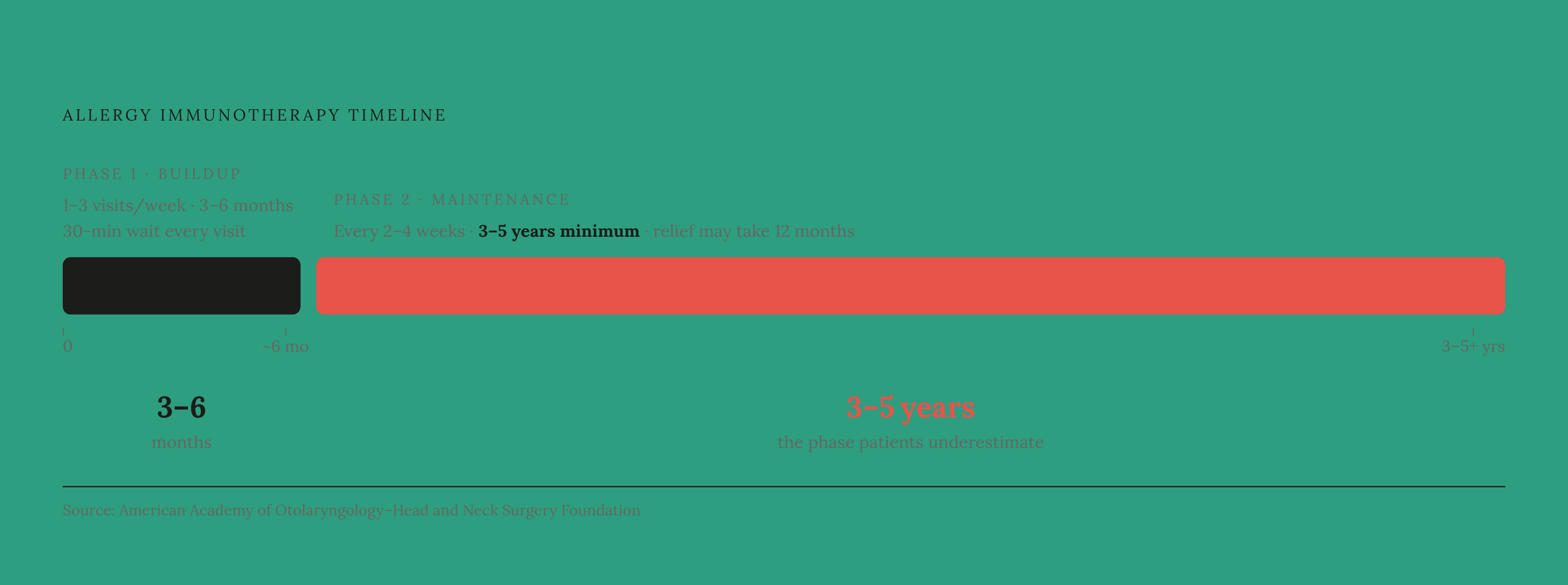
Once a patient hits the target maintenance dose, visit frequency drops to once every 2 to 4 weeks. This phase sticks around for a while though: about 3 to 5 years, and the American Academy of Otolaryngology-Head and Neck Surgery Foundation recommends a minimum of 3 years for patients responding to treatment.
Relief doesn't show up on day one of maintenance. Some patients notice improvement earlier, but meaningful relief can take several months after reaching the maintenance dose, and full benefit might not land until 12 months in. That means years of visits before the real payoff arrives, and I don't think that trade gets spelled out plainly enough before people sign the paperwork.
Missed doses carry consequences too. Let more than a month pass between injections, and the patient has to notify the clinic to confirm the appropriate dose amount before continuing. Consistency is what lets the immune system bank the tolerance the entire treatment depends on, and miss enough doses, and the consistency the whole protocol depends on is broken.
An injection every 2 to 4 weeks sounds manageable on paper. Stretch that across 3 to 5 years, though, and you're looking at dozens of visits, each one still carrying that same 30-minute wait. Life doesn't pause for any of it: a new job, a move across the country, a change in insurance, a bad flu season. Any one of those can break the consistency the whole protocol leans on.
Why the schedule itself, not the injections, is the real barrier to finishing treatment
Nobody's arguing with the mechanism, and the biology holds up fine. What's heavy is the practical weight of the calendar: multiple visits a week for 3 to 6 months during buildup, then monthly visits for 3 to 5 years during maintenance, with a mandatory 30-minute wait bolted onto every single one.
Add it up, travel and waiting room included, and the total time commitment over a full course is substantial. Patients who stop early, before crossing the tolerance threshold the whole treatment is built around, absorb all that inconvenience without collecting anything on the other side. That's the part that gets me: the dropout doesn't just waste time, it wastes the exact investment that was supposed to buy the payoff.
Who struggles most with a schedule like this? Often the people who need it most: working parents, folks in rural areas without a clinic nearby, anyone without a flexible job or a reliable car. The biology stays sound the whole way through, but what matters more, month after month, year after year, is what the calendar demands of someone's actual week.
So the real question isn't whether a patient wants to finish treatment. It's whether the schedule fits into a life that already has a job, kids, a commute, and a thousand other things pulling at it.
What sublingual immunotherapy does differently with the same underlying mechanism
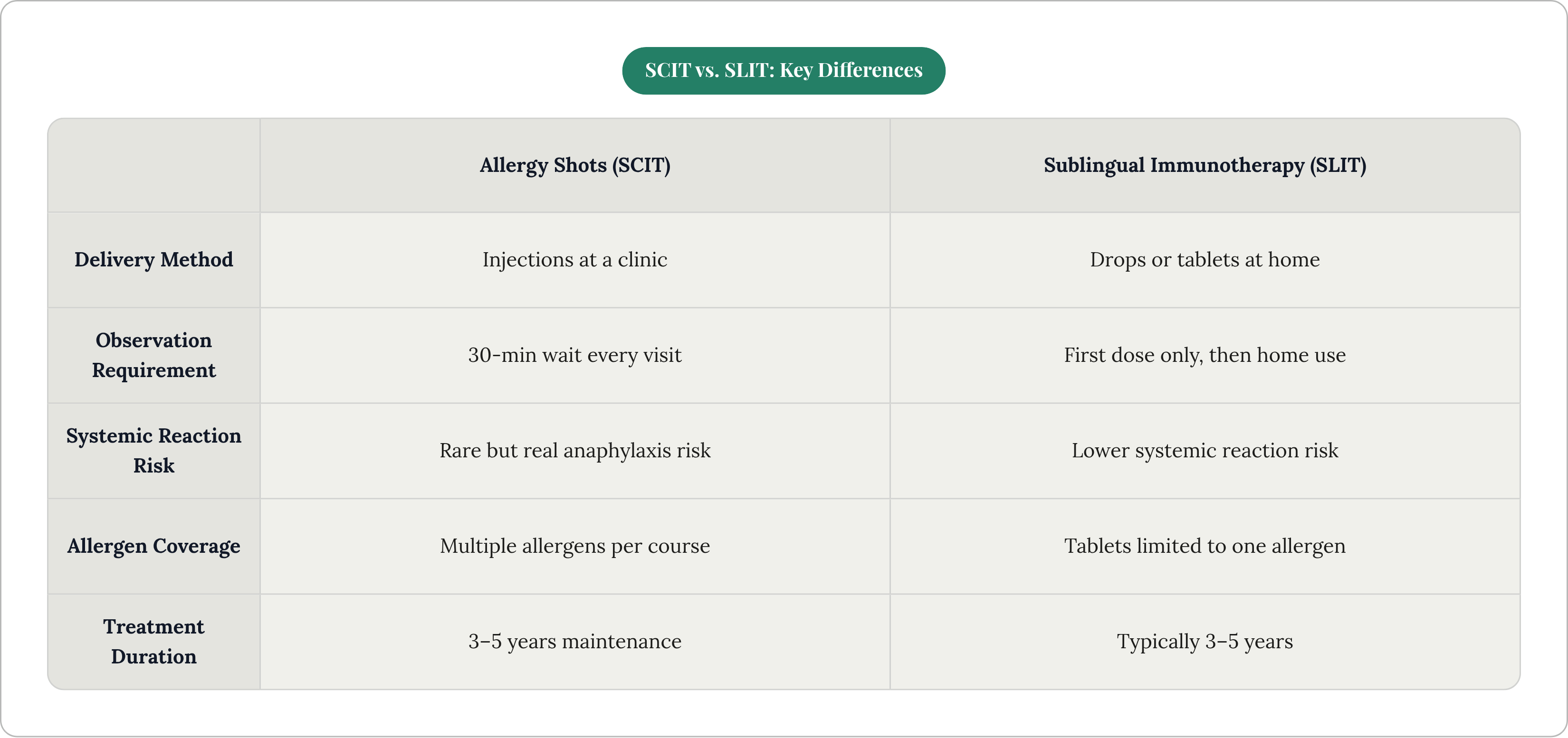
Sublingual immunotherapy, or SLIT, uses drops or tablets dissolved under the tongue, and it runs on the same immune mechanism as shots. The allergen absorbs through tissue in the mouth, where immune cells kick off the same underlying desensitization process. Treatment duration lands in a similar window too, typically 3 to 5 years.
What differs is everything wrapped around the biology. Injections, clinic visits, the mandatory 30-minute observation window are all gone. FDA-approved SLIT tablets require that first dose under medical watch, while the subsequent doses after that happen at home. Every dose after that happens at home, and a daily habit replaces the weekly or monthly drive across town.
The evidence backs it up. A meta-analysis covering 21 trials of sufficient quality found SLIT helped both symptoms and the need for rescue medication, according to the Journal of Allergy and Clinical Immunology. In the US, FDA-approved SLIT tablets cover grass, ragweed, and house dust mites, and they went through the full clinical trial process to earn that approval.
On safety: subcutaneous shots carry a rare but real risk of anaphylaxis, and that risk is part of what pushed researchers toward developing SLIT back in the 1990s. SLIT's risk of a systemic reaction runs lower.
Worth knowing: not all SLIT is built the same. Drops can treat several allergens at once, while tablets cover only one, and drops aren't FDA-approved in the US, so they get prescribed off-label, though plenty of doctors use them anyway. Tablets carry formal regulatory approval, just for a narrower slate of allergens.
How Wyndly's approach works for patients who can't fit allergy shots into their lives
Wyndly is a telehealth allergy care provider offering sublingual immunotherapy, both drops and FDA-approved tablets, as a home-based alternative to the in-office shot model. The process is built to strip out the exact friction that makes the shot schedule so hard to finish.
It starts with an at-home allergy test, no lab visit needed. A board-certified physician reviews the results in a virtual consult and builds a plan around the patient's specific allergens. Custom drops get formulated and shipped to the door, and treatment happens daily at home: a drop under the tongue standing in for the drive to the clinic.
The regimen stays personalized and doctor-guided, which is what the medicine calls for no matter how it's delivered. Pricing is upfront and FSA/HSA eligible, and stretched across a multi-year course, it holds up well against what in-office visits cost once you count the parking, the gas, and the afternoons off work.
Shots, SLIT, or some mix of the two: whichever a patient lands on, that choice holds up better once buildup and maintenance get laid out in real numbers instead of getting glossed over until after the paperwork's signed.