Hydroxyzine for Allergies: Uses, Dosing, and Side Effects
It calms itchy skin conditions but won't touch seasonal allergies.

Hydroxyzine treats itching from hives, eczema, and contact dermatitis. It won't touch the sneezing and congestion of seasonal allergies, and that's the first thing I tell people before we go any further. This drug blocks histamine, but it also crosses into the brain, which is why it makes people drowsy and why doctors reach for it for anxiety too. That dual identity is basically the whole story: a genuinely useful drug for the right problem, and a bad match for most of the roughly 81 million people in the U.S. diagnosed with seasonal allergic rhinitis in 2021, per the AAFA.
How hydroxyzine actually works in the body
Hydroxyzine does two jobs at once, and both explain most of what a patient feels within the first hour of taking it.
Out in the skin and tissues, it blocks H1 histamine receptors. That calms hives, cuts the itch, quiets the allergic skin response. But the molecule is small enough to cross the blood-brain barrier too, so it ends up blocking H1 receptors in the brain at the same time. Histamine up there keeps you alert; block it, and you get sedation, and at the right dose, real anxiety relief.
There's a third piece most people never hear about. Hydroxyzine has anticholinergic activity, meaning it dries up secretions, and sometimes that eases allergic symptoms too. It's also the direct reason behind dry mouth, thick mucus, and in some patients, trouble urinating.
It kicks in around 30 to 60 minutes after you take it, and the effect lasts roughly 4 to 6 hours. Short window. That's why it gets dosed several times a day instead of once, unlike newer antihistamines built for 24-hour coverage.
Here's the detail I wish more people knew going in: when the liver breaks hydroxyzine down, close to half the dose turns into cetirizine, the same compound in Zyrtec. So a chunk of hydroxyzine's antihistamine effect is technically cetirizine doing the work downstream. Anyone with a known allergic reaction to cetirizine or levocetirizine (Xyzal) shouldn't take hydroxyzine; they'd just be reintroducing the same molecule through a side door.
On the reassuring side, hydroxyzine doesn't build tolerance and doesn't cause physical dependence. People sometimes lump it in with benzodiazepines since both treat anxiety, but the two work differently at the pharmacological level. You won't need bigger doses over time to get the same effect, and stopping doesn't trigger withdrawal.
The dosing framework for allergic conditions in adults and children
Dosing comes down to matching the dose to how bad things are, then adjusting based on how the person actually responds.
For adults dealing with itching or allergic skin conditions, 25 mg, three or four times a day, is the standard starting point. Depending on severity and tolerance, doses can climb from 25 mg up to 100 mg per dose, three to four times daily, putting total daily intake anywhere from 75 mg to 400 mg. When it's used specifically for sedation, a single dose of 50 to 100 mg is typical.
Kids need a different approach. For children 6 and older, that's 50 to 100 mg total per day, split into divided doses. Under 6, it drops to 50 mg total per day, also divided.
Hydroxyzine comes in a few forms depending on what's needed. Hydroxyzine pamoate ships as 25 mg and 50 mg capsules, while hydroxyzine hydrochloride comes in 10 mg, 25 mg, and 50 mg tablets. There's also an oral syrup at 10 mg per 5 mL, which matters for young kids or anyone who struggles to swallow pills.
Since each dose only covers 4 to 6 hours, doses get spread across the day to keep coverage steady. A lot of prescribers load the evening dose heavier, so the sedation works with sleep instead of against a workday.
What tends to get skipped in these conversations: hydroxyzine isn't built for indefinite use. Its value as an anxiety treatment past four months hasn't been established in the data we have, and that same caution should stretch to long-running allergic conditions too. Six months into it for a chronic skin issue? Talk to your doctor. Don't treat it like an automatic refill.
Older adults need a gentler hand: start low, go slow, since aging bodies handle this drug differently. More on exactly why in the next section.
Common side effects that affect everyday functioning
Sedation isn't rare or unlucky here. It's the direct, predictable result of blocking histamine in the brain, and for anyone trying to get through a workday, it's often the whole problem.
The common list: drowsiness, fatigue, dizziness, coordination trouble, dry mouth, thick respiratory secretions, stomach upset. None of that should surprise you once you know the mechanism behind it.
But there's a catch that's easy to miss. Allergic inflammation on its own already messes with mental clarity and energy, since histamine acts as a neurotransmitter that helps regulate wakefulness and sleep. So someone walking in already foggy from disrupted sleep and immune signaling might take hydroxyzine expecting relief, and instead watch their daytime functioning get worse. The drug meant to fix the itch can deepen the exhaustion that came with it.
The anticholinergic side is its own cluster: dry mouth, thick mucus, sometimes constipation or trouble urinating. Older adults feel this harder, mostly because aging bodies clear the drug less efficiently to begin with.
Then there's the interaction risk. Hydroxyzine amplifies sedation from alcohol, benzodiazepines, opioids, and sleep aids, so stacking more than one of those is worth taking seriously.
One firm line applies here: hydroxyzine shouldn't be used in early pregnancy. Anyone who becomes pregnant while taking it should call their provider right away.
Serious but less common risks: cardiac, dermatologic, and injection-related
Most people on hydroxyzine will only ever deal with drowsiness and dry mouth. A smaller set of risks deserves real attention, mostly because they're rare enough to get missed.
QT prolongation is the big one: a change in the heart's electrical rhythm that, in rare cases, can trigger torsade de pointes, a potentially life-threatening arrhythmia. Risk climbs for older patients, anyone with a family history of QT abnormalities, people running low potassium or magnesium, and anyone already on another QT-prolonging drug. This matters more than it might seem, because plenty of chronic urticaria patients are managing other conditions with other medications at the same time. A full medication review before starting hydroxyzine isn't a formality; it's a necessity.
There's a strange irony in the skin risks too. Hydroxyzine gets prescribed for skin-based allergic conditions, yet in rare cases it can cause severe skin reactions of its own, including acute generalized exanthematous pustulosis and fixed drug eruptions. Watch for sudden redness, a spreading rash with white or yellow pustules, blistering, or peeling skin. Any of that means stopping the drug and calling a doctor right away, not waiting to see if it passes.
In clinical settings where hydroxyzine gets injected, there's a separate risk: severe tissue irritation at the injection site, and in rare cases, necrosis or gangrene. That's mostly a hospital or clinic concern rather than a home-dosing one. Still, it belongs in the full picture.
Older patients carry a compounded burden across all of this. Drowsiness raises fall risk, confusion sets in more easily, and age-related changes in liver, kidney, and heart function all affect how the drug gets processed and cleared. That's exactly why start-low-go-slow is the standard of care, not an extra caution someone tacked on for good measure.
Why hydroxyzine treats symptoms but leaves the underlying immune response untouched
Here's the limitation nobody sugarcoats once you push on it: hydroxyzine does nothing to change the immune system's tendency to overreact to allergens in the first place.
Walk through the actual sequence and it becomes obvious why. The immune system gets sensitized to an allergen through IgE antibodies. On exposure, mast cells release histamine and other inflammatory chemicals, and that release is what causes the itch, the hives, the swelling. Hydroxyzine blocks the histamine receptor, so the downstream signal gets muted. But the upstream sensitization, the part where the immune system decided this allergen was a threat, never gets touched. The next exposure brings the same cascade, right on schedule.
This isn't a hydroxyzine problem specifically. Every antihistamine, first-generation or second-generation, works this way. The limitation is baked into the entire drug class, not any one product.
That's exactly why chronic urticaria and atopic dermatitis, hydroxyzine's main indications, tend to be long, grinding conditions. People keep needing antihistamines because the immune dysfunction driving the reaction never resolves on its own. The medication manages the output. The source stays untouched.
Hydroxyzine isn't even indicated for seasonal allergic rhinitis, which affects roughly 26% of U.S. adults and 19% of children according to AAFA figures. That group is generally managed through second-generation antihistamines, intranasal steroids, and, more and more, immunotherapy.
So the trade-off compounds the longer it runs. Using hydroxyzine for a short, acute urticaria flare is reasonable and well-supported by the evidence. Using it indefinitely in a chronic allergy patient just piles up side effect exposure over months and years without moving the needle on the disease itself.
How immunotherapy addresses what antihistamines like hydroxyzine cannot
Antihistamines manage the output. What changes the input?
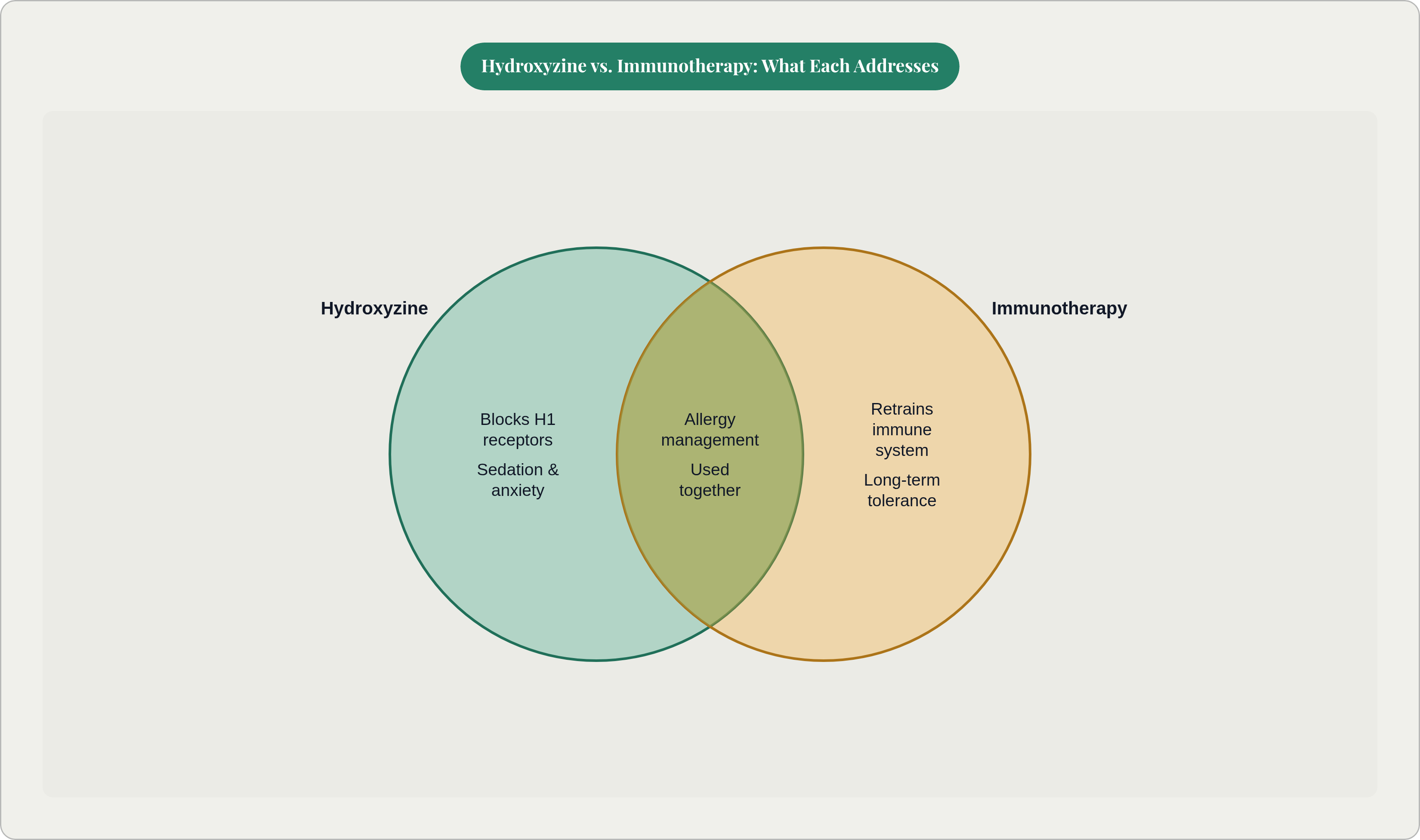
Immunotherapy introduces the immune system to gradually increasing doses of the specific allergen causing trouble, retraining the response over time instead of blocking the chemical signal after it's already fired. It comes in two main formats.
Subcutaneous immunotherapy, the classic allergy shot, gets injected in-office on a schedule running weekly to monthly. It works, and it's well-established, but it demands clinic access and real time out of your week. Sublingual immunotherapy, SLIT for short, uses drops or tablets under the tongue at home, working through a comparable immune-modifying mechanism, minus the needles and the office visits.
SLIT tablets carry FDA approval for specific allergens, while sublingual drops are prescribed off-label, though they're backed by a solid body of clinical evidence and used widely in practice.
The practical difference from hydroxyzine comes down to what each one is actually doing. A patient with dust mite-driven chronic urticaria taking hydroxyzine is managing flares as they show up. A patient on dust mite SLIT is working toward a point where dust mite exposure stops triggering anything at all. One dampens the alarm; the other turns down the sensitivity that sets it off in the first place.
None of this happens fast, either. Immunotherapy works over months, sometimes longer, which is why people dealing with acute or severe flares often still lean on hydroxyzine or other symptom relief while their tolerance builds in the background. Two tools, two timelines: one for right now, one for the pattern underneath it.
Who hydroxyzine is and isn't the right tool for
Who should actually reach for this drug?
Hydroxyzine makes sense for people with acute or chronic hives who need fast itch relief, for those with atopic or contact dermatitis where pruritus is the main complaint, and for short-term sedation layered onto allergy management, like recovering from a severe reaction. It's also a reasonable step-up for anyone who's tried over-the-counter second-generation antihistamines like cetirizine, loratadine, or fexofenadine without enough relief, and whose doctor wants to escalate care.
It's a poor fit for plenty of other situations, too. Hydroxyzine doesn't touch seasonal allergic rhinitis: sneezing, congestion, a runny nose. Older adults need careful dose management and fall-risk monitoring before starting it. Anyone already on QT-prolonging medications or carrying cardiac risk factors needs a cardiologist's input first. Pregnant patients, especially in the first trimester, should avoid it entirely. Combine it with CNS depressants, alcohol, or benzodiazepines, and you need explicit guidance from your provider on that interaction risk. Anyone with a known allergy to cetirizine or levocetirizine should skip it too, given the metabolic overlap covered earlier.
That raises a bigger question. If you've been taking any antihistamine, prescription or over-the-counter, for months or years and you're still dealing with chronic symptoms, the duration itself is telling you something: symptom management alone isn't solving the problem underneath it.
A finger-prick IgE panel can pin down which allergens are actually driving chronic skin or respiratory symptoms. Once you know the specific trigger, immunotherapy becomes a real option, one aimed at the sensitization itself, not another prescription for blocking the signal downstream. Services like Wyndly, a direct-to-consumer telehealth allergy clinic that mails personalized sublingual drops or tablets to patients after a virtual doctor visit, exist specifically to make that root-cause path more accessible without requiring weekly in-office appointments.