Safest Antihistamine for Long-Term Daily Use
Second- and third-generation antihistamines are safer for daily use than older options.

Not every antihistamine on the shelf carries the same long-term safety profile, and that gap affects which drugs are safe for daily use rather than which brand name is on the box. Second- and third-generation drugs have become the default for daily allergy control, while the older, first-generation options carry risks that make them a poor fit for anything beyond occasional, short-term use.
Why the generation of antihistamine matters more than the brand name
Most people standing in the allergy aisle grab whatever's cheapest or most familiar. The box rarely explains that the pill inside belongs to a specific "generation" of antihistamine, and that generation determines a lot more than how drowsy someone feels an hour later.
All antihistamines work the same basic way: they block histamine receptors, which calms sneezing, itching, and runny nose. That part hasn't changed since the older drugs were developed decades ago. What's changed is how the newer drugs are built to avoid crossing into the brain. First-generation antihistamines cross the blood-brain barrier easily. Second- and third-generation drugs were engineered specifically to limit that crossing, and that single design difference is what separates a drug that's fine for occasional nighttime use from one that's fine for daily, indefinite use.
Medical guidance as of 2026 has moved almost entirely away from first-generation drugs for anyone managing allergies on an ongoing basis. That's not a small shift. Allergic rhinitis affects more than 50 million Americans, according to the American College of Allergy, Asthma, and Immunology. At that scale, a generation-level safety difference isn't a footnote, it's a population-level question about what tens of millions of people are putting into their bodies every single day.
So what's actually at stake in picking the wrong one? It's not just an inconvenient afternoon of drowsiness. The next section gets into what prolonged use of first-generation drugs does to the brain and body, and the picture is more serious than most people assume.
What first-generation antihistamines do to the brain and body with prolonged use
Diphenhydramine and chlorpheniramine, the active ingredients behind familiar sleep-aid and allergy brands, cause real sedation because they cross into the brain rather than staying confined to nasal tissue. That's not a minor side effect tucked into the fine print. It's a central mechanism of how these drugs work, and it's the reason they knock people out.
These drugs are anticholinergic, which matters more for long-term use. They block a brain chemical involved in memory and cognitive function, not just the histamine receptors that cause sneezing and itching. Observational studies have linked long-term use of first-generation antihistamines like Benadryl to a higher risk of dementia and cognitive decline. The evidence isn't conclusive. But the signal has shown up consistently enough that medical consensus has shifted against chronic use of these drugs, which is a meaningful thing for a medical field to do based on data that's still short of a smoking gun.
Beyond memory, the anticholinergic effect brings dry mouth, constipation, and confusion, symptoms that hit older adults especially hard. Dr. Sandra Lin at Johns Hopkins University School of Medicine has noted that some people find first-generation antihistamines lose effectiveness within days of daily use. So the drug isn't just riskier long-term, it's also becoming less useful as the body adjusts to it. That's a strange combination: rising risk, falling reward.
One more practical note. First-generation antihistamines and alcohol don't mix safely, which becomes a real issue during allergy season when social plans and pollen counts often overlap. Taken together, none of this means first-generation drugs are useless. They still have a place for acute situations: an unexpected reaction, a rough night where sleep affects morning clear-headedness. But for anyone managing allergies as a daily, ongoing condition, they're the wrong tool for the job.
The second-generation options considered safe for daily use and their differences
Cetirizine, loratadine, and fexofenadine make up the second-generation tier, and none of them are linked to physical dependence or tolerance. That alone makes them appropriate for regular, daily use in a way first-generation drugs simply aren't. All three are available OTC and provide 24-hour coverage with once-daily dosing.
Timing affects how well the medication works.
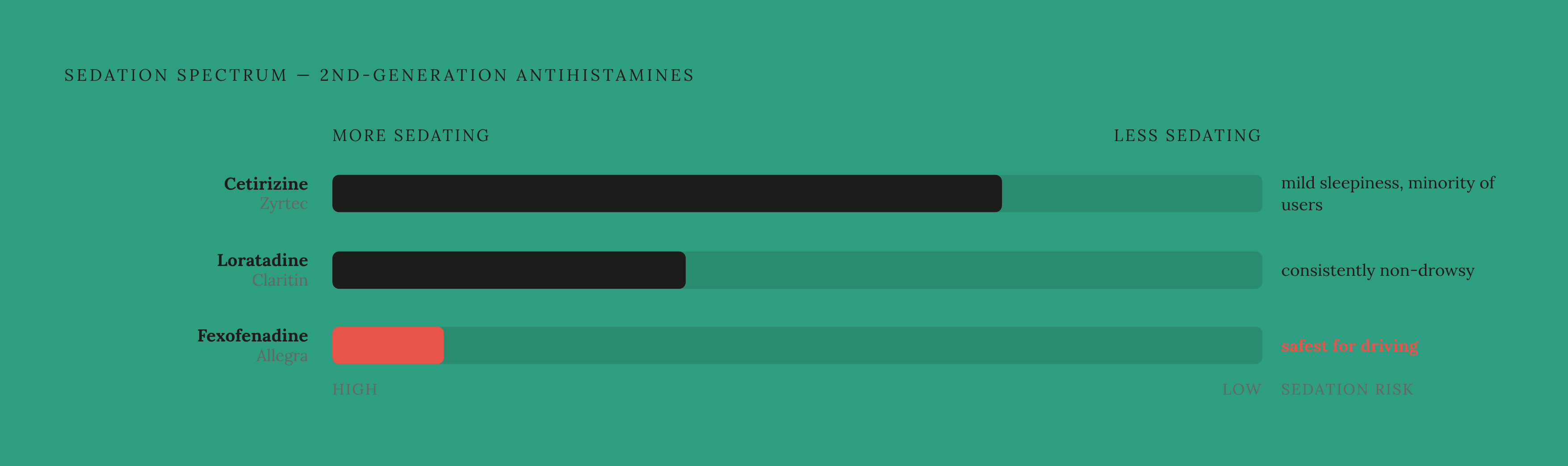
All three are available OTC and provide 24-hour coverage with once-daily dosing, though. A minority of users notice mild sleepiness with it, less than what first-generation drugs cause, but more than loratadine or fexofenadine produce. That's a meaningful data point for parents managing a child's allergies long-term, not just a seasonal inconvenience.
Loratadine, known as Claritin, sits at the other end of the sedation spectrum. It's consistently non-drowsy and safe for daytime use without meaningfully affecting alertness. It's also approved for children older than two and for older adults.
Fexofenadine, sold as Allegra, is the least sedating of the group and doesn't appear to affect thinking or movement. Research from 2019, cited by Optum Perks, suggests it may be safer than first-generation drugs and may carry less sedative effect than cetirizine specifically, though there's no evidence it's categorically safer than the other second-generation options as a class. It's a sensible choice for anyone who drives for a living, operates machinery, or just needs to stay sharp during the day. It's unlikely to impair driving or machine operation, though testing the first dose at home before relying on it is still a good idea, since individual reactions vary.
Then there's the third generation: levocetirizine (Xyzal) and desloratadine. These are refinements of the second-generation molecules, aiming for the same relief with an even lighter sedation footprint. Levocetirizine is often taken in the evening and delivers strength comparable to cetirizine. Desloratadine, sold as Clarinex, is a non-drowsy option that also provides 24-hour protection. Cetirizine (Zyrtec). A 2020 review recommends cetirizine for long-term therapy in children: taking it for at least 6 months correlated with reduced need for other medications in children with dust mite allergies, and treatment for at least 3 years correlated with a lower likelihood of developing new allergies Optum Perks.
Anyone who needs to stay alert during the day should look at fexofenadine first. Anyone dealing with broad, stubborn symptoms might lean toward cetirizine. And anyone wanting a steady daily baseline with minimal side effects has a solid option in loratadine. Oral antihistamines generally begin working within 30 minutes and reach maximum effect in about 2 hours Is it safe to take an antihistamine every day?. For seasonal allergy sufferers, starting 2–4 weeks before peak season allows drug levels to stabilize and provides more consistent protection.
A specific FDA warning about cetirizine and levocetirizine that long-term users need to know
Even within the safest tier of antihistamines, there's a specific discontinuation risk to know about before starting a long-term routine. On May 16, 2025, the FDA issued a Drug Safety Communication warning that stopping long-term use of cetirizine or levocetirizine can trigger pruritus, meaning severe itching. This isn't the original allergy symptom resurfacing. It's a distinct, withdrawal-like reaction tied to stopping the medication itself.
The FDA communication notes that these symptoms typically resolve once the medication is restarted, and that gradual weaning worked for some people instead of stopping cold. This is not an internet rumor or a scattered handful of complaints on a forum. It's a documented, FDA-level safety signal.
What does this actually mean for someone taking cetirizine daily for allergy season after allergy season? The drug remains safe for ongoing use. But stopping it after a long stretch is something to do gradually, ideally with guidance from a doctor or pharmacist, rather than quitting outright. Loratadine and fexofenadine don't carry this same warning, a practical detail for anyone who plans to start and stop medication seasonally rather than staying on it year-round.
Compare that to decongestant nasal sprays, where the line is far less negotiable. Those must not be used for more than seven consecutive days, full stop, because exceeding that window causes rebound congestion that can be worse than the original problem medino. The cetirizine caveat is a nuanced, manage-it-carefully situation. The decongestant spray rule is a hard stop.
When nasal corticosteroid sprays outperform antihistamines for daily allergy control
Intranasal corticosteroid sprays are considered the recommended first-line treatment for persistent allergies, and they're safe for extended daily use. For anyone whose main complaint is congestion, stuffiness, sinus pressure, or post-nasal drip rather than sneezing and itching, these sprays often do more than a pill ever will.
The mechanism explains why. The sprays reduce inflammation by blocking the release of the chemicals that cause allergy symptoms in the first place, and they work locally in the nasal tissue with very little of the drug reaching the rest of the body. Common OTC options include fluticasone propionate (Flonase), mometasone (Nasonex), budesonide (Rhinocort), and triamcinolone (Nasacort).
One catch: these sprays aren't instant. Improvement appears within a few days, but full effect can take up to two weeks, which means they need to be used consistently every day rather than reached for only when symptoms flare. Technique matters too. Aiming the spray slightly outward, away from the septum, improves how well it works, and rinsing with saline first helps when congestion is severe.
Side effects tend to be mild and local: dryness, burning, occasional nosebleed, an unpleasant taste, some sneezing. Nothing close to the systemic footprint of a first-generation antihistamine. Using the spray in the evening carries a specific advantage, since it cuts down on the nighttime congestion and post-nasal drip that disrupts sleep.
For allergies severe enough that one medication alone isn't cutting it, combining a second-generation oral antihistamine with a nasal corticosteroid spray often produces the best results. This option exists before assuming a stronger dose of the same pill is the only path forward.
Leukotriene modifiers like montelukast (Singulair) are one other daily preventer for completeness (prescription, once-daily, and particularly useful for patients who also have asthma).
How untreated or poorly managed allergies affect sleep, cognition, and daily functioning
Histamine doesn't just live in nasal tissue. It also acts as a neurotransmitter that helps regulate alertness and sleep cycles, so ongoing allergic inflammation doesn't just cause physical symptoms, it disrupts mental sharpness and energy at a chemical level.
The sleep disruption follows a fairly predictable chain. Nasal tissue swells more at night, which restricts airflow. Restricted airflow pushes people into mouth breathing, and mouth breathing fragments sleep. The Sleep Foundation reported in 2021 that people with untreated allergic rhinitis wake up more often overnight and get less deep sleep than people without it. Deep sleep is when the brain consolidates memory and recovers, so losing it isn't a minor inconvenience. It appears the next morning as grogginess and trouble concentrating that becomes chronic rather than occasional.
Mouth breathing brings its own complications too, including snoring and worsened breathing patterns overall. In people who already deal with sleep-disordered breathing, untreated nasal inflammation can make those existing problems noticeably worse.
Why does the brain take such a hit from something as seemingly minor as a stuffy nose? The brain uses roughly a fifth of the body's total oxygen supply despite being a small fraction of overall body weight, so even a modest dip in oxygen availability from nasal or sinus congestion can produce a noticeable cognitive effect. Layer that daytime histamine disruption on top of nighttime sleep loss, and the result is a form of cognitive impairment that doesn't resolve until both the daytime and nighttime symptoms get managed together.
This appears in places people don't always connect back to allergies. A child who seems inattentive or distracted in class might actually be running on poor sleep caused by nighttime congestion, a pattern that's likely underdiagnosed. The very medication someone reaches for to manage these symptoms can backfire if it's the wrong generation. A first-generation antihistamine taken to relieve daytime symptoms can itself impair focus, stacking its own sedative effect on top of the fatigue the allergies were already causing.
The ceiling of what daily antihistamines and nasal sprays can do for symptom management
Second-generation antihistamines and nasal corticosteroids are genuinely safe and genuinely effective. But they're actually doing something specific. They block or dampen the allergic response after it's triggered. They don't retrain the immune system to stop triggering that response in the first place.
That distinction has a real consequence: stop taking the medication, and the symptoms come back. For cetirizine specifically, stopping can also bring on that FDA-documented discontinuation itch discussed earlier. No generation of antihistamine, first, second, or third, has been shown to produce lasting immune tolerance. Relief lasts exactly as long as the dosing continues, and not a day longer.
For anyone with perennial allergies, dust mites, pet dander, mold, "daily" doesn't mean a few weeks during pollen season. It can mean indefinitely, year after year. That's precisely what makes generation-level safety such a serious question rather than a minor detail, and it's also what exposes the gap in what symptom management can offer. Even when everything is managed about as well as it can be, some residual burden remains: sleep that's good but not great, mild cognitive dips on the worst pollen days, and the ongoing cost and hassle of taking something every single day, potentially for years.
So the honest question for anyone who's been on a daily antihistamine for months or years is worth asking directly. Is this the ceiling of what's available? Or is there a path that addresses the immune response causing the symptoms in the first place, rather than just managing what it produces?
How sublingual immunotherapy works as a long-term alternative to daily medication
Immunotherapy takes a fundamentally different approach than any pill or spray discussed so far. Instead of blocking the allergic reaction after it starts, it works by repeatedly exposing the immune system to small, gradually increasing amounts of a specific allergen, over time building actual tolerance rather than just suppressing symptoms.
Sublingual immunotherapy, known as SLIT, delivers this through allergen extracts placed under the tongue, where immune tolerance gets initiated through a different immune pathway than an injection would use.
Why does the sublingual route matter compared to allergy shots? Subcutaneous immunotherapy, the traditional injection-based approach, carries a small but real risk of systemic reactions, including anaphylaxis. SLIT was developed in the 1990s specifically to address that risk while maintaining clinical effectiveness comparable to shots. That's a meaningful trade: a treatment path aimed at the root cause of the allergic response, with a safety profile built around avoiding the more serious risks that come with the injection-based version.
None of this replaces the value of a well-chosen daily antihistamine or nasal spray for someone who needs relief right now. But for anyone weighing whether daily medication is a permanent fixture of their life or a bridge to something more durable, sublingual immunotherapy stands apart as a genuinely different category. At the cellular level, sublingual immunotherapy induces IL-10–producing T regulatory cells, allergen-specific T-cell tolerance, and immune deviation. A meta-analysis of 21 double-.
Sources
- Safest antihistamines for long-term use | Optum Perks
- Is it safe to take an antihistamine every day?
- Can you take antihistamines long-term? | medino
- Antihistamines - StatPearls - NCBI Bookshelf - NIH
- Safety of second generation antihistamines - PubMed
- The effects of antihistamines on cognition and performance - Journal of Allergy and Clinical Immunology
- From cockpit to community: Time to stop the use of first-generation H1-antihistamines - World Allergy Organization Journal
- H1 Antihistamines: Current Status and Future Directions - PMC