When Allergy Season Ends by Region and Allergen
Tree pollen peaks in spring, ragweed in fall, but your region determines everything.
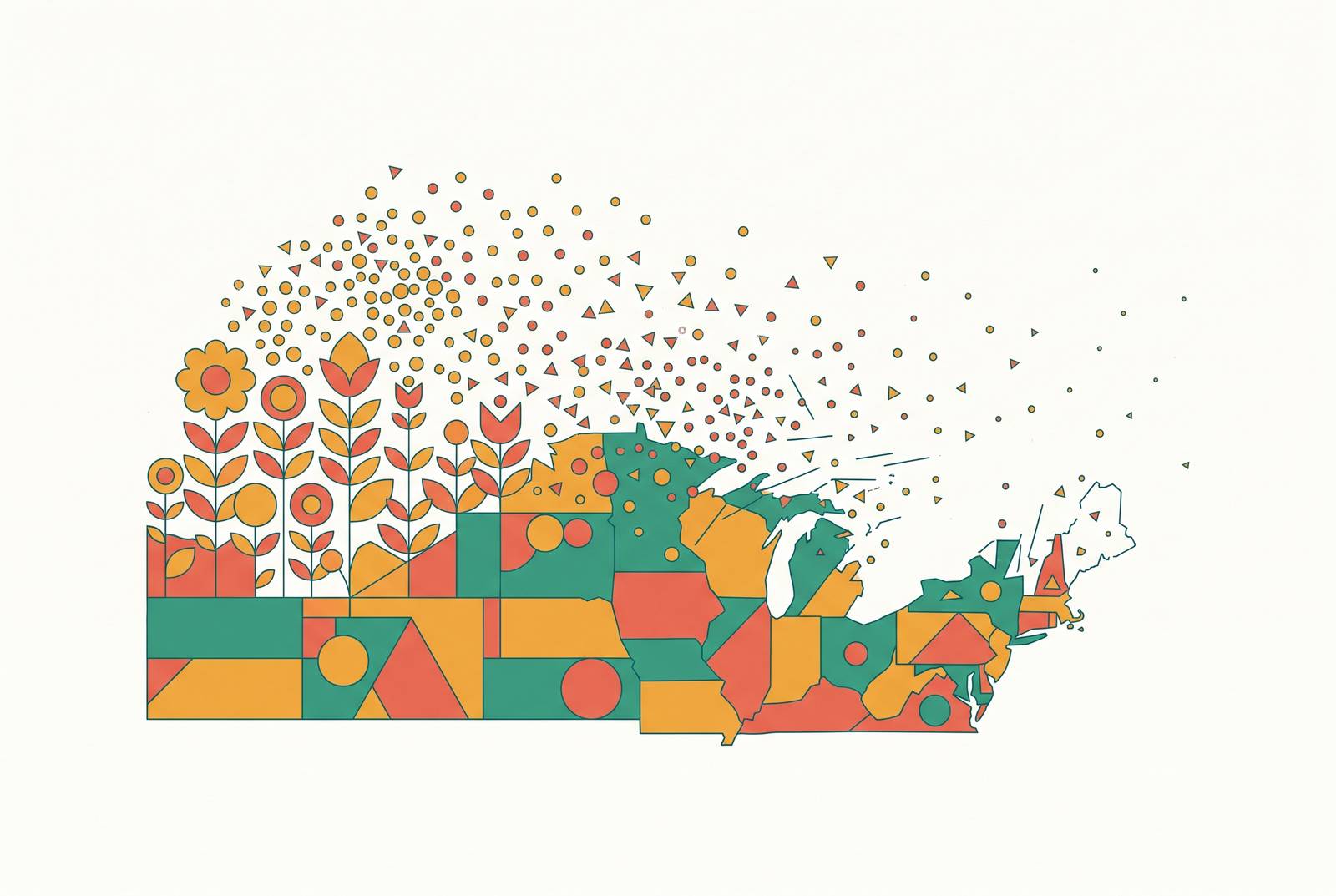
Allergy season is a rolling handoff between overlapping tree, grass, and weed seasons, so it has no single closing date. It's a rolling handoff between tree, grass, and weed pollen that starts in February and doesn't fully wrap up until November, and where a person lives changes almost everything about how that plays out. Geography moves the start date, the peak, and the end date all at once, so someone in Houston and someone in Minneapolis can be dealing with completely different allergens in the exact same week. Indoor triggers, dust mites, pet dander, mold, don't even bother with a calendar; they're just there, sometimes worse in winter once the windows get sealed shut. Because allergen exposure varies by region and by week, "allergy season" is a specific set of dates a person can plan around rather than an abstraction, and the rest of this piece maps out where you actually sit in that rolling sequence, region by region and allergen by allergen.
The national allergen sequence: tree, grass, and ragweed pollen windows
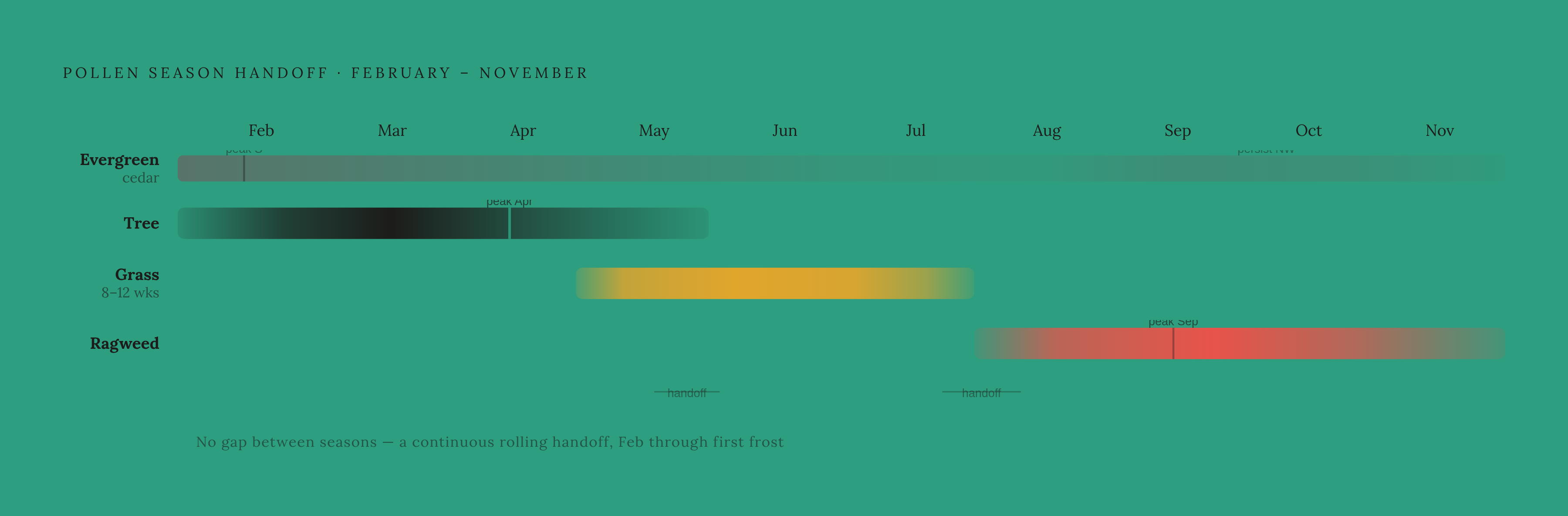
Before getting into regional quirks, it helps to know the base pattern everyone's variation gets layered onto. Three allergen categories take turns dominating the calendar, moving in a fairly predictable order from late winter through the first hard frost of the year.
Tree pollen goes first, running February through May nationally and peaking in April. Oak, birch, maple, and elm are the usual suspects, and they tend to bloom hard and fast rather than dragging things out; in the eastern U.S., deciduous tree pollen typically hits its peak in late April. Grass takes over next, spanning late spring into early summer with a peak window from May through July. Unlike trees, grass doesn't spike and crash. It holds a steadier, more consistent level in the air, and the season itself can stretch 8 to 12 weeks.
Ragweed closes things out, starting in August, peaking in September, and lingering until the first hard frost finally shuts it down, usually in October or November. A single ragweed plant isn't shy about this either: it can release a staggering volume of pollen over the course of one season. There's also a fourth player that doesn't fit neatly into the spring-summer-fall progression: evergreen pollen from junipers, cedars, and pines. It peaks in the eastern and western U.S. in May and hangs around through summer in parts of the Northwest, but the South and Southeast get an extra evergreen peak in winter that the rest of the country doesn't see.
That's the skeleton. Now stretch it, compress it, or reshuffle it by region, and you start to see why "allergy season" means something different depending on the zip code.
The South's allergy season, starting in winter and stretching to November
Texas breaks the spring-equals-allergies assumption before spring even arrives. Mountain cedar trees pollinate in January and February. Texas winters rank among the worst allergy periods in the country. Cedar fever is the clearest proof that the "allergy season starts in spring" mental model just doesn't hold everywhere.
That's not an isolated quirk. Southern states overall run the longest allergy seasons in the nation, often stretching 8 to 9 months, simply because warmer temperatures let plants start pollinating earlier and keep going longer into the year. The Southeast's freeze-free growing season has measurably lengthened since 1970, which extends, directly and mechanically, the window in which plants can produce pollen in the first place. And when ragweed season finally should be winding down, the South often gets a later first frost, so warm fall temperatures can push symptoms all the way into November.
The Southeast ends up with tree, grass, ragweed, and mold all active at overlapping points across much of the year. A sufferer there asked what's actually causing their symptoms in, say, late September has a decent chance of being unable to answer with confidence. Multiple allergens are running at once, and untangling which one is responsible becomes a genuine diagnostic problem, not just an inconvenience.
The Northeast and One Other Region's Compressed but Intense Season
In the northern half of the country the shape of the problem changes. Cold winters delay the start of pollen season, but that just means everything gets pushed into a tighter window, roughly 4 to 5 months. Compressed means concentrated, not gentle. It means concentrated.
The Ohio Valley is projected to be one of the hardest-hit regions in 2026, with stretches of exceptionally high tree pollen, especially in the aftermath of spring rain. That's the real contrast between North and South: not severity so much as pacing.
The compression is easing slightly at the edges, though. The Northeast's freeze-free growing season has lengthened since 1970, meaning that tight window is slowly stretching outward on both ends. In the Ohio Valley specifically, that freeze-free season has grown by about 14 days on average since 1970. Ragweed still matters here, but it plays a smaller role than it does down south, and its season ends more reliably with the region's first frost. So northeastern and midwestern sufferers get something their southern counterparts largely don't: a clear, dependable finish line.
The West and Southwest: A Different Allergen Mix and a Lengthening Season
Out west, the whole allergen lineup changes. Different dominant plants, different timing, and, notably, the fastest-expanding freeze-free seasons in the country, so the allergy window itself is growing quicker here than almost anywhere else.
California is the clearest example of how different the western pattern is. Bermuda grass, not ragweed, is one of the most severe pollen allergens in California, and ragweed is not a major concern there at all, a real departure from the fall-driven pattern that dominates in the east. The Southwest's season runs roughly February through September, about 6 to 7 months, with desert plants and dust joining mold as the primary triggers. The West Coast runs a shorter stretch, March through August, dominated by tree and grass pollen with limited ragweed exposure.
But the number that really stands out here is the Northwest's growing-season expansion: 31 days longer than it was back in 1970, the largest increase of any region in the country. Individual cities show it more sharply. Those aren't small seasonal nudges.
On top of that, evergreen pollen (pines, junipers, cedars) sticks around through summer in parts of the Northwest, meaning sufferers there are often still symptomatic in months when their eastern counterparts have long since gotten relief. Putting the allergen mix and the growing-season data together, the West looks less like a milder allergy region and more like the place where the calendar is shifting fastest. In Climate Central's analysis (S5), Reno, NV leads individual cities with 100 more freeze-free days, while Medford, OR gained 68 more days and Boise, ID gained 55 more days.
Climate change's role in earlier starts and later ends for every region's season
Every regional season described so far is a snapshot. Warmer temperatures are stretching the freeze-free growing season almost everywhere, and that's the direct mechanism tying climate change to longer, worse allergy seasons: more freeze-free days simply gives plants more time to grow and pump out pollen. Climate Central's 2026 analysis of 198 U.S. cities found the freeze-free growing season lengthened in the overwhelming majority of them, by 21 days on average between 1970 and 2025.
It's not just duration, either. Higher CO2 concentrations actually boost how much pollen certain plants produce, particularly grasses and ragweed, so the seasons are also more intense on a day-by-day basis. That's already showing up in real time: the first spring leaves and flowers of 2026 emerged early along the Gulf Coast and across Oklahoma.
What does that mean for someone sitting at home wondering when symptoms will finally quit? It means the old assumption, "my allergies wrap up by October," is getting shakier every year. The season a person expects to end on a certain date may already be running longer than it did a decade ago, and there's no reason to expect that trend to reverse. What happens when the outdoor pollen calendar finally does end, but the sneezing and congestion don't stop with it?
Indoor Allergens and the Year-Round Sufferer
For a lot of sufferers, the pollen calendar closing doesn't bring the relief they're expecting. That's because indoor allergens run on their own separate schedule, one that has nothing to do with frost dates or bloom cycles.
Dust mites are a big piece of this. Chronic exposure to dust mites, which live year-round in bedding, carpets, and upholstered furniture, causes nasal congestion, headaches, and fatigue that a person might never trace back to their mattress or couch. Pet dander behaves the same way: no season, no calendar, just steady accumulation indoors regardless of what's happening with the trees outside.
Mold sits in an odd middle ground. Outdoors, it peaks during damp, warm months, but indoors it just keeps going all year. In humid climates with mild winters, outdoor mold seasons alone can stretch 4 to 6 months, which puts mold-sensitive individuals among the longest-suffering allergy patients in the country. A 2021 study published in Proceedings of the National Academy of Sciences analyzed pollen data from 60 North American stations between 1990 and 2018, finding that pollen seasons lengthened by 20 days on average and pollen concentrations increased by 21%. And then there's a wrinkle most people never connect to pollen at all: oral allergy syndrome, where cross-reactivity between certain foods and pollen proteins causes symptoms that get blamed on the food itself, when the real driver is pollen sensitization operating in the background year-round.
So the "when does it end" question doesn't have one answer. For plenty of people, the honest answer is that it doesn't, not fully, which raises the real stakes of this whole conversation: what does it cost someone to be exposed, whether seasonally or continuously, month after month?
Effects of Prolonged Allergy Exposure on Sleep, Cognition, and Daily Function
Length of exposure gets underestimated. A runny nose, for a grass pollen season that can run 8–12 weeks or a West Coast season running roughly 5–6 months, is a different problem than a brief annoyance, and it's the problem West Coast sufferers in particular are actually living with.
Start with histamine. It's not just a nasal-tissue chemical, it also acts as a neurotransmitter that helps regulate alertness and sleep cycles. When allergic inflammation throws off histamine balance and cytokine signaling, it degrades energy and mental sharpness directly, not as some secondary effect but as a straightforward biological consequence. Layer nighttime congestion on top of that. Swollen nasal tissue restricts airflow, pushes people toward mouth breathing, and fragments sleep; the Sleep Foundation reported that people with untreated allergic rhinitis wake up more often at night and get less deep sleep than they otherwise would.
Poor sleep worsens daytime inflammation, and daytime inflammation makes sleep worse the following night, a loop that keeps running for as long as the allergen exposure does. A kid who seems zoned out in class during peak pollen season might be running on fragmented sleep caused by congestion, while a working adult dragging through the same weeks might be feeling histamine's direct hit on cognition. Either way, it often gets misread as something else entirely, stress, workload, just being tired, because most people don't think to trace a months-long mental fog back to pollen counts. There's also a sharper edge to this for people who already have sleep-disordered breathing: untreated nasal inflammation can make those symptoms measurably worse.
The reduced relief symptom-masking medications provide as the season lengthens
None of that math works in a sufferer's favor once the season itself starts running longer than the relief window most people plan for. The biology doesn't pause just because a bottle of medication runs low or a course of treatment reaches its typical end point, and the pollen counts driving all of it, tree, then grass, then ragweed, then, in some regions, evergreen again, don't check a calendar before deciding to keep going.
Knowing your regional window isn't trivia; it's the practical consequence of everything mapped out above. Knowing your regional window means bracing for a defined stretch of symptoms instead of getting blindsided by a season that keeps extending past where memory says it should have ended.
Sources
- Understanding Allergy Season: Start, Peak, and End Times 2026 | Wyndly
- Warmer Growing Season, Longer Allergy Season | Climate Central
- 2026 Allergy Forecast: When will pollen be bad across the US?
- When Does Allergy Season Start? Real Seasonal Allergy Calendar Guide
- When Does Ragweed Season End? A Regional Guide
- Seasonal Allergy Guide by Region | Family Allergy and Asthma
- How Climate Change Makes Your Allergies Worse - Inside Climate News
- Earlier start, longer duration, worse symptoms: Navigating allergy season in 2026