Seasonal Allergies in Infants and Babies
Babies under two rarely have true seasonal allergies due to biology, not diagnosis.

A baby under two years old almost never has true seasonal allergies, and that's a fact about biology, not a gap in diagnosis. Building an allergic response to pollen or mold takes repeated exposure spread across multiple seasons, and an infant hasn't lived long enough to rack up that exposure history.
A six-month-old spends most of her day indoors, with limited contact with outdoor allergens like pollen and mold spores. Mostly indoors, mostly in the same few rooms, with only brief, incidental contact with outdoor allergens like tree pollen or mold spores carried in on a breeze. The immune system needs sustained, repeated encounters with a specific allergen before it builds the kind of IgE-mediated response that causes hay fever. No exposure history, no sensitization. It's a mechanical requirement tied to exposure history, unrelated to severity or bad luck.
Colds, dry indoor air, and normal anatomical quirks in a developing nasal passage account for most infant congestion, and chasing an allergy diagnosis in that age group usually just delays finding the actual cause.
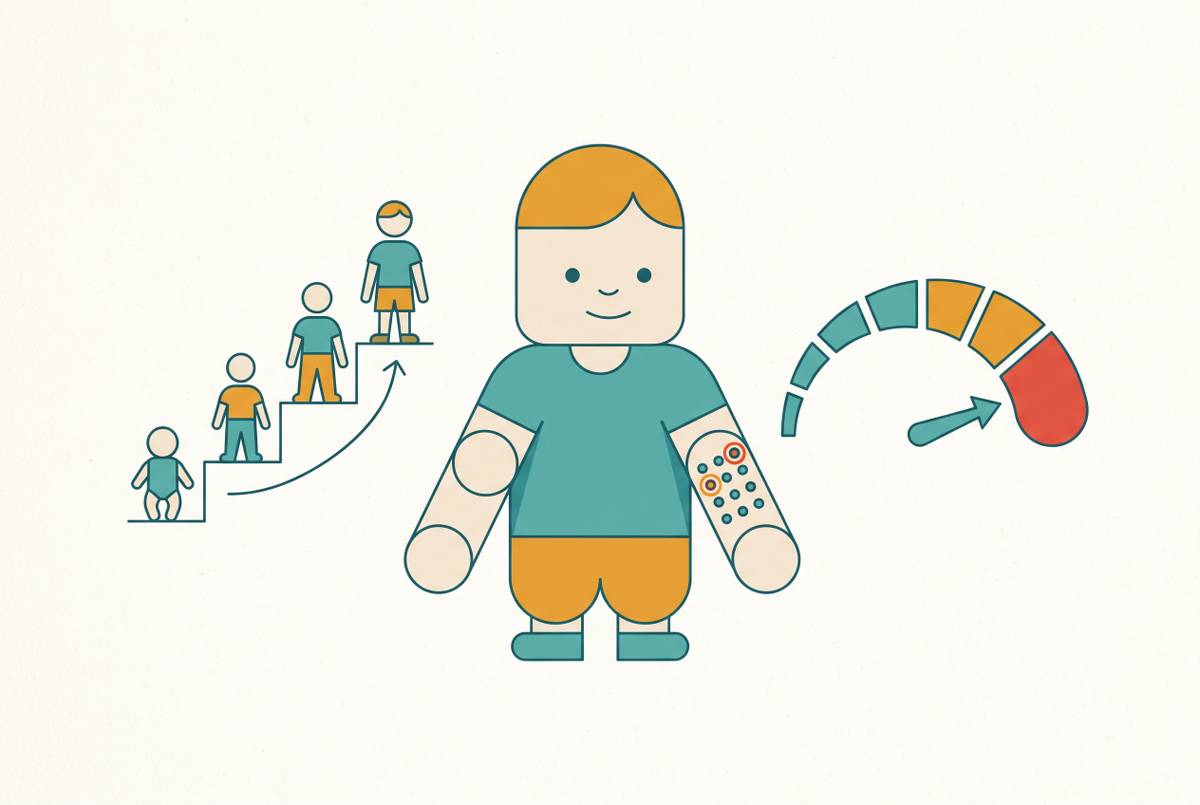
The sequence in which allergic sensitization develops from birth through age three
Allergic sensitization doesn't appear all at once. It builds in a fairly predictable order, moving from indoor triggers to outdoor ones as a child ages, and knowing that order gives parents something concrete to check their child's symptoms against.
Below six months old, essentially no environmental allergic sensitization has had time to develop. Congestion, sneezing, a stuffy nose during naps: almost always something other than allergies at this stage.
Between one and two years, indoor allergens become the first real culprits. Dust mites are the most common offender, and they live in bedding, carpets, and upholstered furniture, thriving in the warm, moderately humid conditions of a typical household, which happens to describe a crib and a play mat pretty well. Mold is the second major indoor trigger, growing in bathrooms, kitchens, and basements, and releasing spores small enough to inhale without anyone noticing. Pet dander rounds out the list: a dog or cat living in the home means continuous exposure, though even a visiting relative's cat hair on a sweater can set off a short-lived reaction. Roughly one in six children develops an indoor allergy by this stage, usually showing up as a runny or stuffy nose paired with sneezing.
Outdoor allergens don't typically start registering until somewhere between two and three years old, and even then, they stay relatively uncommon. Tree pollen shows up in spring, grass pollen in summer, and ragweed and other weed pollens in fall. But a child who hasn't yet lived through two or three full pollen seasons simply hasn't had the exposure window needed to build sensitization. Outdoor seasonal allergens can begin to register by ages two to three, but they remain relatively rare even at this age.
None of this is arbitrary. It tracks directly with how infants and toddlers actually live: overwhelmingly indoors, in close and repeated contact with the same mattress, the same carpet, the same household pet. Indoor allergens accumulate exposure earliest, so it makes sense they'd be sensitized to first.
Telling normal infant congestion from early signs of allergic sensitization
Once a parent knows which allergens are even possible at a given age, the next question becomes practical: how do you tell a cold from something allergic? The pattern matters more than the symptom itself.
Ordinary congestion behaves like an illness. It tends to clear up within one to two weeks, consistent with a garden-variety viral cold. It often comes with a fever, thicker green or yellow discharge, or other people in the house getting sick around the same time. And it doesn't care what room the baby is in or what's on the floor.
Allergic congestion behaves differently; it repeats on a schedule. Maybe it's every morning at wake-up, every time the child plays on the living room rug, or every visit from grandma's cat. The discharge tends to run clear and watery rather than thick, and sneezing tends to come in sudden fits rather than building gradually the way a cold does. Symptoms often intensify in high-allergen environments, carpeted rooms, homes with pets, and then ease up noticeably once the child is somewhere else. If eczema or hives show up alongside the nasal symptoms, skin and respiratory allergic signs often travel together and the combination signals a stronger case for allergy.
Feeding and sleep deserve a separate word here. Young infants can't easily breathe through their mouths while nursing or bottle-feeding, so nasal congestion, allergic or not, disrupts feeding and sleep in a way it wouldn't for an older child or adult. Nasal congestion disrupts feeding and sleep at this age even when the pattern doesn't point to allergies.
As a child moves into the one-to-two-year window, a few additional clues raise the suspicion of allergic rhinitis specifically: itchy or watery eyes, frequent throat-clearing, and recurring ear problems like fluid buildup or infections layered on top of the nasal symptoms. None of these alone confirms an allergy. Together, and repeated over weeks, they start to paint a clearer picture.
Effects of untreated allergies on a young child's sleep, development, and airway
A stuffy nose sounds minor. Left alone in a young child, allergic congestion can set off a chain of effects that reach well past the nose itself, and each one traces back to the same starting point: swelling and inflammation in the nasal passages, not just extra mucus sitting around.
Blocked nasal passages force a child to breathe through the mouth instead. That shift, if it becomes the norm rather than the exception, can actually reshape jaw and facial development over time. It also dries out the airway, changes head and neck posture during sleep, and can lower oxygen levels overnight without anyone realizing it's happening. Mouth breathing that persists past six months is a real threshold and warrants a referral to an ear, nose, and throat specialist.
Sleep disruption in a toddler rarely looks like the tired adult version of the same problem. Instead of dragging through the day, a congested, poorly-sleeping toddler tends to show up as hyperactive, irritable, and unable to focus, which parents and even pediatricians can easily mistake for a behavioral issue rather than a breathing one.
Year-round allergic rhinitis carries its own list of associated problems: ear infections, snoring, and, in more severe cases of airway obstruction, sleep apnea. Chronic congestion that drags on unaddressed can chip away at attentiveness and school performance down the line, and that burden starts earlier than most parents expect, often taking root in toddlerhood and simply continuing if nothing changes.
Allergic congestion is an inflammatory process, not just a mucus problem. Medications that ease the sniffling and stuffiness treat the discomfort. They don't touch the inflammation driving it, and they don't interrupt the downstream chain toward mouth breathing, poor sleep, and ear disease.
Signs a toddler needs an allergy evaluation
Waiting for a toddler to "grow out of" a nasal problem is a reasonable-sounding instinct that costs time a parent doesn't actually have to spare. If the pattern fits allergic disease, earlier evaluation opens the door to treatment that changes the underlying immune response instead of only managing symptoms while sensitization potentially spreads.
A handful of situations are clear enough to act on. Nasal symptoms that stretch past the two-week window typical of a viral cold are one. Mouth breathing that's lasted more than six months is another. So is a pattern of recurrent ear infections showing up alongside respiratory symptoms, or eczema paired with nasal and respiratory signs, the combination clinicians sometimes call the atopic march. Symptoms that reliably worsen in one environment and ease up the moment a child leaves it round out the list.
What does an evaluation actually involve? Skin prick testing remains the standard clinical approach and it's used routinely in young children. At-home finger-prick testing has opened up access for families who don't live near a pediatric allergist or can't easily get an appointment; results still get reviewed by a physician and can identify specific sensitizations without a clinic visit. Telehealth options extend that access further for families further from specialty care.
Cost is a real barrier for a lot of parents weighing whether evaluation is worth pursuing, and it's worth knowing that allergy testing reimbursement is generally eligible through FSA, HSA, or HRA accounts. That alone brings the actual out-of-pocket cost down for a lot of families who assume testing is out of reach financially.
But why does timing matter so much here? Children sensitized to indoor allergens during the one-to-two-year window are at risk of expanding that sensitization to additional allergens, including outdoor pollens, if it goes unmanaged. Acting early means getting ahead of that expansion instead of playing catch-up once a child's allergen profile has already broadened. And because that profile is shaped entirely by a child's own home environment, a generic approach based on regional pollen counts won't tell a parent much of anything useful. A toddler's allergies trace to the mattress they sleep on, the pet in the house, and the humidity in the basement.
Limits of symptom-relief medications for infant and toddler allergies
Reaching for an antihistamine or a nasal spray is the natural first move for a parent watching a toddler sneeze through breakfast, and it isn't the wrong instinct. It just isn't the whole answer.
Antihistamines work by blocking histamine receptors, which cuts down on sneezing and itch while the drug is active. But the immune system's underlying misidentification of the allergen as a threat carries on completely unchanged underneath the relief. Nasal sprays work on a different piece of the puzzle, reducing inflammation locally in the nasal passages, but they don't modify the IgE-mediated sensitization driving the reaction either.
Side effects matter more in this age group than they do in adults. Antihistamines can cause real drowsiness in toddlers, drowsiness that affects alertness and can interfere with normal daytime development. Oral decongestants carry a firmer line: they aren't recommended for children younger than four years old at all, a restriction that surprises a lot of parents reaching for a medicine cabinet standby. Nasal sprays bring their own friction, since a bitter taste and local irritation often make young children fight the whole process, which tanks adherence fast.
There's also a duration problem baked into how these medications work. Relief from a nasal spray or an antihistamine lasts hours, sometimes a full day if the dosing lines up. Stop taking it and the symptoms come right back. No carry-over benefit accumulates over time, no matter how consistently a parent uses it.
None of this touches what's arguably the bigger concern: neither antihistamines nor nasal sprays do anything to slow the atopic march, the tendency for allergic disease in young children to progress from eczema toward allergic rhinitis and eventually toward asthma if the underlying immune dysregulation goes unaddressed. Environmental controls, allergen-proof mattress covers, HEPA filtration, keeping humidity low enough to discourage dust mites, genuinely help reduce exposure and belong in the toolkit. They just don't retrain the immune system any more than the medications do.
So what actually changes the underlying response, rather than managing around it?
How allergen immunotherapy works for young children
Allergen immunotherapy is the one approach on this list that goes after the immune dysregulation itself rather than the symptoms it produces. Instead of blocking a reaction after it starts, it changes how the immune system responds to the allergen in the first place, by delivering controlled, gradually increasing doses of that allergen over time until the body learns tolerance instead of alarm.
This isn't new territory. Allergen immunotherapy has been used clinically for more than a century, beginning with early allergy injections in 1911, as noted by Désirée Larenas-Linnemann, MD, presenting at AAAAI 2026. Systemic reactions to SLIT occur in fewer than one in a hundred patients, making home administration appropriate and safe.
What sets immunotherapy apart from anything discussed so far is durability. Clinical trial evidence shows that three or more years of treatment with high-dose sublingual immunotherapy is needed to achieve a sustained effect, but that effect then persists for two or more years after the treatment itself stops. Medications require daily upkeep indefinitely. Immunotherapy front-loads the effort and pays out afterward.
Two delivery methods exist, and they come with meaningfully different logistics for a family with a young child. Subcutaneous immunotherapy, the traditional allergy shot, requires repeated injections under medical supervision, plus a period of observation after each dose, along with a small but genuine risk of systemic reaction. That's a heavy lift for a family juggling a toddler's schedule around recurring clinic visits.
Sublingual immunotherapy, or SLIT, takes a different shape. Allergen is delivered as drops or a tablet held under the tongue, and once treatment is underway, it's administered at home rather than in a clinic. That lets treatment happen at home instead of through frequent clinic appointments.
The evidence base behind SLIT has kept expanding. A 2026 World Allergy Organization position paper lays out an internationally harmonized framework for SLIT, pulling together data on efficacy, safety, adherence, and how it's actually implemented across different healthcare settings. Randomized controlled trials back grass and house dust mite SLIT tablets specifically, showing clinically meaningful reductions in both symptoms and medication use, with benefits lasting one to two years after finishing a three-year course. A systematic review of randomized trials in children with allergic rhinitis found both SLIT and subcutaneous immunotherapy effective, with tablets, drops, and shots performing comparably overall, though shots showed an edge on certain specific outcomes.
Safety is where SLIT distinguishes itself for home use. Systemic reactions occur in fewer than one in a hundred patients, a rate low enough to make administering it at home a reasonable and safe choice for families rather than a risk to be managed in a clinical setting. For a toddler already sensitized to dust mites or pet dander in the one-to-two-year window, that combination, a century of clinical grounding, durable effects after stopping, and a delivery method that doesn't require a clinic visit twice a week, makes immunotherapy worth a real conversation with an allergist, not just a fallback after medications stop working.
Sources
- Sublingual Immunotherapy for Allergy in 2026, With Désirée Larenas-Linnemann, MD | HCPLive
- Frontiers | Sublingual allergen immunotherapy: evidence from randomized trials, real-world studies and meta-analyses
- Efficacy and Safety of Sublingual and Subcutaneous Immunotherapy in Children with Allergic Rhinitis: A Systematic Review of Randomized Trials Including Direct and Indirect Comparisons - PMC