How Parental Allergies Increase a Child's Allergy Risk
Parental allergies pass down a susceptibility to overreacting, not specific diagnoses.
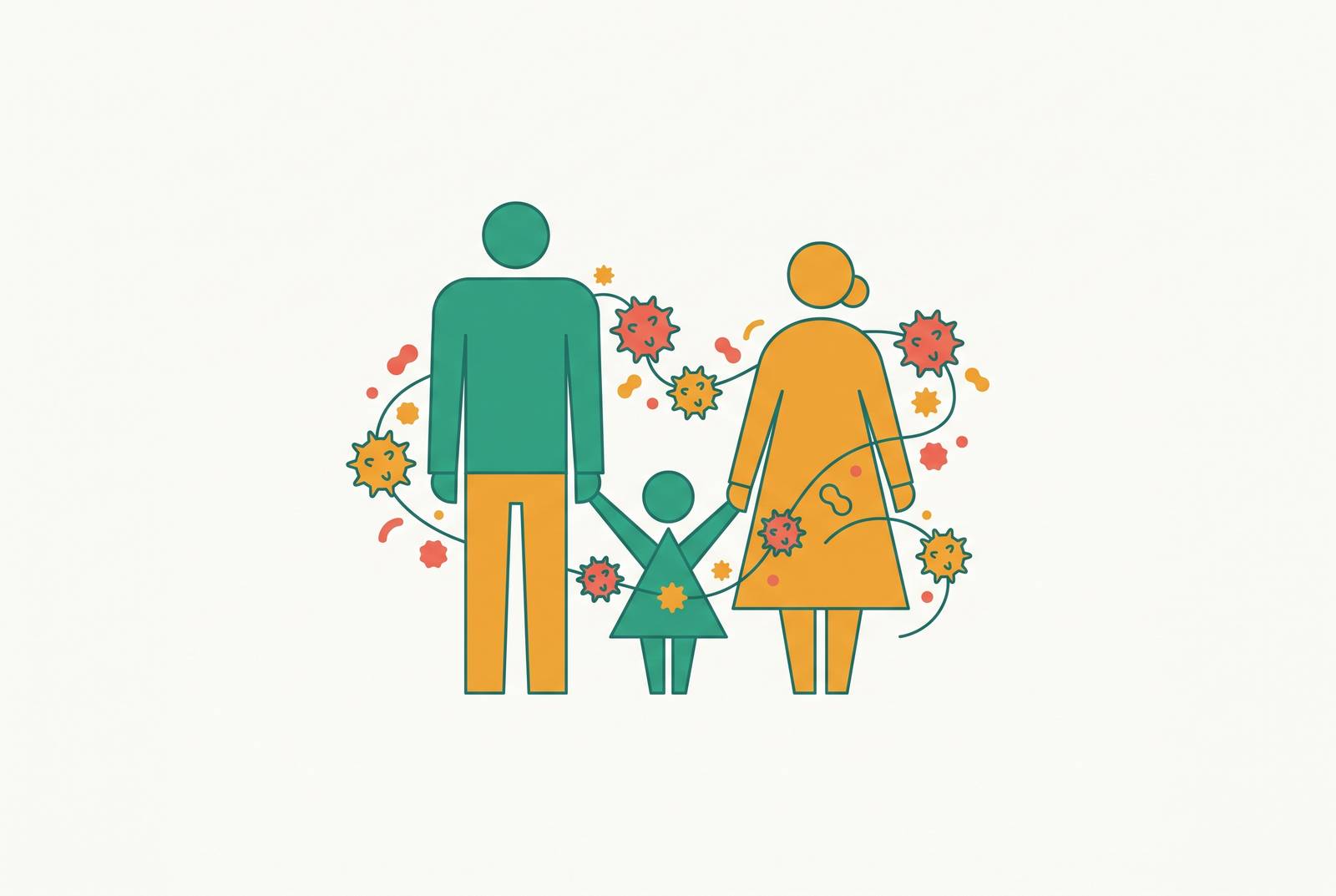
Two siblings grow up in the same house, with the same two allergic parents, eating the same foods and breathing the same air. One develops asthma by age six. The other never sneezes at a cat in her life. This is the piece's actual subject: parental allergies raise a child's odds of developing allergies, sometimes substantially, but what passes down is a predisposition, not a specific diagnosis.
What parental allergies pass down to children
Start with that pair of siblings, because they explain more than any chart of percentages. If allergies were handed down the way eye color is, that shouldn't happen. It happens routinely, and the reason is that parents don't pass down a specific allergy. They pass down a tendency toward allergic reactivity in general.
The technical word for that tendency is atopy: a genetically increased likelihood of developing allergic disease. Atopy is a susceptibility, not a verdict. Children with no family history of allergies still develop them. Some children born to two allergic parents never develop a single one. What seems to run in families isn't a fixed target, like a peanut allergy copied from parent to child, but a broader readiness of the immune system to overreact to things that shouldn't trigger a reaction.
That broader readiness shows up as a cluster of conditions. Most children with eczema are also more likely to have food allergies, which is one reason doctors watch a child's skin as closely as they watch for sniffles.
The inconsistency inside families is not a mystery to be solved. A parent who manages hay fever every April is not handing a child hay fever. That parent is handing down a slightly higher chance that some allergic condition, not necessarily hay fever, might take hold.
One allergic parent versus two: how the odds change
Once the mechanism is clear, the next question is practical: how much does this actually move the needle? Multiple studies indicate that genetics play a real role in whether a child develops allergies, and the role scales with exposure. One allergic parent raises a child's likelihood of developing allergies substantially. Two allergic parents raise it further. That's a gradient worth taking seriously, not a coin flip dressed up in scientific language.
But what if neither parent has ever had so much as a seasonal sniffle? Even children born to two non-allergic parents carry a baseline risk of developing an allergic condition. No child is categorically safe from it. That baseline matters because it keeps the numbers honest: genetics shift probability, they don't issue guarantees in either direction.
These numbers describe what they are and aren't. They describe patterns across populations of children, not a forecast for any single child sitting in a parent's lap. A family with two allergic parents should treat the higher odds as a reason to watch early and test early, not as a diagnosis handed down before any symptom has appeared. One might argue that statistics like these are more useful for planning than for predicting, and that's close to the right way to read them.
Environmental and behavioral factors that raise or lower a child's inherited risk
Genetic predisposition sets a floor, not a ceiling. Whether that floor ever gets reached depends heavily on what happens around a child, starting well before birth and continuing through early childhood. This is the part of the allergy story where parents have more influence than they tend to assume.
Some of that influence traces back to the father, in ways that surprise people who assume allergy risk is mostly a maternal question. A published study identified paternal smoking before conception, paternal alcohol consumption before conception, and paternal allergic disease as independent risk factors for allergic rhinitis in children, separate from whatever the mother contributes. Fathers are part of the risk calculation well before a child is born.
Tobacco exposure doesn't act alone, either. The combination compounds.
Parental age also shapes the picture in ways that complicate it. A 2026 JAMA Network Open cohort study found that children of older mothers had reduced odds of food allergy, wheezing, and house dust mite sensitization in early childhood, suggesting advanced maternal age may be protective in some contexts. That finding cuts against a common assumption that older parents automatically mean higher-risk children. The relationship isn't linear, and it isn't simple.
Even the calendar plays a role. A 2025 study of nearly 50,000 children found that children born in certain winter months faced elevated odds of allergic rhinitis, and children born in October faced elevated odds of atopic dermatitis, independent of sex, age, and family allergy history. Why would a birth month matter? It includes timing most parents never think to track.
Other modifiable factors sit alongside these: early-life exposure to high concentrations of allergens, increased antibiotic use, diet, viral respiratory infections, and pollution. None of these function as an on-off switch for allergy risk. They shift the odds, sometimes meaningfully, around a genetic predisposition that was already in place. Two parents with identical genetic profiles, raising children under different pre-conception habits and different home environments, can end up with children whose allergy outcomes look nothing alike. That's the honest version of this story: not prevention, but risk reduction, built from dozens of small, modifiable choices.
The atopic march: how one allergic condition in a child often leads to others over time
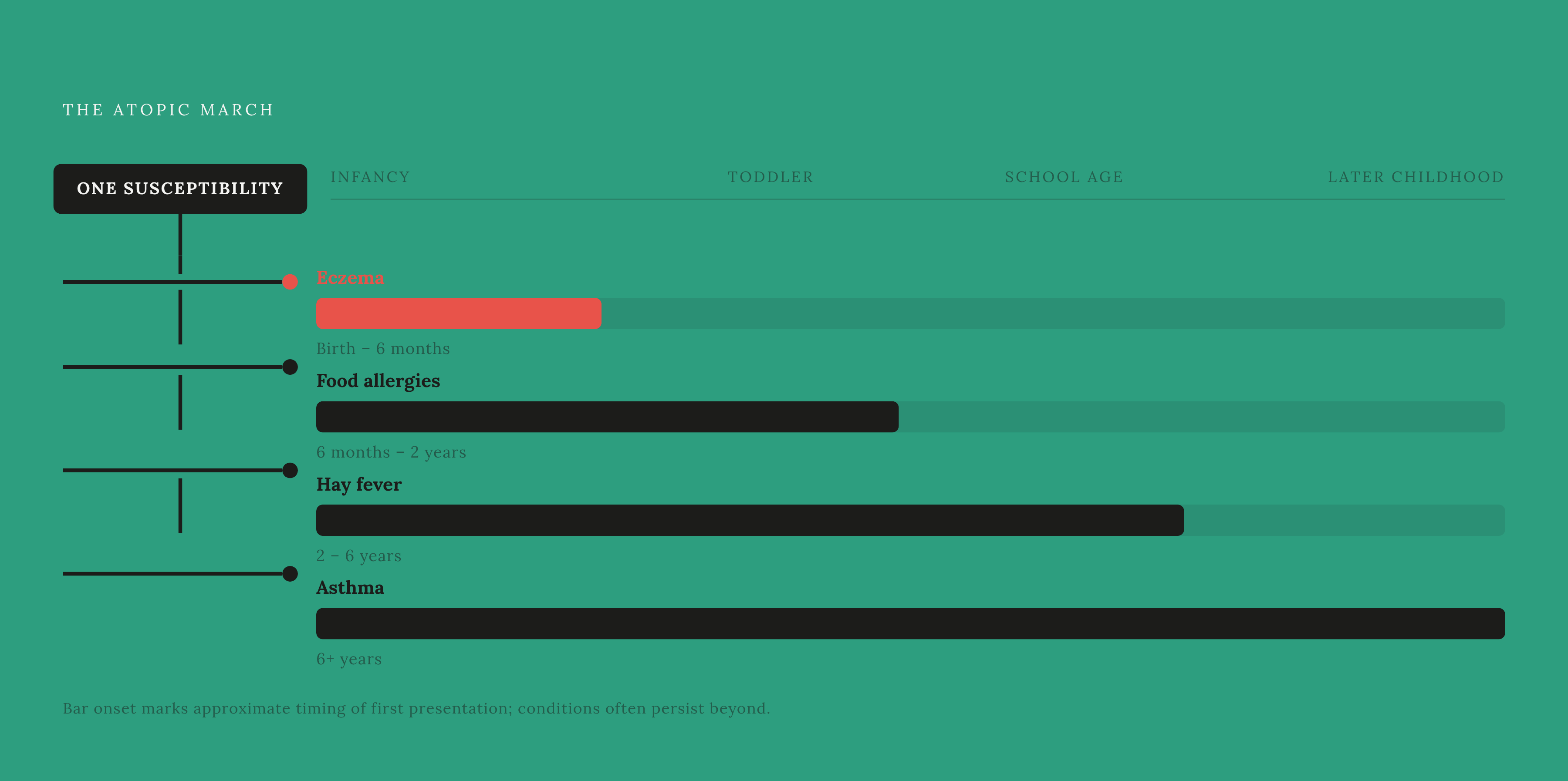
A child with a genetic predisposition toward allergic disease rarely develops every related condition at once. Instead, there's a documented sequence to how these conditions tend to appear, one that researchers call the atopic march. Atopic dermatitis, better known as eczema, commonly appears first in early childhood. It often precedes the later development of allergic rhinitis and asthma.
Why would skin trouble in infancy predict breathing trouble years later? Researchers describe a pattern, a tendency for these conditions to cluster and progress in a fairly predictable order. Most children with eczema are more likely to also develop food allergies, which reinforces the idea that these aren't separate problems showing up by coincidence. They track together because they share the same underlying susceptibility.
Asthma, hay fever, atopic eczema, and food allergies all relate to that same individual genetic susceptibility. Thinking of them as different expressions of one predisposition, arriving on different timelines, gets closer to what's actually happening in a child's immune system.
For a parent noticing a toddler's dry, itchy patches, the practical takeaway is to treat that early eczema as more than a skincare issue. But the pattern is well-documented enough that early identification changes what a family watches for, and how early they watch for it.
How untreated allergies in children affect more than sneezing and itching
Allergic disease that goes unmanaged in children rarely stays confined to the nose or the skin. It bleeds into sleep, attention, mood, and school performance, often in ways a parent has already noticed without connecting them back to allergies.
Common symptoms include fatigue, nasal congestion, headache, and worsened asthma symptoms. Each one can quietly degrade a child's day-to-day functioning even when nothing resembling an acute reaction is happening. A child doesn't need to be mid-sneeze to be suffering the effects of allergic disease.
Congestion is one of the clearer mechanisms here. Allergic congestion pushes children toward mouth breathing, which disrupts the structure of sleep and lowers how restorative that sleep actually is. A child wakes up tired, struggles to focus in class, and gets labeled inattentive, when the root issue was never attention. It was airflow.
There's a less visible mechanism running alongside the physical one. The flood of histamine during an allergic reaction affects the brain's attention systems directly, producing a kind of cognitive fog that can look a lot like, or worsen, existing attention difficulties. That pathway goes unnoticed constantly, simply because nobody has traced the fog back to its allergic source yet.
Parents of children with inherited allergy risk often watch closely for the obvious signs: sneezing, hives, watery eyes. The quieter consequences slip past that watch. Fatigue, irritability, and trouble concentrating are the hidden face of allergy left unaddressed.
How to tell whether a child's symptoms are allergy-driven
A child from an allergic family showing any of these symptoms deserves more than a guess and a bottle of medicine from the pharmacy shelf. Identifying the actual trigger is the step that makes any long-term solution possible, because treatment built on a wrong guess doesn't help much.
Two main methods establish what a child is actually reacting to: the skin prick test and specific IgE blood testing. Neither test is exotic or experimental. Both are standard tools for pinning down a specific allergen rather than treating allergy as one vague, undifferentiated problem.
Skin prick testing has to happen in a clinical setting, performed by a trained healthcare professional, an allergist, a nurse, or another clinician with allergy training, in a space equipped to handle a reaction if one occurs. For a family still deciding whether to see a specialist at all, that's a meaningfully lower barrier to start with.
Why does the specific allergen matter so much? Because immunotherapy, the only treatment that changes the underlying immune response rather than papering over it, has to be built around what a child is actually reactive to. Generic symptom management doesn't need that information. Lasting relief does.
A child from an allergic family already showing eczema, recurrent respiratory symptoms, or hay fever fits the profile for testing now, not after another season of watching and waiting. Early identification is what turns a vague family history into an actionable plan.
Limits of Symptom-Masking Medications for Children With Inherited Risk
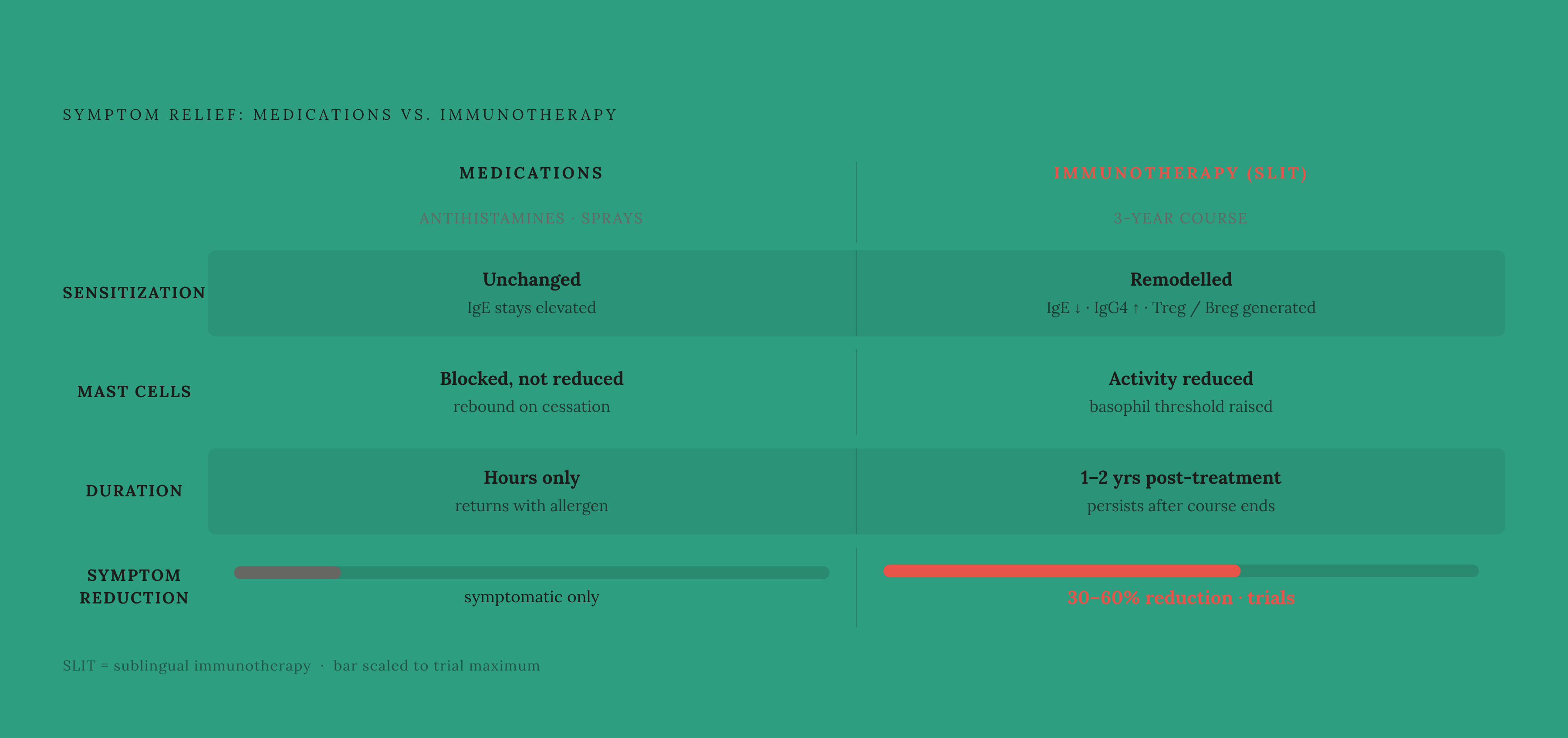
Antihistamines and nasal sprays do real work. They calm inflammation, dry up a runny nose, and get a child through a rough pollen week. What they don't do is change the immune response producing the symptoms. A child on daily antihistamines is still sensitized, still reactive, and still moving along whatever trajectory the atopic march has set for them.
Over-the-counter allergy medications bring short-term relief but leave the underlying cause untouched. Allergen-specific immunotherapy stands apart as the only treatment that produces lasting change in the immune system itself. That distinction matters most for children with a known inherited risk, where the question isn't whether symptoms can be controlled this week, but what happens over the next ten years.
The medications themselves carry tradeoffs parents should weigh with open eyes. "Non-drowsy" turns out to be a relative term, not an absolute one.
Antihistamine nasal sprays bring their own list of side effects: bitter taste, headache, nosebleeds, a burning sensation on use. One genuine point in their favor is that long-term use doesn't typically cause the rebound congestion associated with decongestant sprays. Even so, a child using these sprays daily is trading one set of discomforts for another, not resolving the underlying problem that made the spray necessary.
Some parents will reasonably push back here: the medication controls symptoms well enough, so why complicate things? Control and modification aren't the same thing. A child whose symptoms are kept in check by a daily pill is still allergically reactive underneath that control, and still at risk of the condition progressing, whether toward asthma or toward new sensitizations the family hasn't seen yet. Managing symptoms buys comfort today. It doesn't change what's happening in the immune system tomorrow.
How sublingual immunotherapy works for children at inherited risk
Allergen immunotherapy is the only approach that produces durable, disease-modifying change in how the immune system responds to an allergen, rather than just blunting the symptoms once exposure happens. Sublingual immunotherapy, usually shortened to SLIT, delivers that change through drops or tablets placed under the tongue, which sidesteps a lot of the logistical weight that comes with injection-based treatment.
Immunotherapy changes something inside a child's immune system even as it delivers that convenience. Immunotherapy produces an early rise followed by a gradual decrease in allergen-specific IgE, a steady increase in specific IgG, particularly IgG4, the generation of allergen-specific regulatory T cells and B regulatory cells, and reduced activity from mast cells and basophils. None of that is symptom suppression: it's the immune system being retrained, piece by piece, to stop treating a harmless allergen as a threat.
The clinical evidence backs up what the mechanism suggests. Randomized controlled trials support clinically meaningful reductions in symptoms and medication use from grass and house dust mite SLIT tablets, with both sublingual immunotherapy and allergy shots reducing symptoms by 30 to 60 percent in most patients. A 2026 review of the evidence found sustained benefits lasting one to two years after a child completes a three-year course of treatment, with some major trials showing benefits stretching even further. Real-world data adds another point in its favor: cohorts that received SLIT report a reduced risk of new asthma onset afterward, which lines up with the broader goal of interrupting the atopic march rather than just treating whatever condition has already shown up.
FDA-approved sublingual tablets exist for certain grasses, ragweed, and dust mites. specialty guidelines from AAAAI and ACAAI don't endorse off-label SLIT drops. Families weighing this option deserve that distinction stated clearly: the tablet form carries full regulatory approval for specific allergens, while the broader custom-drop approach operates in a space the major specialty societies haven't yet signed off on, even as supporting research continues to build.
Sources
- Are Allergies Hereditary? Kids & Genes Explained 2026
- Birth month as a risk factor of allergic diseases: Analysis of database of about 50 thousand children
- Parental Age and Childhood Allergy Risk - PMC
- Unveiling the hidden risk: paternal smoking and alcohol exposure prior to conception as independent factors for allergic rhinitis in children
- Parental inheritance and perinatal tobacco smoke exposure increase the gender-dependent risk of physician diagnosed asthma at preschool age
- Efficacy and safety of sublingual immunotherapy for allergic rhinitis: A network meta-analysis
- Frontiers