Allergy Testing Options for Toddlers and Young Children
Different testing methods work better at different ages and for different allergy types.
Testing a toddler for allergies is not a smaller version of testing an adult. The tools overlap, but age changes what each test can actually tell a parent, and getting that sequence wrong wastes time a young child doesn't have to spare. Allergy Testing Options for Toddlers and Young Children
Why allergy testing in young children is genuinely different from adult testing
An infant's immune system is still under construction. That matters clinically, because the same allergen can produce a weaker, harder-to-read signal in a younger child than in an older one, even when a genuine allergy is present.
It also matters because symptoms get misread. Chronic congestion looks like a string of colds. Poor sleep gets chalked up to a developmental phase. A cranky, inattentive toddler gets labeled as having a difficult temperament, when the actual driver might be a stuffed-up nose that's been running interference on sleep for months. Allergic rhinitis that blocks nasal airflow can push a child into mouth breathing, which fragments sleep and shows up the next day as poor focus, and the longer that cycle runs undiagnosed, the more it compounds.
Food allergy carries its own weight. Roughly 1 in 13 children have one, and among food-allergic kids, 42% report at least one allergy-related emergency room visit. That's a common outcome at this frequency. It's a sign that diagnosis delayed is not diagnosis deferred, it's exposure risk extended.
So what does "getting it right early" actually look like in practice? The rest of this piece walks through the testing options in the order they tend to come up: skin testing, blood testing, at-home screening, and the oral food challenge that settles the question when other tests leave it open. Then it turns to how age should shape which of those tools gets used, and what a parent is supposed to do once a result actually lands in front of them.
Skin prick testing: what it can and cannot tell you about a toddler
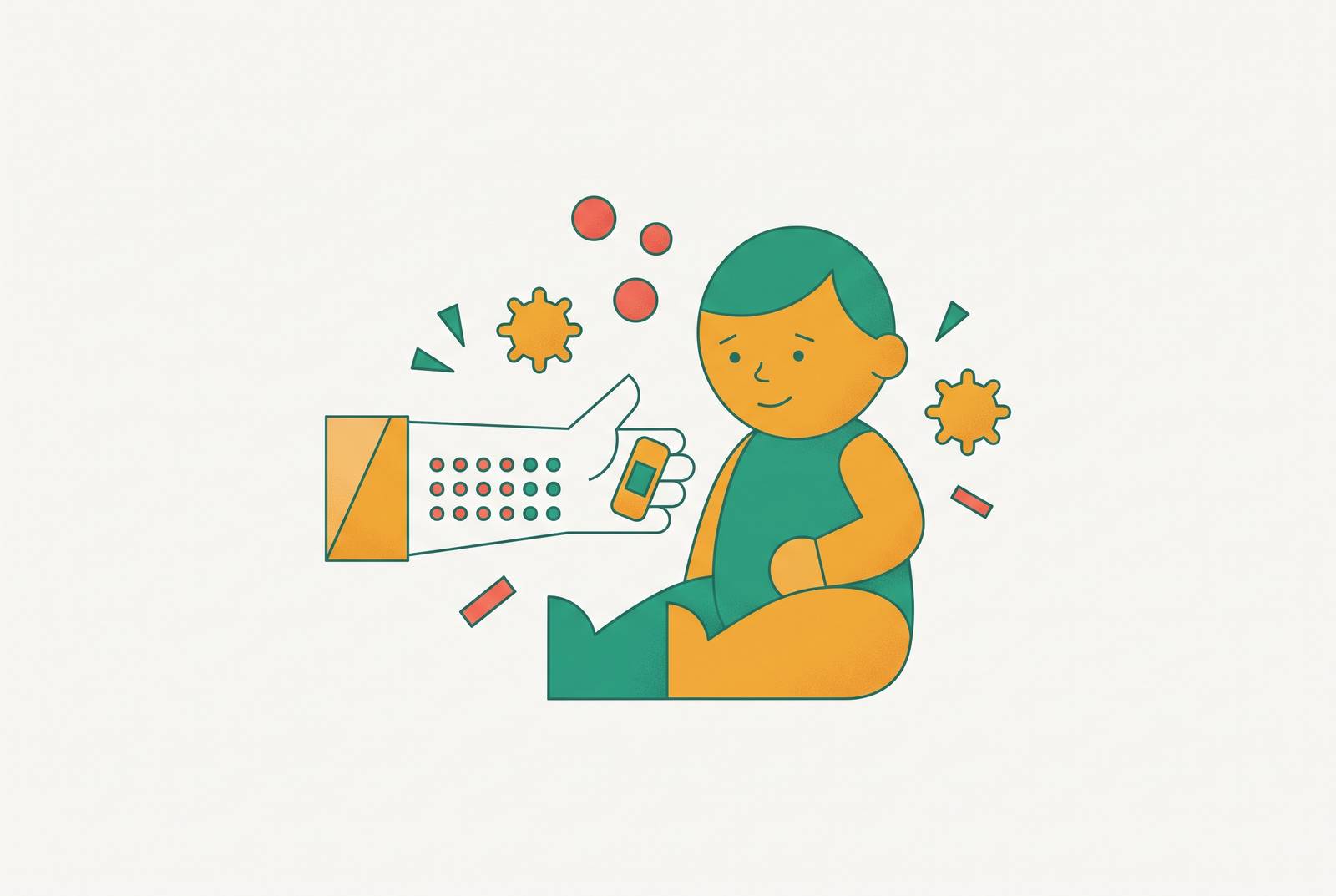
The mechanics are simple enough to describe in one sentence. A clinician places small drops of allergen extract on the forearm or back, pricks the skin lightly through each drop, and reads the wheal-and-flare response 15 to 20 minutes later. It's fast, and it can screen a wide panel of allergens in a single visit. That's why it's held up as the clinical standard for speed and breadth.
But speed isn't the same as reliability, and that gap widens the younger the child is. Skin reactivity itself is lower in infants and very young toddlers. A negative result at a younger age doesn't carry the same weight as a negative result at an older age, because a truly allergic toddler can still produce a smaller wheal than an older child would to the same allergen, since testing is generally feasible from around 6 months but results become more reliable as the child gets older. Read that a different way: a "clean" skin test in a two-year-old is not necessarily a green light. It might just be an immune system that hasn't caught up yet.
Parents should also flag a second layer here. A positive wheal by itself is not a diagnosis. It has to sit next to the child's actual symptom history, interpreted by a clinician, before it means anything actionable. The test is generally workable from around 6 months onward, but the earlier it's done, the more that age-related unreliability has to be factored in. None of this makes skin testing a poor choice. It makes it a tool that needs the right hands and the right context around it.
Specific IgE blood testing in young children
A blood draw measures the level of allergen-specific IgE antibodies circulating in a child's blood, and the result comes back as a number, a quantitative unit. That distinction alone changes how a clinician can use it: instead of a yes-or-no answer, there's a value that can be compared against a threshold, and compared again months later.
This matters most for the children skin testing struggles with. An infant who can't sit still for a forearm full of pricks, a toddler with eczema so widespread there's no clear skin to test on, in both cases blood testing sidesteps the problem entirely. It also doesn't require stopping antihistamines beforehand, which skin testing does.
Newer blood panels go a layer deeper. Component-resolved diagnostics break a single allergen down into its individual proteins, so instead of just flagging "peanut," the panel can point to which specific peanut protein triggered the response. That distinction can separate a child who's at real risk of a severe systemic reaction from one likely to tolerate or outgrow the allergen entirely, though availability still varies by practice.
None of this erases the core limitation shared with skin testing: a detectable IgE level means sensitization, not a confirmed clinical allergy. Plenty of children carry specific IgE to a food they eat without issue. Where blood testing pulls ahead is in tracking. Because the result is a number, not a wheal size, it can be followed over months or years, which turns out to be one of the more useful things about it for monitoring a child's actual growth out of a food allergy, something skin testing alone doesn't do nearly as well.
At-home finger-prick allergy testing
The science behind at-home testing produces the same results as what happens in a clinic. A small finger-prick sample gets collected at home, mailed to a lab, and analyzed for the same specific IgE antibodies a blood draw would measure. What's different is the barrier removed: no scheduling a lab visit, no coordinating a toddler's nap schedule around an appointment.
That convenience comes with fine print parents should actually read. A positive result from a finger-prick kit is a starting point for a conversation with a clinician, not an endpoint. It needs to be weighed against the child's actual symptoms and exposure pattern before anyone changes what that child eats or how a household manages its pets. Panel breadth differs by provider too, so confirming which allergens are actually on the panel matters before assuming a kit covers everything worth checking.
Where does this fit best? As a first screening step for suspected environmental allergies, it opens a clinical conversation rather than replacing it. For a suspected severe food allergy, standalone testing at home isn't the right tool. That situation calls for in-office evaluation, where epinephrine is on hand if something goes wrong. Telehealth allergy practices have leaned into this gap by pairing at-home collection with virtual consultations and physician review, which keeps the clinical interpretation step intact even when the blood draw itself happens at the kitchen table.
Oral food challenges: the diagnostic gold standard for food allergies in children
An oral food challenge works by feeding a child gradually increasing amounts of a suspected allergen under direct clinical supervision, watching closely for any reaction as the dose climbs. It's considered the definitive test for food allergy for one reason: it measures what actually happens when the food goes in, not just whether IgE antibodies are floating around. Sensitization and allergy are not the same thing, and the OFC is the test built to tell them apart.
It gets used in a few specific situations: confirming whether a positive IgE or skin result reflects a genuine clinical allergy, checking whether a previously diagnosed allergy has been outgrown, or resolving a case where the symptom history and the test results point in different directions. It is never a home procedure. It has to happen in a medical setting equipped to treat anaphylaxis, full stop. The more rigorous version, double-blind and placebo-controlled, tends to stay in research settings, while open-label challenges appear in routine clinical practice.
For a parent, the outcome is binary but clarifying either way. A passed challenge means the food goes back on the menu. A failed one confirms the allergy and sharpens avoidance planning and emergency preparedness. OFCs run several hours, and a pediatric allergist typically orders one only after skin or blood testing has already laid the groundwork. When an OFC is used.
How age shapes which tests are appropriate
Age is a central variable here. It's the variable that decides which test even makes sense to order.
If a food allergy is suspected under roughly 6 months of age, clinical history and a trial elimination diet are usually the first step. And at every point in this range, medication decisions should run through a pediatrician first, without exception.
By ages 2 to 5, skin prick testing starts to close the reliability gap, since immune maturity by that point makes the wheal response more trustworthy. Environmental allergen testing becomes more meaningful here too.
Across every age band, one caution holds: a positive result, skin or blood, means sensitization. It does not mean diagnosis. That distinction is easy to state and easy to forget in the moment a parent is staring at a lab report. False negatives cut the other way, and they're just as important. A young child may not have mounted a detectable IgE response yet to an allergen that becomes clinically significant later, so a negative test at age 1 doesn't close the file. What can help settle the ambiguity is watching the trend rather than the single number: rising IgE levels over time tend to suggest a persisting allergy, while falling levels suggest the child might be growing out of it. For context on what a pediatric panel typically needs to cover, peanut allergy runs at roughly 2.2% prevalence in children and milk allergy at roughly 1.9%, making them the most common food allergens in children. 6 months to 2 years. Specific IgE blood testing is generally preferred over skin prick testing because results are less age-dependent and the procedure is more feasible.
What a positive result means for a young child's day-to-day management
A confirmed food allergy changes the shape of a family's daily routine immediately. It calls for a written emergency action plan on file with the pediatrician, shared with every caregiver and with daycare or preschool staff. It calls for a prescribed epinephrine auto-injector, along with real training on how to use it, and that last point carries more weight than it should: less than half of food-allergic children currently have one on hand. It also calls for practical, ongoing habits around label reading and avoiding cross-contact in shared kitchens.
A confirmed environmental allergy points in a different direction. The first-line response is usually environmental control rather than medication: mattress covers for dust mites, HEPA filtration for airborne particles, and managed exposure if a pet is part of the trigger. Symptom management options can layer on top of that, appropriate to the child's age, with the understanding that medication treats the symptom without touching the underlying immune response driving it.
For the child whose allergy has been quietly forcing mouth breathing and broken sleep for months, a positive result carries weight well beyond a label. It's the point where those downstream effects, the poor sleep, the daytime fog, finally get addressed alongside the allergy itself, rather than being treated as separate, unrelated problems.
And if the result comes back negative but the symptoms haven't let up? The workup continues from there. It's a cue to revisit testing as the child gets older, or to widen the search toward non-allergic causes. A pediatric allergist earns their keep in exactly this moment, translating a number on a lab report into an actual clinical picture, and drawing the line for parents between "sensitized" and "allergic" before that line gets blurred into a decision the family didn't need to make.
Treatment options after diagnosis: from symptom management to addressing the root cause
Symptom control is the most familiar layer, and the most limited. Antihistamines and nasal corticosteroids manage what a child feels without changing the immune response, so they only work for as long as they're taken. For children under 2, that decision should never be made without a pediatrician first. Among antihistamines, non-drowsy options like fexofenadine or loratadine are the recommended first choice for kids, while older options like diphenhydramine are discouraged, given their side effects and thin evidence of benefit in children. Nasal steroid sprays such as fluticasone propionate or triamcinolone tend to work better for nasal symptoms specifically, though they're meant for limited stretches of use rather than indefinite daily reliance.
Immunotherapy sits in a different category entirely, because it's the one approach aimed at the immune mechanism itself rather than just muting its output. Subcutaneous immunotherapy, allergy shots, has a long track record behind it, but it requires in-office injections with observation time built in, which is a real logistical wall for a family with a toddler in tow.
Sublingual immunotherapy, SLIT, delivers the allergen under the tongue instead. After one supervised first dose in a clinical setting, the rest happens at home, a logistical difference that matters enormously for young families. Below that age line, custom compounded SLIT drops are prescribed off-label and used widely for children under 5 or for allergen combinations the tablets don't cover, though families should check insurance coverage carefully since drops are frequently self-pay. A systematic review of seven randomized controlled trials in children with allergic rhinitis found both SLIT and SCIT cut symptoms and medication use compared to controls, with SLIT's safety profile coming out ahead on systemic reactions.
The food allergy data is where this gets genuinely exciting. Multisystem reactions occurred in 8% of children on active treatment, and none of those required epinephrine, a safety signal that's hard to overstate. Researchers studying this age range describe early childhood as a window of opportunity, the idea being that a younger immune system may simply be more responsive to retraining than an older one. Telehealth allergy practices have made this whole pathway more reachable, pairing virtual physician consultations with at-home testing and treatment plans mailed straight to a family's door, closing the distance between a diagnosis and an actual plan to do something about it. FDA-approved SLIT tablets (Odactra for dust mite, Grastek for Timothy grass, Oralair for 5-grass mix, Ragwitek for ragweed) are indicated for ages 5–65 as of 2025 labeling.
Sources
- The promise of sublingual and other immunotherapy options for infants and toddlers with food allergy - ScienceDirect
- Efficacy and Safety of Sublingual and Subcutaneous Immunotherapy in Children with Allergic Rhinitis: A Systematic Review of Randomized Trials Including Direct and Indirect Comparisons - PMC
- Pediatric Allergy Testing: At What Age Is It Worth It? - PubMed
- Diagnosed Allergic Conditions in Children Ages 0−17: United States, 2024
- Allergy Skin Tests: About Your Child's Tests | Kaiser Permanente
- For Children and Infants | ACAAI Public Website
- Allergy Testing in Childhood: Using Allergen-Specific IgE Tests | Pediatrics | American Academy of Pediatrics
- Outcome Predictors of Oral Food Challenge in Children - PMC