OTC Allergy Medications FDA Approval Status by Type
Different FDA pathways mean some OTC allergy drugs carry stronger evidence than others.

Most allergy sufferers assume the FDA signs off on every drug on the shelf the same way. That assumption is wrong, and the difference matters for how you evaluate what you take. The two regulatory pathways behind OTC allergy medications explain why some products carry stronger evidence than others.
How OTC allergy drugs reach the shelf — two regulatory pathways, not one
Two distinct pathways govern OTC drug marketing in the United States. The first is the OTC drug monograph system, which deems products "Generally Recognized as Safe and Effective" at the ingredient level. That is a category determination, not an individual product review. The second is the New Drug Application pathway, which includes the prescription-to-OTC switch process where a specific branded product undergoes individualized FDA review before receiving nonprescription status.
The FDA's Rx-to-OTC switch list covers only that second pathway. A large proportion of nonprescription drug products reach the market through the monograph system instead. The practical difference comes down to timing and specificity. Monograph products inherit GRASE status from a determination that may be decades old. Switched products got a contemporary, product-specific efficacy review of their exact formulation and dose.
Why does this matter to you as a patient? GRASE status can be revisited and revoked when new evidence accumulates. A product sitting on the shelf today does not guarantee that current science still supports what it claims to do. One significant question follows: can you trust that an OTC allergy product works simply because it is for sale? The answer depends on which pathway brought it there, and the categories below show how unevenly that trust is distributed. If you want long-term allergy management, the distinction between symptom relief and immune retraining matters, and services like Wyndly's telehealth sublingual immunotherapy approach the problem from a different clinical foundation.
Nasal corticosteroid sprays — the category with the strongest modern FDA endorsement
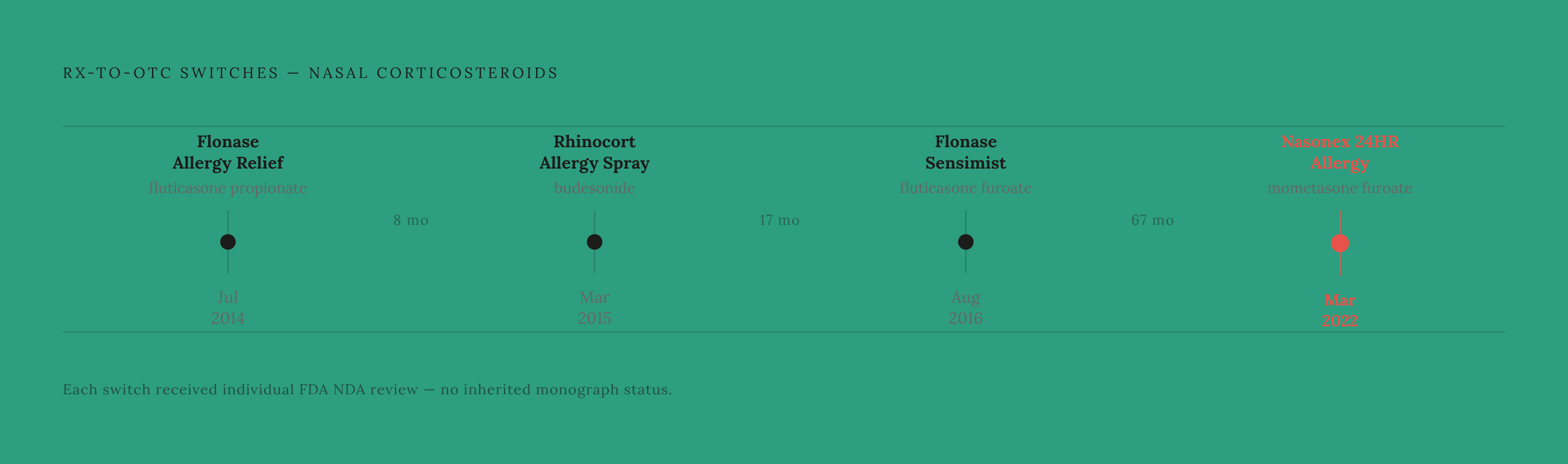
Nasal corticosteroid sprays are the OTC allergy category that has most recently and consistently passed individualized FDA scrutiny. Every major product in this class reached nonprescription status through a formal Rx-to-OTC switch, not a legacy monograph determination. The switch record tells the story clearly.
Flonase Allergy Relief (fluticasone propionate) switched to OTC status in July 2014. Rhinocort Allergy Spray (budesonide) followed in March 2015. Flonase Sensimist Allergy Relief (fluticasone furoate) made the switch in August 2016. Most recently, Nasonex 24HR Allergy (mometasone furoate nasal spray, 50 mcg per spray) gained OTC status in March 2022. Each of these products was evaluated on its specific formulation and dose before the FDA permitted nonprescription sale.
That individualized review represents a meaningfully higher bar than inherited monograph status. The category's regulatory standing is also current. The most recent switch happened in 2022, so this is not a category coasting on determinations from the 1970s. The strong regulatory record reflects well-characterized efficacy for symptom relief.
But here is the important distinction: symptom relief and disease modification are not the same thing. These sprays carry strong modern FDA approval and offer demonstrable efficacy for symptom relief, yet their regulatory standing reflects what the FDA explicitly endorses, which is symptom management rather than immune system retraining. If you want lasting relief instead of daily medication dependence, that limitation matters. So immunotherapy-based approaches, including at-home sublingual treatment, are a distinct clinical path if you are ready to address root cause.
Oral antihistamines — a mixed picture of solid approvals and a new FDA safety warning
Oral antihistamines occupy two regulatory tiers. Older first-generation drugs entered the market through the monograph system. Newer second-generation drugs went through formal Rx-to-OTC switches with contemporary product-level reviews. That split means the category carries both inherited GRASE status and modern individualized approvals.
The switch record for the second-generation agents is substantial. Zyrtec Allergy and Zyrtec Hives Relief (cetirizine tablets) switched to OTC status in November 2007, along with Children's Zyrtec Allergy in solution and chewable tablet forms, and Zyrtec-D, which combines cetirizine with pseudoephedrine. Allegra (fexofenadine) followed in January 2011, with multiple forms switching at once, including Allegra D 12hr.
The new complication arrived in 2025. The FDA issued a drug safety communication requiring that prescription cetirizine and levocetirizine labeling be updated to warn about rare but severe itching that can occur after stopping long-term use. The agency also said it will ask manufacturers to add this warning to OTC Drug Facts labels.
The itching, called pruritus, was reported in patients who used these medicines daily, typically for at least a few months and often for years. FDA identified 209 cases worldwide, 197 of them in the United States, reported between April 25, 2017, and July 6, 2023. Cases were rare but sometimes serious, requiring medical intervention. In most reported cases, restarting the medicine resolved the itching. No one knows the underlying mechanism, but the FDA's evaluation supports a causal relationship.
Timeline matters here. Cetirizine was first approved for prescription use in December 1995. Levocetirizine followed in May 2007. These drugs had been in wide use for years before this signal emerged. That is a live example of approval status being revisited after post-market evidence accumulates. An old approval does not mean the risk picture is closed.
Should this change how you think about daily antihistamine use? The FDA itself calls the risk rare, so the point is not alarm. The emerging FDA safety warnings around long-term antihistamine use nonetheless underscore a broader pattern: symptom-masking medications can carry hidden costs that only surface after years of daily use. That is why allergy sufferers increasingly explore whether a permanent solution, such as sublingual immunotherapy delivered by telehealth, might eliminate the need for indefinite pharmaceutical management.
Antihistamine nasal sprays — a newer Rx-to-OTC switch with a distinct side-effect profile
Antihistamine nasal sprays are a separate category from both oral antihistamines and corticosteroid nasal sprays. You may not make that distinction, but it carries real regulatory and clinical weight. The one major OTC product in this class received its nonprescription status only recently.
From the FDA's switch list: Astepro Allergy and Children's Astepro Allergy (azelastine hydrochloride nasal spray) switched to OTC status in June 2021. Azelastine had a long prescription history before that switch, so its nonprescription status was supported by an established safety and efficacy record. That gives it a more recent individualized review than most legacy OTC antihistamines.
The side-effect profile is distinct from oral antihistamines. Azelastine offers faster onset and minimal systemic drowsiness risk, but it carries local effects including bitter taste, headache, nosebleeds, and nasal burning or stinging. Those trade-offs are worth knowing before you buy. Oral or nasal, the format of an antihistamine affects its approval pathway history and the side effects you are likely to notice.
Oral decongestants — the category where the FDA has concluded the flagship ingredient does not work
Oral phenylephrine entered the market through the monograph pathway decades ago. It is the nasal decongestant active ingredient in a wide range of branded combination OTC products. That legacy determination, inherited GRASE status, is now being undone.
In November 2024, the FDA proposed removing oral phenylephrine as an active ingredient for temporary relief of nasal congestion in OTC monograph drug products. The agency reviewed the available data and determined that oral phenylephrine is not effective for this use. This is a proposed order, not a final one. Only a final order will affect what products can be marketed.
What does this mean practically? For now, companies may continue to market OTC monograph products containing oral phenylephrine as a nasal decongestant. The products remain on shelves, and the labels have not changed. The proposed order is based on effectiveness concerns, not safety concerns. Some products contain only oral phenylephrine as a single active ingredient. Others combine it with something else, like acetaminophen or dextromethorphan, and its presence does not affect how those other ingredients work for their intended symptoms.
This is the clearest illustration of the monograph system's vulnerability. An ingredient can sit in the GRASE category for decades. You can buy products containing it on the assumption that the FDA has validated it. Meanwhile the actual evidence base eroded over time. One might argue that a system designed to ensure "safe and effective" drugs should have caught this sooner, and that raises an important question: how many other monograph ingredients rest on evidence that no longer holds up?
Pseudoephedrine, the other major oral decongestant, is not under equivalent challenge. But its sale is regulated under the Combat Methamphetamine Epidemic Act, which keeps it behind the pharmacy counter. It is not a freely accessible OTC product in the traditional sense.
OTC allergy eye drops — a category shaped by formal Rx-to-OTC switches, with several options now available
OTC antihistamine eye drops are among the most recently and thoroughly reviewed products in the nonprescription allergy space. Several prescription-strength options have received formal Rx-to-OTC switches over the past decade, and each underwent individualized product-level review before nonprescription sale was permitted. The switch record spans multiple products. Zaditor (ketotifen fumarate ophthalmic solution) was switched under NDA 21066/S-011. Pataday Twice Daily Relief and Pataday Once Daily Relief (both olopatadine hydrochloride) switched to OTC status in February 2020. Pataday Once Daily Relief Extra Strength followed in July 2020. Lastacaft (alcaftadine ophthalmic solution) switched to OTC status in December 2021, with an indication for temporarily relieving itchy eyes due to pollen, ragweed, grass, animal hair, and dander.
The regulatory quality here matches the nasal corticosteroid sprays, with contemporary product-level reviews across the board. The category's limitation is scope, not rigor. These products address ocular symptoms only. They do not treat nasal, respiratory, or systemic allergy manifestations. If your allergies hit your eyes alone, that is fine. If they hit everywhere, an eye drop is a partial answer. So the quality of FDA review varies sharply by category, not by symptom severity. A product for itchy eyes may carry more recent individualized scrutiny than a product for congestion that sits right next to it on the shelf.
What the regulatory patchwork reveals about relying on OTC allergy products long-term
Across these categories, the regulatory picture is uneven in a way that should inform how you think about long-term daily use. Nasal corticosteroids and switched antihistamine eye drops carry the strongest recent individualized FDA review. Oral antihistamines in wide daily use now carry FDA safety language about discontinuation effects that was not there at approval. The primary oral decongestant ingredient is under a proposed FDA removal for ineffectiveness after decades of presumed GRASE status.
The common thread across all four categories is that every OTC allergy medication is approved or proposed for temporary symptom relief. None carries an FDA indication for modifying the underlying allergic disease. If you use these products daily for months or years, "FDA approved" describes a regulatory checkpoint, not a permanent endorsement of indefinite, open-ended use as a substitute for treating root cause.
That raises an important question: what does genuine, lasting relief require? The relevant contrast is sublingual immunotherapy. You can get it as FDA-reviewed tablets for certain grasses, ragweed, and dust mites, or use it off-label as custom drops with guideline support. This is the category of treatment designed to retrain the immune system rather than suppress its reactions.
Wyndly offers personalized, doctor-guided sublingual immunotherapy via telehealth, with at-home finger-prick testing and treatment plans delivered to the door. It is an accessible path to addressing root cause for patients whose daily OTC routine is managing but not resolving their allergies. In the end, the regulatory patchwork teaches you the difference between symptom suppression and immune retraining.
Sources
- Prescription to Nonprescription Switch List
- FDA requires warning about rare but severe itching after stopping long-term use of oral allergy medicines cetirizine or levocetirizine (Zyrtec, Xyzal, and other trade names)
- FDA Proposes Ending Use of Oral Phenylephrine as OTC Monograph Nasal Decongestant Active Ingredient After Extensive Review