Long-Term Antihistamine Side Effects on Cognition and Organ Systems
First-generation antihistamines carry cognitive and organ risks that warrant closer examination.

Taking an antihistamine for a long time can harm cognition and other organ systems, especially when first-generation drugs are taken regularly. Symptom relief matters, but it is not the same as treating the allergic response that makes medication necessary. For adults seeking an at-home alternative to allergy shots, physician-guided sublingual immunotherapy offers a disease-modifying approach, with suitability and any switch assessed by a clinician.
How first-generation antihistamines reach the brain and why that matters
The blood-brain barrier is a boundary between the bloodstream and the brain that limits which substances can enter. First-generation antihistamines, or FGAs, can cross that boundary. Once inside, they block histamine receptors, interfering with a chemical messenger that helps regulate alertness, focus, and memory. Sedation is not an unrelated side effect but a consequence of where these drugs act.
FGAs also block receptors for acetylcholine, another chemical messenger central to memory and learning. This is what “anticholinergic” means, namely that a drug interferes with acetylcholine’s signals. Certain bladder medications and antidepressants act through the same mechanism, so an allergy medicine may contribute to a burden that other prescriptions already create. Second-generation antihistamines, or SGAs, have a meaningfully different profile. Cetirizine, for example, stays mostly outside the brain and does not block much acetylcholine, so it helps relieve allergies with fewer of the central anticholinergic effects of older drugs.
What the cumulative-dose evidence shows about dementia risk
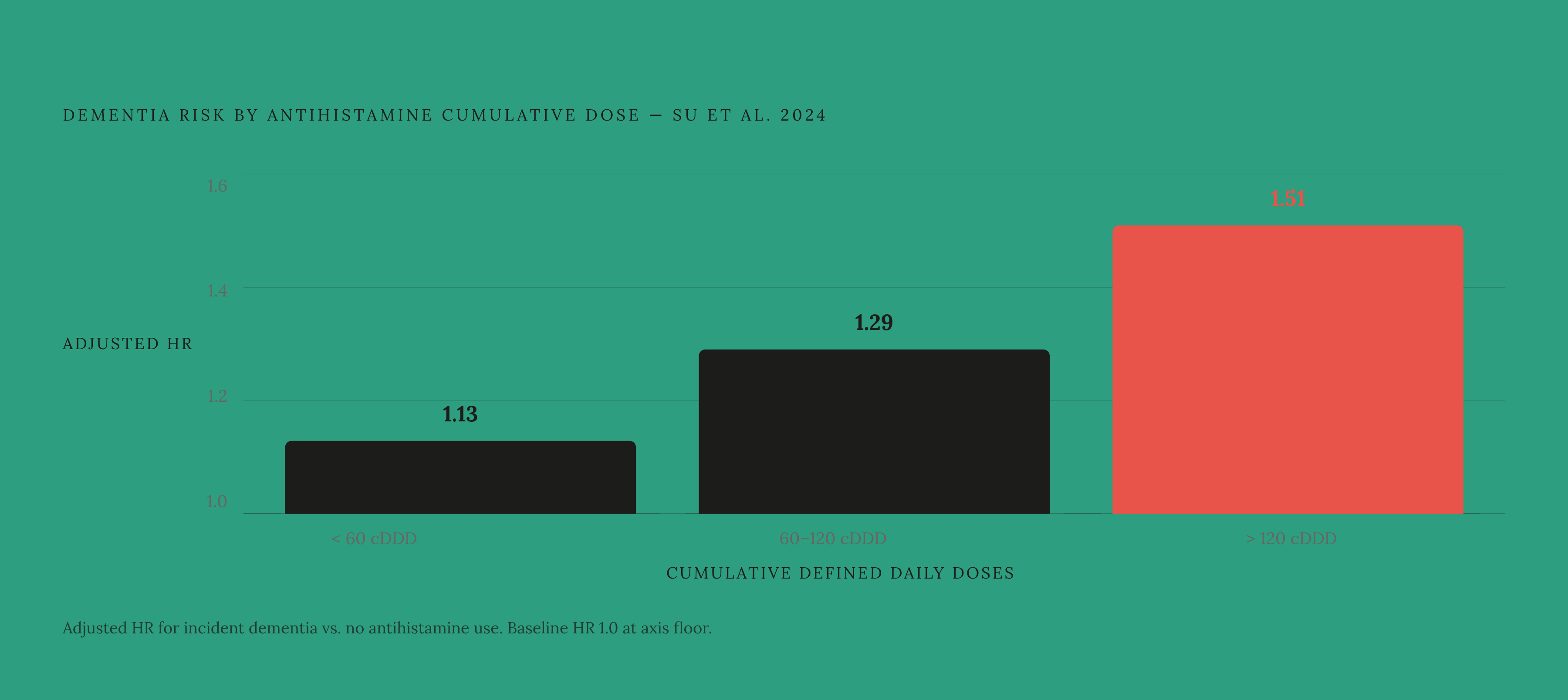
Su et al. (2024) studied more than 700,000 patients with new-onset allergic rhinitis using Taiwan’s National Health Insurance Research Database from 2011 to 2017. Their retrospective cohort study grouped exposure by cumulative defined daily doses, or cDDD, a measure of medication use accumulated over time. The categories were fewer than 60, 60–120, and more than 120. For people who used an FGA, adjusted hazard ratios for dementia rose from 1.13 to 1.29 to 1.51 across those categories. These figures describe relative differences in hazard.
SGA users also showed elevated hazard ratios, but at lower magnitudes than FGA users. That distinction matters because the two generations differ in their ability to enter the brain and block acetylcholine. The results do not justify describing all antihistamines as carrying the same cognitive risk. They do support closer attention to the drug being taken and the amount accumulated.
Reallon et al. (2024) examined a different outcome in a memory clinic cohort at Hospices Civils de Lyon. Patients with moderate Drug Burden Index scores lost roughly 1.74 MMSE points per year, compared with 1.26 in unexposed patients. This measure tracks cognitive performance rather than new dementia diagnoses, and the exposure included anticholinergic and sedative drugs broadly. It therefore supports concern about cumulative medication burden without isolating antihistamines as the cause.
The limits deserve equal attention. Some large studies of anticholinergic drugs have found no clear dementia signal specifically for allergy medications, and Su et al.’s observational design cannot establish causation. A dose-response gradient strengthens concern, but it does not rule out confounding. Higher cumulative FGA exposure is associated with greater risk.
Why the cognitive risk is not limited to dementia decades away
Drowsiness, slower reaction times, and difficulty concentrating are established acute effects of FGAs. Problems with memory and processing can affect everyday tasks long before anyone thinks to check for dementia. For a person who drives, works, or studies, those effects are part of the medication’s practical cost.
The American College of Allergy, Asthma & Immunology notes that fatigue and cognitive impairment from allergic disease can affect decision-making and hand-eye coordination, contributing to school and work injuries and car accidents. FGA-induced sedation can compound that existing problem. This creates a difficult trade-off when a medicine reduces sneezing but leaves the person less alert. The relevant comparison considers overall function with the disease, the treatment, and any other sedating medication taken together.
The memory clinic findings also show why cognition should not be treated as a binary outcome. Changes on an assessment can accumulate without an obvious moment when the patient notices a loss. Some regular FGA users may never have a steady decline, and the cohort was made up of older adults receiving memory care. It means patients deserve to hear about measurable cognitive effects before a familiar medicine becomes an unquestioned daily routine.
The organ systems beyond the brain that chronic antihistamine use affects
Acetylcholine does not work only in the brain, so blocking it creates effects elsewhere in the body. FGAs can affect the urinary tract, gastrointestinal system, cardiovascular system, and eyes. Their familiar peripheral effects include urinary retention, constipation, dry mouth, blurred vision, and elevated heart rate. These follow from interference with acetylcholine signaling in smooth muscle and secretory glands. They show that an allergy pill is a whole-body exposure, even when the symptom being treated is confined to the nose.
The Drug Burden Index framework used by Reallon et al. captures exposure to anticholinergic and sedative drugs across a patient’s medication regimen. A daily FGA, a sleep aid, and a bladder medication may together place a heavy burden on the body even if each seems to have little effect on its own. In older adults, anticholinergic burden is also associated with falls and hospitalization. These concerns support reviewing the whole regimen, but they do not establish that every affected organ sustains permanent damage from chronic antihistamine use.
What distinguishes occasional users from chronic symptom-maskers — and who is actually at risk
Taking an antihistamine on a single bad pollen day is not the exposure pattern that drives the cumulative-dose argument. The greater concern is regular use that continues for months or years without a fresh look at the plan. Allergic rhinitis can persist, making it easy for a short-term response to become permanent maintenance. Su et al. studied patients with new-onset allergic rhinitis, so the findings apply to people at that familiar starting point. However, the study’s dose categories measure exposure and do not set a number of days after which harm is sure to occur.
Older adults are more at risk because the body makes less acetylcholine as it ages. Adding a drug that blocks its signals can place further strain on a system already working with less. Other anticholinergic or sedating medicines can compound that burden. Diphenhydramine also appears in sleep aids, so someone treating both allergies and sleeplessness may accumulate exposure from more than one product.
Younger adults are not exempt from sedation or impaired concentration, but findings in older memory clinic patients should not be treated as a direct forecast for them. Likewise, daily SGA use should not be equated with daily FGA use. SGAs have a meaningfully lower anticholinergic risk profile, although Su et al. found an association at lower magnitudes for that group too.
Why symptom-masking guarantees the underlying problem continues
Antihistamines block part of the output of an allergic response without teaching the immune system to tolerate the allergen. That explains their limitation as a stand-alone long-term strategy. Relief from sneezing or itching does not establish that the underlying allergic process has resolved. Stopping the medicine also leaves that process in place.
Allergic inflammation can itself interfere with cognition. Cytokines, including interleukin-1β and tumor necrosis factor-α, can cross the blood-brain barrier and disrupt neural function, affecting processing speed, working memory, and executive function. A person may therefore have brain fog from inflammation even when some outward symptoms get better. Nasal obstruction can also drive mouth breathing and fragmented sleep. Poor sleep can also impair memory consolidation and reduce executive function.
This is a possible dual burden, consisting of medication effects and incompletely controlled disease. It is especially relevant when a sedating FGA is used to manage allergies that still disturb sleep. Symptom-masking leaves immune tolerance unaddressed. Disease-modifying options, including sublingual immunotherapy offered through services such as Wyndly, address that different treatment goal.
Can adults switch from allergy shots to at-home drops — and what does immune retraining do differently
Physician-guided sublingual immunotherapy, or SLIT, is an at-home option for adults who want treatment other than allergy shots at a clinic. Whether someone can switch depends on a clinician’s assessment and an individualized treatment plan. Both approaches are forms of allergen immunotherapy. Unlike antihistamines and nasal corticosteroids, which act downstream of the allergic response, immunotherapy targets the response itself. SLIT is therefore a disease-modifying option.
SLIT introduces controlled allergen doses to specialized immune cells under the tongue. Over time, it shifts the response away from allergy-driving Th2 activity toward Th1 and regulatory T-cell tolerance, with downstream reductions in IgE. In plain terms, the aim is to make the immune system less reactive to the allergen. Successful treatment can reduce both symptoms and the need for medication. Taking less of an FGA cuts the anticholinergic exposure that builds up over time.
Randomized controlled trials of grass and house dust mite SLIT tablets support clinically meaningful reductions in symptoms and medication use. Sustained benefits have been observed up to one to two years after a three-year treatment course. Those findings support SLIT’s role in allergic rhinitis, but results for tablets should not be assumed to establish identical outcomes for every custom drop formulation. Effects on day-to-day asthma control are also less consistent. Reduced medication use is a supported goal.
SLIT does not introduce an anticholinergic or sedative burden, though it has its own side effects. Most reactions are local and affect the mouth and throat or gastrointestinal tract, while severe systemic reactions are rare. Wyndly offers physician-guided drops mixed to match a patient’s allergen profile and sent to the patient for treatment at home.
What patients and clinicians should weigh when reassessing long-term antihistamine use
An informed reassessment starts with the generation of antihistamine, the accumulated dose, other medications, and age. Daily diphenhydramine use presents a stronger pharmacological reason to consider switching than use of an SGA with little anticholinergic activity. The review should also account for sleep aids, bladder medicines, and antidepressants that contribute to the same burden. The aim is an explicit risk-benefit decision.
For patients who have used antihistamines for a year or more with no end in sight, immunotherapy deserves discussion. Identifying relevant allergens is a prerequisite to a personalized plan. At-home finger-prick blood testing can identify specific IgE sensitizations as part of that assessment. Through Wyndly, patients have a virtual consultation and at-home testing, then receive a sublingual treatment plan made for them.
Antihistamines still have a role in treating acute allergies and symptoms that occur now and then. Indefinite daily exposure, particularly to FGAs, carries biological costs and leaves the disease itself unresolved. The evidence supports concern about cognition and whole-body anticholinergic burden, while leaving uncertainty about how much dementia risk is directly caused by these medicines.