Are Allergies Contagious or Hereditary
Allergies run in families but require environmental triggers to develop.
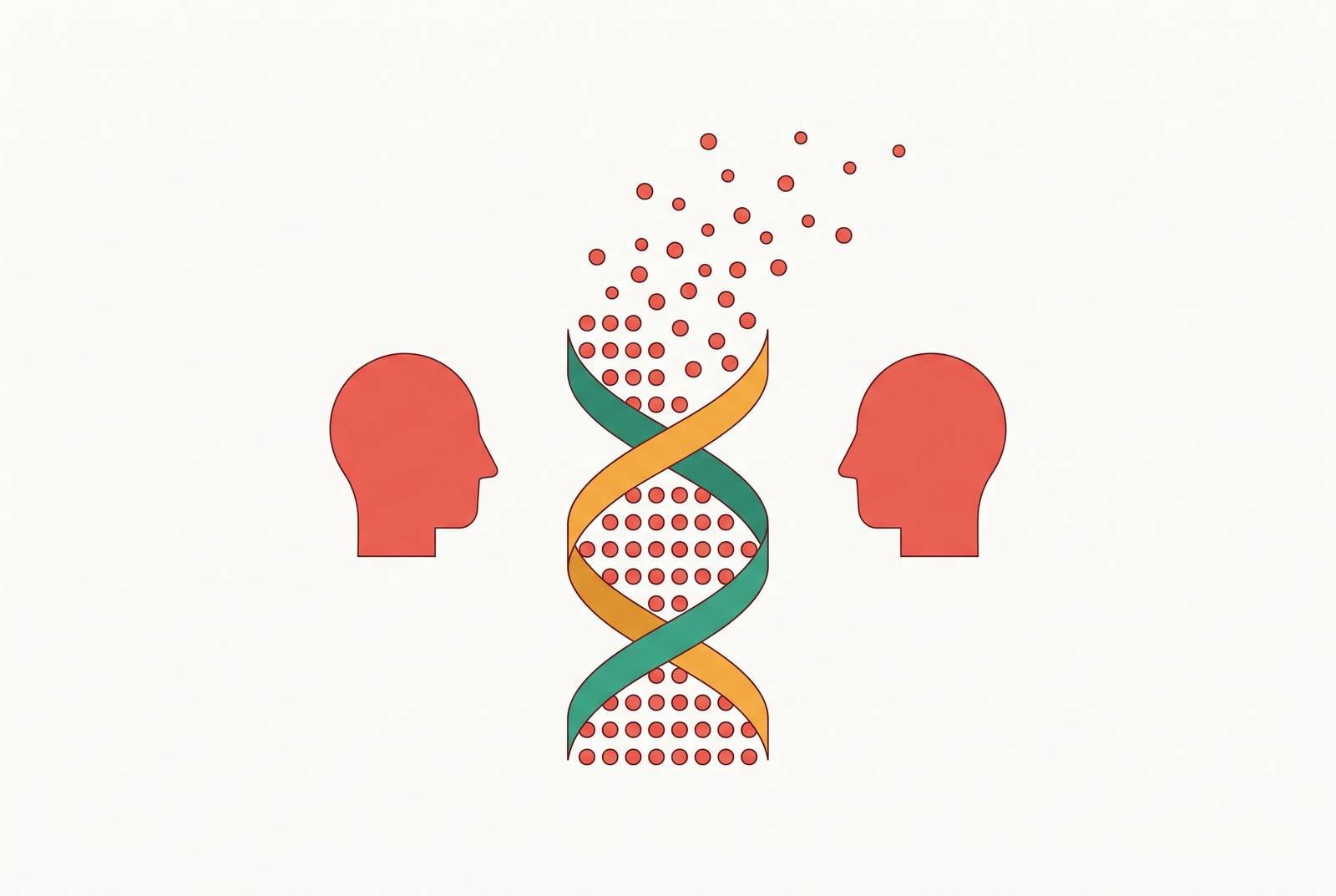
Allergies can run in families. Parents pass down a general tendency to develop allergies.
Why the question "are allergies contagious?" is worth taking seriously
When several people in a household sneeze or develop runny noses around the same time, a shared illness is an understandable explanation. Seasonal allergies can look much like that from the outside. Their symptoms overlap with those of a cold, and allergies often cluster within families.
An allergic condition cannot pass from one person to another through contact, air, or proximity. Being near someone with allergies does not make their allergy yours. Why relatives so often have allergic conditions remains to be explained. The answer lies in what they inherit and how that inheritance interacts with their surroundings.
What parents actually pass down: predisposition, not specific allergies
The inherited tendency to develop allergies is called atopy. It means a person is more likely to develop an allergic response because of their genetics, with the particular food or pollen their immune system will react to remaining uncertain. That distinction explains why an allergic parent's triggers do not reliably predict a child's.
Consider a family in which one sibling has hay fever, another reacts to cat dander, and another has an egg allergy. Another sibling may have none of these conditions even though they have the same parents. These differences show why inheritance is better understood as a tendency that can take different forms, or never become an allergic condition at all.
Asthma, hay fever, atopic eczema, and food allergies share patterns of genetic susceptibility. Children with eczema are also more likely to have food allergies, which helps explain why different allergic conditions appear together. A child whose parents have allergies is more likely to have them, but children with no family history of allergies can have them too. Family history and inherited susceptibility cannot tell which condition a child will have or how severe it will be.
How environment activates a genetic predisposition
Genetics can prime the immune system, while environmental and lifestyle factors influence an allergy's development.
Researchers associate several factors with increased allergy risk, including tobacco smoke exposure, antibiotic use, viral respiratory infections, and early exposure to high concentrations of allergens. Diet, particularly high-sugar and highly processed foods during childhood, is another area of study. Climate-related changes in temperature and humidity also form part of the environmental picture. These links suggest that a person's biology and surroundings work together, with each playing a part.
That interaction helps explain why siblings with the same parents can develop different allergies. Timing and exposure matter as well as inherited susceptibility. A child's future allergies remain uncertain even when their exposures are identified. A genetic predisposition is a warning signal, and it cannot reveal with certainty whether allergies will develop or which triggers will matter.
What recent genetic research is beginning to reveal — and where the gaps remain
Allergic disease has a more complex and varied genetic basis than early research assumed. Scientists are finding shared biological pathways, but a population-level association is not the same as a dependable prediction for one person.
Maier & Sun et al. published the largest genome-wide meta-analysis of food allergy to date online in The Journal of Allergy and Clinical Immunology in February 2026. Their analysis identified variants with suggestive links to food allergy, with some reaching genome-wide significance in adults. But follow-up analyses did not back up those findings. The authors concluded that the genetic factors contributing to food allergy remain incompletely understood.
The study also found that many of the genetic locations linked to food allergy were also involved in asthma and allergic rhinitis. That overlap supports shared underlying biology. Yet the risk variants differed markedly between children and adults. Food allergy therefore does not appear to have one uniform genetic pattern across the lifespan.
UT Southwestern used a different approach in a study published in The Journal of Allergy and Clinical Immunology in May 2026. Its researchers used whole exome sequencing, which examines the protein-coding regions of genes, to uncover clear genetic causes in a substantial share of patients with multiple food allergies. Most mutations involved FLG, a gene that helps maintain the skin's protective barrier. When the barrier is weakened, allergens may get through more easily and trigger immune responses.
This method found more FLG mutations than traditional genotyping did, including variants that are often missed in patients of non-European ancestry. That is meaningful progress toward explaining existing disease and, eventually, more personalized treatment. It is not evidence that consumer genetic testing can predict or prevent a child's allergies. For now, finding out about someone's genetic susceptibility is a separate task from finding what triggers their allergies.
Why allergies are so often missed, even when family history is a clear signal
Congestion, sneezing, a runny nose, itchy eyes, and a scratchy throat can point toward allergies, but they also overlap with other conditions. Headaches, fatigue, and aggravated asthma make the picture broader still. Family history can sharpen suspicion, but the symptoms alone make self-diagnosis unreliable.
Some of the most frustrating effects happen downstream of nasal congestion. Swollen tissues restrict airflow at night, encouraging mouth breathing and fragmented sleep. Less restorative sleep can then leave someone groggy, irritable, and unable to concentrate the next day. A person may blame stress or poor sleep habits and miss the link between those daytime problems and a blocked nose.
Histamine also acts as a neurotransmitter involved in alertness. Disruption of histamine balance and cytokine signaling during allergic inflammation can affect energy and mental sharpness independently of sleep quality. That helps explain why allergy-related fatigue may feel more diffuse than a familiar bout of sneezing.
None of these experiences proves an allergy on its own. Taken together with a family history, however, persistent congestion, poor sleep, and reduced concentration are reasons to investigate them together.
How allergy testing moves from genetic suspicion to a specific, actionable diagnosis
Family history gives a reason to check for allergies, while allergy testing helps find what the immune system reacts to. The main methods are skin prick tests and specific IgE blood tests. Both detect IgE-mediated sensitization to common airborne allergens, including tree, grass, and weed pollens, molds, dust mites, and pet dander. They answer a more focused question than a family history can answer.
Skin prick testing is generally performed by an allergist in a clinical setting. It gives results quickly and is widely considered reliable for immediate-type allergies. Specific IgE blood testing is another option, with at-home finger-prick kits that use the same laboratory technology as tests arranged through a doctor's office. That option can make investigation more accessible when location, cost, or daily responsibilities make clinic visits difficult.
The crucial step comes when the results are interpreted. A positive result shows sensitization through antibody production by the immune system, but it does not by itself establish a clinical allergy or predict reaction severity. The result must fit the symptoms the person has had. Physician interpretation turns a laboratory finding into a diagnosis that can support a personalized treatment plan, rather than leaving someone with a list of positive results and no clear meaning.
Why symptom-masking medications leave the hereditary problem unsolved
Once an allergy is identified, the next distinction is between calming its effects and changing the response that causes them. Antihistamines temporarily block histamine receptors. Nasal corticosteroid sprays reduce local inflammation. Those actions can relieve symptoms, but neither teaches the immune system to stop treating a harmless substance as a threat.
Genetic susceptibility and environmental exposure have helped prime an allergic response, and these medicines act on its output. As a result, symptom control does not mean the underlying sensitization has changed.
Medication can also bring its own burdens. First-generation antihistamines can cause drowsiness and dry mouth, while nasal sprays can cause local irritation and nosebleeds. Decongestant nasal sprays are a distinct case because use beyond a few days can produce rebound congestion.
For someone with recurring symptoms, choosing treatment therefore involves both relief today and the possibility of changing the allergic response over time. That is where an immune-level intervention differs from medicines that suppress symptoms.
How sublingual immunotherapy addresses the inherited immune tendency directly
Allergen immunotherapy is the treatment category that modifies the underlying allergic disease. Sublingual immunotherapy, or SLIT, exposes the immune system to progressively higher allergen doses under the tongue. Over time, it shifts the response away from the IgE-driven allergic cascade and toward tolerance. It works on the immune response shaped by inherited susceptibility, leaving the inherited genes themselves unchanged.
Clinical evidence shows that SLIT can cut symptoms and the need for medication enough to make a difference. Key trials have also observed benefits that continue beyond the treatment course. Real-world data suggest that after treatment, people may need less medication over the long term and be less likely to develop asthma. Outcomes may vary from person to person.
SLIT also has a more favorable systemic safety profile than subcutaneous immunotherapy, or allergy shots. Systemic reactions are extremely rare with SLIT. Local reactions, such as oral itching and mild throat irritation, are usually mild and go away on their own in the first few weeks. A favorable safety profile, however, is not the same as an absence of possible reactions.
The evidence also needs to be read at the level of the treatment being offered. FDA-approved SLIT tablets are available for certain grasses, ragweed, and dust mites. Custom multi-allergen drops cover more allergens, but they are used off-label and are not formally endorsed by major U.S. allergy guidelines. Studies differ meaningfully in design, so evidence for SLIT broadly should not be treated as equal proof for every custom formulation.
What a family history of allergies should actually prompt you to do
A good first step is to take symptoms that keep coming back seriously while keeping an open mind about their cause. That includes persistent congestion, disrupted sleep, and brain fog, as well as obvious sneezing or rashes. Testing can then identify specific sensitizations, and a physician can interpret those findings against the symptoms you actually experience. The next discussion can focus on treatment that addresses the immune response, rather than an indefinite cycle of symptom suppression.
For people who find repeated clinic visits difficult, at-home testing followed by physician-guided sublingual immunotherapy can make that path more accessible. FSA/HSA eligibility may also reduce the effective cost, subject to plan rules and the medical-purpose standard for at-home test kits. Accessibility can remove some of the practical barriers to getting the necessary interpretation and personalized plan.
The goal is not to treat a family history as a diagnosis, but to use it as a reason to seek clarity sooner. With an individual diagnosis, the choice becomes more precise than simply taking another medicine whenever symptoms return. It becomes a discussion about whether immune retraining is appropriate and what lasting benefit might look like. Inherited susceptibility cannot tell you exactly what comes next, but it can point toward a clearer path to relief.
Sources
- New genetic insights into food allergies
- Gene variants help explain why food allergies run in families: Newsroom - UT Southwestern, Dallas, Texas
- Grand challenges in genetics and epidemiology of allergic diseases: from genome to exposome and back
- How does sublingual immunotherapy work? - Journal of Allergy and Clinical Immunology
- Efficacy and safety of sublingual immunotherapy for allergic rhinitis: A network meta-analysis