Stopping Allergy Shots Mid-Course to Switch to Sublingual Drops at Home
Switching from shots to drops works, but research hasn't proven how much progress transfers over.
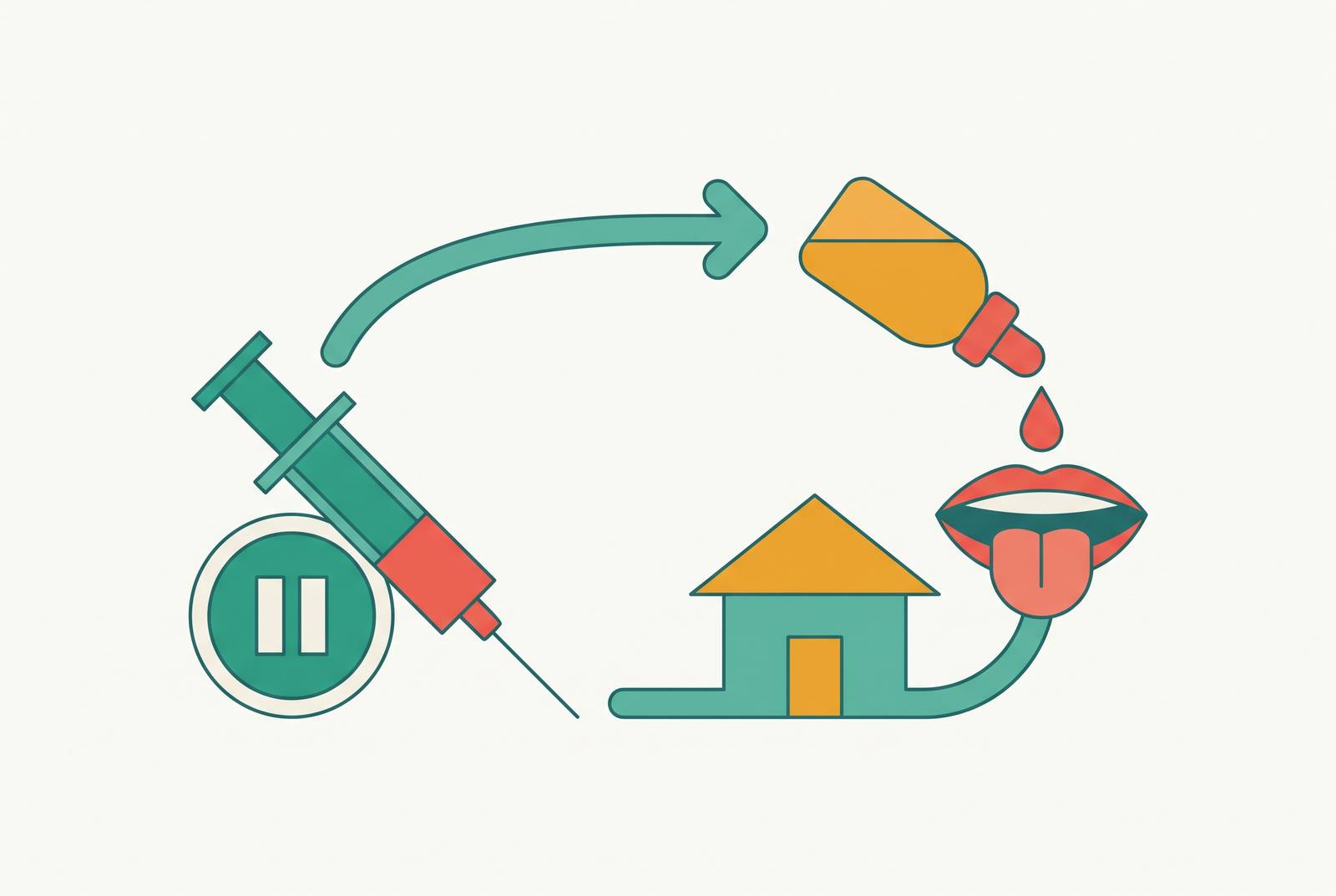
Stopping allergy shots mid-course to switch to sublingual drops at home can be a legitimate, physician-guided way to continue immunotherapy when clinic visits no longer fit your life. Drops build immune tolerance in much the same way as shots, but research has not shown how much of the progress from an unfinished shot course carries over. A planned transition, realistic expectations, and a treatment schedule you can sustain are central to the decision.
Why patients stop allergy shots before completing the full course
Allergy shots mean office visits every week during build-up, then every few weeks during maintenance, with time for observation after each injection. A new job, a move, or a child can make the schedule unsustainable even for someone determined to finish treatment. Meanwhile, build-up can take months, so patients must weigh the disruption to their lives against relief they may not yet feel.
For others, injection-site reactions or anxiety about rare systemic reactions make each appointment harder to face. These are practical concerns. Patients need to consider what happens to the treatment already completed and whether another route can support the same long-term goal.
What allergy shots are building inside the immune system — and what stopping interrupts
Subcutaneous immunotherapy, or SCIT, gradually exposes the immune system to an allergen so that it learns tolerance. Build-up uses progressively increasing doses, followed by maintenance at the highest tolerated dose. Maintenance gives tolerance time to become more durable. Some patients improve during build-up, but full benefit may take up to 12 months at maintenance.
The work done before maintenance is not zero. Blocking antibodies start to form, while IgE-mediated sensitization, which is part of the allergic response, starts to ease. Yet those early changes may not last if exposure stops before tolerance has had time to take hold. Feeling better and having lasting protection are not necessarily the same milestone.
This helps explain why patients who restart shots after a long gap may need lower doses or a return to build-up. The immune system does not reliably hold its position. Switching to drops raises a related but unresolved question about whether sublingual treatment can inherit and consolidate the groundwork of partial SCIT. Published research has not definitively settled that question, so a switch should not come with a promise that every completed injection counts toward a shorter drop course. The firmer basis for switching is SLIT’s ability to build tolerance in its own right.
What SLIT actually does — and how its mechanism compares to shots
Sublingual immunotherapy, or SLIT, delivers allergen extracts under the tongue. The route changes, but the central goal does not. Both approaches use repeated allergen exposure to build immune tolerance, unlike antihistamines, which address symptoms without reproducing that process.
Ji and Jiang’s 2023 network meta-analysis found fewer adverse reactions and a higher safety profile with SLIT than with SCIT, with dust mite SLIT ranking highest for effectiveness among the treatments compared. The World Allergy Organization’s 2026 Position Paper shows that experts agree that both SLIT tablets and drops work in clinical practice. Its findings suggest that they work about as well as each other for allergic rhinitis. That does not make every formulation interchangeable for every patient.
Dangerous systemic reactions are very rare with SLIT, while SCIT’s small but real anaphylaxis risk requires office administration and observation. In the U.S., Odactra, Grastek, Oralair, and Ragwitek are FDA-approved SLIT tablets for specific allergens. Custom SLIT drops are used off-label and can include multiple allergens in one formulation. That distinction affects insurance coverage as well as the choice of treatment.
How long SLIT takes to work and what the evidence says about sustained benefit
Does switching mean starting over from scratch? There is no established way to subtract time spent on shots from the SLIT course a physician recommends. Benefits can take several months to become apparent, and patients switching mid-course may still have three or more years of treatment ahead. The WAO panel reached high consensus that SLIT should be prescribed for at least three years. It also agreed that SLIT is disease-modifying, with stronger consensus for children and adolescents than for adults.
Baba et al.’s 2021 three-year randomized case-control study found sustained clinical improvement and a meaningful reduction in inhaled corticosteroid dose with house dust mite-specific SLIT. The study also found prevention of neosensitization to other airborne allergens. Completing treatment may help limit the development of new allergies, although this result in house dust mite-allergic patients is not a guarantee for every formulation or patient.
Home dosing removes travel but also removes the accountability of regular injection appointments. Physician-guided telehealth programs can supply regular virtual check-ins, personalized dosing, and adjustments to the treatment plan. Convenience becomes useful when it makes completion more achievable.
Can drops treat the same allergens as your allergy shots?
A patient who gets shots for dust mite, grass, and dog dander naturally wants to know whether drops can treat all three. Custom drops can include those triggers in a multi-allergen formulation. More broadly, drops can cover common environmental allergens treated with shots, including pet dander, mold, tree pollen, and cockroach. A change in delivery route need not create a gap in allergen coverage.
Tablets offer a narrower match for some patients. Their FDA-approved coverage does not extend to pet dander, mold, tree pollen including birch, or cockroach, so tablets alone cannot fully replace a shot mix targeting those allergens. This is where custom drops differ in practice. A physician can use allergy test results to tailor the formulation to the sensitization profile the shot course was treating.
The WAO paper identifies house dust mite, grass, birch, and weed pollens as the allergens best represented in SLIT efficacy trials. The fact that an allergen can be included in drops does not mean its evidence base is equally extensive. To match a prior shot regimen, the physician and patient need to identify the triggers and discuss how much evidence backs the proposed treatment for them.
How to time the transition — practical guidance on stopping shots and starting drops
For someone ready to switch, the first step is a conversation with the prescribing allergist before stopping injections. There is no published consensus on a standard carry-over dosing protocol from partial SCIT to drops. The treating physician needs to look at which allergens were included, how high the doses got, and whether the patient had reached maintenance.
The last injection date, any brief washout period, and the first drop dose should follow the physician’s instructions. Someone still in build-up has a different treatment history from someone who has spent time at maintenance. The latter has had more opportunity to consolidate tolerance, but neither history supplies a reliable conversion formula.
SLIT’s favorable safety profile makes dose-finding less constrained by systemic reactions than restarting SCIT, although it does not make dosing a do-it-yourself decision. Drops and tablets also have different onboarding requirements. FDA-approved tablet labels require the first dose under medical supervision, with 30-minute observation and epinephrine availability, before later doses are taken at home. For custom drops through telehealth, an at-home finger-prick allergy test can establish or update the sensitization profile, while a virtual consultation can replace most in-office onboarding. The physician uses that information together with the prior shot history to prescribe the plan.
What to expect in the first months after switching — symptoms, side effects, and realistic milestones
The first months on drops may feel unremarkable. That is expected because tolerance builds gradually, so there may be no clear sensation that the treatment is doing its work. Having had part of a shot course does not show that drops will bring relief sooner.
The most common side effects early on are local oral reactions, such as itching or tingling under the tongue, mild throat irritation, and mouth swelling. These typically diminish with continued dosing and do not usually require stopping treatment. Even with this good overall safety record, some reactions can matter. Physician follow-up remains part of home treatment.
Milestones are useful as expectations. Many patients start to notice early changes around three months, while symptoms usually ease enough to make a difference at six to twelve months. The changes that support lasting tolerance consolidate over a full three-to-five-year course. For patients making the switch, the practical advice is to establish a daily dosing routine at a consistent time and maintain the planned follow-up. Interrupting SLIT can erode incremental tolerance, so staying with the prescribed course is central to the lasting result.
The cost and coverage difference between shots and at-home drops — what to plan for
Insurance often covers allergy shots and may cover FDA-approved SLIT tablets, depending on the plan. Custom drops are rarely covered because they are off-label. This creates a real change in how treatment is paid for, but it is not a direct measure of treatment quality. Evidence of benefit and eligibility for reimbursement answer different questions.
For someone planning a switch, the useful comparison includes more than the price of the drops. Shots can mean co-pays to see a specialist, repeated office visits, and time off work for injections and observation. Telehealth drops remove the repeated injection-visit burden, which can offset part of the out-of-pocket expense. FSA/HSA eligibility may also help with planning. Without knowing the plan and price, though, no one can promise that everyone will save money.
The longer-term calculation includes the cost of poorly controlled allergies. Antihistamines, nasal sprays, urgent care visits, and lost productivity can all add recurring expense. A completed immunotherapy course can reduce some of those costs as symptoms and medication dependence decline. Those potential offsets are worth considering, but they are not guaranteed savings or money available to pay the initial treatment bill.
How to confirm whether you're a good candidate before committing to the switch
Someone whose shot treatment was moving ahead but who can no longer keep going to the clinic may be a good candidate for the switch. Completed or nearly completed build-up and an allergen profile that drops can address are useful criteria. They are not a substitute for medical assessment. Uncontrolled asthma or a history of severe systemic reactions to SLIT can change whether home treatment is appropriate.
A board-certified allergist can look at the patient’s prior SCIT history, check how far treatment got, and decide whether a drop plan tailored to that patient is a good fit. This conversation also tests the practical side of the choice. Can the patient maintain daily treatment for years, and does the program provide follow-up that supports that commitment? The best at-home alternative depends on allergen coverage, safety, access, cost, and the ability to finish (not convenience alone).
An updated test can help complete that assessment. An at-home finger-prick blood test can identify current IgE sensitization, which the allergist interprets together with symptoms and previous treatment records. If the shot mix was based on older testing, the results may show that the patient’s profile has changed and needs to be discussed.
Sources
- World Allergy Organization Sublingual Immunotherapy Position Paper: 2026 update - World Allergy Organization Journal
- Efficacy and safety of sublingual immunotherapy for allergic rhinitis: A network meta-analysis
- Effectiveness of Sublingual Immunotherapy in the Treatment of HDM-Induced Nasobronchial Allergies: A 3-Year Randomized Case-Control Study From Kashmir