Allergy-Related Sinusitis vs. Chronic Sinusitis Without Allergy
Distinguishing between the two conditions changes which treatment actually works.
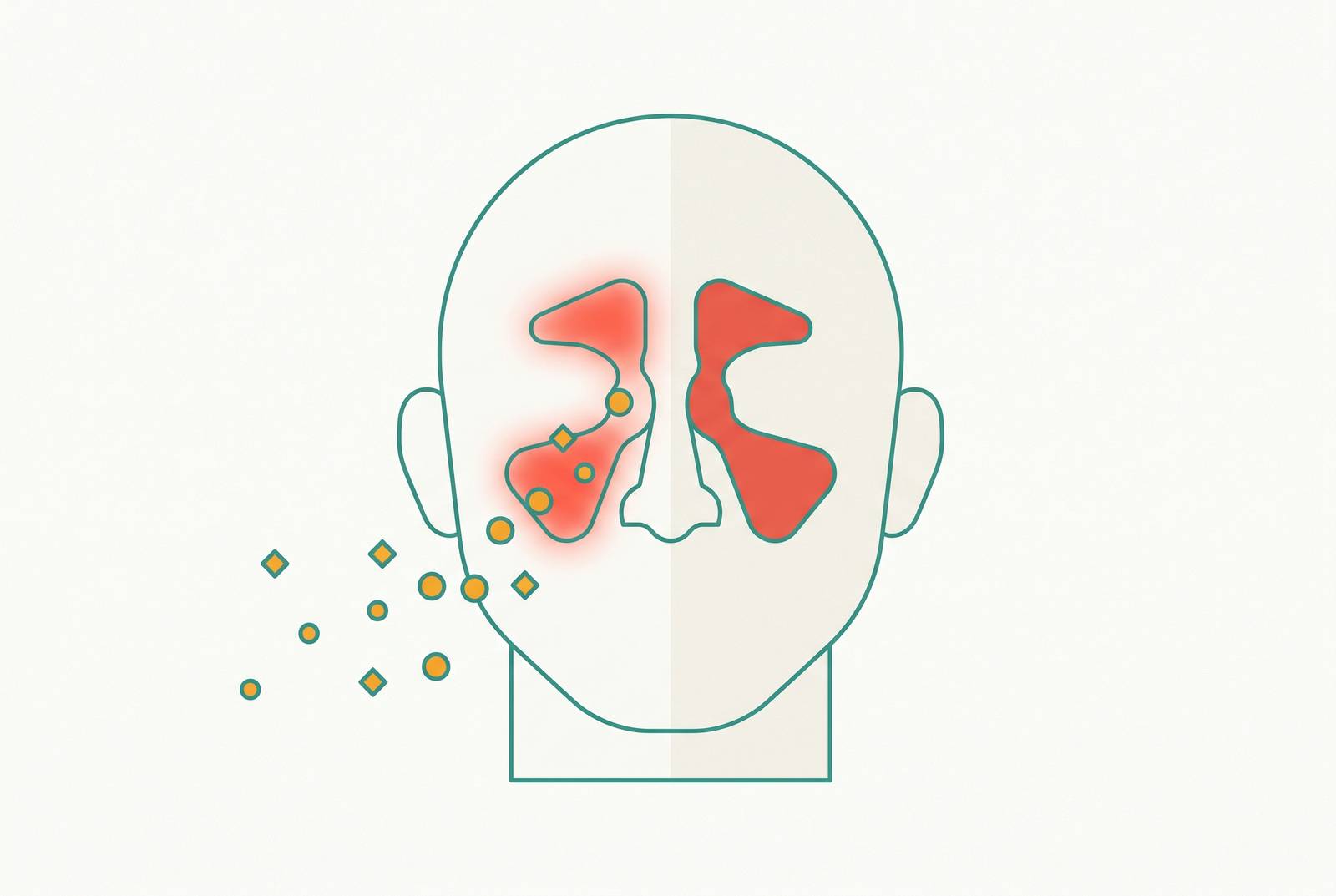
Allergic sinusitis and chronic non-allergic rhinosinusitis can feel identical from the inside: stuffy nose, facial pressure, headaches, a dulled sense of smell. But they come from two different mechanisms in the body, and mixing them up is a major reason undiagnosed allergies keep causing fatigue, brain fog, and poor sleep that never gets traced back to its source. Figuring out which one you have isn't a technicality; it's the step that decides whether any treatment you try will actually work.
Why allergy-related sinusitis and chronic sinusitis without allergy are so easy to confuse
Someone who has been taking an antihistamine every day for a year, with no real change in how they feel, is living out a common diagnostic dead end. The congestion is still there. The facial pressure still builds by afternoon. The postnasal drip still wakes them up at night. At some point, the question stops being "which allergy medication should I try next" and starts being "is this even allergies at all."
That question is harder to answer than it sounds, because allergic sinusitis and chronic non-allergic rhinosinusitis produce nearly the same surface picture. Both cause persistent nasal congestion, facial pressure or fullness, postnasal drip, headaches, and a reduced sense of smell. Looking at the symptom list alone gives a patient, and sometimes even a clinician, almost nothing to go on.
That overlap is why people spend months or years treating the wrong condition. Antihistamines get cycled through. Antibiotics get prescribed for suspected infections. Neither does much of anything, because neither is aimed at what's actually driving the problem. Dr. Eugene Chang, a sinus surgeon with Banner - University Medicine, has described chronic non-allergic rhinosinusitis as "often overlooked" and distinct from other sinus conditions. Two details back that up: allergy testing in these patients usually comes back negative, and antibiotics don't help, because there's no allergen and no infection driving the inflammation.
One clue separates the two conditions earlier than most people expect: itching and sneezing. Those symptoms appear far more often in allergic disease. As Dr. Chang put it, "most people don't have itching or sneezing with chronic non-allergic rhinosinusitis," a small detail worth paying attention to before reaching for another round of antihistamines.
What is actually driving each condition, the mechanistic split
Two different processes can produce the same symptoms, and understanding which one is at work changes everything about treatment.
Allergic sinusitis starts with the immune system. The body flags something harmless, pollen, dust mites, mold, pet dander, as a threat. That triggers an IgE-mediated response, and the inflammation from that response swells the lining of the nose and sinuses. The congestion, the pressure, the drip: all downstream of an immune reaction to a specific trigger.
Chronic non-allergic rhinosinusitis works differently. It's long-term inflammation of the nose and sinuses, lasting more than twelve weeks, and allergy testing in these cases is usually negative. Antibiotics don't help either, since there's no allergen setting off the immune system.
Part of this category is vasomotor rhinitis, where the nasal lining has become overly sensitive and reacts to everyday irritants: air pollution, cigarette smoke, strong odors, dry air, sudden weather changes.
Structural issues can cause the same pattern on their own. A deviated septum, narrow sinus passages, or poor drainage pathways can keep the sinuses backed up without any allergy or infection involved. Think of it like a drainage system that keeps clogging: the pipes themselves are the problem, not what's flowing through them.
Other contributors stack onto this list: acid reflux irritating nasal and sinus tissue, hormonal shifts, overusing decongestant nasal sprays, and long-term exposure to workplace irritants. Most non-allergic cases involve more than one of these factors at once, not a single clean cause.
Chronic rhinosinusitis also has a structural classification independent of allergy status. Chronic rhinosinusitis is typically split into two types: CRS with nasal polyposis (CRSwNP) and CRS without nasal polyposis (CRSsNP). That distinction matters for treatment planning, but it runs on its own axis. A patient can fall into either category regardless of whether allergies are involved.
Why the relationship between allergy and chronic sinusitis is genuinely contested, and what that means for patients
The clean split between "allergic" and "non-allergic" gets messier once real patients enter the picture, because plenty of people have both at the same time.
Researchers themselves describe the link between allergic disease and chronic sinusitis as poorly defined. Some studies find a cause-and-effect relationship between the two. Others find no meaningful association. A study comparing allergen sensitization in patients with and without nasal polyposis found that allergy co-occurrence varies a good deal by subtype, showing that these aren't interchangeable patient populations lumped under one label.
This matters for anyone trying to make sense of their own test results. A positive allergy test does not automatically mean allergies are causing the symptoms happening right now. Sensitization, the immune system being primed to react to something, and active clinical allergy, that reaction actually producing symptoms, are not the same thing.
This is part of why misdiagnosis sticks around as long as it does. A patient with both allergic sensitization and a structural sinus problem might get treated for allergies alone, while the deviated septum or narrow passage behind their symptoms goes untouched. Or the reverse happens: someone gets referred straight to structural evaluation while an active allergy goes unchecked. Neither patient gets full relief, because only half the picture got addressed.
Telling the Two Conditions Apart
Timing is usually the first clue. Allergic sinusitis tends to track with allergen exposure, tree pollen in spring, grass pollen in summer, ragweed in fall, or a steady year-round pattern if the trigger is indoor, like dust mites or pet dander. Non-allergic chronic rhinosinusitis tends to ignore the calendar. Symptoms stay fairly constant and track more with irritants or structural issues than with the season.
Dr. Chang lays out the diagnostic path for suspected non-allergic disease: a detailed symptom history, a physical exam of the nose and sinuses, nasal endoscopy to look directly inside the nasal passages, ruling out allergy or infection, and CT imaging when needed.
Allergy testing sits at the center of that process as a fork in the road, not a final verdict. A negative allergy panel in someone with sinus symptoms lasting more than twelve weeks points the diagnosis firmly toward the non-allergic category. How a patient responds to treatment adds another data point: symptoms that persist despite allergy medication are a recognized feature of non-allergic rhinosinusitis. If antihistamines are doing nothing, that's information, not just a failed attempt.
The confusion around all this persists partly because allergy testing often gets skipped as the first step, leaving patients guessing whether they're dealing with an allergic or non-allergic driver, a distinction that decides whether antihistamines or antibiotics stand any chance of working. Telehealth allergy providers like Wyndly have made it possible to rule allergies in or out before months get spent on the wrong category of treatment. Wyndly's at-home test uses a finger-prick blood sample to check for IgE antibodies against more than 40 indoor and outdoor allergens, including pet dander, dust mites, grass pollen, tree pollen, weed pollen, and mold species. A board-certified Wyndly doctor reviews the results against the patient's actual symptom history.
That last part matters. A positive result confirms sensitization. It doesn't by itself prove that allergy is causing the symptoms happening right now. Spring symptoms paired with a positive tree pollen result point toward an allergic driver. Persistent, year-round symptoms paired with a negative panel point the other way, toward the non-allergic pathway and a different kind of evaluation.
Why getting the diagnosis wrong has health consequences beyond sinus symptoms, like brain fog and exhaustion doctors keep missing
Misdiagnosed allergic sinusitis does not stay contained to the nose. Treated only with symptom management, the underlying immune driver keeps running in the background, and its effects reach places that have nothing to do with sinuses on the surface.
Chronic congestion, whichever condition is causing it, tends to push people into mouth breathing at night. That worsens snoring and raises the risk of sleep disorders, including sleep apnea. The next morning brings fatigue and brain fog that have nothing to do with how many hours were spent in bed.
Allergic disease carries an extra layer on top of that. The inflammatory cascade it triggers involves cytokines that cross the blood-brain barrier and interfere directly with cognitive function, affecting attention, working memory, mental stamina, and processing speed. Someone dealing with this can experience it as a thinking problem or a focus problem for a long time before ever connecting it back to their nose.
Can undiagnosed allergies cause chronic fatigue and trouble thinking clearly? For a meaningful number of people, yes, and that disconnect is what makes this hard to catch. Wyndly has pointed out that a large share of the tens of millions of Americans with environmental allergies don't realize allergies are behind what they're feeling. Migraines, headaches, brain fog, a runny nose that never quite resolves: these get treated as separate, unrelated complaints that are actually symptoms of one allergic process.
The misdiagnosis trap makes this worse. When allergic inflammation never gets identified as the actual cause, patients end up making reasonable changes, eating better, exercising more, going to bed earlier, that do nothing for the fatigue and poor sleep, because none of it touches the immune reaction actually driving those symptoms.
Why Treatments for the Two Conditions Diverge
This is where the stakes of getting the diagnosis right become concrete. Antihistamines and allergy immunotherapy don't do anything for non-allergic chronic rhinosinusitis, since there's no allergen-driven immune process for them to interrupt. Treatment instead focuses on calming inflammation and removing irritants: nasal steroid sprays, saline rinses, humidifiers, and addressing whatever structural issue is in play. When structure is the problem, surgery enters the picture: septoplasty to correct a deviated septum, inferior turbinate reduction for chronic swelling, or posterior nasal nerve radiofrequency treatment for vasomotor rhinitis. None of these would make sense for someone whose sinusitis is purely allergic.
Allergic sinusitis has an option non-allergic disease doesn't: allergen immunotherapy. Given as shots or as sublingual drops and tablets, it retrains the immune system to tolerate a specific allergen. That's a fundamentally different mechanism than symptom control.
Antihistamines and nasal sprays for allergic disease do real work, but only in the moment. They quiet inflammation while they're active. They don't change the underlying sensitization, so symptoms come right back once the medication wears off or stops.
Sublingual immunotherapy, the method Wyndly uses through officially approved tablets along with allergy drops that are clinically supported though not officially approved, exposes the immune system to small, controlled doses of an allergen over time to build tolerance. Clinical evidence backs meaningful drops in both symptoms and medication use, with benefits that tend to hold up even after the treatment course ends.
Understanding whether the immune system is reacting to something, or whether structural, environmental, or systemic factors are the real cause, is the foundation for any treatment that's going to work. For patients whose sinusitis traces back to allergies, pinning down the specific triggers, pollen, dust mites, mold, pet dander, opens the door to immunotherapy aimed at the root cause, rather than years of sprays and antihistamines managing symptoms without ever resolving them.
Sublingual immunotherapy also has a practical edge over allergy shots for a lot of people's lives. After an initial supervised dose, it can be taken at home. No weekly clinic visits. The risk of a systemic reaction is much lower too: injection site reactions alone occur in 26 to 86 percent of patients getting allergy shots. For anyone who can't realistically commit to years of in-office injections, that difference in logistics and risk is substantial.
Finding Out If Allergies Are Behind Your Fatigue and Brain Fog
The first move, regardless of which condition turns out to be the answer, is figuring out whether allergic sensitization is even present. Without that piece of information, neither a patient nor a clinician can point treatment in the right direction with any confidence.
A few signs mean it's time for an actual evaluation rather than more self-treatment: symptoms lasting beyond twelve weeks, symptoms that don't budge despite allergy medication, symptoms interfering with sleep or daily life, or simply not being able to pin down a clear trigger pattern.
For anyone who suspects allergies are the driver, Wyndly's at-home test, a finger-prick kit screening for more than 40 indoor and outdoor allergens, with results reviewed by a board-certified doctor in a virtual visit, offers a starting point that's easy to access and produces data a clinician can actually use, not just a curiosity score to glance at.
If that testing comes back negative, or if symptoms keep going despite allergy treatment, the next step is an ENT evaluation: assessing structural contributors, ruling out vasomotor rhinitis, and considering imaging if needed. That pathway calls for a different specialist and a different set of tools than the allergy route does.
Having positive allergy test results doesn't automatically mean allergies are driving the symptoms happening right now. Sensitization and active clinical allergy aren't the same thing. Test results need to be read alongside symptom pattern and timing, not on their own. That pairing matters most for patients dealing with both allergic sensitization and a structural issue at once: treat the allergy alone, and the structural cause sits there untouched, keeping real relief out of reach.
Allergy-related sinusitis and chronic non-allergic rhinosinusitis are not the same disease, and treating them as if they were is a major reason so many people stay symptomatic for years on end. The question of which one is in play is answerable. Getting that answer is the beginning of treatment that actually fits the problem, not just another attempt at managing symptoms that were never going to respond.
Sources
- When Your Sinus Symptoms Aren’t Allergies
- A Comparison of Allergen Sensitization Profiles in Patients with Chronic Rhinosinusitis with and Without Nasal Polyposis
- Efficacy and safety of sublingual immunotherapy for allergic rhinitis: A network meta-analysis
- The Role of Allergic Rhinitis in Chronic Rhinosinusitis - PMC